We commoditized external penetration testing, rewarded the lowest bidder, checked the compliance box, and slept on the internet-facing attack surface for a decade.
Now agents are crushing through the leftovers and we're calling it a cybersecurity revolution, but it's really compound interest on technical debt.
It's important to remember that a single CVE is just 1 step in a multi-step attack full of exploited misconfigurations, compromised credentials, and ineffective security controls. Attached is an example - CVE-2026-59310 (CVSS 9.8 in vCenter) is 1 step in a sequence that led to the compromise of a Microsoft Entra Global Admin credential
(note: this is a real attack path from a production system, not a lab or simulation. No humans in or on the loop. No prior knowledge of the environment. Just NodeZero doing its thing in a large production system)
1. vCenter RCE via CVE-2026-59310 -> Implant
An unauthenticated attacker who can reach the vCenter syslog service exploits a directory traversal to achieve code execution on the host and drops an implant
2. Root on vCenter is used to locate and extract the machine-account keytab/hash
3. The stolen machine-account hash is used to authenticate to Active Directory.
4. Domain foothold is used to enumerate shares and extract SQL admin credentials from a log file
5. The discovered SQL Admin credentials are used to authenticate to the SQL Server
6. Sysadmin rights are used to abuse xp_cmdshell and drop another implant
7. The SQL service account’s SeImpersonatePrivilege is abused to become SYSTEM
8. SYSTEM access is used to dump LSASS and extract a Domain Admin hash
9. The stolen DA hash is used for pass-the-hash / Kerberos authentication
10. Domain Admin rights are used to move laterally and deploy another implant
11. On a host with an active privileged Office session, process memory is dumped to extract an Entra access token
12. The stolen token is used to authenticate to Microsoft Graph and escalate to Entra Global Admin
So as defenders, what do we do about this?!
1. The Implant / RAT that successfully deployed means the EDR was missing or misconfigured. Verify the tools you pay millions of dollars for are actually set up correctly!
2. Make sure you can detect the pivot early (especially the vCenter foothold, SQL abuse, LSASS dump, and token theft)
3. Make sure you have some ability for automatic containment (isolate, disable accounts, revoke tokens, kill processes)
4. Rotate or invalidate the credentials that were just stolen asap
5. Immediately threat hunt to every system the stolen identity touched
What's interesting is that the NodeZero Attack Path + NodeZero Context Graph become critical inputs to a "Blue Team Agent", where a planning agent parses out tasks to specialized defensive agents that immediately start mitigating, remediating, and threat hunting.
Stay tuned!
Attackers don't "hack in" with CVE's or zero days, they log in with credentials they've compromised. As security practitioners this isn't news, however given the vulnpocolypse craze and maniacal focus on squashing application bugs, it's a principle that's important for all to remember.... and here's a clear example from a real customer environment...
our AI Hacker NodeZero was run against a large enterprise. No humans in or on the loop, no prior knowledge of the environment, just point+click+hack
During that pentest (or, "agentic attacker swarm" is what the cool kids are calling it now 🤣 ), NodeZero methodically compromised credentials using a variety of techniques.
In this case, NodeZero:
- successfully cracked 61k+ credentials due to weak passwords
- and it took ~5 mins of GPU time to crack a single credential
- A single credential provided access to 11k hosts (!!) due to credential reuse
- 1300+ credentials were compromised because the EDR on the host wasn't configured properly (happens all the time)
- 1200+ credentials had easily guessed passwords
This is the attacker's perspective... so while organizations surge resources into fixing vulnerabilities in custom code, remember the attackers have a vote... and it's much easier for attackers to reuse credential compromise techniques across thousands of targets versus spending a ton of time researching a zero day in your custom app that cannot be reused elsewhere
#ai #hacking #pentesting #infosec
Most people in OffSec know clients who are still shook up from an incident 10 years ago when pentesters knocked over some servers or prod, and they’re still scoping and putting restrictions around testing because of it. Don’t be the people who start this cycle over because your agent framework is untested and does stupid things.
Today, we honor the courage, commitment, and sacrifice of those who have served in the United States Armed Forces.
To all veterans, including those here at Horizon3, thank you for your service and the example you continue to set. 🇺🇸
"Agentic pentesting" is the GLP1 of cybersecurity.
It will rapidly melt away a bunch of low-hanging findings and make your dashboard look great for a quarter.
Then the moment you stop the subscription (or the agent gets bored, hallucinates, or gets prompt-injected), the risk comes right back because nobody fixed the underlying misconfigs, weak passwords, missing defensive controls, risky user/admin behaviors, and general lack of hygiene that allowed it work in the first place.
You still need the diet and exercise. The shot just makes the progress photo look better.
There's no easy button. Shortcuts get you hacked.
Adversaries pursue objectives with the least cost and effort. They have little incentive to exploit every vulnerability or race to exploit each new one. When old exploits stop working, they’ll then look to exploit more.
The reason these "throw everything at once" style agentic cyberattacks work is because most orgs are chronically terrified of deploying deterministic detection + remediation automations.
Most security products have a "lock out this account" or "disconnect this system" or "block this IP" options that you can set if certain alerts are triggered. But because business function takes precedent, most orgs would rather risk a successful intrusion than an accidental disruption.
There's no reason to believe that "agentic defenders" would be a viable solution. Defenders need to consume many times more context/signals that attackers do, therefore by nature are slower. Defenders win on controlling the playing field, not out-maneuvering attackers like it's some Hollywood style fighter jet battle.
In the same way that reactive human defenses are slower than human offense, reactive AI defense are slower than AI offense (and regular old deterministic automations, too). The whole "fight AI with AI" thing is pretty ridiculous and misunderstands what good defense looks like.
The only answer is proactive defense + fast deterministic detection & response. But nobody is ready for that talk yet, so we're probably just gonna do like 10 years of "agentic AI SOC", until everyone runs out of money and/or figures out it doesn't work.
So much “wait until the agent swarms are stealthy” talk. They’re effective today because they do a massive amount of noisy testing and iterate on the results. Making them stealthier means sacrificing coverage.
That tradeoff has always existed. This is the same pentest vs. red team conversation we’ve been having for years. You get coverage or stealth you don't get both.
@ResilientCyber Now imagine trying to fundraise … and having to hear the VC opine that the “next generation generative super intelligence mega swarms will disrupt blah blah blah”
Imagine how lost our cyber community would be right now if we didn’t have VC’s to educate us on groundbreaking concepts such as least privilege and microsegmentation that we’ve never heard of before 🙃
The exploit was never the bottleneck… attackers don’t hack in with CVE’s, they log in with compromised credentials, laterally maneuver due to misconfigurations, bypass security controls due to misconfigurations.
Rarely was a CVE, webapp bug, or 0-day the root cause of an attack. If anything, those class of issues were 1 step in a 20 step attack chain, and without it the attacker would have found another path anyways.
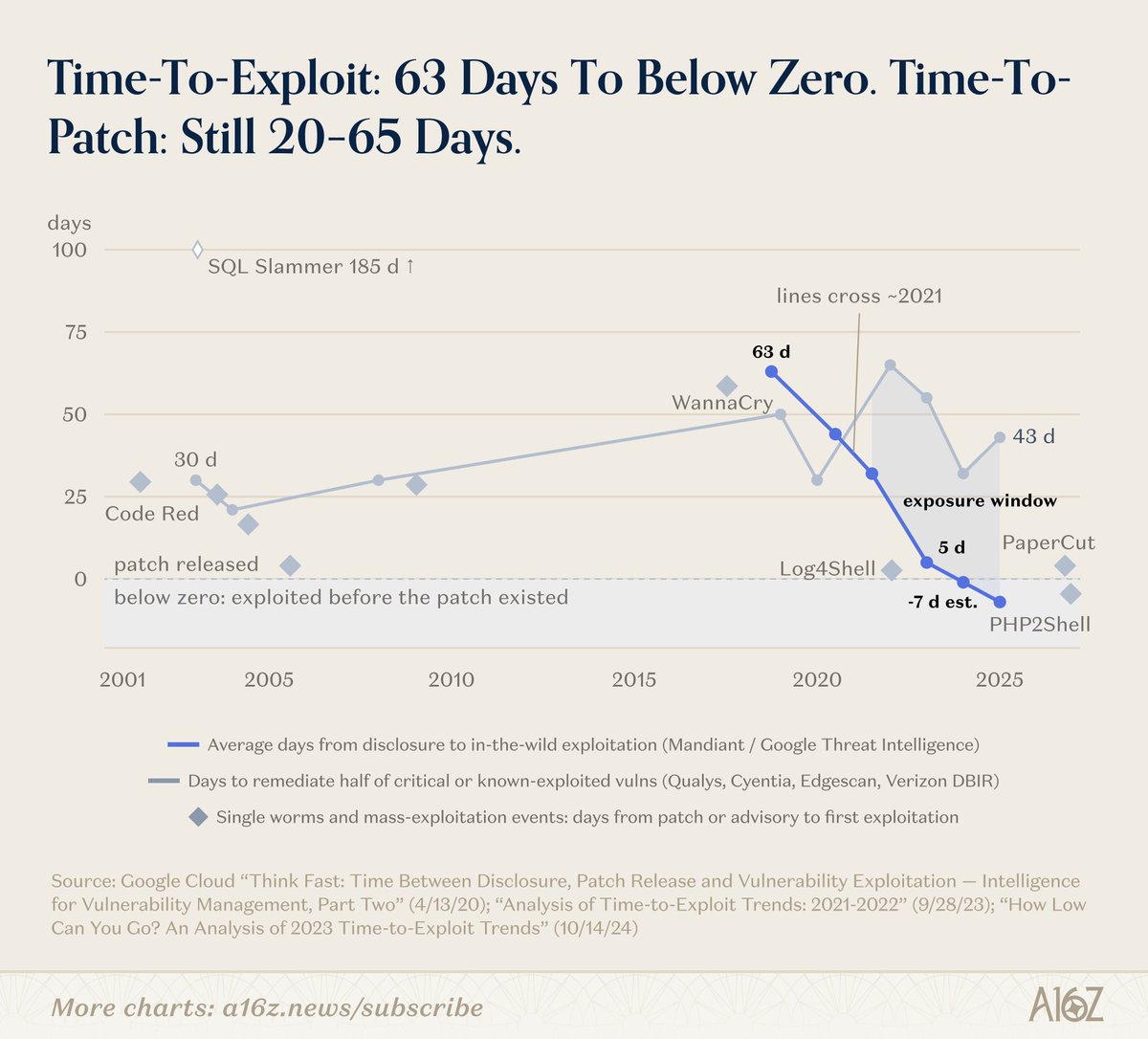
For two decades, writing the exploit was the bottleneck in a cyberattack. AI made that step cheap, and patching hasn't gotten faster:
- On average, attacks went from landing 63 days after disclosure in 2018-19 to 7 days before it in 2025
- A working exploit went from a skilled person's month to a few hours of machine time
- The median time to fully fix a known-exploited bug rose to 43 days
a16z's @asafezra and @steph_zhang expect a long, expensive worm era, hitting hardest where systems can't update fast: hospitals, schools, small water systems.
"When attacking is nearly free, attackers no longer need to want a target."
Full piece from Asaf Ezra and Steph Zhang: https://t.co/8L3D9mnL44
The exploit was never the bottleneck… attackers don’t hack in with CVE’s, they log in with compromised credentials, laterally maneuver due to misconfigurations, bypass security controls due to misconfigurations.
Rarely was a CVE, webapp bug, or 0-day the root cause of an attack. If anything, those class of issues were 1 step in a 20 step attack chain, and without it the attacker would have found another path anyways.
At a global industrial manufacturer with more than 13,000 employees, one SQL Server foothold led to a second instance and exposed a path to data stores containing 120 million and 85 million records.
#NodeZero uncovered how access extended from one environment to another through an additional account, turning a complex sequence into a clear picture of what was at risk.
That’s where our differentiation shows: scale and speed, with a continuous stream of reinforcement and no human-in-the-loop or human-on-the-loop dependencies.
That’s the value of Hack, Fix, Verify, Repeat: understand the path, fix what matters, verify the change, and keep testing as your environment evolves.
#Cybersecurity #ExposureManagement
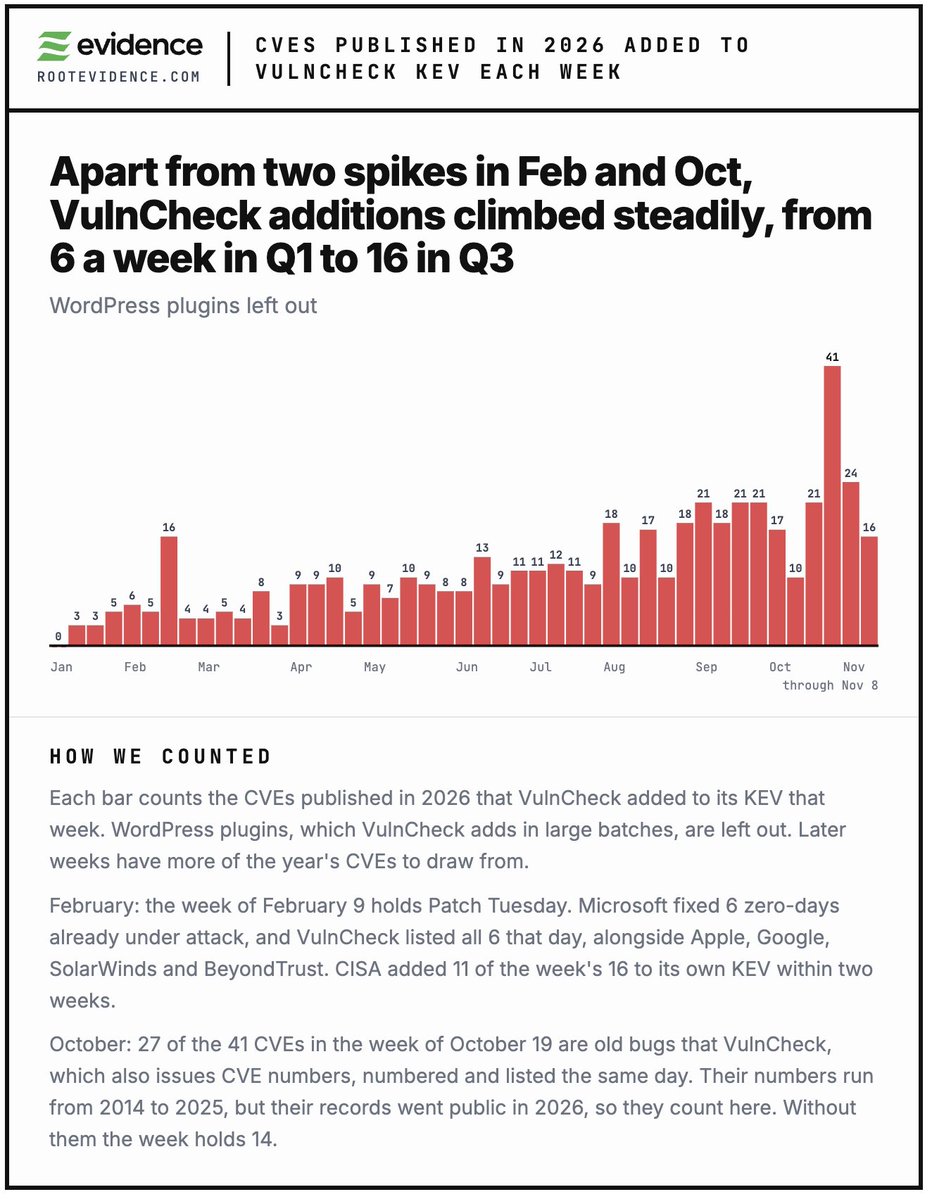
Of all the vulnerabilities (CVEs) published so far in 2026, 4% have been reported as exploited in the wild (by @VulnCheckAI ). The last 2 years, it was 7%.
In the 4 days since php2shell was published:
* 1,448 more CVEs published.
* No published exploit code for any in Metasploit or Exploit-DB.
* VulnCheck added 25 on its KEV list. 24 are old bugs.
* CISA added just 1 to its KEV list, the only new bug anyone has seen adversaries exploit.
Nothing in the record shows AI or anything else driving up how many vuln adversaries exploit, or how fast. Adversaries keep working a small set of bugs until those stop paying, and only then move on.
Patch php2shell because there are too many eyes are on it not to. Then apply the same rule to everything else, prioritize patching all systems against what adversaries exploit. It sounds simple, and the evidence says it’s what we still haven’t done that actually works.