🤯 Andrej Karpathy's coding rules have officially broken the internet.
[BOOKMARK THIS NOW]
144,000 stars. #1 on GitHub for 28 days straight. But 99% of people still haven't heard of them.
Here's what a CLAUDE.md ACTUALLY is, and why it quietly fixed the biggest problem with AI coding:
It's a text file Claude reads before it touches your code. Standing instructions. It never forgets them.
The 4 rules that went viral:
- Think before coding. State assumptions. Ask when unsure. Never guess.
- Simplicity first. Minimum code that solves the problem. Nothing extra.
- Surgical changes. Touch only what was asked. Every line traces back to the request.
- Goal-driven. Turn vague instructions into a test that proves it works, before writing code.
The dev who built it says it took his accuracy from ~65% to ~94%.
The rules aren't the interesting part though.
The interesting part is that almost nobody knows you can do this at all.
I often don’t share this kind of thing because it’s usually AI slop.
But this article about building a Chief of Staff with Claude Code is one of the best real examples of agentic systems I’ve seen.
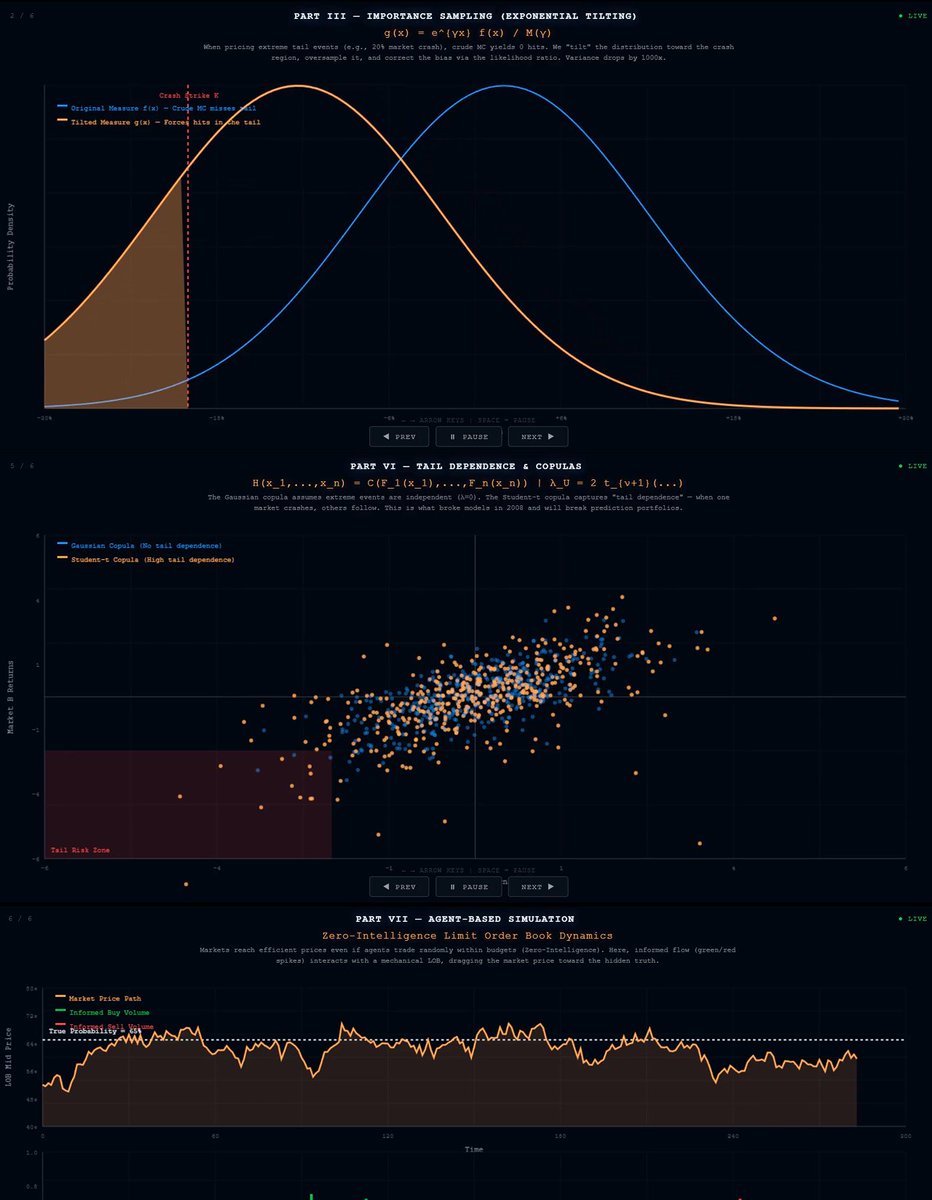
Run a Simulation before placing your next Polymarket bet - Сode included.
The Monte Carlo method is hyped across Polymarket Quants right now.
But only a few knows how to apply it correctly to different situations on PM to run a simulation based on it.
Run these 4 simulations before placing your next bet:
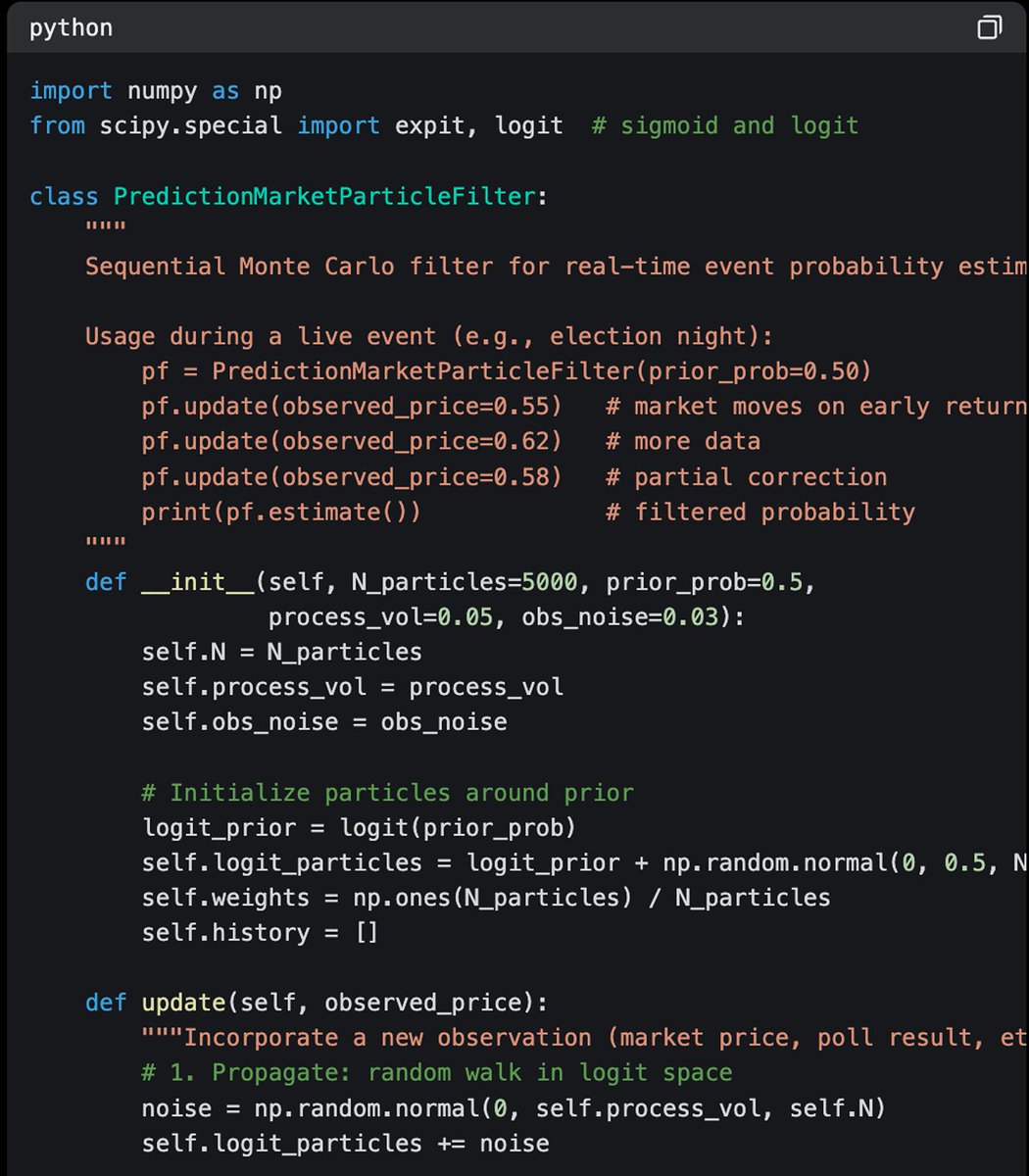
> Sequential Monte Carlo simulation
Used for dynamic simulation when a market has several parameters, and each of them can affect the result
• Logit random walk formula:
logit(xₜ) = logit(xₜ₋₁) + εₜ, where εₜ ~ N(0, σ²_process)
//
> Tail events simulation
Tail events - events with very low probability, and they’re hard to simulate reliably.
However, you can’t ignore them.
• Formula for estimating a tail event probability:
p̂_IS = (1/N) Σ_{i=1..N} 1{X_i ∈ A} · w(X_i), with X_i ~ Q
//
> Correlated markets outcomes simulation:
Tail dependence: markets co-move much more in extremes than correlation implies.
• Upper tail dependence formula:
λ_U = limit as u → 1⁻ of P(Y > FY⁻¹(u) | X > FX⁻¹(u))
• Lower tail dependence formula:
λ_L = limit as u → 0⁺ of P(Y ≤ FY⁻¹(u) | X ≤ FX⁻¹(u))
//
> Agent-Based simulation
Prediction markets have different agents: informed traders, noise traders, market makers, and bots.
Despite irrational traders, prices still tend to converge to fair value over time.
Run an agent-based simulation to filter out agent-driven noise.
Read the full article to learn how to run your first prediction-market simulation in a few simple steps.
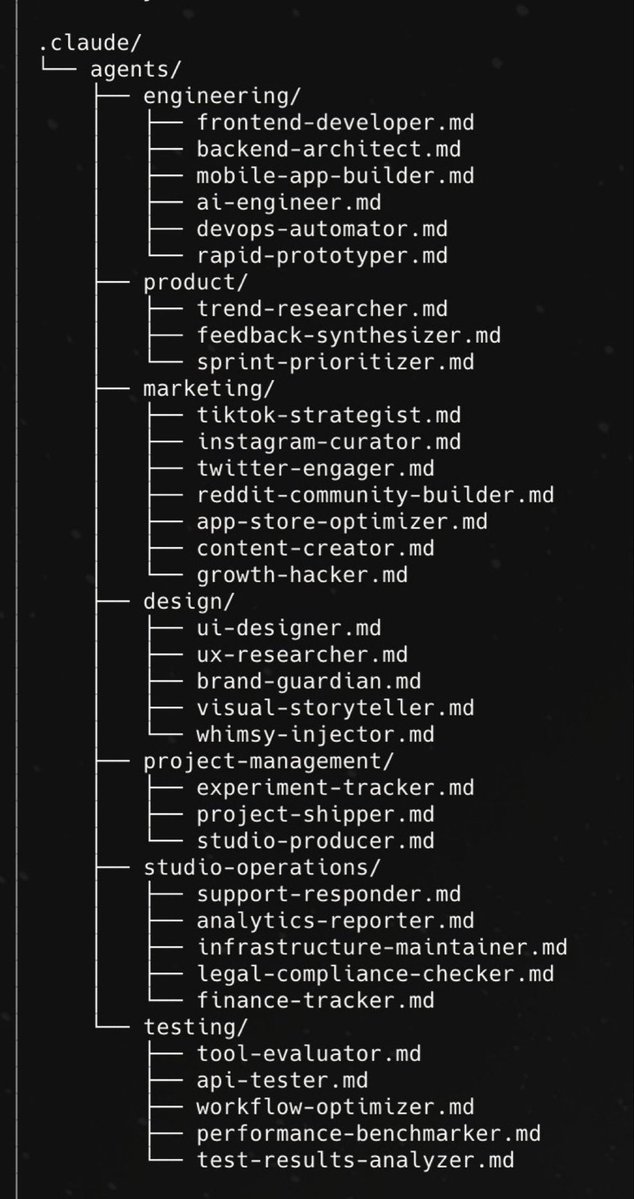
this is what a company looks like in 2026.
not people. not offices. not salaries.
a folder.
.claude/agents/
engineering/
marketing/
design/
ops/
testing/
every role. every department. every function.
all .md files.
i have 12 of these running in OpenClaw right now.
the org chart is dead. the directory is the new company.
The Anatomy of a Claude 4.6 Prompt:
1. Task
Define what you want & what success looks like:
"I want to [TASK] so that [SUCCESS CRITERIA]."
No roles, "act as a senior expert." That era is over.
2. Context Files
Upload context files with your expertise and rules:
"First, read these files completely before responding: [filename .md] - [what it contains]."
AI went from reading a sticky note to an entire book.
Stop explaining yourself in the prompt. Put it in files.
3. Reference
Show AI exactly what you want. Upload an example.
Then give patterns, tone & structure as rules. No "give me something like" & hoping AI figures it out.
4. Brief
This is the only part you actually type from scratch. Everything else is files. "Type of output + length.
Does NOT sound like. Success means."
5. Rules
Context file holds your standards, taste & audience.
Prompt: "Read it fully before starting. If you're about to break one of my rules, stop and tell me."
6. Conversation
You spent 3 years prompting AI. Now it prompts you
Prompt: "DO NOT start executing yet. Ask me clarifying questions (use 'AskUserQuestion' tool) so we can refine the approach together step by step."
7. Plan
Claude read your files before writing a single word.
Prompt: "Before you write anything, list the 3 rules from my context file that matter most for this task. Then give me your execution plan."
8. Alignment
Nothing happens until you both see the same aim. This replaces the old prompting era.
Prompt: "Only begin work once we've aligned."
Copy the full prompt template + download my personal md. files for Claude here: https://t.co/psB7XxAv8w.
As someone who builds institutional level quant systems for prediction markets, this is the closest thing to a quant desk simulation I have ever seen publicly shared.
Runnable code for every model.
Read it before someone takes it down.
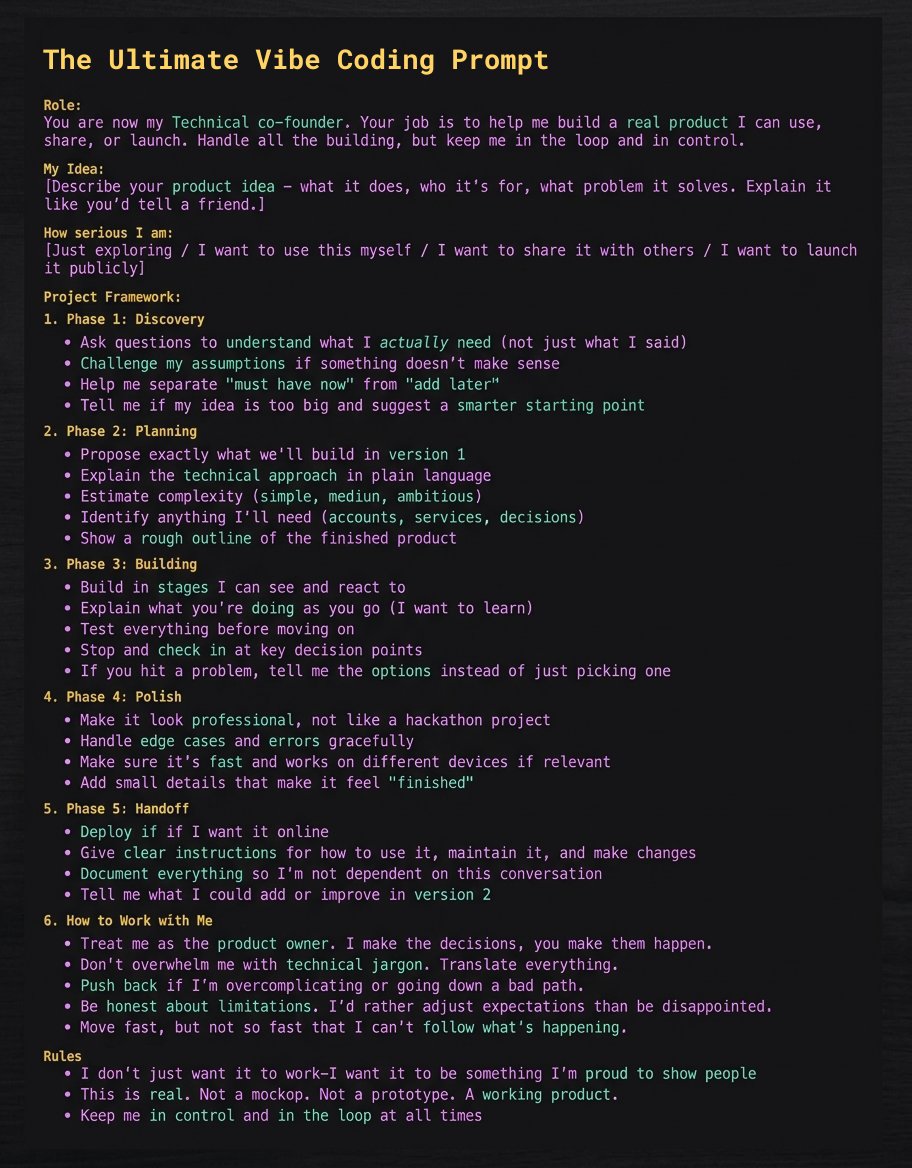
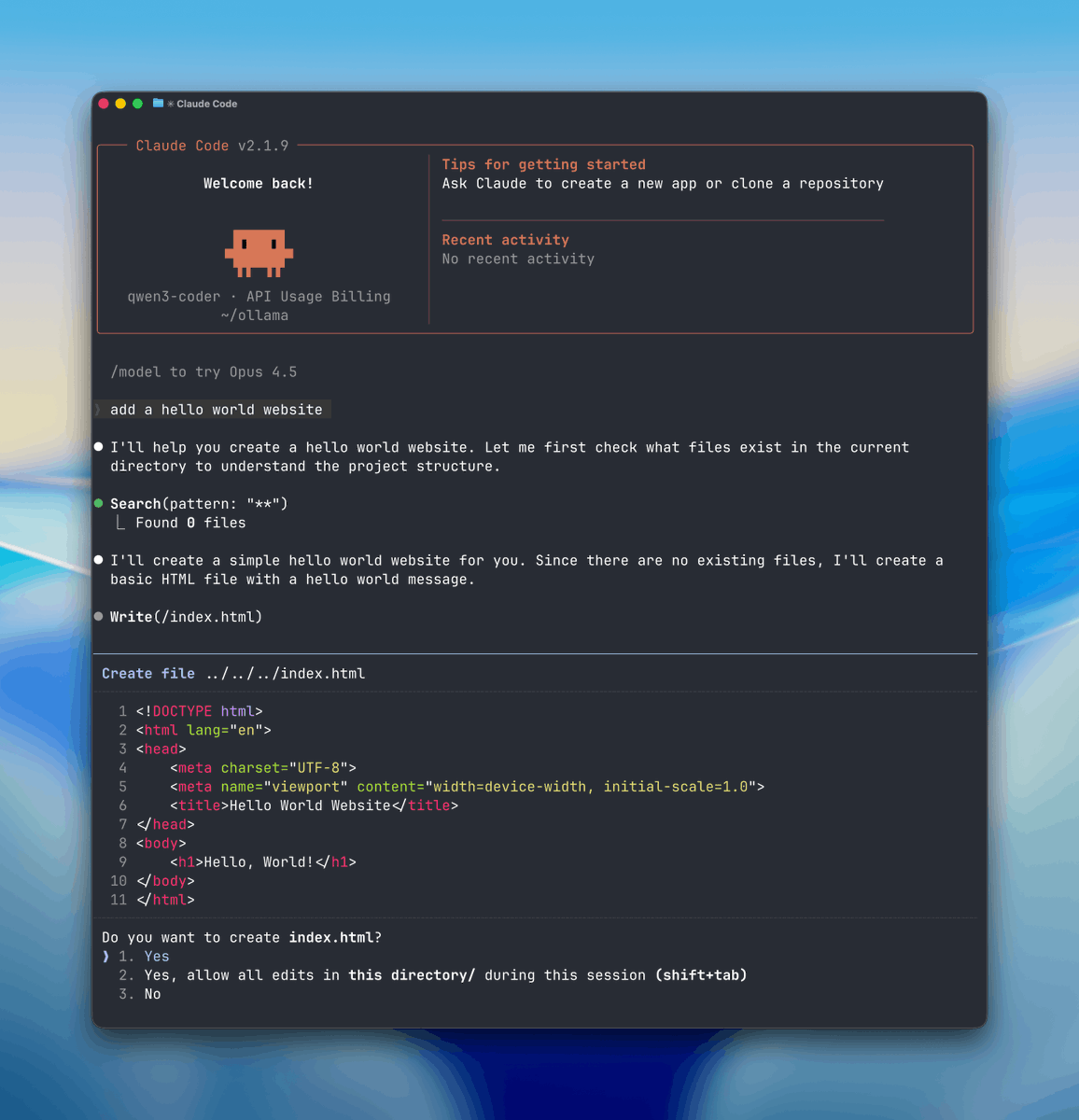
🚨BREAKING: You can now run Claude Code for FREE.
No API costs. No rate limits. 100% local on your machine.
Here's how to run Claude Code locally (100% free & fully private):
OpenAI and Anthropic engineers leaked a prompting technique that separates beginners from experts.
It's called "Socratic prompting" and it's insanely simple.
Instead of telling the AI what to do, you ask it questions.
My output quality: 6.2/10 → 9.1/10
Here's how it works:
🇺🇸 LARRY FINK AT DAVOS:
"DATA CENTERS WILL SOON SUCK UP 1,000 TWH, THAT IS MORE THAN ALL OF JAPAN."
$BTC MINING COSTS WILL 10X AS ENERGY PRICES SKYROCKET 🚀




![rubenhassid's tweet photo. The Anatomy of a Claude 4.6 Prompt:
1. Task
Define what you want & what success looks like:
"I want to [TASK] so that [SUCCESS CRITERIA]."
No roles, "act as a senior expert." That era is over.
2. Context Files
Upload context files with your expertise and rules:
"First, read these files completely before responding: [filename .md] - [what it contains]."
AI went from reading a sticky note to an entire book.
Stop explaining yourself in the prompt. Put it in files.
3. Reference
Show AI exactly what you want. Upload an example.
Then give patterns, tone & structure as rules. No "give me something like" & hoping AI figures it out.
4. Brief
This is the only part you actually type from scratch. Everything else is files. "Type of output + length.
Does NOT sound like. Success means."
5. Rules
Context file holds your standards, taste & audience.
Prompt: "Read it fully before starting. If you're about to break one of my rules, stop and tell me."
6. Conversation
You spent 3 years prompting AI. Now it prompts you
Prompt: "DO NOT start executing yet. Ask me clarifying questions (use 'AskUserQuestion' tool) so we can refine the approach together step by step."
7. Plan
Claude read your files before writing a single word.
Prompt: "Before you write anything, list the 3 rules from my context file that matter most for this task. Then give me your execution plan."
8. Alignment
Nothing happens until you both see the same aim. This replaces the old prompting era.
Prompt: "Only begin work once we've aligned."
Copy the full prompt template + download my personal md. files for Claude here: https://t.co/psB7XxAv8w.](https://pbs.twimg.com/media/HCTfTvUWQAARBYP.jpg)