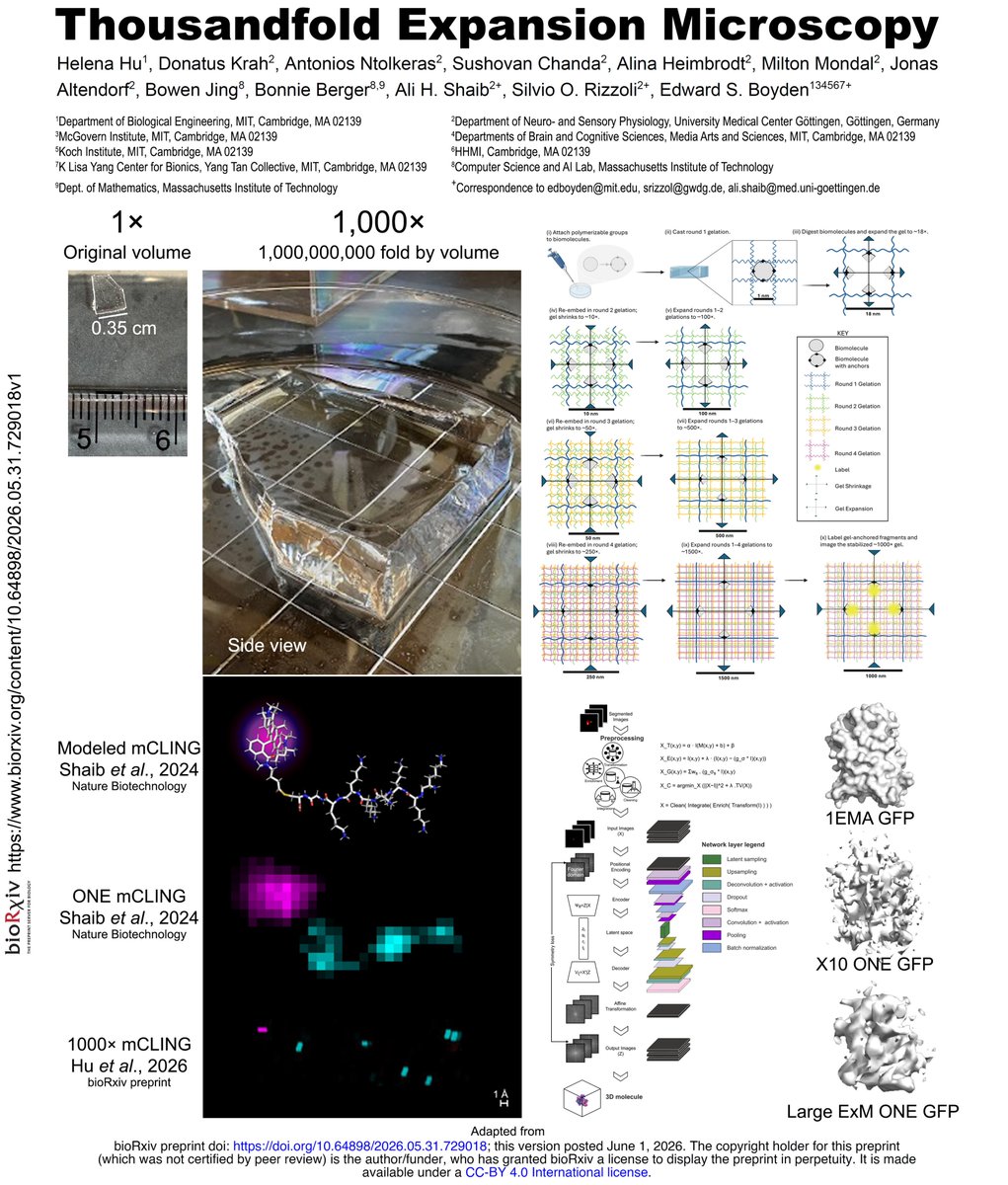
Hello world, meet 1,000× Expansion Microscopy.
1,000,000,000× expansion by volume! A gel that starts at a few centimeters will then expand to the volume of an Olympic swimming pool. https://t.co/E43kxx4O5M
In our new bioRxiv preprint, work carried out between MIT and UMG, led by Helena Hu in collaboration with scientists from the labs of @eboyden3 Ed Boyden, Silvio Rizzoli, and myself, we present Thousandfold Expansion Microscopy.
By enlarging biological specimens across multiple rounds of expansion, molecular-scale features, as small as the distances between adjacent amino acids, can be visualized with conventional optical microscopes.
Democratizing super-resolution microscopy.
Papers like this are why science remains endlessly exciting. This one made me feel the same wonder I felt at 15 when I first discovered science. || Homing pigeon navigation relies on superparamagnetic macrophages under overcast conditions | Science https://t.co/Rl3AlgF982
@multicellgenome The fact that all these transitions to complex multicellularity occur in eukaryotic cells makes me think there would be some feature of eukaryotes linking all of the multicellular lineages.....
Though, I recall a recent article of archea going multicellular under high pressure..
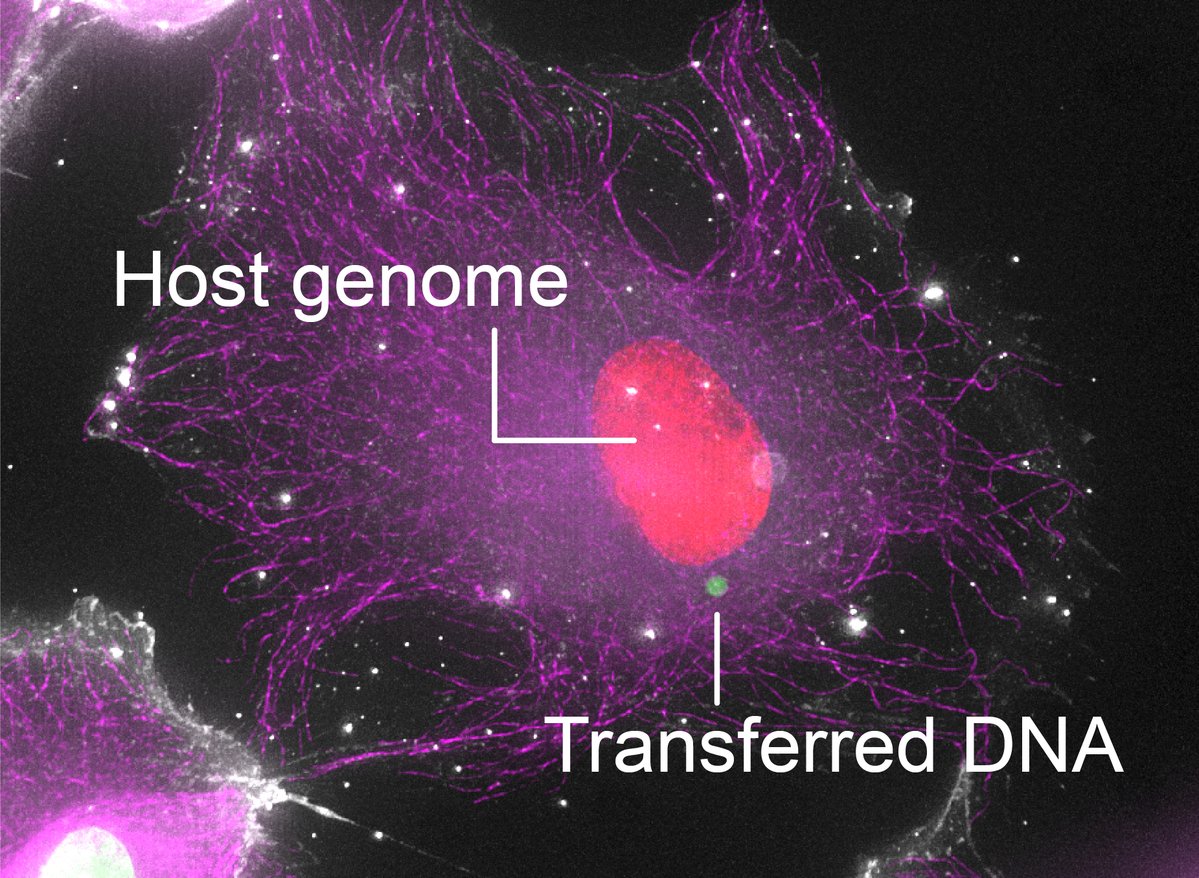
Excited to share our latest paper, out today @CellCellPress. We found that large pieces of the human genome can transfer between cells upon direct contact, endowing recipient cells with heritable phenotypic changes. (1/7)
https://t.co/SbshGhofN0
Growing up in Pune, mango season was predominatly May. The rich enjoyed it starting April till early June. Mango meant either Hapus (Alphonso) - sold in wooden boxes holding 4-5 dozens or Paayri sold in करंडी or flexible bamboo containers that held two dozens. The Paayri was sweeter and tangier but Hapus undoubtedly the king. Valsad hapus from Gujarat and Madras Paayri that came from Karnataka were considered inferior to their Ratnagiri cousins. Devgad, then a part of Ratnagiri dist did not differentiate its separate identity. Most hapus from kokan went by the nomenclature - Ratnagiri hapus/paayri. Then there were गोटी or रायवळ varieties mainly from the Maval - inexpensive, affordable to all and rather fibrous and rustic in taste. Always eaten by sucking out the juice after softening the fruit. The totapuri made it appearance on handcarts in June - much cheaper in price but never a real fav of Pune residents. Was often sought by home makers for making mango jam due to its rather tough pulp. The totapuri was a bit notorious for housing wasp like insect inside its seed. The other varieties were only heard of never seen. They did not have a market here because by the time they made an appearance people already had their fill that too of the premium hapus and paayri varieties. It was really the Kokan, Mumbai and Pune who enjoyed Hapus and Paayri in abundance due to their availability. Other places even within Maharashtra received a rather limited supply if at all of the hapus and paayri since yield was limited and transportation was not easy.