If you get cancer, your risk of Alzheimer's drops by about a third. If you get Alzheimer's, your risk of cancer drops by about half.
The body playing tug of war with itself.
Two diseases pulling against each other, using the same cellular mechanism in opposite directions.
my wife thinks i'm obsessed...but I will keep repeating this.
Claude Fable 5 + SEO is going to create more “self made millionaires” this year than the last decade combined.
don't bookmark this if it crosses your timeline.
just paste this entire thing into Claude Fable 5.
thank me later.
I think I’ve discovered the most beautiful and patriotic place in America.
It’s called Kiawah Island, SC.
There are HUNDREDS of kids just riding bikes and playing games.
Everyone is friendly, signs everywhere that say “WE LOVE AMERICA 🇺🇸”
This is unbelievable!!!!
just getting into boxing, recorded a bag session with with an event sensor and built a basic hit detection app.
hoping to turn this into something that can be used to improve form and highlight mistakes.
is there anything event sensors can't do???
Forget trying to design everything in Figma. You can build your own design tools with AI.
Introducing Toolcraft - a starter kit and UI library for building beautiful creative apps. It's free and available for you today.
npx @pixel-point/toolcraft create
Use it to build apps to stylize images, create WebGL shaders, Three.js scenes, animations, photo editing tools, or whatever else needs a canvas and controls.
Toolcraft gives you the full architecture in a single solution. It comes with:
- plenty of UI components: sliders, pickers, timelines, curves, and more
- built-in canvas, export, and toolbar setup
- AI instructions to help the agent deliver a great result to you
With Toolcraft, you don’t need an extensive prompt. Just explain what type of visuals you want to build, attach references, and wait.
It’s been a game changer for our design process.
Watch the full video on our YouTube channel with all the details and examples.
Palantir CEO: "most AI companies are going to die - Anthropic and OpenAI give no value and take your IP" - so he announced a deal with Nvidia to build a new AI
Alex Karp just revealed which AI companies will survive and showed his current strategy
His words:
"AI is real but somehow it's not working - and we're not allowed to say it publicly because we'll look stupid"
"I've been telling them for six months - we're going to be nationalized - they say it can't happen in America"
"if you say AI let you fire two-thirds of your workforce - you might as well sign up for the Bernie Sanders manifesto"
he built Palantir with Peter Thiel from zero to $500 billion - the Pentagon, CIA and NATO use his software - now he's coming for OpenAI and Anthropic
bookmark & watch today ↓
Just added $6.5M to my $BOT investment after investing $700K at $10.
Targeting $150-300 a share minimum.
If @fundstrat raised $18.7B to invest in freaking ethereum:native, then I think chadlord @Rewkang & @GoingBallistic5 & @intern can easily raise that for Robots.
NAV model below, GM.
Yesterday was the end of paper retirement processing at OPM, a major milestone in modernizing how we serve the federal workforce. Read the @foxnews exclusive: https://t.co/fXc2RXlb09
they did it. the mad lads actually did it.
i never talked about my time at DOGE last year because it was so controversial and contentious (remember that?)
early last year, @jgebbia recruited a handful of his most trusted early Airbnb engineers to embed at the Office of Personnel Management to solve the "retirement paper" problem.
processing a federal retirement took months, and in the extreme retirees could wait up to 6 months for their full pension to arrive. what was the holdup? paper. remember hearing Elon talk about "the mine" in Pennsylvania? we got to visit it. in deep underground caverns blasted out of limestone, there were literally acres of file cabinets, as far as the eye could see, storing files detailing federal employees' employment and paystub history. a simple "case" might be only a quarter or half inch thick, but really complex cases filled up whole filing cabinets. one famously took up a whole pallet.
each case was hand processed by case workers in cubicles deep underground. they checked calculations, made sure forms were filled out properly (many weren't), and handled a long tail of complex issues. we'd watch as they keyed data into a black and white terminal, transmitting to the COBOL mainframe built many decades ago.
since cases were processed by hand, there were multiple rounds of human review, and additional rounds for complex cases. case files were walked around between one worker's outbox and another's inbox. sometimes it would sit in one place for days, waiting to be picked up.
to OPM's credit, they'd done multiple rounds of "digital transformation" spanning decades, so some systems were newer than others. there was a big effort in the mid-90s. but the systems were disparate, and it was a total maze getting them to talk to each other. there was a big effort to build a web app where employees applying for retirement could digitally fill out the necessary forms — just to be mailed to the mine and stuffed into the paper file. and few federal agencies were even using it.
when we arrived, OPM was midway through a fresh attempt at digital transformation, delivered by a software contractor.
the blackpill was seeing the terrible quality of the software and interacting with the contractors. coming from silicon valley, i couldn't believe how low the talent and quality bar was for selling software to the government. it's clear, as the OG USDS people explained to me a decade ago, the primary skill these vendors have is securing government contracts. it's a huge moat. delivery of quality product be damned.
we fired the vendor and took over the project. they'd been working on it for more than a year, and there was another year before they were going to deliver it. at first we tried to bend it to our will, to actually connect all the various data sources and get to a decent UX for case workers in the mine to use, but we soon realized we were going to have to rebuild the whole stack from scratch.
it was around this time I had to go back to new york — i had a new job waiting for me, a four month old, and a wife whose patience was running out. but i got to watch from afar as the team cranked day and night, hitting early milestones. and now they've fully done it.
huge congrats to Joe and the team. @yatshitcray was the hero in the trenches. indefatigable, unrelentingly optimistic, and determined to see this project through. when i recruited him for "ok i can do two, maybe three months", he stuck it out over a year making this project a reality.
while the retirement project was under the DOGE banner, it operated different from what you heard from the breathless, negative media — we came in with the attitude of partnering with career OPM employees. we were team members determined to bring our software talents to bear on the problem they've been trying to fix for years, which they hadn't had the resources to solve before. they were wary at first, not sure about us, but they quickly saw how authentic and determined we were to work together toward the same goal. props to Joe for developing those relationships, setting the example of how to collaborate together.
what's the end result? lifelong federal employees, veterans, postal carriers get their full pension installments almost immediately. days instead of months. peace of mind for these people to devoted their careers to serving our country. massively streamlined operations inside of OPM. and NO MORE PAPER 🫡🇺🇸
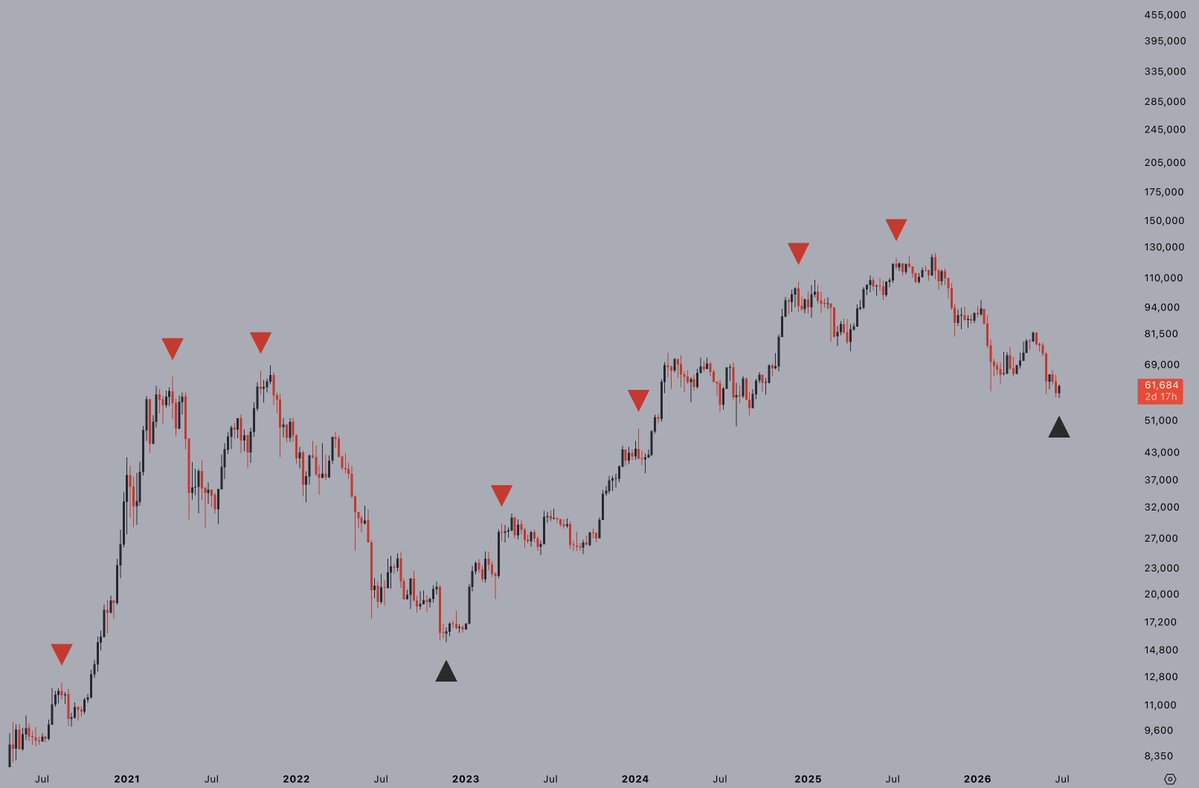
The dorito indicator has flashed 👀
This powerful signal does not come around very often, but when it does, the bottom tends to be close, or already in.
Pair that with the weekly RSI bullish divergence forming - and suddenly DCA-ing here doesn't look that silly anymore.
$BTC
After reflection, this new narrative by Palantir is probably much more consequential than people may assume.
Palantir is basically being the canary in the coal mine announcing the death of two major assumptions propping up the US economy right now:
1) that AI labs will be able to extract significant economic rent - as opposed to AI models being mere commodities
2) that other countries can accept structural dependency on US technology and services without pushing back on sovereignty concerns
Why are Palantir specifically starting to be vocal about this?
First off, major middle-powers, even US “allies”, are one by one showing them the door. In June, France announced that the DGSI - its domestic intelligence agency, which had relied on Palantir since the 2015 Paris attacks - would replace it with French firm ChapsVision, with Prime Minister Lecornu explaining (https://t.co/SLhEGprBZC) that France “cannot accept new strategic dependencies in the digital sphere” and shouldn't depend on the goodwill of companies “capable of turning off the tap.”
Germany moved even earlier: its domestic intelligence service, the BfV, also selected ChapsVision over Palantir (https://t.co/pDZVj4SYUY), and the German military has said it will no longer use Palantir at all. Then, just this week, Spain instructed state-controlled companies - including strategic firms like Telefónica, Indra and Navantia - to avoid signing any new contracts with Palantir (https://t.co/0ik4UAFrT7).
Even in the UK, Washington's most loyal vassal, the NHS's £330 million data contract with Palantir is under review following parliamentary pressure (https://t.co/uJl6g4BMsW), and London Mayor Sadiq Khan blocked a proposed £50 million Palantir contract with the Metropolitan Police.
Palantir making a lot of noise around them caring about sovereignty makes a lot of sense: it's damage control since they keep being told they're a sovereignty risk.
I doubt it will work - because it's true: they are a sovereignty risk - but the fact that they feel the need to be vocal around this tells you where the wind is blowing: they're not shaping the narrative, they're reacting to one they're losing.
What they're saying against closed-source AI (basically a broadside attack on OpenAI and Anthropic), is again highly self-serving. Palantir's sudden love of open-weight AI models conveniently coincides with them launching 2 days before a partnership with Nvidia to sell exactly that: open models models (NVIDIA's Nemotron) in sovereign environments.
So it's essentially a product launch.
It doesn't make what they're saying wrong: it is factual that the value proposition of closed-source AI labs looks increasingly unsustainable. I mean: you're paying 10X the price of Chinese open-source AI models for something that's not really better (or just marginally) and on top of that you have zero control over your data, or the models themselves.
When Palantir says that "the architecture that maximally preserves sovereignty is one that enables institutions to own their tribal knowledge, and to compound it as alpha," they're right. I'd add that this also means you shouldn't trust Palantir either with that "tribal knowledge"... they obviously left this part out 😉
When you take a step back, these two things have major implications on many other US companies.
SpaceX - which just went public at the largest IPO valuation in history - is one clear example as I describe in my latest article on the new space race with China (https://t.co/JK3ELAyEVO).
If countries like France concluded with Palantir that they couldn't depend on a company “capable of turning off the tap” when it’s merely analyzing their data, what should they conclude about a company that aims to literally control their entire connectivity - at one man's whim, from space?
What percentage of SpaceX's crazy market cap is based on the assumption that foreign governments will not do to Starlink what they're currently doing to Palantir?
And SpaceX - or Palantir - aren't alone: a significant proportion of the top US tech giants, who rose in a world where no one questioned American technological hegemony, now face an environment that's much less conducive to the kind of lock-in their business models - and valuations - depend on.
When you pair this with the fact that it increasingly looks like the US made a wrong bet with closed-source AI - an extremely expensive wrong bet - the picture that emerges is of a country that bet its economic future on two things - proprietary AI and captive allies - and is losing both at the same time.
And to compound the problem, it doesn't help that the official narrative of the US government - via the voice of Jacob Helberg, the Under-Secretary of State (https://t.co/Z1rotPl9Ee) - is to be vocally opposed to "AI Sovereignty": essentially telling everyone "you know what, your worst fears are real, our tech companies are really out to undermine your sovereignty."
Read Helberg's post (the one I linked) and put yourself in the shoes of - say - a European or Asian leader and ask yourself how you'd react to being told that building your own AI capabilities is "marching in perfect formation into the past," that your pursuit of sovereignty is really just "synchronized mediocrity," and that your only path to the future runs through American technology.
If it was me in a position of power, I'd read this as a massive wakeup call: when another country's official position is that your sovereignty is a problem, history says you're about to need it.
So yes, it looks like - unexpectedly - Palantir, of all companies, is being quite the canary in the big tech mine. Yes they obviously do this for self-serving and cynical purpose, and yes they're of course also very much part of the problem and not the solution. But it doesn't make them wrong: sometimes it takes a vulture to tell you something is dying.
Mark Zuckerberg is bankrupting a $22 billion startup because they refused to sell to him.
The company is Kalshi.
They run the largest prediction market in the US. Users bet real money on real-world outcomes.
Last year, prediction markets did $28 billion in monthly volume across the industry.
This month, they did $220 BILLION.
The sector literally 8x'd in a single year.
Bernstein now projects the entire prediction market industry will hit $1 TRILLION by 2030.
Zuckerberg saw the growth curve coming. Last year, when Kalshi was valued at only $2 billion, he sat down with founder and CEO Tarek Mansour to discuss buying the entire company.
Mansour said no.
Kalshi went on to raise at $11 billion in December. Then $22 billion in March. It is now pursuing a $40 billion round and openly weighing an IPO.
Zuckerberg's response:
He walked back to Meta headquarters, took every piece of information he learned in that meeting, and directed a small internal team to build a Kalshi clone from the ground up.
Meta's version is called Arena. It uses Llama to generate the questions. Every one of Meta's 3.5 billion daily users will get access.
And here's where the plan gets ruthless...
Meta is deliberately launching with play money. That single decision lets Zuckerberg dodge every gambling regulator on Earth while he trains billions of users to bet on prediction markets.
Meanwhile Kalshi is spending millions fighting state gambling laws, the CFTC, an Illinois sports tax, a Minnesota felony statute, and the Department of Justice.
Kalshi is the crash test dummy. Meta is the getaway driver.
The moment the regulatory war is settled, Zuckerberg flips the switch. Arena becomes a real-money market, and 3.5 billion users are already trained to use it. Kalshi's user base of a few million cannot compete.
This is the exact playbook Meta ran on Snapchat in 2016 when Instagram Stories launched. It is the exact playbook they ran on TikTok in 2020 when Reels launched. It is the exact playbook they ran on Twitter in 2023 when Threads launched.
The FTC took Meta to court over this pattern last year and called it "buy or bury." The judge sided with Meta. So the playbook is legally protected.
Tarek Mansour walked into a meeting with the most predatory copycat in tech history and gave him the entire pitch deck for the fastest growing product in Silicon Valley.
Six months later, Zuckerberg is executing on that intel while Mansour is stuck defending his company in courts across America.
Kalshi survived Zuckerberg's offer. But it probably will not survive Zuckerberg's clone.
Meta ended Q1 with $81 billion in cash. That is enough to buy every prediction market company on Earth six times over. Zuckerberg is choosing to STEAL them instead because he can, and because the courts already gave him permission.
The next 12 months will decide whether Kalshi becomes a $50 billion IPO or a cautionary tale about what happens when a founder says no to Meta.
What do you think?