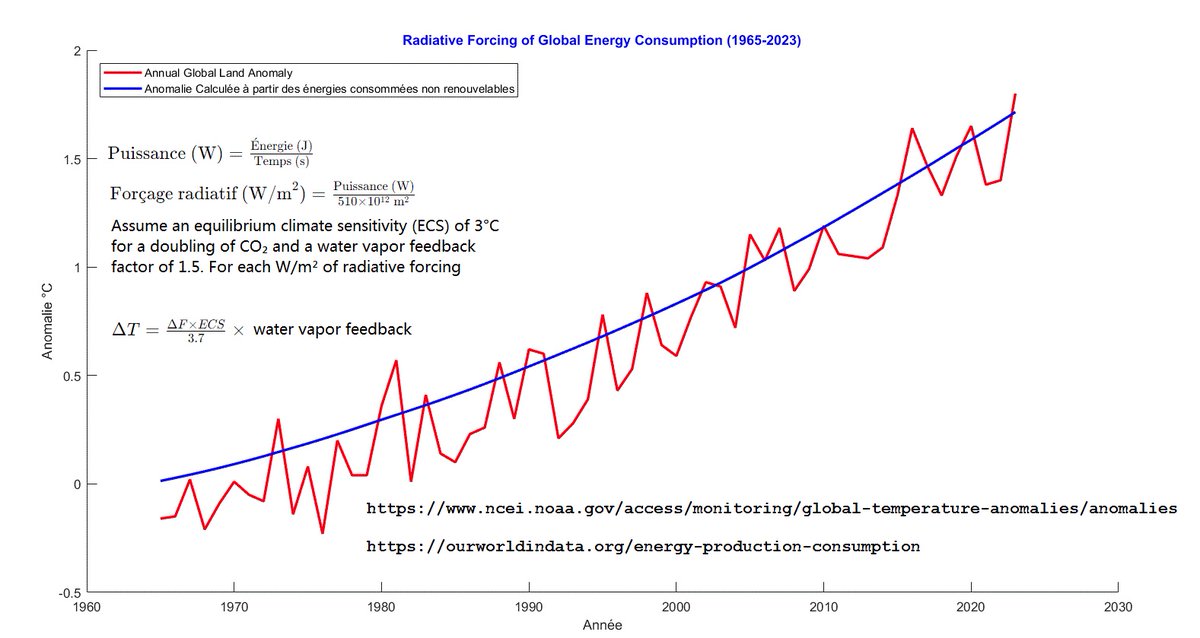
RT @WSchumberg The WTO is preventing nations from combating climate change they must be stopped, MHD natural gas and coal power generation, forth generation nuclear, superconducting power lines, nuclear fusion, solar hydrogen stor… https://t.co/YIQABykeqL
RT @WSchumberg The WTO is preventing nations from combating climate change they must be stopped, MHD natural gas and coal power generation, forth generation nuclear, superconducting power lines, nuclear fusion, solar hydrogen storage a green new economy https://t.co/YIQABykeqL
RT @BrianTakita: @RogTallbloke@WHUT @theresphysics @Cedders68 Charvatova noted that the sunspot maxima is at the end of each trefoil lobe. The change in direction adds to the angular velocity between layers in the Solar Convection Zone?
RT @TDS_Observatory: Interesting double loop solar prominence on the Sun yesterday. High temperatures and poor seeing didn't allow for any type of details to be captured. Tech Specs: Sky-Watcher Esprit 120ED, ZWO ASI290MC, Daystar Quark Chromosphere + Da… https://t.co/bfgqIe5fJW
RT @ichaitrabhatt: 2020: India’s 1st Solar probe to observe and image the Sun’s corona from the First Lagrange point also known as L1 Lagrange point #AdityaL1 @isro https://t.co/b3mWqE1ZqN
RT @astrofotoPR: Our #Sun today continues its solar minimum behavior, with a spotless chromosphere. However, many bright prominences can be observed. According to Space Weather, it should continue this pattern for at least the… https://t.co/QVi4tcSFe5
RT @1cRebeca The university also has some modern buildings as well, like this one, the Max Planck Institute for solar system research, with its fantastically curated: https://t.co/Q2ZP4upGQq
RT @IFLScience Comet P/Shoemaker-Levy 9 (SL-9) collides with Jupiter, 25 years ago. The collision was our first look at an extraterrestrial collision of Solar System objects. Video: Max Planck Institute for Astronomy https://t.co/zaKAPtdXTc
RT @vu2mue: "Aditya-L1 is meant to observe the Sun’s corona. It will image and study the sun from the First Lagrange point also known as L1 Lagrange point. L1 point... https://t.co/b3mWqE1ZqN
RT @PhysRevLett: #astro#coolvideo re last week's cover image: Evolution of the supra-arcade region seen by the Solar Dynamics Observatory (Atmospheric Imaging Assembly) with 94 Å (left) & 131 Å (right) filters "Evidence for Vortex Shedding in the Sun’s … https://t.co/z76fTPpqb1
RT @Zavijavon: Sunday, July 21 at 23h Universal Time. (00h Local UKTime 22/07/'19) The waning gibbous Moon's appearance and celestial position as should be seen from Scarborough and the UK. Also today's Solar image of the Photosphere courtesy of NASA. … https://t.co/wr2cjJngWL
RT @stuartgary: 📷 cosmicdustpw: Sun’s chromosphere is visible in red during the total solar eclipse. Credit: Cerro Tololo Inter-American Observatory. by MistWeaver80 ★☆★ SPACE ★☆★ https://t.co/QYNP6ei6TX
RT @KpHaciserif: Sun's chromosphere is visible in red during the total solar eclipse. Credit: Cerro Tololo Inter-American Observatory. via /r/spaceporn https://t.co/o2O5tgswkX https://t.co/AUP7dRGhTo
RT @redditSpacePorn: Sun's chromosphere is visible in red during the total solar eclipse. Credit Cerro Tololo Inter-American Observatory. https://t.co/WhcaqPnY9I