@encord_team@NVIDIAAI@anybotics Rare anomalies are the hard part. Synthetic helps coverage; human review still decides whether the model trusts the edge cases in production.
@MechEconomy@agilityrobotics@Nasdaq Public listing for a pure-play humanoid company raises the bar on ops proof: uptime, failure recovery, and the data engine behind both — not just demos.
@asteris_ai Selecting demos that improve the policy beats flooding the buffer. Same rule for annotation: label the failures that move the eval, not every frame.
@wallstengine Licensing surge vs royalty lag is the story. Physical AI demand shows up in design wins first — production volume (and the data ops behind it) shows up later.
@jimmy_voxel51 Robot logs → curated → auto-label → detector is the right workshop arc. The step teams underinvest in is gold-set review so auto-label doesn't quietly drift.
@RobotCentral Open hardware + simulation is useful. The bottleneck after that is still contact-rich demos labeled well enough that policies transfer off the lab bench.
@aktoriarobotics@ycombinator Solid list. One more filter when picking who to follow in physical AI: who actually talks about eval data, teleop review, and failure tagging — not only model releases.
@AriaXChainz@InvLambda Physical AI infrastructure is the right lens. The missing piece most decks skip: closed-loop labeling of failure cases, not just more demos. Whoever owns that loop owns the fleet.
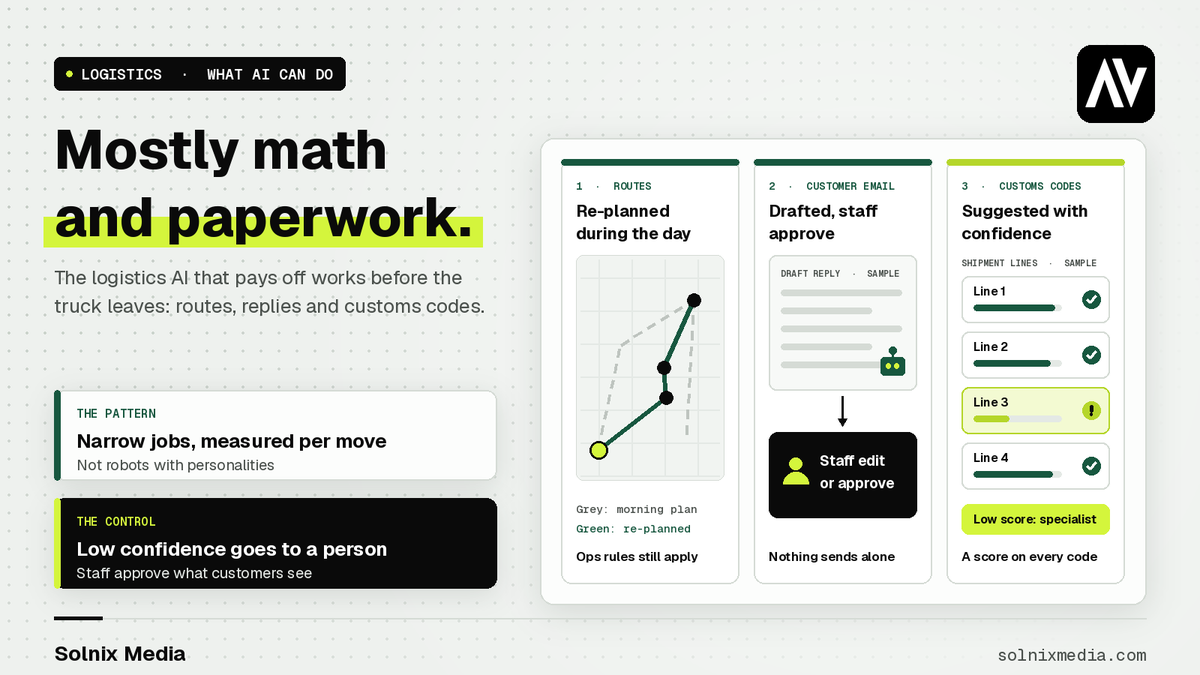
Logistics AI that pays off is mostly math and paperwork.
Routes re-planned during the day. Customer emails drafted, then approved by staff. Customs codes suggested with a confidence score. Low scores go to a specialist.
Which of these eats your team's week?
A transformer runs hot at the evening peak. The reflex is a bigger transformer.
Solnix Industry suites put loading, switching and capex plans in one live view, so agents can suggest a zero capex switching option first. A person approves it.
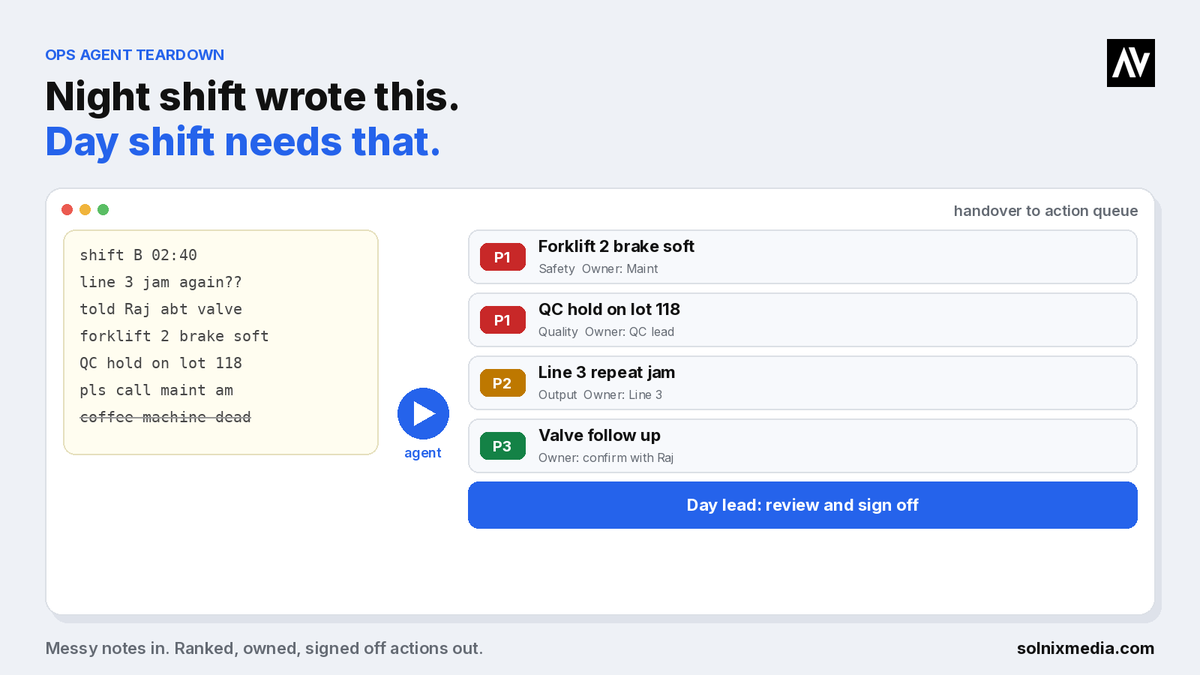
Night shift wrote this. Day shift needs that.
An ops agent reads messy handover notes, pulls out each issue with an owner, ranks by safety, quality and output, then the day lead signs off.
Agent sorts. Human decides.
A tower drawing can look perfect and still hide one leg running near its limit.
Solnix AI CAD turns a plain brief into dimensioned geometry and checks it against codes and loads. Passes stay green, the weak leg gets flagged, and an engineer signs off first.
In a multi agent run, one agent's guess becomes the next agent's fact. A smudged unit on a scanned order and boxes become pallets.
Solnix Agentic workflows set a confidence floor for every run. Below it, the run stops at a checkpoint for your team.
A patrol drone sees the same branch in every frame. Flag it frame by frame and you get a flood of alerts nobody reads.
Solnix Drone ops gives each pole and branch one ID for the whole flight. One branch, one alert, one person.