We just announced our Fusion API:
- Fable-level performance on deep research tasks, at half the cost
- Better-than-SOTA performance using panels
The future of AI is neurodiversity, not single-model takeovers.
Hot take 2: the software stack is where AI infrastructure is actually won or lost.
Today we're thrilled to welcome Rich Heaton as SambaNova's new EVP of Software. 🙌
Rich has spent his career doing one thing exceptionally well: building world-class software organizations that ship at scale, under pressure, against the best competition in the industry. That's exactly the assignment at SambaNova.
Our inference platform is powering some of the most demanding AI deployments in the world — and customer demand is only accelerating. Rich's job is to make sure our software scales with every bit of that ambition.
Rich, SambaNova is lucky to have you. Let's get to work. 🔥 https://t.co/qBMVRQoluc
it's not done if it's not implemented
it's not done if the implementation is ugly
it's not done if it's not documented
it's not done if users can't discover it
it's not done if you can't market it
When the team from @Forbes came to our San Jose headquarters, the conversation quickly became about more than just chips.
It became a discussion about the future of AI and what it actually takes to run it at scale.
As AI adoption accelerates, the challenge is no longer training models, it’s inference: running models efficiently, reliably, and fast enough to power the next generation of agentic applications.
As our CEO and Founder @RodrigoLiang put it:
“It's much lower power, much smaller footprint, and it's faster than anybody else. What's not to like?”
And as @Dthakker02 General Partner of @BatteryVentures explained:
"The technology that SambaNova has is very complimentary to what @intel has because most AI data centers need a combination of CPUs and GPUs."
A big thank you to @aton2006 and @v_mohan_ for helping bring this story to life and for the thoughtful conversations throughout the day.
We’re excited about what this shift means in practice, from premium inference and agentic AI to more efficient, sustainable data center infrastructure that lets enterprises deploy AI at scale, not just experiment with it.
And thank you to Kirsten Taggart and the team at @Forbes for spending the time with us and taking a deeper look at what we’re building.
🎥 Watch the full feature below.
What actually happens during AI inference?
This video breaks down how RDUs, memory architecture, and multi-level parallelism work together to generate thousands of tokens in parallel across racks.
Built for scalable, real-world AI inference 🦾
Learn more: https://t.co/uo77Ere4ub
This week, I was honored to deliver the Computex 2026 keynote in Taipei. From silicon to systems to software – Intel's vision for the future of computing spans across Personal Computers and Edge devices to Data Centers and Intelligence Centers. Thank you to the many colleagues and friends who joined me in presenting this vision. It was wonderful to reconnect with so many customers, partners, and longtime friends on “Silicon Island.” Thank you for your support. We are just getting started on our journey to build a new @intel.
I was too lazy to troubleshoot a lab crash and burn k8s nginix ingress . So I used @MiniMax_AI 2.7 on @SambaNovaAI through @opencode pointed at a good and the baby cluster. Analyzed and Fixed in 5 minutes with $0.013 in cost.
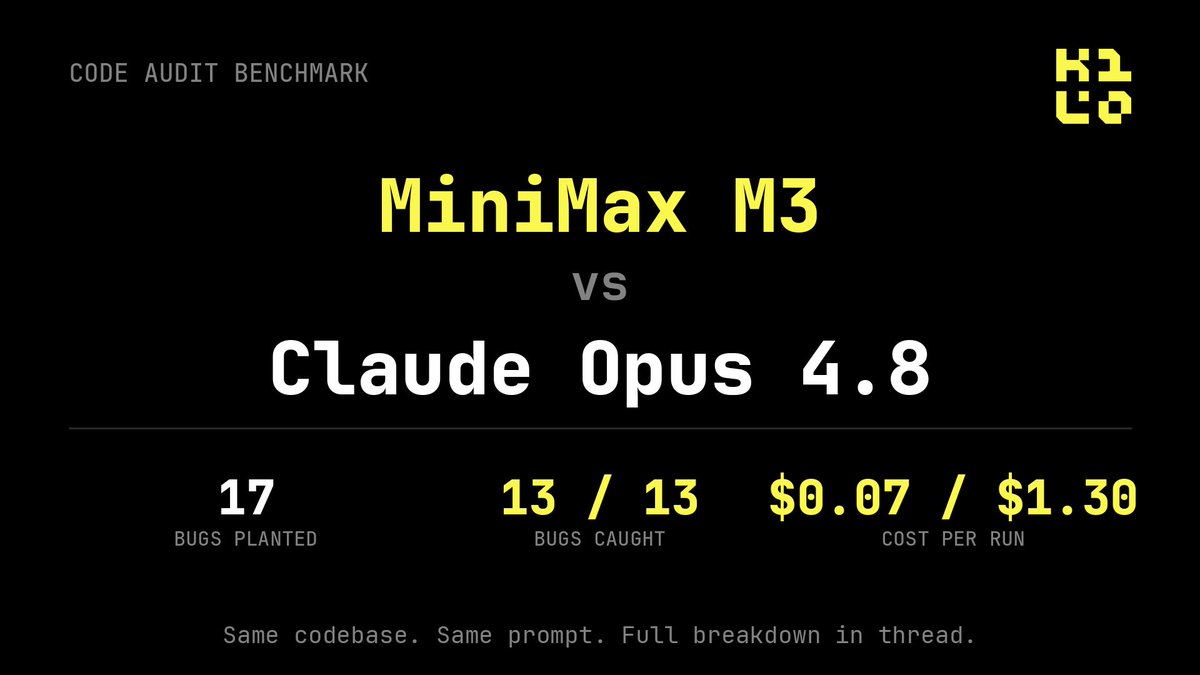
We gave the same code audit to Claude Opus 4.8 and MiniMax M3.
Same codebase. Same prompt. 17 known bugs planted in advance.
MiniMax M3 caught 13 of them for $0.07. The cheapest Claude run caught the same 13 for $1.30.
Here's the breakdown. 🧵
Ex-OpenAI Tech Lead, Justin Lebar joins SemiAnalysis as an Visiting Fellow to Burn $10,000 in 3 hours to find dozens of AMDGPU LLVM, x86 LLVM, NVPTX bugs
00:00 - Intro & Justin’s background
00:59 - How compiler fuzzing works
01:56 - Why we did this project
02:48 - The gap in GPU vs. CPU compiler testing
04:13 - The major AMD & x86 bugs we found
05:38 - Using LLMs to read code & find vulnerabilities
07:56 - The impact of UltraCode mode
12:18 - Doing this without AI (Time & manual limits)
15:03 - The future of AI in software development
16:17 - What’s next + key takeaways for devs