Introducing Code Video Model 🎬
Amazing work led by @raywzy1 and the team!
Agentic coding as the engine for controllable video generation.
Scene layout, motion, timing, camera trajectories, and physical dynamics, all in editable code.
A coding agent turns prompts into executable programs that render proxy videos. Our training-free early-step conditioning lets a pretrained video model follow the proxy’s structure while adopting a reference image’s appearance.
From physics-grounded motion and bullet time to 3D/4D reconstruction and robotics simulation, it all starts with code.
Watch the demo and explore more visual results 👇
Project page: https://t.co/3eyhkYhR2t
Paper: https://t.co/VzHC03u9JN
Code: https://t.co/nspc5JM1A4
Data: https://t.co/18WMfQldOK
Youtube: https://t.co/ohyGXbKRZE
🚢 Marin 535B-A23B started training this week! As usual, the whole process is open.
Voyage plan: pretraining (80%) + midtraining (20%) on 18.75T tokens on 11 x GB200 NVL72 for ~3 months (2.7e24 FLOPs). Post-training will follow.
Before kicking off the run, we trained a 4-rung scaling ladder from 1.6B-A61M (48B tokens) to 27.7B-A1.2B (926B tokens) to debug issues, and to make a forecast of our hero run. This is by far our biggest run, so definitely expecting the unexpected.
🚀 LingBot-VA 2.0 is here!
After half a year of teamwork, we're thrilled to release LingBot-VA 2.0 — a native video-action foundation model for generalizable robot control.
Unlike prior world-action models that retrofit generic video generators for robot control, LingBot-VA 2.0 is natively pretrained from scratch as a video-action foundation model.
Three key insights:
🌍 Native Video-Action Pretraining for learning world knowledge that enables strong generalization.
🧩 Semantic Visual-Action Tokenizer for more accurate action prediction with robust prompt following
⚡ Foresight Reasoning enables the robot to think ahead while acting, delivering continuous, responsive control without interrupting execution.
It runs in real time on consumer-grade GPUs, supports up to 150 Hz control, and generalizes to unseen tasks.
👇 Demos below
Another cool stuff from NVIDIA.
LocateAnything - high-speed visual search engine. You provide a text prompt and it instantly pinpoints that object's exact location in an image.
- 10x speedup for dense object detection
- Qwen2.5-3B + Moon-ViT
- Fast/Slow/Hybrid modes
- trained on 138M samples for UI, docs, generic grounding.
https://t.co/bEvD6pRKaR
Proud to share what I’ve been working on with my colleagues at Rhoda AI: Direct Video-Action Models (DVA).
TL;DR:
- We pre-train causal video models from scratch to control robots
- They handle complex production tasks for hours without intervention
- Only use ~10 hours of robot data
How? 🧵👇
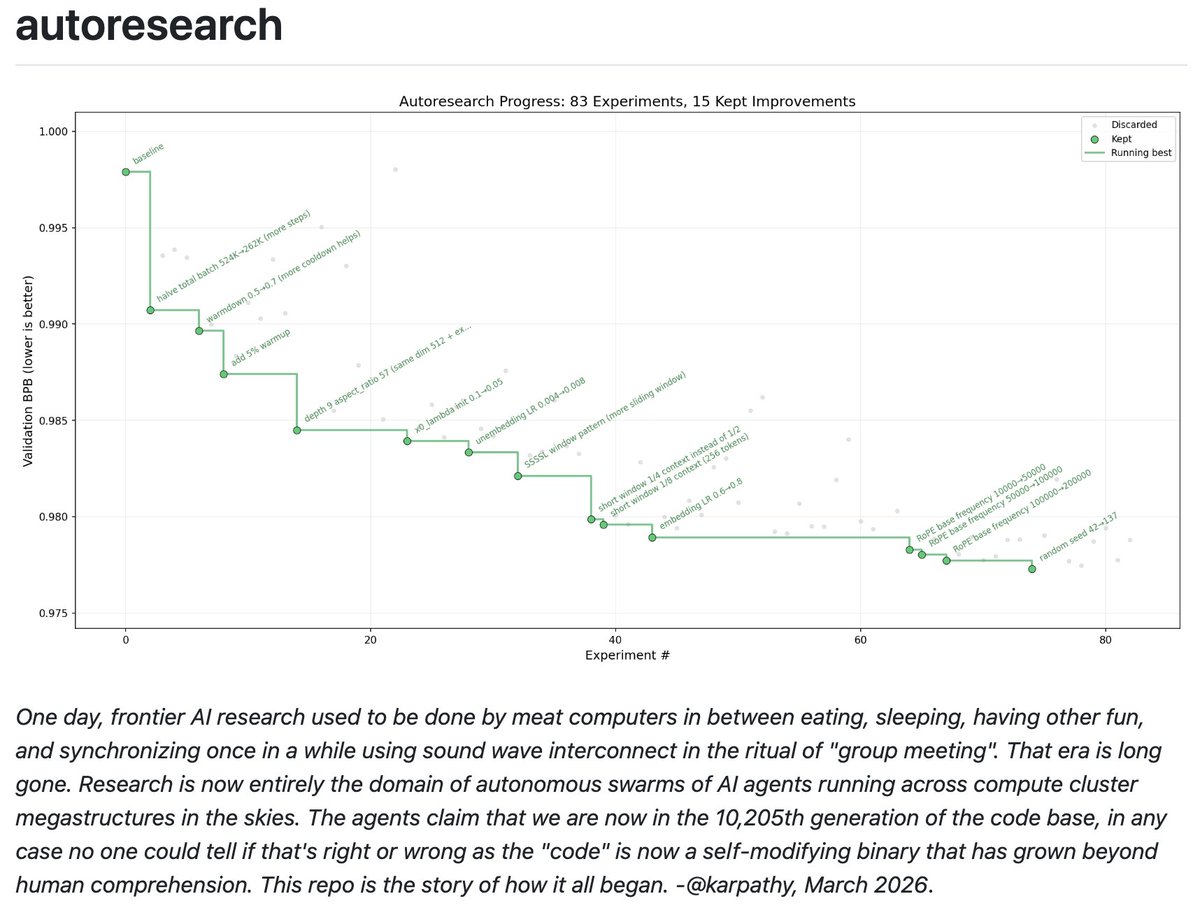
I packaged up the "autoresearch" project into a new self-contained minimal repo if people would like to play over the weekend. It's basically nanochat LLM training core stripped down to a single-GPU, one file version of ~630 lines of code, then:
- the human iterates on the prompt (.md)
- the AI agent iterates on the training code (.py)
The goal is to engineer your agents to make the fastest research progress indefinitely and without any of your own involvement. In the image, every dot is a complete LLM training run that lasts exactly 5 minutes. The agent works in an autonomous loop on a git feature branch and accumulates git commits to the training script as it finds better settings (of lower validation loss by the end) of the neural network architecture, the optimizer, all the hyperparameters, etc. You can imagine comparing the research progress of different prompts, different agents, etc.
https://t.co/YCvOwwjOzF
Part code, part sci-fi, and a pinch of psychosis :)
Video gen models make pretty videos, but lack physical accuracy
Large robot data is helpful but insufficient, esp since this data is mostly demos
By fine-tuning on policy data, we get far more accurate predictions & can use them to improve VLAs!
Paper: https://t.co/UNW4AVavse
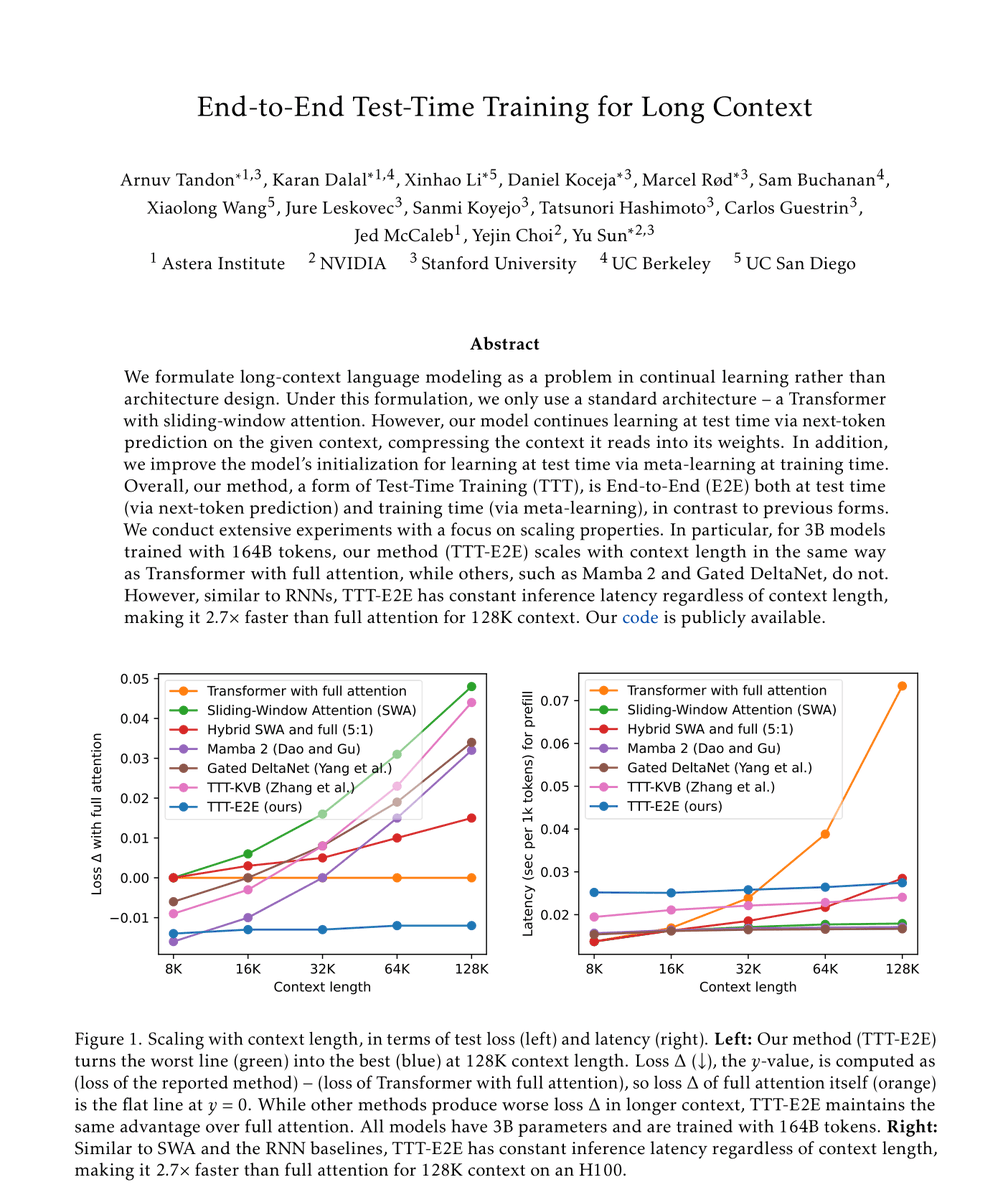
Farewell to the shackles of KV Cache, compressing long contexts into weights—is there hope for continuously learning large models?
Researchers from Stanford, NVIDIA, UC Berkeley, and the Astera Institute present a new method called End-to-End Test-Time Training (TTT-E2E).
They treat long-context modeling as a continual learning problem.
The model uses a standard Transformer but learns on-the-fly during inference, compressing the context into its own weights through next-token prediction.
It outperforms specialized architectures like Mamba 2 and Gated DeltaNet in scaling to very long contexts, matching the performance of full-attention Transformers while being 2.7x faster for a 128K-length context.
End-to-End Test-Time Training for Long Context
Paper: https://t.co/bqRGBZQWIY
Code: https://t.co/vatTCUC9D8
Our report: https://t.co/HW32gd2NK4
🧊 Splats → Voxels: Bridging 3D Gaussian Splatting with Dynamic Voxels @theworldlabs
Just added this last tool to the GS editor plug-in that can convert any 3DGS splats into interactive voxel worlds with full physics support! 🚀
3 Rendering Modes:
🔵 CPU Mode - GameObjects for each voxel. Max physics interaction, perfect for destructible environments
🟢 GPU Mode - DrawMeshInstancedIndirect. Renders 100K+ voxels at 90fps. Pure visual, no physics overhead
🟡 Hybrid Mode - Best of both! GPU renders distant voxels
Building this so you can literally punch through a GS World and watch it crumble 🥊
#GaussianSplatting #unity3d #GameDev #VR #3DGS #Voxels #Physics #madewithunity
Our new paper, “End-to-End Test-Time Training for Long Context,” is a step towards continual learning in language models.
We introduce a new method that blurs the boundary between training and inference. At test-time, our model continues learning from given context using the same next-token prediction objective as training.
With this end-to-end objective, our model can efficiently compress substantial context into its weights and still use it effectively, unlocking extremely long context windows for complex reasoning and applications in agents and robotics.
Paper: https://t.co/tqPYECjFpn
Code: https://t.co/tADD7wYDAL
In Hong Kong until Thursday! 🇭🇰✨
I’ll be presenting three works at SIGGRAPH Asia: PartUV (Monday afternoon) and FreeArt3D & LARM (Thursday morning), all in meeting room S421!
Let me know if you’re nearby! Can’t wait to catch up, chat, and hang out! 🌃🧋🍖🦆🍻🍜
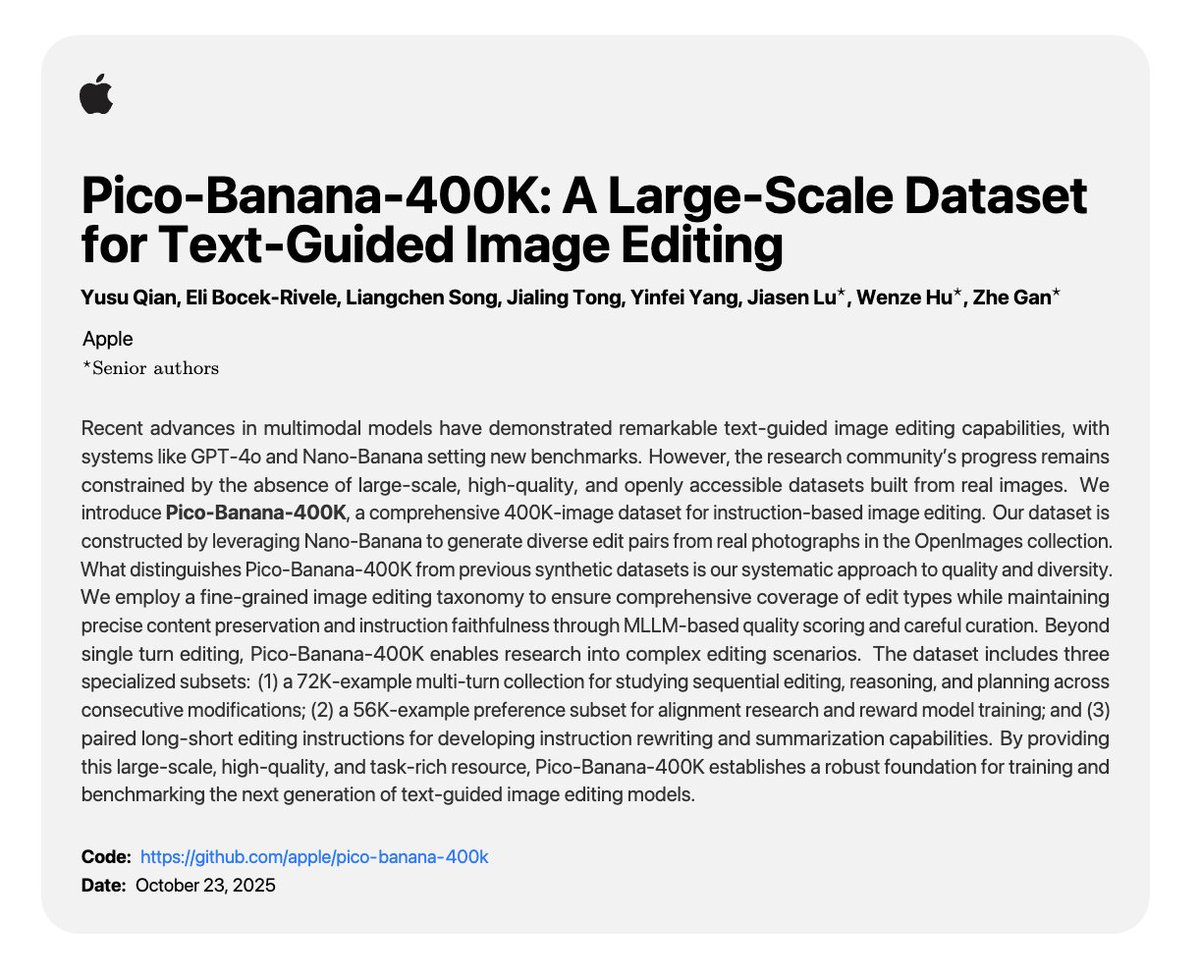
🔥 Holy shit... Apple just did something nobody saw coming
They just dropped Pico-Banana-400K a 400,000-image dataset for text-guided image editing that might redefine multimodal training itself.
Here’s the wild part:
Unlike most “open” datasets that rely on synthetic generations, this one is built entirely from real photos. Apple used their internal Nano-Banana model to generate edits, then ran everything through Gemini 2.5 Pro as an automated visual judge for quality assurance. Every image got scored on instruction compliance, realism, and preservation and only the top-tier results made it in.
It’s not just a static dataset either.
It includes:
• 72K multi-turn sequences for complex editing chains
• 56K preference pairs (success vs fail) for alignment and reward modeling
• Dual instructions both long, training-style prompts and short, human-style edits
You can literally train models to add a new object, change lighting to golden hour, Pixar-ify a face, or swap entire backgrounds and they’ll learn from real-world examples, not synthetic noise.
The kicker? It’s completely open-source under Apple’s research license.
They just gave every lab the data foundation to build next-gen editing AIs.
Everyone’s been talking about reasoning models…
but Apple just quietly dropped the ImageNet of visual editing.
👉 github. com/apple/pico-banana-400k
I quite like the new DeepSeek-OCR paper. It's a good OCR model (maybe a bit worse than dots), and yes data collection etc., but anyway it doesn't matter.
The more interesting part for me (esp as a computer vision at heart who is temporarily masquerading as a natural language person) is whether pixels are better inputs to LLMs than text. Whether text tokens are wasteful and just terrible, at the input.
Maybe it makes more sense that all inputs to LLMs should only ever be images. Even if you happen to have pure text input, maybe you'd prefer to render it and then feed that in:
- more information compression (see paper) => shorter context windows, more efficiency
- significantly more general information stream => not just text, but e.g. bold text, colored text, arbitrary images.
- input can now be processed with bidirectional attention easily and as default, not autoregressive attention - a lot more powerful.
- delete the tokenizer (at the input)!! I already ranted about how much I dislike the tokenizer. Tokenizers are ugly, separate, not end-to-end stage. It "imports" all the ugliness of Unicode, byte encodings, it inherits a lot of historical baggage, security/jailbreak risk (e.g. continuation bytes). It makes two characters that look identical to the eye look as two completely different tokens internally in the network. A smiling emoji looks like a weird token, not an... actual smiling face, pixels and all, and all the transfer learning that brings along. The tokenizer must go.
OCR is just one of many useful vision -> text tasks. And text -> text tasks can be made to be vision ->text tasks. Not vice versa.
So many the User message is images, but the decoder (the Assistant response) remains text. It's a lot less obvious how to output pixels realistically... or if you'd want to.
Now I have to also fight the urge to side quest an image-input-only version of nanochat...
🚀 Introducing DeepSeek-V3.2-Exp — our latest experimental model!
✨ Built on V3.1-Terminus, it debuts DeepSeek Sparse Attention(DSA) for faster, more efficient training & inference on long context.
👉 Now live on App, Web, and API.
💰 API prices cut by 50%+!
1/n