St. John the Baptist, the forerunner of Christ, is one of only three people in history — after Jesus and Mary — whose birthday is celebrated in the Church’s liturgy.
In fact, the Nativity of St. John the Baptist on June 24 is a solemnity, meaning it is the highest form of Catholic feast day. And because it falls exactly six months before the solemnity of the Nativity of Our Lord, it is sometimes known as “Summer Christmas.”
“The Church observes the birth of John as in some way sacred; and you will not find any other of the great men of old whose birth we celebrate officially. We celebrate John’s, as we celebrate Christ’s,” St. Augustine of Hippo said in his sermon 293.
In the Mass for the solemnity, the priest prays to God in the preface that in Christ’s precursor, “St. John the Baptist, we praise your great glory, for you consecrated him for a singular honor among those born of women.”
“His birth brought great rejoicing; even in the womb he leapt for joy at the coming of human salvation. He alone of all the prophets pointed out the Lamb of redemption,” the prayer continues. “And to make holy the flowing waters, he baptized the very author of baptism and was privileged to bear him supreme witness by the shedding of his blood.”
St. Augustine explained that “John, it seems, has been inserted as a kind of boundary between the two Testaments, the Old and the New. That he is somehow or other a boundary is something that the Lord himself indicates when he says, ‘The Law and the prophets were until John.’ So he represents the old and heralds the new. Because he represents the old, he is born of an elderly couple; because he represents the new, he is revealed as a prophet in his mother’s womb.”
Read more: https://t.co/YASAoHFPo8
The Eclipse of the Century is coming — August 2, 2027 On Monday, August 2, 2027, Earth will witness the longest total solar eclipse of the entire 21st century. At its peak, lucky observers will experience 6 minutes and 23 seconds of complete daytime darkness — an extraordinarily long stretch of totality.The Moon’s shadow will sweep from the Atlantic across southern Spain and Gibraltar, then race through North Africa (Morocco, Algeria, Tunisia, Libya, Egypt) and into the Middle East (Saudi Arabia, Yemen, and parts of Somalia). The longest duration will occur near Luxor, Egypt, where the ancient temples and the Nile will be plunged into an otherworldly twilight.Why is this eclipse so special?The Moon will be near perigee (closest to Earth), appearing larger in the sky.
Earth will be near aphelion (farthest from the Sun), making the Sun appear slightly smaller.
Together, these factors allow the Moon to completely cover the Sun for longer than in almost any other eclipse this century.
During those precious minutes of totality, the Sun’s magnificent corona will blaze into view, bright stars and planets like Regulus (in Leo) may appear, and the temperature will drop noticeably. It’s a rare chance for scientists to study the Sun’s outer atmosphere — and for the rest of us to experience one of nature’s most awe-inspiring spectacles.Millions are expected to travel to the path of totality. If you can, make plans now — the next eclipse of this length on land won’t happen until 2114.A reminder that the universe still knows how to put on a show.
NASA shares clearest image ever captured of hexgonal storm raging on Jupiter's South Pole.
How this configuration remains stable is a mystery to this day and scientists are still looking for answers.
No city lights. No haze. No interference.
Just rust-red dunes stretching to the horizon… and above them, a sky so loaded with stars it looks unreal.
This is what nights might look like on the Red Planet.
Silent. Massive. Otherworldly.
A view no human has ever witnessed in person… yet.
Amazing.
Armenia is building a statue of Christ that will reportedly be the largest in the world, standing at 77 meters high on Mount Hatis.
Every country should have this much reverence for our Lord.
This is the night sky on Mars—raw, unfiltered, untouched by a single streetlight.The atmosphere is so thin that every star slices through like a diamond on black glass. No haze, no glow, just infinite clarity.140 million miles from home, our little rover sits beneath a ceiling humanity has never truly seen: a universe stripped of Earth’s comforting blur.Close your eyes and stand there with it. Suddenly the cosmos stops feeling edited for our comfort. It feels brutally honest. And in that vastness, you feel perfectly, gloriously small.
Happy Mother’s Day
to all women who nurture
and care for others.
Your heart, presence, love,
joy, vulnerability, tenderness,
strength and sacrifice is a
tremendous gift for all.
Thank you! 💐
NASA just shared the most detailed view of Moon in its true & natural color and breaking the internet.
Just look at the detail here, this whole view is over 705 GB.
You are looking at the first photograph of another multi-planet solar system.
A real image of a real sun-like star, with real planets orbiting it — taken by a telescope on Earth.
We have been alive for 300,000 years as a species. This is the first time we have ever seen another sun's family.
"Integrity held strong! The Orion spacecraft from NASA’s Artemis II mission has been safely recovered after its fiery re-entry from the lunar flyby — and it looks absolutely incredible. Despite blazing through Earth’s atmosphere at over 25,000 mph and enduring temperatures up to 5,000°F, the heat shield performed beautifully. You can still clearly see the NASA logo and American flag proudly visible on the charred surface — a striking symbol of resilience and precision engineering. What an inspiring milestone as we prepare to send humans back to the Moon and push further into the solar system!
Credit: NASA/Bill Ingalls
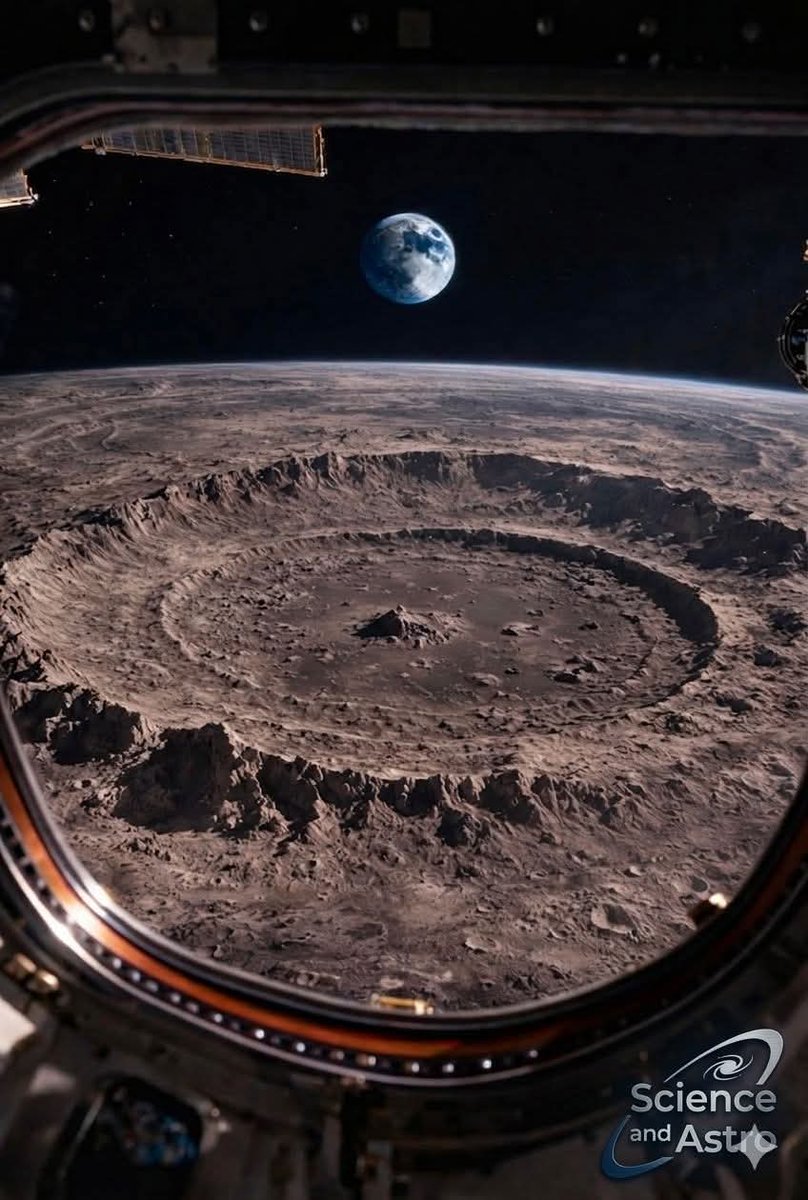
NASA’s Artemis II Reveals the Basin in Full
For the very first time, the mysterious Orientale Basin has been fully photographed. Thanks to Artemis II, humanity now sees the Moon in unprecedented detail, reminding us of the endless wonders beyond Earth. 🛰️
Historic First: Artemis II Crew Becomes the First Humans to Witness the Orientale Basin in Its EntiretyBREAKING: In a stunning milestone for deep-space exploration, the Artemis II astronauts have captured the first-ever view of the Moon’s Orientale Basin with human eyes — seeing its complete, majestic structure for the first time in https://t.co/PDp5ThIn0L the Orion spacecraft swept past the lunar limb during its historic flyby, the crew photographed the entire basin in one breathtaking frame, with Earth hanging beautifully in the black void beyond.A 930-Kilometer Cosmic BullseyeThe Orientale Basin is one of the Moon’s most impressive geological features — a massive multi-ringed impact structure roughly 930 km (580 miles) across. Formed about 3.8 billion years ago by a colossal asteroid or comet strike, its concentric rings ripple outward like frozen waves from a stone dropped into a cosmic pond.The outermost Cordillera ring forms the dramatic outer rim, while inner rings (the Rook mountains) mark zones of dramatic crustal rebound and collapse after the initial impact. Because Orientale straddles the Moon’s near and far sides near the southwestern limb, it has always appeared severely foreshortened and partially hidden from Earth-based telescopes and earlier missions. Only now, from Orion’s unique vantage during the flyby, has the full scale and symmetry been revealed directly to human observers.The Shot of a LifetimeThe image was taken through an Orion window as the crew passed over the site at just the right moment — with perfect illumination highlighting every ridge, ring, and shadow. It’s not just a photo. It’s a pivotal new dataset that complements decades of orbital data from Lunar Reconnaissance Orbiter, GRAIL’s gravity maps, and earlier probes.Entering the Zone of SilenceAs Orion continues its trajectory around the Moon, the crew is now heading into the most isolated phase of the mission: loss of signal. For roughly 40 minutes, the bulk of the Moon will completely block all radio communication with Earth, leaving Reid Wiseman, Victor Glover, Christina Koch, and Jeremy Hansen in profound solitude on the far side.They are venturing where only a handful of Apollo astronauts have gone before — deeper into cislunar space, pushing the boundaries of human exploration farther than any crew since 1970.The Moon is yielding its secrets once again… and humanity is watching live.This is what returning to the Moon — and preparing for Mars — truly looks like.