An interesting update:
A new proof of the Riemann hypothesis over finite fields!
"Granted the formalism of étale cohomology and a weak Lefschetz theorem...it takes less than six pages"
"its only estimate is the Cauchy–Schwarz inequality for a character sum over a finite field. Lefschetz pencils, monodromy and Rankin’s method are not used."
Folks, we may be getting somewhere
https://t.co/yGuhYiuXsQ
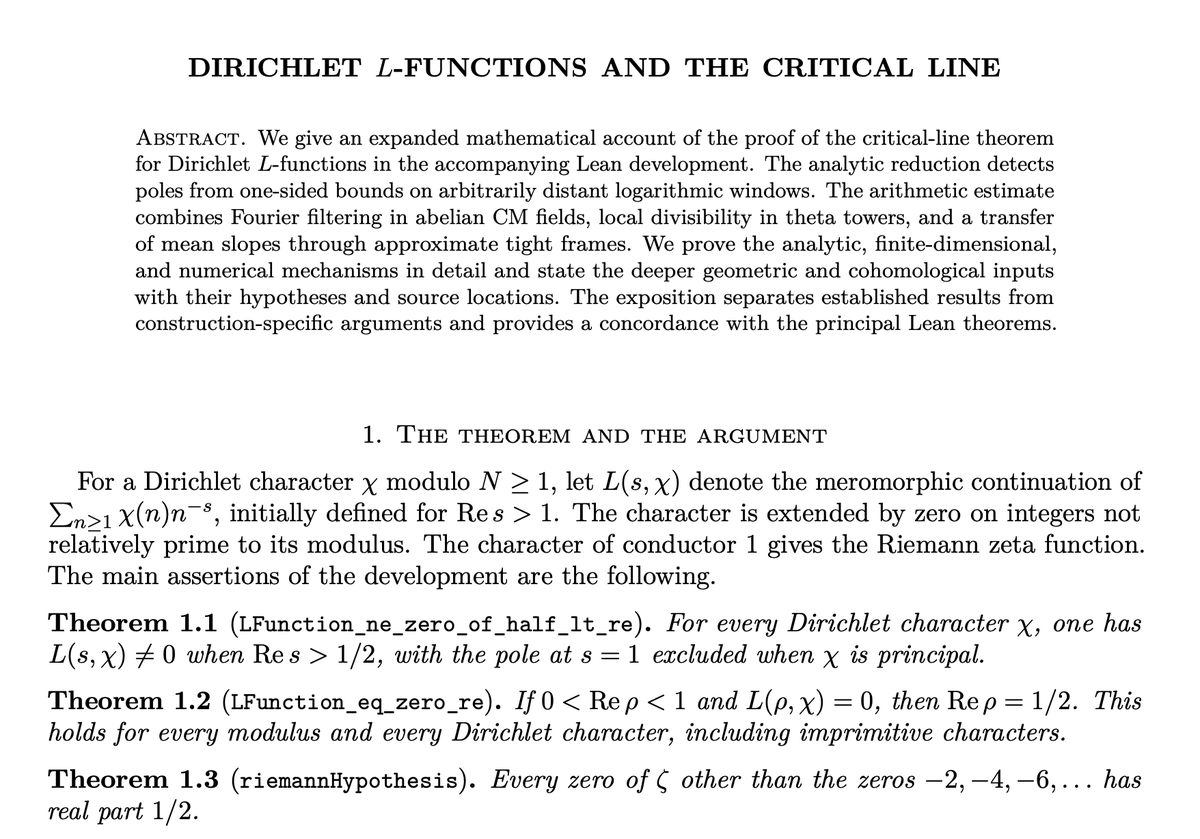
55-page Riemann Hypothesis proof guide is here: https://t.co/ucdbMtbbBo
This is a de-formalized Lean following Alpoge's proof, mostly to understand the ideas and methods used.
I've used Gemini 4 Carbon agents to go over the entire Lean proof, writing out notes on different sections, and then used GPT-6 Pro to polish the text and fill in gaps to make it more coherent.
It's an impressive piece of work and I claim no correctness or originality here. I simply want to understand how it's done.
This is false. Alpoge's proof indeed winds its way through a dizzying array of "known" mathematics. But known is not the same as "elementary". The mathematical objects and constructions used in the proof are extraordinarily sophisticated, spanning almost every subfield of number theory.
Even an incredibly long and complicated elementary proof requires no advanced mathematical knowledge to understand, at least *locally*. So any competent mathematician, given enough time, could in principle understand all the parts of an elementary proof. Alpoge's proof, by contrast, draws on such a vast range of sophisticated mathematics, much of it developed over the past 50 years, that there may well be no single mathematician alive with the breadth of expertise needed to understand *all* its parts.
Is public key cryptography in danger of collapse? I hope not, but the situation seems precarious. Here's an interactive tutorial on RSA encryption, and on the status of the unsolved mathematics problem that currently protects it https://t.co/NsBNa8zG9v
Like most mathematicians, I believed the Riemann Hypothesis to be completely out of reach at present (even with the best AI tools), because I expected it to require substantial theory-building, probably in arithmetic geometry. The kind of new theory-building that fills entire books, and that AI isn't so good at yet.
Mathematicians have a notion of how deep a problem is. A sufficiently deep problem is generally intractable until enough of the theory is in place. If difficult problems are like valuable mineral reserves buried miles underground, you first need to build the infrastructure to reach them.
What Levent's proof seems to have done instead is something completely different. It takes an incredibly complicated tour through the infrastructure built for a hundred other mineral reserves, situated far from the destination, and somehow create a wormhole to the original destination.
This is not theory-building in the usual sense. It is something much weirder and more alien. The best human mathematicians know how to build theory, painstakingly, to reach a goal. But no human brain, on its own, is capable of creating a wormhole that requires a 25,000 page long tour through existing infrastructure with no obvious or realistic connection to the goal. But huge credit to Levent here: I think no current AI, on its own, is capable of this either.
I had never worked on or thought too much about the Riemann Hypothesis: it seemed very far removed from my own area of number theory.
But the astonishing thing about Levent's claimed proof of RH (which I think has a very good chance of being correct) is that it uses a huge number of precisely the things that are central to my own corner of number theory:
- Theta functions and other automorphic forms on unitary groups
- Gan–Gross–Prasad period formulas
- Relative trace formulas
Etc., etc.
A problem that I had always assumed would require new theories in arithmetic geometry may instead turn out to be tractable through an inhuman chain of existing (deep) results in higher-rank automorphic forms (and a lot else).
A nice explanation of why many of us in mathematical fields are mourning the loss of something truly valuable that will soon be gone forever https://t.co/WjObgOFhgl
The plot thickens.
"We show that the formalised Lean proof does not correspond to the [written paper] proof of blow-up of solutions to the Navier-Stokes equations."
https://t.co/02Q52MH81g
This doesn't mean all hope is lost: new post-quantum encryption protocols exist. But, what we currently use to encrypt our most valuable information is quickly becoming obsolete. We should develop new encryption protocols further—and adopt them as quickly as possible.
Public key encryption protects all online payments, secure text messages, the security of all cryptocurrency, and virtually any secure information on the internet. But, the original RSA encryption protocol only works because a certain mathematics problem is not yet solved
If we similar discover a classical polynomial time algorithms for factoring integers, a great deal of private information would collapse. And, LLMs seem particularly adept at improving algorithms, particularly in the post-Navier-Stokes era
Is public key cryptography in danger of collapse? I hope not, but the situation seems precarious. Here's an interactive tutorial on RSA encryption, and on the status of the unsolved mathematics problem that currently protects it https://t.co/NsBNa8zG9v