This is the flicker you’re working with in a hospital. The place where mainstream orthodoxy says you’re supposed to “heal.” Atrocious reductionist garbage
Even the slow motion audio sounds reptilian and demonic 😂
The answer: The physics has the answer: realize that year-round lush, green, high-moisture zip codes are dangerous is rooted in the physics of electrical conductivity and grid-coupling. Soil moisture content directly dictates the earth's local electrical impedance.
In areas of high grid density, utilities constantly dump massive amounts of return current and stray voltage straight into the ground ( Anywhere in the SAA like Miami). In dry, high-magnetism desert regions or horizontally pinned volcanic plates (like El Salvador’s basaltic rock), the ground exhibits high electrical resistance, keeping these currents localized.
However, the entire Eastern Coast of the US combines high infrastructure density with an unbroken, shallow water table and high-salinity soil moisture. This damp lithology acts as a massive, continuous macroscopic ground-loop wire. The moisture does not wash the current away; it holds it in place, turning every stream, lake, and backyard lawn into an active electrode that couples directly with the feet of any mammal walking across it.
Even the Pacific Northwest, despite its localized sub-oceanic volcanic pinning, becomes a structural hazard during its long, high-precipitation seasons. The continuous water film across the landscape creates a giant surface-level sheet conductor that carries low-frequency grid transients straight into the biological semiconductor matrix.
The Botanical Fractal: Lumps, Warts, and Structural Tumors
Physics scales universally across all living things]. Plants utilize chloroplasts, the evolutionary brothers of our mitochondria, to run their own solid-state, light-harvesting semiconductor circuits.
When a plant’s root system is permanently locked into a high-moisture, low-frequency electrified zip code, the continuous ground current disrupts the subatomic spin states of its internal fluid matrix. The Maya used maize to follow this Telluric effect.
The electrical potential across the plant's stem drops, causing the liquid crystal sap table to lose its coherent k=160 capacitance. The growth coordinates go blind. Without sharp directional guidance from the background field, the plant loses its apical dominance, causing the tops to thin out, the leaves to lose their full-spectrum solar pigmentation (becoming blotchy), and forcing the cells to proliferate into chaotic, localized, high-entropy structures: lumps, warts, and morphogenetic tumors. Decentralized science always has the answer for those who look.
Elon musk, on lex fridman last month: "anyone not running a swarm of agents by the end of 2026 will look like someone who refused to use email in 1998"
this is what he meant, in one screen recording:
one guy. 50 claude agents. a full working system shipped in 30 minutes. he did not write a single line of code. he gave the orders and watched them execute in parallel, each one handling a different piece of the build
meanwhile 90% of people reading this are still using claude the same fucking way they used chatgpt in 2023. one chat window. one task at a time. asking the same question in the same thread until it finally gets it right
the setup costs you one evening to learn and pays back forever. whoever learns it this month will be running 10x what their coworkers ship by january. the ones who do not will still be slow-typing into a blank chat like it is still 2023
i wrote the full breakdown of how the 50-agent setup works, what each agent is told to do, and the exact claude code config behind it. the article is below
the gap between the person who runs agents and the person who runs chats is about to become the only gap that matters. do not land on the wrong side of it
Someone is putting the law of every country into one git history.
Git for Global Law turns each country's laws into a repository where every commit is a real law taking effect. So you can see exactly what the law said on any date, and which law changed every word.
It started with the US Code, which hit #1 on Hacker News. The global version is growing country by country: Germany's constitution since 1949, Estonia and more so far.
Free to use for anything, and perfect for feeding to an AI.
https://t.co/vGdw67DKpE
It’s almost incomprehensible how wide the distance is between someone who’s working at the frontier with AI and basically everyone else right now.
The crazy thing is these lines are not converging, but only growing farther apart. If the curve of AI progress had leveled off, it would certainly have given most people and companies time to catch up or implement their workflows in a standardized way. The technology would have neutralized competitive advantage because everyone would be using it the same way.
But what’s happened is the opposite. The curve of AI progress is basically going vertical right now, which means if you had codified your processes 3-6 months ago you’re likely already behind again. Now imagine most companies that kicked into gear a year ago and thought that they were done. Even further behind now.
I’ve never seen a technology in my life and career that improves at this rate, which consequently means you need to upgrade your expectations at a similar rate. Our brains weren’t wired for this, and our organizational change management processes certainly weren’t either.
With any form of recursive self improvement, things just get wilder. It’s a time when you will need to be constantly reevaluating the things that didn’t work just a couple months ago to see if they now can be solved. AI native companies certainly have a strong advantage due to this right now, so now it comes down to can the bigger companies keep up. Wild times.
this might be my last normal tweet before biotech goes vertical
i'm not a whistleblower. I don't work at Lilly, Novo or any of the big labs
but there is a massive shift happening in human biology right now.
it's sitting in press releases and almost nobody reads them
the last 6 months alone:
- a once-daily pill roughly doubled median survival in metastatic pancreatic cancer (13.2 vs 6.6 months)
- a one-time gene editing infusion cut hereditary angioedema attacks 87%, and 62% of patients stayed attack-free and off all other prevention for 6 months
- a one-time gene edit for cholesterol dropped LDL up to 62%, and it held for over a year
- a personalized mrna vaccine beat keytruda alone in a 1,137 patient melanoma phase 3
- retatrutide hit ~28% weight loss in a phase 3
- an ai-designed drug entered phase 3
- a pill that regrows hair passed its second phase 3
- an immunotherapy that could let some rectal cancer patients skip surgery, chemo and radiation just got fda approved
- a man lived 271 days off dialysis on a pig kidney
- human cells were caught passing chromosome-sized chunks of DNA to their neighbors, and it changes how the neighbors behave
we are on the verge of an era where the human body is a software problem and the update cycle gets shorter everyday
stick around, it's going to get weird
bio/acc
OpenAI Dots is insane for building a 24/7 AI company...
I mapped the whole OpenAI Dots architecture into one paper: agents, models, tools, memory, delegation, guardrails and the revenue layer.
Here are the 10 steps:
step 1 → stop treating Dots like a chatbot. each Dot runs in a persistent cloud environment with its own browser, terminal, files, memory and scheduled execution. close the laptop and the workflow keeps moving
step 2 → hire by responsibility. give every Dot one clear domain, dedicated sources, a working style, an approval boundary and a trigger. a "general helper" has no role, only undefined context
step 3 → make one Dot the orchestrator. you give it the objective, it decomposes the work, delegates to specialized agents, checks their outputs and merges everything into one deliverable
step 4 → stop being the courier between agents. with isolated delegation, each worker gets only the context and tools it needs, executes in its own environment, then returns a structured result to the orchestrator
step 5 → connect the real business stack: cloud browser sessions, Slack, Microsoft Teams, Google Workspace, internal dashboards and APIs. a Dot without tools is still just a conversational layer
step 6 → put the company on a clock. recurring routines and event triggers turn one-off tasks into persistent operations. research, monitoring, reporting and pipeline checks can run while nobody is online
step 7 → automate the reversible, gate the irreversible. let agents read, research, analyze and draft autonomously, but require human approval before messages send, money moves, records change or production code ships
step 8 → route intelligence by cost. keep the strongest model on orchestration, conflict resolution and final audits, and let cheaper high-context models handle background research, classification and repetitive execution
step 9 → give the company shared memory. project specs, approved claims, pricing, decisions and requirements live in one persistent workspace, so every agent works from the same source of truth instead of rebuilding context from old chats
step 10 → connect the loop to revenue. research finds the signal, outreach creates the opportunity, execution moves the work forward, analytics measures the result and monitoring discovers the next action
AI stops being something you open when you need an answer. It becomes an operating layer that keeps economically useful work moving after you log off.
Copy the complete OpenAI Dots architecture blueprint, then read the full roadmap below ↓
Andrew Ng just dropped the best 2-hour course on Graph Engineering: from single agent to full automation
9:14 - your first agent
33:11 - loop engineering
1:02:46 - graph engineering
1:30:15 - agents that rewrite themselves
1:49:05 - full graph system
two hours, and it replaces every agent tutorial you bookmarked this year
Prompts → Agents → Loops → Graphs
most people will stop after the first agent and call it automation
he saves the last forty minutes for the graph that runs it without him
same model, same tokens, completely different week
watch it today
the step-by-step guide is below, save it while it is still early ↓
Researchers proved AI has deleted every reason universities exist.
Harvard University ran a controlled experiment pitting a custom AI against their own top-tier classrooms.
And the results are going to collapse the higher education bubble.
They took 194 undergraduates and split them up.
One group learned physics in one of Harvard’s best hands-on, active-learning physical classrooms. Group work. Instructor support. The premium university experience.
The other group went home and learned the exact same material with an AI tutor.
The AI didn't just win. It embarrassed the institution.
Students using the AI learned more than twice as much as the students in the elite Harvard classroom.
They scored 30% higher on the final assessment.
And they did it in less time.
Let that sink in.
A piece of software sitting on a laptop outperformed a world-class faculty in one of the most elite learning environments on Earth.
Universities have always justified their exorbitant tuition with two things: access to elite knowledge and the physical classroom experience.
This study just proved both of those moats are gone.
When software can teach you complex physics twice as well as a $60,000-a-year institution, the math of higher education breaks permanently.
The AI didn't just give the students answers. It used strict pedagogical guardrails. It guided. It questioned. It forced the students to do the cognitive work.
It offered perfect, one-to-one tutoring, personalized to the exact moment a student misunderstood a concept.
That level of attention is mathematically impossible to scale in a physical lecture hall.
For a thousand years, the university was the only place to get a premium education.
Now, it’s the bottleneck.
If AI can double your learning speed for a fraction of the cost, what exactly are students taking on decades of debt to pay for?
A NEW BRAIN NEURON DISCOVERY!
Human Attention Is All You Need.
It may help solve ADHD and Autism.
The Brain’s Ancient Focus Filter: How a Handful of Brainstem Neurons Decide What You Notice
For decades, attention was treated as a late, sophisticated product of the prefrontal cortex. Find a friend in a crowded room, follow one voice in a noisy café, ignore the flashing notification while you finish a sentence—those feats were assumed to require the most recently evolved parts of the human brain. A new paper from Johns Hopkins University upends that story.
An evolutionarily ancient cluster of inhibitory neurons in the brainstem, called PLTi (parabigemino-lateral tegmental inhibitory neurons), is required for selective spatial attention. When these cells are temporarily silenced in mice, the animals become hyper-distractible. Weak, irrelevant stimuli steal their focus. The next day, when the same neurons are allowed to fire again, the identical animals ignore even strong distractors. Vision is intact. Movement is intact. Only the ability to pick a winner among competing signals is gone.
The finding, published in Nature Communications recasts attention as something far older than the primate cortex. Birds, fish, frogs, and turtles all possess homologous circuits. The implication is stark: the brain solved the problem of “what matters right now” hundreds of millions of years before humans grew a large prefrontal cortex.
What PLTi Actually Is
PLTi neurons sit in the midbrain tegmentum, a region shared by all vertebrates. They are parvalbumin-positive GABAergic cells. Almost all of them co-express GABA and PV. They receive input from the superior colliculus (SC) and send long-range inhibitory projections back into the intermediate and deep layers of the SC—the SCid, an established hub that builds a topographic map of surrounding space and helps select where to look or turn.
The circuit is reciprocal. The SC talks to PLTi; PLTi talks back and quiets the SC. When researchers activated PLTi chemogenetically, firing rates in SCid dropped. When they silenced PLTi, SCid became overactive. That overactivity is not random noise. It erodes the sharp competitive boundary that normally lets one stimulus suppress its rivals.
In earlier work, Mysore’s lab had already mapped an analogous circuit in birds (the nucleus isthmi pars magnocellularis, or Imc). The mouse work was the first causal demonstration that the same logic operates in a mammal performing a human-style attention task.
The Experiment That Made Distractibility Visible
The team trained freely moving mice on a touchscreen flanker task modeled on human psychology experiments. A target grating appeared straight ahead. The mouse had to report its orientation (vertical or horizontal) by poking the correct location. Meanwhile, a flanking grating of varying contrast appeared off to the side. Sometimes the flanker matched the target (congruent). Sometimes it conflicted (incongruent). Contrast of the flanker was titrated so the team could measure how strong a distractor had to be before it won.
Normal mice handled the task well. Accuracy stayed high even with moderately strong incongruent flankers. After bilateral chemogenetic silencing of PLTi (inhibitory DREADDs + CNO), performance on incongruent trials collapsed. Accuracy could fall from about 90 percent to chance. The animals were now captured by faint distractors. Congruent trials and single-target trials were largely spared. Motor trajectories, head-orienting, and basic visual discrimination remained intact.
1 of 2
Andrej Karpathy:
"Prompting is going away. Delete everything, keep Graph."
In 69 minutes he shows how to build Graphs, and why it's the only thing that will be left standing at the end
Prompts → Agents → Loops → Graphs
a loop keeps one agent working until the job is done
a graph decides which agents exist and what each one hands to the next
anyone can build an agent, almost no one builds the graph that runs them
watch it today, then save the full guide on Graphs below before everyone catches up ↓
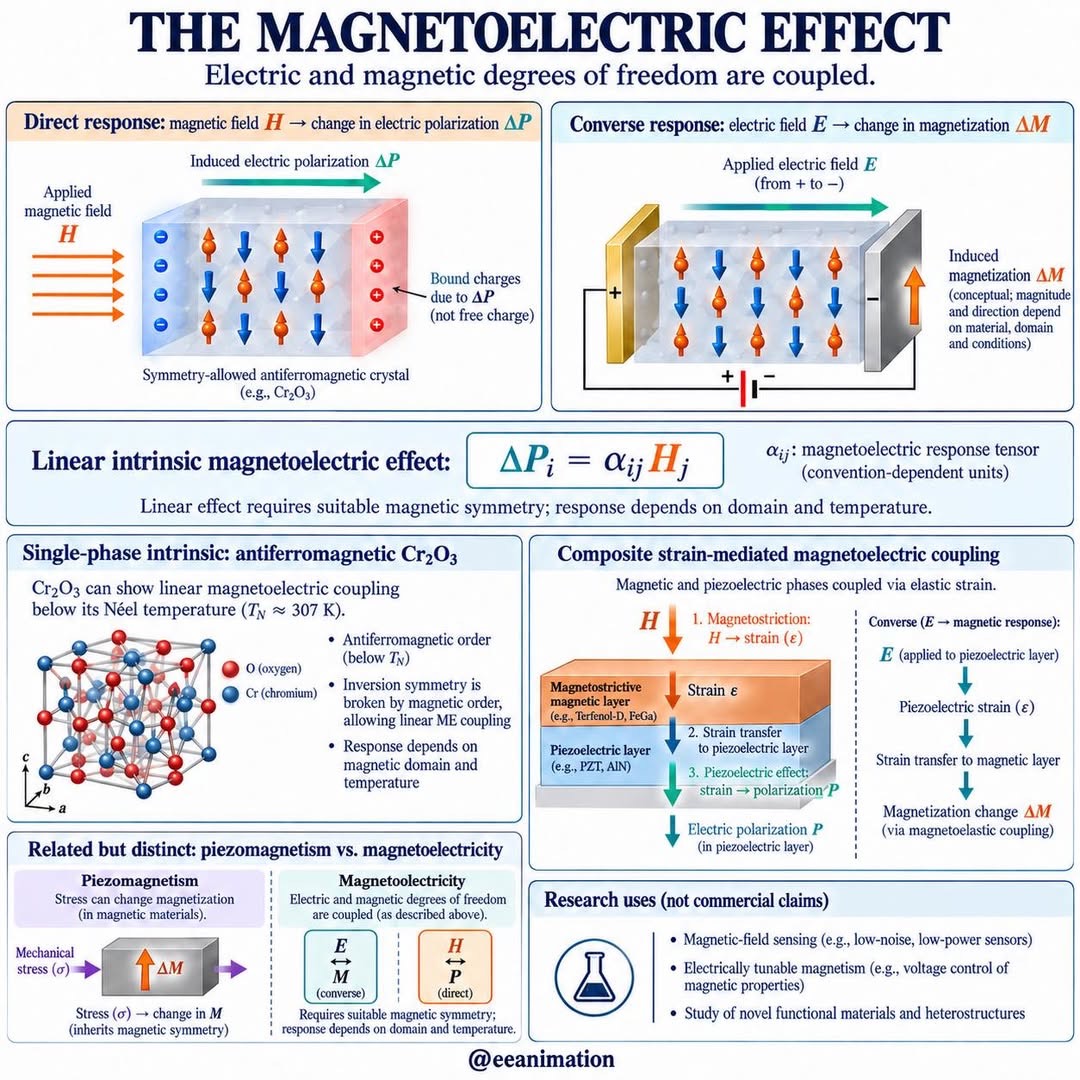
Why you better be careful with Levin and Picard. Logan ask the question, how does magnetism scale to lipids.
CHAPTER 11.1: THE MITOCHONDRIAL MAGNETOELECTRIC COUPLING MATRIX11.1.1
The Direct and Converse Responses of the Inner Mitochondrial Junction The central dogma of centralized biology treats the electric membrane potential (Delta Psi) and the localized magnetic fields of the cell as completely siloed, independent phenomena.
Textbooks describe bioelectricity as a closed chemical event governed exclusively by passive ion diffusion through membrane channels, remaining entirely blind to the overarching physical laws that dictate how electric and magnetic degrees of freedom interact.
My decentralized thesis completely upends this reductionist model supported by Levin/Picard/Wallace by deploying the physics of the Magnetoelectric (ME) Effect.
As explicitly detailed in the slide and the podcast, magnetoelectricity defines a cross-coupled thermodynamic system where:
The Direct Response: An applied magnetic field (H) immediately induces a change in electric polarization (Delta P).
The Converse Response: An applied electric field (E) immediately induces a change in magnetization (Delta M). In the paradigm of non-equilibrium quantum electrodynamics (QED), the Inner Mitochondrial Junction (IMJ) and the cristae folds act as a single-phase and composite strain-mediated magnetoelectric heterostructure [CIFRA, 2014, PICARD, 2019]. @prospertarian
https://t.co/3fzl5K1Bly
I've been harping on Effective Altruism (EA) a lot lately.
This article explains the philosophy behind EA and why I consider it so alarming and important to stop.
Look forward to my project release mapping the EA network tomorrow. https://t.co/z8Kt7LXciV
SpaceXAI just dropped a 12-page PDF on best GrokBot use cases - after reading you will use GrokBot better than 95% of people
What Grok Bot is, which use cases work today and how to deploy without burning trust in my 12-page research:
step 1 → every working use case follows one shape: read, check, apply rule, write draft. If your task fits this, the bot can handle it
step 2 → five criteria before handoff: repeatable, cross-system, rule-governed, draft-first, bounded error cost. Fails on any? Add a gate or wait
step 3 → start with sales. 36 LinkedIn drafts queued overnight. Zero sent without review. Highest density of agent-ready work
step 4 → engineering gets bug repro, CI/CD monitoring and dependency audits. Bot catches the ticket, hits staging, drops a repro pack
step 5 → operations runs inbox, expenses and travel. Bot signs into portals without APIs. Finance saves 8-12 hours at month-end
step 6 → marketing owns 13 of 56 roles. Paid media, content calendars, competitor watch. All overnight, all draft-first
step 7 → the approval boundary: every official use case stops before external action. Nothing sends, books or pays without you
step 8 → deploy in four weeks. Watch, review all, review flags, scheduled routine. Skip a week and risk compounds
step 9 → fleet pattern: Chief of Staff on top, specialists underneath, bots message each other. You stop being the middleman
step 10 → sort by cost of mistake. The bot nails 49 tasks then does something odd on the 50th with full confidence. Keep a human at every exit
the result: 56 roles, one playbook. The bot handles the 80% that repeats. You handle the 20% that matters.
this 12-page PDF learns you how to get best results from GrokBot
save now, then read how to build a 24/7 GrokBot agent team in the article below


![DrJackKruse's tweet photo. The answer: The physics has the answer: realize that year-round lush, green, high-moisture zip codes are dangerous is rooted in the physics of electrical conductivity and grid-coupling. Soil moisture content directly dictates the earth's local electrical impedance.
In areas of high grid density, utilities constantly dump massive amounts of return current and stray voltage straight into the ground ( Anywhere in the SAA like Miami). In dry, high-magnetism desert regions or horizontally pinned volcanic plates (like El Salvador’s basaltic rock), the ground exhibits high electrical resistance, keeping these currents localized.
However, the entire Eastern Coast of the US combines high infrastructure density with an unbroken, shallow water table and high-salinity soil moisture. This damp lithology acts as a massive, continuous macroscopic ground-loop wire. The moisture does not wash the current away; it holds it in place, turning every stream, lake, and backyard lawn into an active electrode that couples directly with the feet of any mammal walking across it.
Even the Pacific Northwest, despite its localized sub-oceanic volcanic pinning, becomes a structural hazard during its long, high-precipitation seasons. The continuous water film across the landscape creates a giant surface-level sheet conductor that carries low-frequency grid transients straight into the biological semiconductor matrix.
The Botanical Fractal: Lumps, Warts, and Structural Tumors
Physics scales universally across all living things]. Plants utilize chloroplasts, the evolutionary brothers of our mitochondria, to run their own solid-state, light-harvesting semiconductor circuits.
When a plant’s root system is permanently locked into a high-moisture, low-frequency electrified zip code, the continuous ground current disrupts the subatomic spin states of its internal fluid matrix. The Maya used maize to follow this Telluric effect.
The electrical potential across the plant's stem drops, causing the liquid crystal sap table to lose its coherent k=160 capacitance. The growth coordinates go blind. Without sharp directional guidance from the background field, the plant loses its apical dominance, causing the tops to thin out, the leaves to lose their full-spectrum solar pigmentation (becoming blotchy), and forcing the cells to proliferate into chaotic, localized, high-entropy structures: lumps, warts, and morphogenetic tumors. Decentralized science always has the answer for those who look.](https://pbs.twimg.com/media/HW2ttYqWMAAJR7D.jpg)