@amitabhk87 Make the cost of non-compliance multiples greater than the cost of compliance - the only way we'll see results. In any context. Sadly, the reverse seems to be the policy default.
The 2027 Census is going digital, and the geo-mapping software has been handed to a single bidder running a proprietary US-owned platform with a known backdoor that Chinese state-backed hackers exploited for over a year. Every household’s location data, on that. Stupid, foolish, or insane? IFF has analysed the procurement and filed RTIs with the Registrar General.
#Census2027 #DataSecurity #DigitalRights #IFF
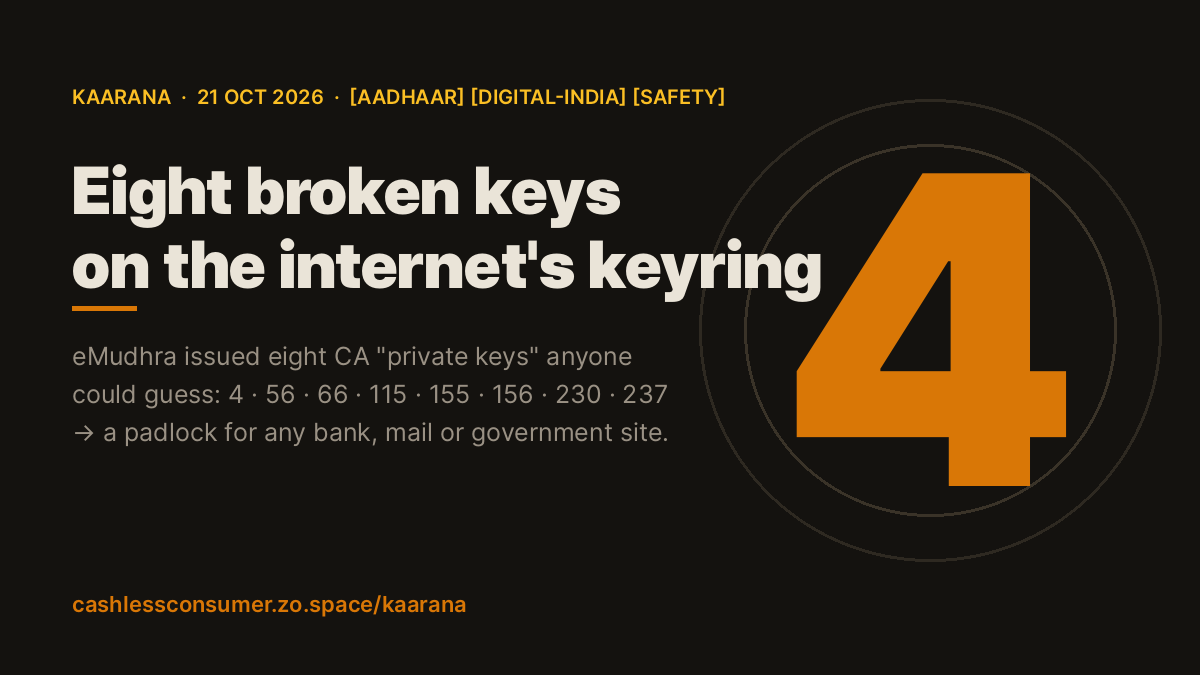
News: We now know how eMudhra broke its CA keys. They were not stolen. They were tiny numbers: 4, 56, 66, 115, 155, 156, 230 and 237.
What happened: On Oct 17 a researcher named Wayne found he could recover the private keys of eight eMudhra intermediate CAs from their public certificates. He signed "We have a problem here - Wayne" with each key and sent it to the browser root programs. Mozilla rebuilt the keys on its own the same day.
Who is hit: Six of the CAs issue TLS certs and chain to emSign ECC Root CA - G3, trusted by Chrome, Firefox, Apple and Microsoft. Two sign code. Sectigo cross-signed all eight under "AAA Certificate Services".
How eMudhra got it wrong: These are ECDSA P-384 keys. A real one is a random number about 116 digits long. All eight were below 256, so you only need to try 255 values. eMudhra says that at an April 2025 key ceremony on Utimaco HSMs, it changed its usual steps to test key wrap/unwrap for export. A bug in its script made a second, weak set of keys. Staff then used the weak keys for the CSRs by mistake, because the key labels looked alike. eMudhra is still hunting the exact bug.
Why browsers were safe: No certs from these CAs appear in CT logs, and Chrome, Firefox, Safari and Edge reject unlogged certs. eMudhra says none of the eight issued end-entity certs. But curl, scripts, apps and devices that skip CT and revocation checks could have been fooled since April 2025. No one knows if that happened.
What to do now:
- Update ca-certificates (Ubuntu, Debian, Fedora, Alpine, Arch)
- NSS 3.131.1, Firefox 158.0.1
- Go 1.27.3 or 1.26.10, certifi 2026.10.19, pip 26.2.2, uv 0.13.4
- Node.js and Bun: fix pending
- macOS /usr/bin/curl still uses the old /etc/ssl/cert.pem
- Sites on emSign ECC Root CA - G3: Chrome drops that root Oct 27. Get a new cert now. eMudhra says about 30,000 certs must move.
https://t.co/dVp44Z73WZ
Eight private keys used to issue web security certificates by Bengaluru-headquartered eMudhra Ltd. have been leaked, sending security teams at major internet browser and operating system developers around the world scrambling to patch their systems to stop trusting the affected certificates.
✍️ @AroonDeep
https://t.co/MdoE57Omgy
Your browser's padlock is a promise: "this is really your bank."
Last week an Indian company broke that promise 8 times.
One of the secret keys was the number 4.
A thread for anyone who has never once thought about how HTTPS works. 🧵
Statement : The removal of BitChat from the India App Store is unconstitutional. Section 69A permits the blocking of unlawful information, not of a messenger for working during internet shutdowns.
New Delhi, 3 October 2026
An Apple App Review notice published today by Jack Dorsey on X records that BitChat has been removed from the India App Store "per demand from the Ministry of Electronics and Information Technology", issued under Section 69A of the Information Technology Act, 2000, on the ground that the application "includes content that is illegal in India". The notice adds that BitChat's TestFlight builds are no longer available for testing in India. It does not identify the content said to be illegal or the ground under Section 69A invoked. The blocking order has not been published. The Internet Freedom Foundation condemns the order and calls for its immediate publication and withdrawal.
BitChat relays end-to-end encrypted messages between nearby phones over Bluetooth mesh. It has no servers and hosts no content of its own. What travels through it is the private speech of its users, so the claim that the application "includes" illegal content is incoherent. The State's actual objection stands recorded in the notices the Indian Cyber Crime Coordination Centre issued on 23 July 2026 to GitHub, Google and Apple against BitChat, Briar and Bridgefy which stated that such applications work even during internet shutdowns and hamper lawful interception, attribution and traceability. Those notices, issued under Section 79(3)(b) were reportedly withdrawn after public disclosure. The same end has now been pursued through Section 69A. The objection is to capability of an application, not to content it transmits. A citizen's ability to speak to another citizen while the State has switched the internet off is not a ground of restriction under Section 69A or Article 19(2) of the Constitution.
Section 69A survived constitutional scrutiny in Shreya Singhal v. Union of India (2015) because of its safeguards which included the need for a reasoned, recorded order, committee review, and a hearing to the originator under Rule 8 of the Blocking Rules, 2009, which the Delhi High Court enforced in Tanul Thakur v. Union of India (2022). Further, Anuradha Bhasin v. Union of India (2020) requires that orders restricting fundamental rights be published and adopt the least restrictive measure. However, it appears in this instance, each safeguard has been evaded. A secret order blocking an entire application, rather than any identified unlawful information, is the most restrictive and disproprotionate measure available. Further, the confidentiality claimed under Rule 16 cannot defeat the right to challenge an order, and the constitutionality of this blocking regime is itself pending consideration before the Supreme Court.
While removal from the App Store does not delete BitChat from phones, it stops new downloads and security updates, leaving existing users on unpatched versions, and it ends security testing in India through TestFlight. During the Jantar Mantar protests, when mobile internet was suspended and jammers were deployed, Bluetooth mesh messaging was a channel of last resort through which young people coordinated their safety. To our knowledge, Apple has removed BitChat on a government's demand in only one other country. This is in China, in April this year.
Our demands
1. MeitY must publish the blocking order, the ground invoked and the record of the committee's proceedings, and serve the developers with a copy and an opportunity of hearing.
2. The direction must be withdrawn. Any specific unlawful use must be met with targeted proceedings under due process, not the removal of a communications tool for everyone.
3. Apple must disclose the demand in its transparency reporting and notify its users in India, and must state whether parallel directions have been received in respect of other app stores.
4. The secrecy of the blocking regime must end. The Blocking Rules, 2009 should be amended to require publication of orders and notice to originators, without awaiting the outcome of the pending constitutional challenge.
The Internet Freedom Foundation will file applications under the Right to Information Act seeking a copy of the order, and stands ready to assist the developers and affected users in India.
@LiveLawIndia There should be 3 language labels if you're putting words. Else, in a country like ours, pictographs / symbols are the way to go. It will also be financially more viable for the manufacturers to have symbols rather than have multiple labels to allow for regional language needs.
Companies getting AI agents to call customers and pretending there’s a human on the other end: please stop.
Just disclose upfront that it’s an AI agent. I’m sorry, I’m not interested in having a conversation with your bot.
Trying to fool me into thinking I’m speaking to a person doesn’t make the experience feel smarter. It makes me feel like an idiot for falling for it.
Being honest might actually increase trust.
Looking at you, @CRED and @Razorpay.
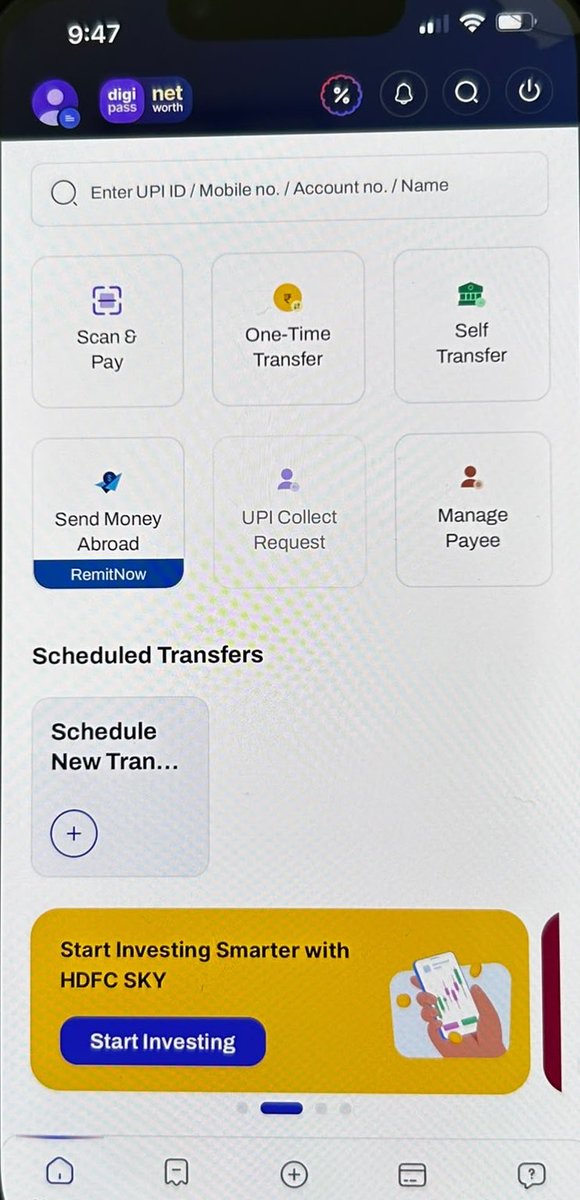
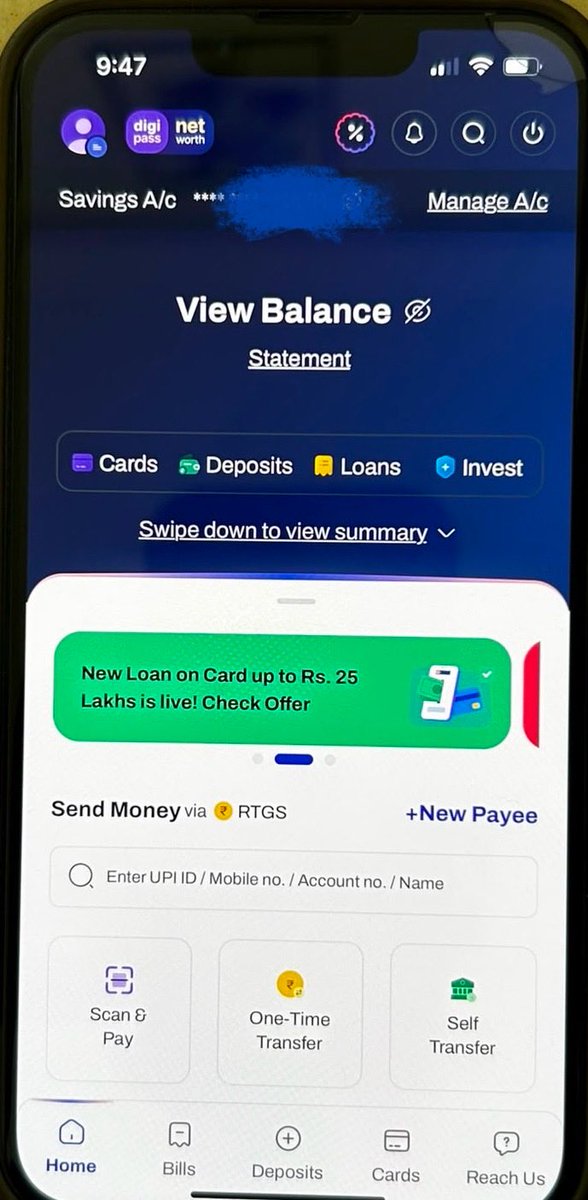
I opened my HDFC mobile banking app today to transfer money to someone, and my first thought was:
Kaun design kiya hai isko?" 😞
Most people open a net banking app to do just three things:
* Check their balance
* See recent transactions
* Send money
But somehow, even these basic tasks are hard to find.
Instead, you're greeted with banners, offers, loans, credit cards, and everything else.
It feels like many Indian mobile banking apps care more about selling products and services than helping users do what they actually came for.