In a world of change, the learners shall inherit the earth, while the learned shall find themselves perfectly suited for a world that no longer exists. -Eric H.
Mark Zuckerberg gets it right:
“The defining question of our age isn’t whether superintelligence will exist, but who will have access to it. Will it be centralized and restricted to a few institutions, or will it be a tool that empowers everyone?”
Concentration of power is the biggest risk of AI. When a small number of labs (working hand-in-glove with the administrative state) decide who has access to which model capabilities, they inevitably shape what can be said, known, and built. That’s not “safety.” It’s control.
As Mark points out, the history of open source shows that broad access and transparency are usually the best path to actual security and resilience. Decentralization creates checks and balances on power. By contrast, centralized alternatives, like bureaucratic approval regimes and mandatory gatekeeping, typically produce regulatory capture and reinforce cartels.
Personal superintelligence in everyone’s hands, with competing models and real data sovereignty, is a far better check on a dystopian future than self-appointed guardians who claim to be “aligned” with all of humanity.
JUST IN: American Heart Association reveals drinking up to five cups of coffee per day may lower the risk of stroke, heart failure & type 2 diabetes.
🚨LMFAO! JD VANCE: "I knew exactly what I wanted to say, but after POTUS said I was so smart and I didn't want to repeat Rep. AOC who froze for 20 seconds over in Munich, now I'm tempted, sir, just to freeze for 20 seconds and just stare at the cameras, and maybe they'll say nice things about me like they do about Congresswoman Cortez."
😂😂😂
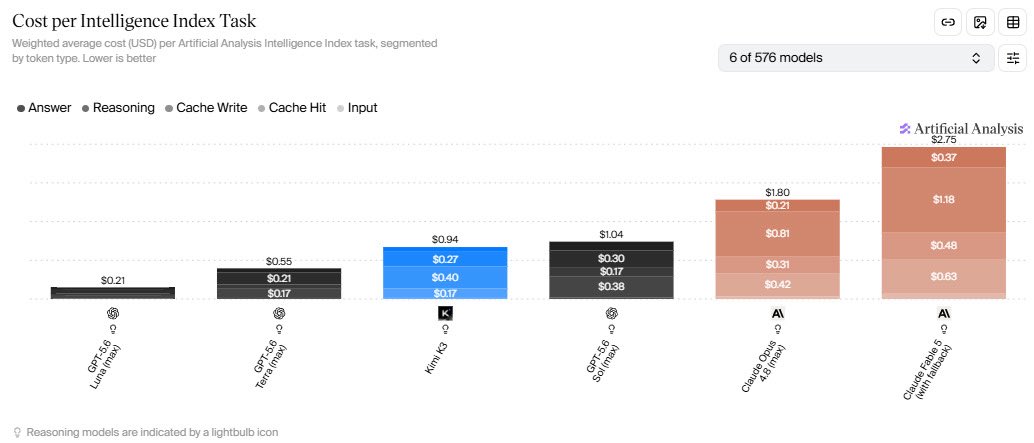
Kimi K3 may be an important inflection point for AI. Potentially negative for Anthropic and OpenAI while being net positive for essentially every other company in the world. I mean that very literally. Although the real “Sputnik moment” would be an open-source frontier model that was also token efficient unlike Kimi K3 which is 50-70% more expensive to run than GPT 5.6 per Artificial Analysis.
Rationale:
A world where there are only 2-3 dominant frontier labs with 90% inference margins is net negative for every other layer while being awesome for those 2-3 labs. Those labs would become monopsonies for power, data centers, semiconductors and hyperscalers and would obviously vertically integrate over time into all those layers while also completely subsuming the application/software layers.
Anything that lowers margins and increases competition at the model layer is good for every other AI layer: power, semiconductors, hyperscalers, neoclouds and yes even software.
This is why Jensen is so supportive of open-source. An open-source model requires the *exact* same amount of compute to run as a closed frontier model of similar size and architecture. Kimi K3 is roughly the same price as GPT 5.6 Terra on a per token basis, which actually suggests that it is less computationally efficient as I am sure that GPT 5.6 is priced to a higher margin than K3. And given that K3 is a token wastrel, i.e. token inefficient, it is significantly more expensive per task than GPT 5.6 and Grok 4.5, which are much more token efficient. Cost per token and token efficiency (i.e. intelligence density per token) are the drivers of intelligence per unit of cost. The winning AI companies will be those that offer the most intelligence per $ over time.
Lower margin % at the model layer = more margin $ at every part of the infrastructure layer and is a godsend for software. This can happen either through open-source models like K3 at the frontier *or* having a vertically integrated model company like Meta, SpaceX or Google at the frontier. Both outcomes result in a lower margin % at the model layer as vertically integrated model companies don’t really care where the margin $ come from. This is why it was so painful for OpenAI and Anthropic when Google was right there with them from a model competitiveness perspective and why Grok 4.5 and Muse 1.1 were just as important as Kimi K3.
The reason Kimi K3 is only *potentially* negative for Anthropic and OpenAI is 1) the @ericvishria point that the Claude and ChatGPT products and harnesses may be more important than their models today and 2) the hypothesis that they have much more advanced model checkpoints internally that are already being used for RSI. In the latter scenario, reaching RSI even a few months ahead of other labs might be enough to cement a permanent lead.
Time will tell on both points. And likely fairly quickly.
Caveat would be that since Kimi K3 is not token efficient and thereby actually more expensive than ChatGPT 5.6, we may need to see a more token efficient open-source model at the frontier or see Grok 5/Composer 4/Muse 2 at multiple points on the Pareto frontier for this potential risk to Anthropic and OpenAI to play out. And I am sure they will both vertically integrate as quickly as possible while continuing the product/harness strength they have shown over the last 8 months.
Empires once drew borders and sank fleets over pepper and nutmeg (literally). Sugar was locked away like jewels, only a few could afford... The average pantry today holds more flavor than a medieval king could buy with a province. We inherited a wealth so total we season our food with it. That's a small glimpse of abundance. Sometimes you don't notice!
U.S. based humanoid robotics company @1x_tech has just unveiled their new tendon-driven robot hands with 25 degrees of freedom (DOF).
• Made in USA
• Tendon Drive Ratio: 5:1–15:1
• Wrist Dexterity: 3 DOF
• Backdrivability: Fully backdrivable
• Tactile Sensing: Pressure + location + slip
• Finger Force: Up to 45 N
• Wrist Torque: 17.75 Nm
• Position Accuracy: ±0.2 mm
• Waterproof Rating: IP68
• Reliability: >2 million cycles
"These hands are designed to do something fundamental: remove the hardware ceiling on what humanoid robots can actually do, and make data the only barrier to capabilities. By matching or surpassing human hands across the dimensions that matter, they ensure our AI models are no longer limited by dexterity. NEO can now perform virtually any task a human can do with their hands– with the precision, adaptability, and gentleness required for real-world environments."
New video from inside the BJ's building in Oakhurst, Jersey shows the extent of the damage caused by the building collapse and subsequent flooding.
There were 27 people inside the building at the time, and two were trapped by were able to free themselves, according to Ocean Township Police Chief Michael Sorrentino.