The elite security team at @LevelBlueCyber. Response & Investigations. Analysis & Testing. Research & Development. Follow for info on the latest threats.
Everyone has a cyberwarfare opinion, but we have the receipts. 📜
Our researchers analyzed 99 cyber incidents tied to active geopolitical conflicts and graded each one for evidence, attribution, and confirmed conflict linkage.
One finding stood out: some of the most widely repeated stories in cyberwarfare remain exactly that...stories. 🤐
That's why the report includes a dedicated appendix of 16 conflict-related cyber claims that have been amplified across media and industry circles without sufficient evidence to prove them.
Separate fact from fiction with help from our research. 🔎⤵️
https://t.co/nx4uuqBFBG
From the @PGA Championship to the Ryder Cup, events of this scale require teams working behind the scenes to manage risk, protect data, and stay ahead of emerging threats. 🛡️
We're proud to serve as the Official Cybersecurity Provider of the @PGA. ⛳
https://t.co/GMHEsr4fFq
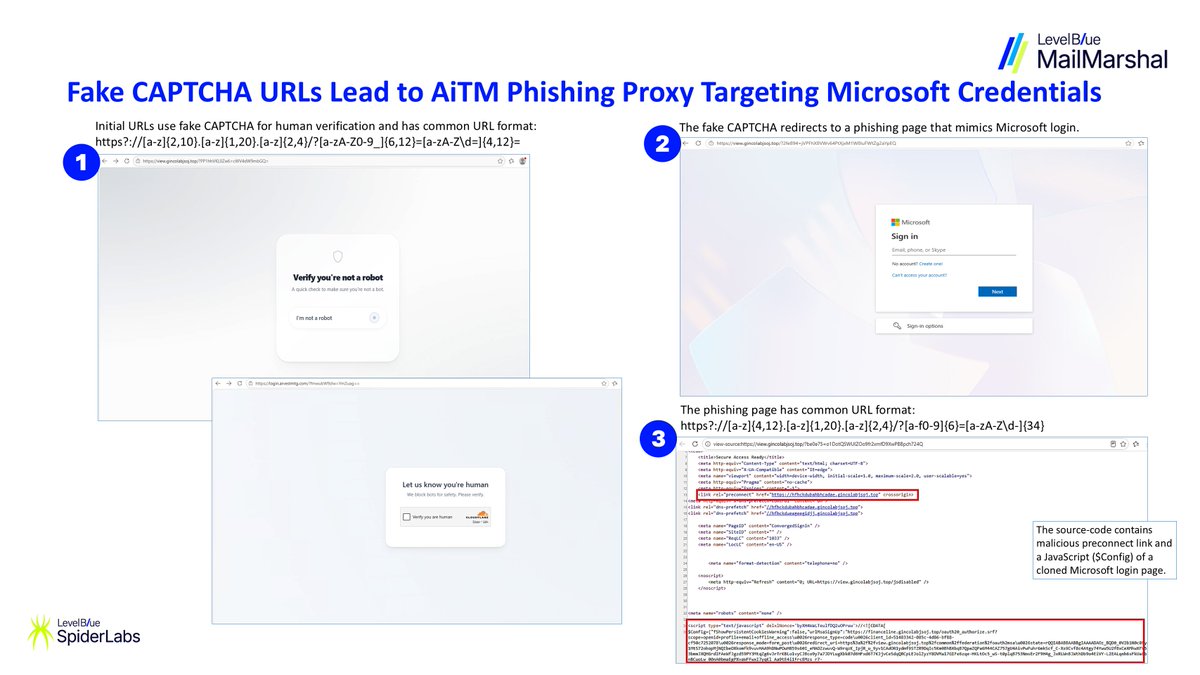
🪝🚨 Another day another #PhishingAlert: A lot of phishing URLs observed on VirusTotal use fake CAPTCHA as the initial URL or as a redirector to a phishing page targeting Microsoft 365.
The initial and final URLs in these attacks share a common structure and often use uncommon top-level domains such as .top and .sbs.
The landing page source contains JavaScript ($Config) copied from a cloned Microsoft login page, and it references a phishing domain. The URL path in the source-code includes "scope=openid+profile+email+offline_access", which requests a refresh token. If the victim signs in, the adversary-in-the-middle (AiTM) phishing kit steals that refresh token.
IoCs:
hxxps[:]//view[.]gincolabjsoj[.]top/?PP1hhVKL0Zw6=cWV4dW9mbGQ=
hxxps[:]//validate[.]accessprojecthome[.]casa/?M7MsoOH1oZM=d3B1dw==
hxxps[:]//app[.]subteratech[.]com/?O58jwndk_gSuaQ=aHRocG5iaw==
hxxps[:]//login[.]arvestmtg[.]com/?fmwubW9zIw=YmZuag==
hxxps[:]//service[.]detilplace[.]sbs/?BJPc_9xjMcg=Z3NqZXNrZm0=
hxxps[:]//view[.]gincolabjsoj[.]top/?be0e75=o1DotQSWUIZOo9fr2xmfD9XwPBBpch724Q
hxxps[:]//login[.]arvestmtg[.]com/?a64e29=wIZX-9mnUoJ0KgvWLXPkHHlXUtLLcVL1dg
hxxps[:]//validate[.]accessprojecthome[.]casa/?77a002=RhLRHK1r1UxRwsYRId9E0m5odP4ssLxdwQ
#MailMarshal #Phishing #LevelBlue #Microsoft365
🪝🚨#PhishingAlert: #MailMarshal detected an active hiring-themed #phishing campaign that impersonates the background-screening provider HireRight and abuses #Calendly to deliver #ScreenConnect.
The email links to an attacker-created Calendly routing form with a fake document-review button, such as 'View Document' or 'View Proposal'. Clicking it submits a Calendly Form Builder request that returns an 'arbitrary_url' result pointing to a ScreenConnect MSI installer. The browser then downloads the MSI from the attacker-controlled ScreenConnect instance, and running it gives the attacker remote access to the device.
IOCs:
Example abused Calendly URLs:
hxxps[://]calendly[.]com/d/dt89-7hh-5ww
hxxps[://]calendly[.]com/d/dvcz-23t-bf6
hxxps[://]calendly[.]com/d/d4jf-gpc-ddy
ScreenConnect instance payload URL:
hxxps[://]treffert[.]screenconnect[.]com/Bin/ScreenConnect[.]ClientSetup[.]msi?e=Access&y=Guest
#RMM #IOC #cybersecurity #spiderlabs
🪝🚨Phishing Alert:
Recently, we have observed many phishing URLs on VirusTotal that abuse AWS Lambda Function URLs.
These URLs follow this format:
https://{generated 32-character identifier}.lambda-url.{aws region}.on.aws/?{tracking parameter}={victim's email address}
Lambda Function URLs provide a simple, direct HTTP endpoint for a Lambda event function. Attackers use the Lambda URL as the initial page, which mimics a OneDrive page and shows a pop-up message box. Clicking the pop-up redirects the victim to a fake security check. Then, it leads to a final landing page that imitates a Microsoft login page and uses an adversary-in-the-middle (AiTM) phishing technique.
IoCs:
hxxps://cjoxgdvexb6wyhih45rmzgeram0vijbb[.]lambda-url[.]us-east-1[.]on[.]aws/?meeting=pmvgedxroe={victim's email address}
hxxps://api-63nkaf68d[.]berimazinjagentleman[.]sbs/
hxxps://berimazinjagentleman[.]sbs/common?key=63nkaf68d
#MailMarshal #Phishing #LevelBlue
Ransomware has dominated conversations for years.
But over this past quarter, we saw the pressure point shifting. 🔃
Across @LevelBlueCyber incident response engagements, data exfiltration appeared in more network and cloud intrusion cases than encryption, indicating that stolen data is becoming a faster route to extortion.
The numbers from Q3:
📊 BEC accounted for 32% of incidents
📊 Network intrusion accounted for 22%
📊 Ransomware accounted for 20%
More attackers are finding they don’t need encryption to create leverage.
Our Q3 TTP Briefing breaks down what we observed across real-world investigations worldwide. 🔎🌎
View the recap below:
https://t.co/tk1tsGglkM
🚨 New research: Our team is tracking #Wazza, a multi-stage device code phishing kit targeting #Microsoft 365 accounts. Active since at least July 2026.
Victims receive PDF lures and are routed through a phishing chain using staging and redirector links, Cloudflare Workers and attacker-controlled domains. The kit uses filtering and decoy pages to steer targets to the final device code page. Final pages seen so far impersonate #Adobe, #DocuSign, and #Microsoft services and abuse Microsoft OAuth device authorization.
Read our full analysis: https://t.co/JakHnwh6QA
🚨 #MalwareAlert: A fake bank payment receipt MSI installs a LuaJIT runtime alongside a Lua script disguised as a font. The decoded Lua runs Donut shellcode in memory, which carries Agent Tesla infostealer set for FTP exfiltration.
#IoCs: ADCB_Bank_Payment_Transfer_Receipt pdf.msi 14f920e611772134999e437c05956970aa4ac8e1a07ba65568e7c24d5b641390 LuaJIT runtime (MainExeFile) 52f0c0230b580e2fdf53a378b5c6d0db9829af900dae43e0df8f18635cd9f0c1 Disguised Lua (ScriptFile) bbc8388371a9a41079191d88893e4599964c6b6246d97953de5c94033b19f900 Raw Donut shellcode 11ca4a2f90b53a58477bf86d565f73e0ada6846a8bab7ff110ffedc4ee8b85be Recovered Agent Tesla EXE ddc85ad4885dd3da9ac8de4c3bc0392c0b2ccee075b79c8564ba71394d5b7aa6
FTP exfiltration host: ftp[.]fundacionpiaz[.]org
#MailMarshal #cybersecurity
🔱 We observed active exploitation attempts targeting Citrix NetScaler appliances affected by CVE-2026-88771, including activity progressing beyond basic command-execution testing.
The vulnerability allows unauthenticated attackers to inject commands through attacker-controlled authentication data that is later processed by a privileged NetScaler component, potentially resulting in command execution.
🕷️ @LevelBlueCyber THOR identified malicious authentication events containing command-injection payloads across multiple customer environments.
🕷️ Observed activity included payload retrieval, NetScaler configuration collection and staging, reverse-shell deployment, and attempted configuration exfiltration.
🕷️ Analysis of https://t.co/tCTMhEw7Vi identified a second-stage payload designed to overwrite customsnmpd and establish a reverse shell to attacker-controlled infrastructure.
🕷️ A separate Perl payload, update_c08937.pl, creates a privileged sec_monitor account, collects NetScaler configuration data, and deploys a PHP web shell.
🕷️ Our analysis includes observed IOCs and behavioral detection opportunities defenders can use to identify exploitation and post-exploitation activity.
Full analysis: https://t.co/PL6Jer3Hqo
🔱 We observed active exploitation attempts targeting Citrix NetScaler appliances affected by CVE-2026-88771, including activity progressing beyond basic command-execution testing.
The vulnerability allows unauthenticated attackers to inject commands through attacker-controlled authentication data that is later processed by a privileged NetScaler component, potentially resulting in command execution.
🕷️ @LevelBlueCyber THOR identified malicious authentication events containing command-injection payloads across multiple customer environments.
🕷️ Observed activity included payload retrieval, NetScaler configuration collection and staging, reverse-shell deployment, and attempted configuration exfiltration.
🕷️ Analysis of https://t.co/tCTMhEw7Vi identified a second-stage payload designed to overwrite customsnmpd and establish a reverse shell to attacker-controlled infrastructure.
🕷️ A separate Perl payload, update_c08937.pl, creates a privileged sec_monitor account, collects NetScaler configuration data, and deploys a PHP web shell.
🕷️ Our analysis includes observed IOCs and behavioral detection opportunities defenders can use to identify exploitation and post-exploitation activity.
Full analysis: https://t.co/PL6Jer3Hqo
Noise is everywhere. Signal is rare. 🎯
#SpiderLabs focuses on what actually matters so your team can move faster with fewer distractions. 🕷️
Take a closer look at how that kind of visibility shows up in the real world:
https://t.co/ppyzCFzUt3
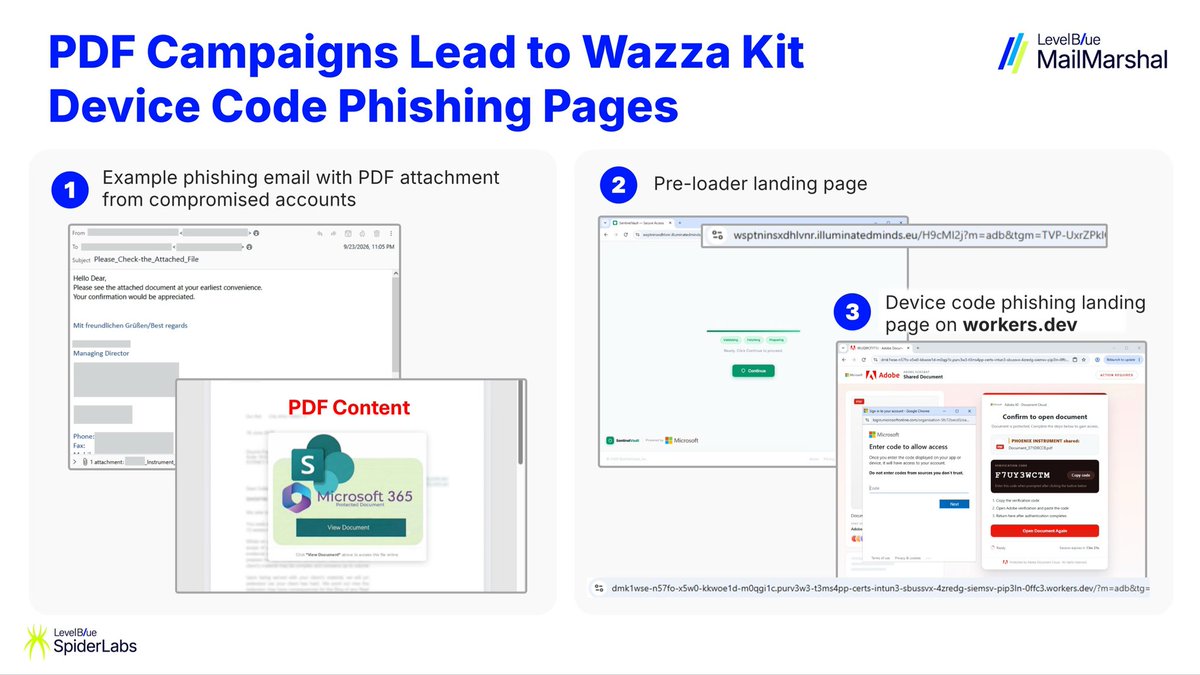
🪝 We are observing active PDF #phishing campaigns impersonating #Adobe and #Microsoft that redirect victims to #Wazza Kit device code phishing pages hosted on https://t.co/CHDeYp0J6n.
- #MailMarshal detected phishing emails from compromised accounts containing PDF attachments with document-themed lures
- The broader campaign leverages Google Sites (https://t.co/Vh1HaUH8bz), Cloudflare Workers (https://t.co/CHDeYp0J6n), and .eu Top Level Domains to host phishing content and related infrastructure
- Wazza kit supports 19 themes via the ‘?thm=‘ URL parameter across six lure categories: file-sharing, account, document, payment, HR, cloud and brand impersonation.
- The kit validates URL patterns, including subdomain and slug checks, to selectively serve phishing content and redirect non-targets to decoy pages.
#IOCs:
beacon-surge-sync[.]workers[.]dev
beton-beton[.]eu
bike-msca[.]eu
bodi-project[.]eu
bruoth-family[.]eu
cardamomo[.]eu
coppietersrecherche[.]eu
diabetesnet[.]eu
dymowski[.]eu
euniverza[.]eu
hutspotmaken[.]eu
illuminatedminds[.]eu
jetcapital[.]eu
languagesforwork[.]eu
lesbolides[.]eu
mdiament[.]eu
nbi-training[.]eu
nellarmonia[.]eu
originalpizza[.]eu
polskaprezydencjacsr[.]eu
robologic[.]eu
safetystock[.]eu
electroloys[.]com
hacsg[.]com
sites[.]google[.]com/view/hgfdsqazxcvhjoswwqq/home
sites[.]google[.]com/view/adobe-docus/home
sites[.]google[.]com/view/miticabo/home
sites[.]google[.]com/view/ctfvygbuhgyftvbgyfpoiuytrftgyh/home
sites[.]google[.]com/view/kjvcfdswqazxcfvghjoplkjmnbvcf/home
sites[.]google[.]com/view/securespdf/home
sites[.]google[.]com/view/onwajuly/home
dv0psh-purv3w-azfn-b2c0-msauth3-m365svc-s3ntln-4zrfn3x-cntnrx[.]workers[.]dev
ssosvc-m365s-kvl-dv0pshb-s3ntln-c0mply-4zrmonx-apimgwx-evnthb[.]workers[.]dev
wndws-pip3ln-sql3-waf3-purv3-gdprsx-dfn-azfn-appsvc-0ffapx[.]workers[.]dev
purv3w3-t3ms4pp-certs-intun3-sbussvx-4zredg-siemsv-pip3ln-0ffc3[.]workers[.]dev
Some vulnerabilities patch. Some vulnerabilities keep sending follow-up emails.
Just days after Microsoft's September Patch Tuesday, Nightmare-Eclipse dropped ShieldCrash, the latest chapter in a Defender bypass lineage we've been tracking through RoguePlanet and ShieldBreak.
3️⃣ PoCs.
2️⃣ patches.
1️⃣ underlying mechanism that's proven remarkably difficult to evict.
Our testing found the public release is more "skeleton" than fully weaponized exploit, but buried in the artifacts, telemetry, and object-manager activity is a bigger lesson for defenders: understanding how a technique survives remediation often matters as much as understanding the vulnerability itself.
https://t.co/2vqyoOfCuM
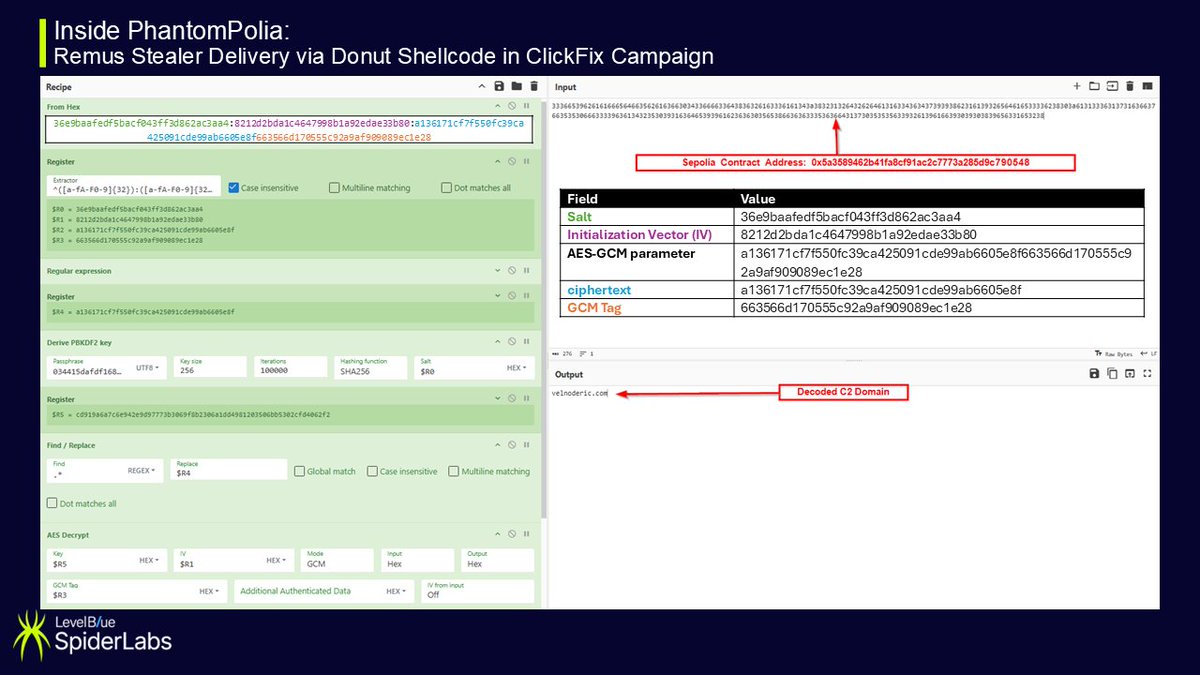
@LevelBlueCyber#OpsIntel recently identified a new campaign exploiting trusted Electron applications. Victims were lured into executing a JavaScript file that silently downloaded a MSI installer containing a tampered #Exodus Wallet.
The MSI contains a modified #ASAR (Atom Shell Archive), a custom archive format designed specifically for #Electron applications to bundle application resources.
The initial payload is an encrypted PE loader that can be decrypted using AES-256-CBC. Once decrypted, the loader reflectively loads the RAT payload directly into memory.
🧐 IOC:
hXXp://35.212.159[.]20/setup2026.msi
e9e5b8e5aa3bf03eca0bda9d1c08f11a70e4d03bbd9e8ac27b2cc7de4f4000c2 (setup2026.msi)
a4e1513e58a5b70389a08714d97c4eb2e22f052856c1471d068451451bfe7840 (exodus_patch.js)
15836a5ab798a5955be566c0322aa9a4140662b91cdda60714ffbe5e57bfcb43 (keystorage.js)
8fa059c30b75233d1e2d1f9b289c899a112a9964a216f0ebc35514ace152a23a (index.js)
eb2d09773e5cb6eecad4bf14ed05b0c885465610a354ea0c9665ffcf56aced18 (app.asar)
56ec5bfb62e9b615b8bb949a76e1d4f6bb3f34983139f0c48cfc73b350961f1c (decrypted buffer)
https://t.co/9q6Qn4Ta7C[.]net
🔎AES-256-CBC parameters:
Key: KlABCwCvW5oplWMsSxjTlKb0o+iOK6OsxCGZZ0td/1U=
IV: 4b44GYeQwOVmpFKlbWdPVw==
Our researchers recently found a 7-stage exploit chain that abuses Cloud Files, Windows Object Manager namespaces, Defender remediation and Windows Error Reporting to escalate from a standard user to SYSTEM on fully patched Windows systems.
https://t.co/7NiRQg70wk
A ClickFix case brought our team down a BabaDeda chain that led to an undocumented end: CNCMachineRMS, a 1.14 MB RAT with zero imports, every string built on the stack, and its own scripting language.
The full research + PDF report below. ⤵️
https://t.co/fUoh0ZoT3a