Hi #EconTwitter! 📈
Interested in applications of #DataScience, #MachineLearning, #BigData analytics (and more) to #Economics and #Finance? 📚
If you haven't downloaded it yet, get this free book, full of accessible and inspiring contributions to this field!
Link: https://t.co/OHygSuw5md
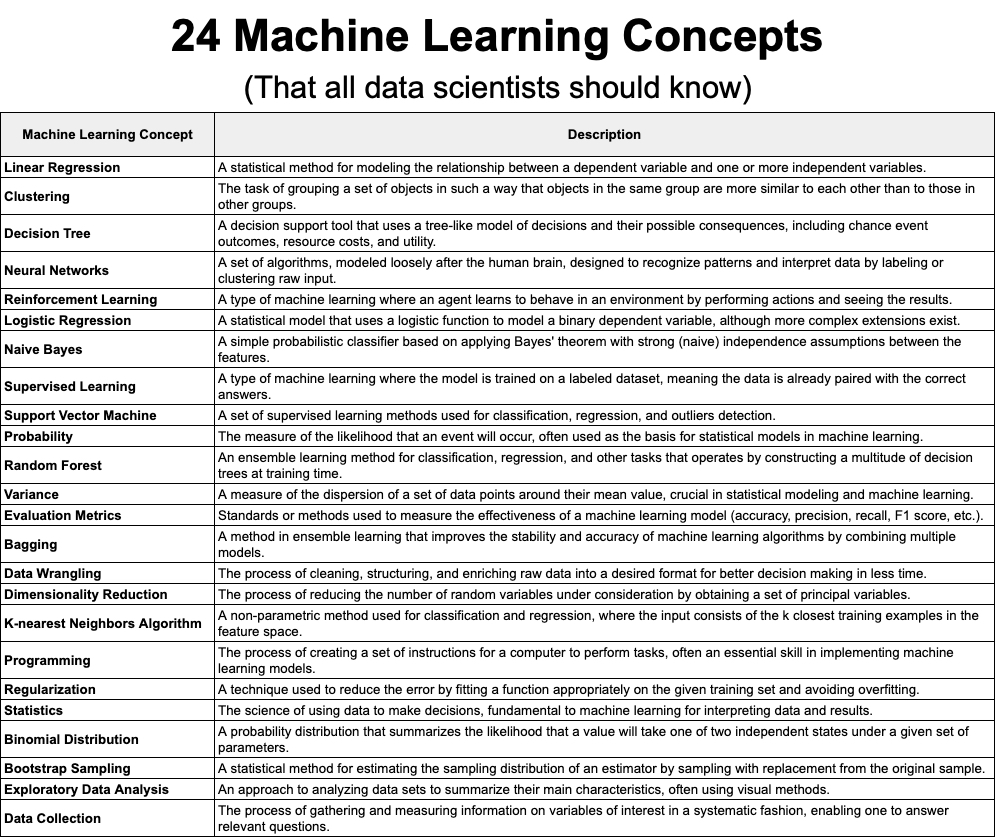
It took me 10 years to master all 24 of these statistics concepts. In the next 24 days, I'll teach them to you one by one (with examples of how I've used them in business cases). Here's what's coming:
1. Probability Distribution
2. Regression
3. Hypothesis Testing
4. Central Tendency
5. Bayesian Statistics
6. Descriptive Statistics
7. Distribution
8. Sampling
9. Confidence Interval
10. Correlation
11. Covariance
12. Dimensionality Reduction
13. Central Limit Theorem
14. Normal Distribution
15. Population and Sample
16. Skewness
17. Variance
18. Data Types
19. Probability
20. Conditional Probability
21. P Values and Level of Significance
22. Variability
23. Over and Under-Sampling
24. Estimation
There you have it- my top 24 concepts on statistics that all data scientists need to know. The next problem you'll face is how to apply data science to business.
I'd like to help.
I’ve spent 100 hours consolidating my learnings into a free 5-day course, How to Solve Business Problems with Data Science. It comes with:
300+ lines of R and Python code
5 bonus trainings
2 systematic frameworks
1 complete roadmap to avoid mistakes and start solving business problems with data science, TODAY.
👉 Here it is for free: https://t.co/YXG4pL97ZN
Large Language Models (LLMs), the engines behind the likes of Chat GPT, are capable (and incapable) of many things. But are they useful for mathematicians?
@JSEllenberg has been working on LLMs with @GoogleDeepMind. Here are his thoughts.
Full lecture:
https://t.co/2X8nvZZ2WZ
Are you a mathematicians? Are you interested in physics? It happened that a super team made out of Pierre Deligne, David Kazhdan, Edward Witten and more, collaborated to create this text on QFT and strings aimed at mathematicians.
Deligne has a whole chapter on spinors. 👀👀
Data scientist Vlad Patryshev, at Lambdaconf, has got a great primer on model theory, where the distinction between theories and models is explained in simple terms.
Short and sweet.
https://t.co/vypgyBwssn
''A bridge in between mathematicians and physicists''
This series (in 6 thick volumes) gives you every single tools you need to make your next step in your understanding of QFT and physics in general.
It's literally all there. 🫡
xv6 is amazing, my new hobby is studying everything about xv6. Awesome! The best! Now I have changed the linker script and pages, so that we really keep kernel text, read-only data, data, and bss in separate pages with the corresponding attributes. Writing access to read-only data generates an exception. Very cool, and the best part is running on KianV RV32IMA Linux xv6 RISC-V SoC.
My book Interpretable Machine Learning has been career-defining.
Even though the book is available on the web for free, many have supported me by buying the ebook or paperback, which ultimately helped me become a full-time writer.
I'm grateful for all your support 🙏
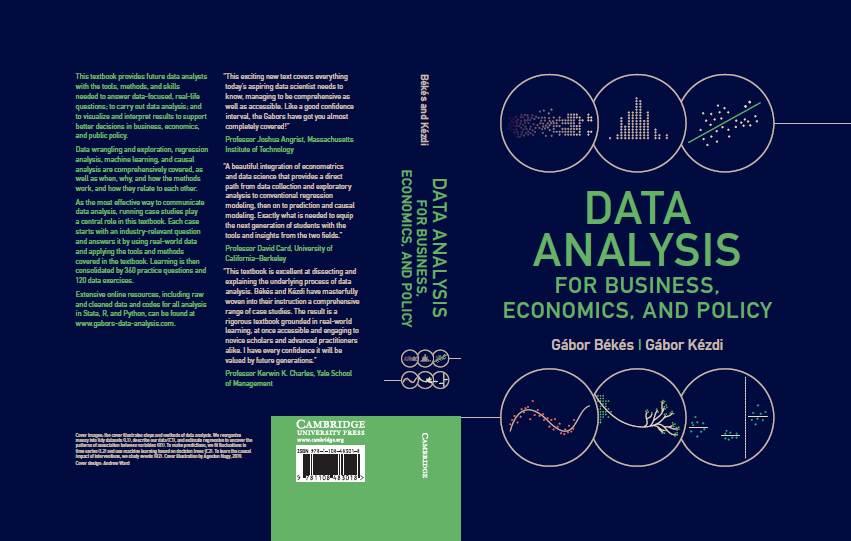
Hi #EconTwitter! 📈
Are you into #econometrics and data analysis? And looking for an amazing set of slides on the topic?
Don't miss 👇 @GaborBekes's collection of slides from his book on data analysis. 📚
Very well-crafted and clear, they cover a lot of material.
Cool stuff! ⭐️
Links
Slides: https://t.co/R17mB2Hztg
Code etc: https://t.co/jqDJ1K3cQp