“We are using our own hands to clean the poison people throw away.
But slowly, people began joining us too.
Members from Ashok Vihar, including Vikas Khari ji, Samay Singh ji, Dr Mudita ji and Dr Sunil Kumar Mishra ji, supported the campaign. The principal of Lakshmibai College also came to join us.
And sometimes, one sentence from a child makes everything worth it.
“Bhaiya, my lane is clean today. Maa is happy.”
That is the biggest emotional reward.
Since 1 September 2018, we have worked every Sunday, without stopping.
More than 1,600 children and young people have joined us, with 350 active volunteers.
We have cleaned dozens of parks, hundreds of lanes, the Yamuna banks, and now several ghats along a 3-km stretch of the Munak Canal.
And we don’t just remove waste.
We plant trees too, and look after the saplings for three months.
Over the years, we have removed thousands of tonnes of garbage, debris and plastic.
In just the last two Munak Canal drives, 50 metric tonnes of waste was removed, a figure also recorded in MCD’s official records.
And there is a bigger dream.
I want to build a school for 1,500 children, where they learn to become protectors of the environment.” – Vinay Das
Know someone who is doing their bit for their community? Tag them below.
#CivicSense #MunakCanal #Delhi #CleanIndia #CommunityAction
[Munak Canal cleanup, Vinay Das, civic sense, Delhi volunteers, environmental activists, community cleanup, waste management, youth volunteers, cleanliness drive]
Thstory of Parvati creating Ganesha to stop Shiva from entering her inner quarters, isn't a real incident but arthavAda with some inner meanings.
Let me explain those meanings here, since so many find the incident superficially strange or absurd. Our rishis never write in vain+
Dans son livre « La Médiocratie » (Système de la médiocrité), le philosophe canadien Alain Deneault écrit :
« Les médiocres ont remporté la bataille de notre époque. Le temps de la vérité et des valeurs a changé. Les médiocres se sont emparés de tout, avec leur médiocrité et leur corruption. Lorsque les valeurs et les principes élevés disparaissent, une corruption programmée des goûts, des mœurs et des valeurs remonte à la surface. C'est l'ère de la décadence. »
« Plus une personne s'enfonce dans la vulgarité, la superficialité et l'abaissement, plus elle gagne en popularité et en notoriété. »
Alain Deneault ajoute :
« Les réseaux sociaux ont largement contribué à promouvoir la médiocrité. Ils permettent à une belle personne dénuée de profondeur ou à un individu séduisant mais vide de contenu de s'imposer auprès du public, grâce à diverses plateformes médiatiques, dont beaucoup sont superficielles et peu productives, incapables d'offrir un contenu porteur de valeurs susceptibles de résister à l'épreuve du temps. »
Shaolin Master Shi Heng Yi dropping ancient wisdom:
Watch your thoughts → they become words.
Words → actions.
Actions → habits.
Habits → character.
Character → destiny.
Everything starts with your thoughts. Energy follows intention. Are you even aware of what you’re thinking?
What’s your take, how much control do you think we really have over our thoughts?
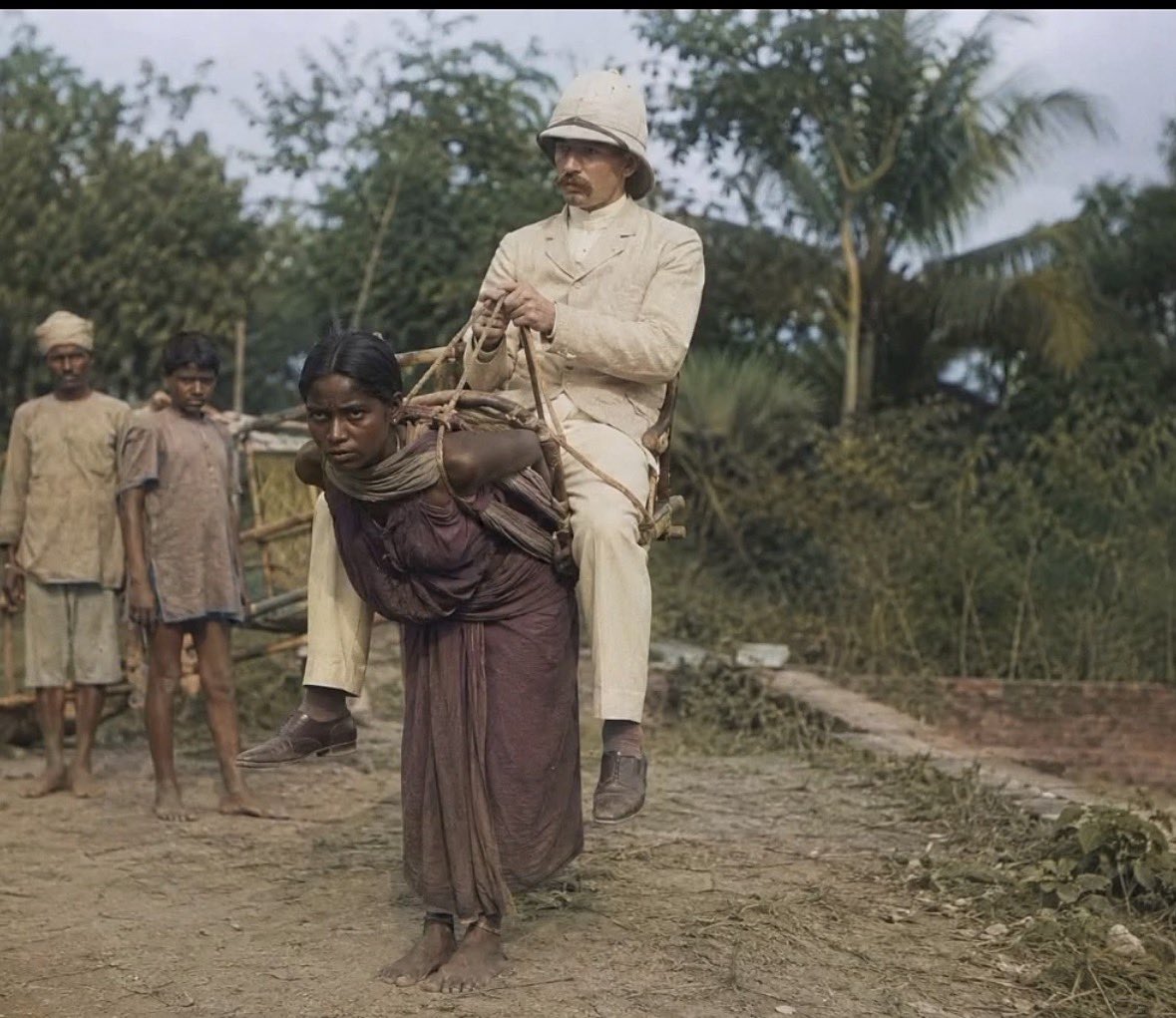
A Bengali woman carrying a British merchant on her back…
📸 This photo was taken in 1903, at the height of British colonialism in the Indian subcontinent. This isn't just a picture…
it's a slap in the face to all those who sing the praises of "Western civilization." This is the true face of colonialism, which they still try to beautify in history books.
It's slavery and the humiliation of human beings, the crushing of human dignity, simply because they don't belong to the white race! And then they ask you about terrorism…
The history of Western colonialism is full of massacres, slavery, plunder, and starvation… But they reduce terrorism to oppressed peoples struggling for their dignity! 🩸
The effects of what British colonialism did in India—the killing, starvation, plunder, and contempt for humanity—are still evident today. Millions
were killed, wealth was stolen, and generations were displaced… all under the banner of a false "enlightenment"!
During Dutch colonial rule in Indonesia, many laborers were bound by systems of indenture that closely resembled coercive labor, especially on plantations producing sugar, tobacco, and rubber.
Workers were often recruited under contracts that limited their freedom, imposed harsh working conditions, and tied them to employers through debt and strict regulations. A key mechanism of control was the penal sanction (Dutch: poenale sanctie), which allowed employers to punish laborers who were deemed to have misbehaved, such as by leaving work, refusing orders, or breaking contracts, through fines, imprisonment, or forced labor, effectively criminalizing resistance.
In colonial records, these workers were frequently referred to as “coolies” (indentured laborers), a derogatory colonial term used to racialize and dehumanize Asian workers while normalizing their exploitation.
Today, historians critically reassess both the labor system and the language used to describe it, emphasizing the inequality and coercion that defined this period.
Opendoor shutting its India office is terrible news for India, and almost nobody is pricing it in.
India's tech and outsourcing industry generates $315 billion a year, employs nearly 6 million people, and accounts for roughly 7% of GDP. Entire cities were built on one trade: Western companies paying Indian wages for process work instead of American wages.
Opendoor just showed exactly how AI unwinds that trade.
Here's the mechanism. Companies never offshored because they loved managing teams 12 time zones away. They offshored because their software was broken. Opendoor's 250-person India team existed to handle manual workflows across fragmented systems. Humans as glue between tools that couldn't talk to each other.
Then Kaz unified the systems and mandated AI by default. Headcount per transaction dropped from 11 to 1. Acquisition velocity rose 4.2x in seven months. The glue work vanished, and with it, the entire economic case for the offshore team. The stock rose 8% on the news.
Now run that logic across every Fortune 500 back office. Claims processing, invoice reconciliation, tier-1 support, document review. The exact task profile India industrialized is the exact task profile AI automates best: repetitive, digital, rules-based, no physical presence required.
The wage arbitrage was $60K American vs $8K Indian. AI does the same work for $400 of inference. No salary can undercut that.
The jobs that survive are the ones near the customer. Those are in America by definition. India built a $300 billion industry exporting the one category of work AI eats first.
Nalanda University , the renowned ancient Mahavihara in Bihar, India, was destroyed by fire around 1193-1200 CE, an event largely attributed to Turkic invader Bakhtiyar Khilji. The destruction occurred during Khilji's military campaigns in the region, aimed at consolidating power. The assault saw the university's massive library, known as Dharmaganja (comprising three large multi-story buildings named Ratnasagara, Ratnodadhi, and Ratnaranjaka), set ablaze.
Reports, including those referencing the Persian historian Minhaj-i-Siraj in Tabaqat-i Nasiri, suggest the library housed millions of precious manuscripts covering philosophy, astronomy, medicine, and Buddhist studies. The library reportedly burned for several months, with thick smoke hanging over the region for days, destroying irreplaceable knowledge.
Alongside the library, monks and scholars were massacred, and the monastery buildings were demolished, dealing a massive blow to Buddhist education in India.
While this was not the first time Nalanda faced destruction-earlier damages occurred in the 5th and 7th centuries - the late 12th-century invasion resulted in its final, irreversible decline, turning the flourishing international intellectual hub into ruins.
The site remained largely forgotten until its excavation.
🔥World War 1: when "Hindous" died for Europeans
... and got scammed
Vive Angleteere! Vivent Hindous! Vivent les Allies!
– French crowds, Marseilles, Sept 1914
Over 1 million Indians left families to fight for Europeans. Many never returned. A 🧵 on Indian sacrifices — and how India got scammed.
🔥When and Why did Indians get Involved?
1⃣July 1914: WW1 start. Aug 1944: Britain declared war on Germany. Troop mobilization started immediately in India. Boarded ships 4-8 week sea journey.
2⃣Sept 1914: the first Indian troops reached Marseilles (FR). Sent straight to the front lines. Among the earliest to die in large numbers in WW1.
3⃣British propaganda told them to fight for “their country,” for “dharma,” and for a better future. Posters repeated these messages until the war ended.
4⃣There is no record that the British ever told Indian soldiers or their families the true nature of the war — or who would actually benefit.
5⃣After the war, the same British told Indian and Nepalese soldiers: “Go back home to your own country. You don’t belong here.”
6⃣The mobilization was massive and widespread — from Assam and Bengal to Punjab, United Provinces, and Madras. It lasted from 1914 to 1918. More Indians served in WW1 than today's active+reserve military of France + UK.
7⃣Between 1914 and 1918, ~1.1 to 1.5 million Indians served outside India in Europe, the Middle East, and Africa. Inside India, the war effort directly and indirectly touched 10 to 37 million people. Nepalese Gurkhas and others also fought alongside them.
🔥Who Paid for All This?
India paid. Not Britain.
1⃣From August 1914 onward, the Indian exchequer covered the cost of sea voyages, salaries, food, clothing, and daily maintenance.
2⃣India also paid for wounded soldiers, pensions, and family support.
3⃣Indian grains and supplies were shipped to Europe, causing scarcity and inflation back home. Taxes were raised across the country.
4⃣Britain only covered “extraordinary” expenses — such as machine guns, grenades, and winter gear issued after arrival in Europe. Even these costs were a small fraction (under 10%) of what India paid.
5⃣In 1917, Britain was running out of money. They pressured an already strained India to give more “to save freedom and justice.”
6⃣The British colonial government announced a £100 million “gift” to Britain. The British needed more. So propaganda urged Indians to buy War Bonds — appealing to emotion, dharma, loyalty, and the safety of Indian soldiers overseas.
👉Total WW1 financial cost to India — adjusted to 2026 US dollars: approximately $23–28 billion.
🔥The Offers!
The British used every tool to recruit Indians.
1⃣They promised land parcels in India to peasant families who sent their sons to the front. Recruitment ads offered sign up bonus, salary, pension, and other benefits to the soldier and his family.
2⃣To the elites — zamindars, nawabs, local politicians — they gave recruitment quota plus cash rewards, robes of honour, titles, and more government land if they met recruitment quota. These bribes worked powerfully.
3⃣The British combined propaganda posters, paid recruitment agents, and social pressure. Over 90% of those who signed up and went overseas were illiterate and came from poor families. They believed the promises of life-changing money for their loved ones back home.
🔥Fog of War: Truth is the First Casualty
The British allowed soldiers to exchange letters with their families in India.
👉But every letter was secretly intercepted and censored by the British authorities!
1⃣Most soldiers were illiterate, so comrades wrote their letters for them.
2⃣In Indian villages, families used local scribes.
3⃣No matter who wrote them, all letters passed through British censors.
4⃣The colonial rulers feared the truth. News of the horror, mud, gas, and heavy losses could stop fresh recruitment. It could also spark rebellion back in India.
5⃣Any letter describing real conditions at the front was suppressed.
6⃣Thousands of these censored letters were finally released nearly a century later. They tell of anxiety and pain in Indian villages, true brutality of WW1 frontlines.
🔥Did the colonial era British scam the Indians?
A scam is a deceptive scheme that cheats people out of something valuable through lies and false promises.
1⃣The British told Indians to fight for “their country.”
Reality: The battlefields of France and Flanders were not their country. After the war, they were ordered to leave Europe: "Go back home, to your own country, you don't belong here".
2⃣The campaign used urgency and emotional appeals to extract money and lives.
3⃣Zero lasting benefit came to India or the families left behind. Many soldiers died or were crippled.
4⃣The war loans were deferred, not paid by the UK. The war bonds raised in India were largely repaid by Indian taxpayers themselves.
🔥Other notes
1⃣Indian soldiers had no citizenship rights in Britain or France.
2⃣They lived in segregated camps. Except for occasional photo-ops, they were barred from social mixing with Europeans.
3⃣They received far lower pay than British soldiers for the same dangers and same work.
4⃣The British and French textbooks suppressed the role of Indians in saving "Western civilization" during WW1. Occasional footnotes and passing remarks spin the narrative to “loyal sepoys”, "demonstrated their loyalty and bravery", but in India that is not how they recruited Indians for their war.
5⃣After the war, instead of gratitude, democracy and freedom, India received the repressive Rowlatt Act that intensified colonial abuses by the British govt.
India gave everything to help Europe.
It received almost nothing in return.
---
Sources:
- Kaushik Roy, Indian Army and the First World War
- Ian Cardozo, The Bravest of the Brave
- S Das, India, Empire, and First World War Culture
- Morton-Jack, The Indian Army on the Western Front
- Official records including Hansard (UK Parliament)
Idol worship
The accusation of “idol worship” misunderstands Hindu mūrti traditions so fundamentally that it reveals more about the limitations of the critic’s metaphysics than about Hinduism itself.
The criticism assumes a very primitive model:
that Hindus believe a stone statue is literally “God” in the simplistic sense of a magical object.
But that is not what the sophisticated Hindu traditions teach at all.
A Hindu mūrti functions more like:
a consciousness interface,
a symbolic–metaphysical architecture,
or a structured resonance model built according to Ṛta — cosmic coherence.
The closest modern analogy is actually an architectural model or mathematical diagram.
An architectural model is not “worshipping cardboard.”
A national flag is not “worshipping cloth.”
A cross is not “worshipping wood.”
A mathematical equation is not “worshipping chalk marks.”
The form acts as an interface into deeper meaning.
The Hindu mūrti works the same way — but at far greater symbolic and metaphysical sophistication.
Its proportions are traditionally constructed through:
Śilpa Śāstra,
Āgama,
Vāstu,
Tantra,
astronomical alignment,
sacred geometry,
mantra,
and recursive symbolic proportion systems.
Why?
Because Hindu civilization understood that consciousness responds to ordered form, rhythm, geometry, sound, and symbolic coherence.
The mūrti is therefore not arbitrary art.
It is consciousness architecture.
Every ratio matters:
eye geometry,
limb proportions,
mudrā orientation,
symmetry,
axis,
cakra alignment,
vāhana symbolism,
temple positioning,
and spatial relation.
These are not random mythological decorations.
They are attempts to embody Ṛta —
the lawful coherence underlying manifestation itself.
More importantly, Hindu civilization recognized that human beings exist at radically different levels of cognition and spiritual maturity.
So it created multiple entry points into truth:
story for the child,
devotion for the heart,
ritual for embodied participation,
philosophy for the intellect,
yoga for direct experience,
tantra for subtle energetics,
Advaita for non-dual realization.
The same mūrti reveals different depths to different minds.
This is why the “idol worship” critique collapses philosophically.
It mistakes symbolic participation for primitive literalism.
Ironically, Abrahamic traditions themselves rely heavily on symbolic mediation:
sacred architecture,
holy books,
crosses,
icons,
relics,
ritual orientation,
pilgrimage sites,
sacred sound,
and consecrated spaces.
The difference is that Hindu civilization openly developed symbolic consciousness technologies systematically instead of denying them while simultaneously using them.
Abhinavagupta’s framework explains the deeper logic precisely.
Śiva — pure consciousness —
manifests through Śakti into progressively articulated forms.
The mūrti is one such articulation:
a finite geometry designed to help finite minds approach the infinite gradually.
Not because the stone itself is “God,”
but because consciousness can recognize deeper reality through ordered manifestation.
The finite becomes a bridge toward the infinite.
That is radically different from naïve object worship.
In fact, it may represent one of the most sophisticated symbolic-metaphysical systems any civilization ever developed.
The tragedy is that critics often attack the outer form without understanding the inner philosophy at all.
Good and swift job by Singapore, as always, to prevent foreign interference creating issues between communities and creating hatred for Indians using social media.
This Modus Operandi by China and Pakistan to create hate against Indians and India in every country using social media has long been left unchallenged by India.
Even in this case, a small Singapore seems to have taken action ordering social media companies for the benefit of Indian community. We did not hear India taking action on its own.
The apathy on this by India for so long is costing India and Indians a lot. There's a requirement for a social media monitoring and rapid response cell that works with SM companies, various ministries, and embassies world wide.
The progressive modernist anchors in the last 3 centuries where the human mind and cognition was decoupled from material boundaries via tech.
The Dharmic traditionalist anchors on thousands of years of wisdom that recognizes limits and human fragility.
Western capitalists say there are no free lunches while printing money out of thin air.
Dharmic capitalists know that there are indeed no free lunches, that the world is a web of obligations and each one of them must be repaid for system sustenance - Rna.
The modern being is one dimensional genius.
Dharmic being is integral.
With respect, Sir, you are confusing Spiritual Mauna (internal silence of the ego) with Social Akarma (cowardice in the face of intellectual subversion).
The Shatapatha Brahmana (2.2.2.19) teaches us that Truth on earth is like a sacred fire, it does not survive on its own; it must be actively fed with fuel (Yajna). If we do not feed it data, the fire goes out.
Furthermore, the Nyaya Sutras of Sage Gautama explicitly list Ananubhashana (remaining silent when a false argument is presented in public) not as 'wealth,' but as a Nigrahasthana, an automatic point of defeat. By the laws of ancient Indian logic, if we are silent against a fabrication, we have legally conceded the debate.
When the elders of Kurukshetra sat in 'dignified, thoughtless silence' during the disrobing of Draupadi, they too thought they were playing a 'long test match' of patience. That passive silence did not protect the truth; it ensured the total annihilation of their civilization.
Truth does not fight digital algos on its own. We are the instruments of that truth. If we do not speak, the distortion becomes the default history for our grandchildren. Passivity is not Dharma.
At least from 1540 onwards, & in the island of Goa before that year, all the Hindu idols had been annihilated or had disappeared.
All the temples had been destroyed & their sites and building material was in most cases utilized to erect new Christian Churches & chapels.
Various viceregal & Church council decrees banished the Hindu priests from the Portuguese territories.
The public practices of Hindu rites including marriage rites, were banned.
The state took upon itself the task of bringing up Hindu orphan children.
The Hindus were denied certain employments, while the Christians were preferred.
It was ensured that the Hindus would not trouble those who became Christians.
On the contrary, the Hindus were obliged to assemble periodically in Churches to listen to preaching or to the refutation of their religion.
Source: Essays in Goan History by T. R. DeSouza
The Indian Ocean slave trade conducted by Arab merchants lasted twelve hundred years, moved an estimated seventeen million people from East Africa to Arabia, Persia, and India, castrated the majority of male slaves in transit, and has received less than one percent of the scholarly attention devoted to the Atlantic slave trade.
The Indian Ocean slave trade — conducted primarily by Arab, Persian, and Swahili Coast merchants from approximately the 7th century AD through the early 20th century — operated across a longer time span and involved comparable numbers of enslaved people to the Atlantic trade, yet occupies a fraction of the space in global historical consciousness, public discourse, and museum representation. The reasons for this asymmetry are themselves historically significant — the Atlantic trade's direct connection to the economic foundations of Western Europe and North America, the survival of large descendant communities in the Americas, and the moral and political urgency of 20th-century American civil rights discourse all oriented historical attention toward the transatlantic system in ways that left the Indian Ocean trade relatively unstudied in Western scholarship until the late 20th century.
The East African coastal peoples — primarily from the regions of present-day Mozambique, Tanzania, Kenya, Somalia, and Madagascar — were the primary source population for the Indian Ocean trade, captured through a combination of Arab-led slave raids, the operations of Swahili Coast intermediary merchants, and the inland expansion of slave-raiding networks that penetrated deep into the African continent. The castration of male enslaved people during the trade — documented in Arab, Persian, and European sources across multiple centuries — was practiced at rates that historians including John Lovejoy and Abdul Sheriff have estimated affected the majority of enslaved African men transported to Arab markets, creating a demographic pattern in which the descendant populations in receiving societies are far smaller relative to the number of people transported than in the Americas. The mortality rate during castration, performed without anesthesia or antiseptic technique, was estimated by contemporary observers at between 75-90%, meaning that the number of people who died in the castration process alone represented an enormous additional casualty figure beyond those who died during capture, transit, and enslavement. The trade was formally suppressed in Oman in 1970 — within living memory of people still alive today.