I think this is an important point that many new traders need to understand.....We sometimes easily say :
''You need 10-15 good/outlier trades to have a great year''
.....But how hard is it to actually capture them?
Below are some of my realizations over the past 5 years and what I truly mean when I say :
''You must surround yourself with assets where asymmetry or outlier potential can emerge more easily and naturally.''
For years into trading I had the following mindset: ''Filter your universe of stocks with some simple rules that and then focus on the stocks that look strong and the BEST setups.''
That worked nicely and still works nicely in certain windows per year where opportunities are all over the place and everything you touch turns into gold.
But these are small windows within each year.
So what do you do the rest of the months when only selective assets work and most of the universe isn't moving? Are you still executing on great setups? Because this leads to extreme frequency of trades and possible deterioration of your capital.
The other issue I had with that mindset was that without knowing anything about companies ( since I was looking only at price as a guiding factor) , I lacked that conviction element to hit the button big when it was needed. So naturally I was missing out on some moves just because I had nothing else to back up my conviction other than price. Trust issues.
Another problem I also figured out as I studied more was that amazing opportunities didn't emerge always from perfect ''setups''. They just went straight up from setups I would classify as 3*/5 or 2.5*/5......So I thought:
''is focusing on the best setups limiting my opportunity potential? Maybe...''
The other issue I also had was that out of 5K stocks available there are at least ~300 of them that look quite good based on prior price action moves, at any given point in time, and on certain occasions provide ''nice setups''....
So what, am I going to trade all of them when they show some linearity and a 5* setup?
<<We are always limited by time, by how many assets we can hold in our portfolio, and by our frequency.>>
You have to remember that even if you track 800 different stocks over the span of a year as a result of your selection filters , where the list sits around 300-400 at any given snapshot of time......due to frequency and portfolio allocation constraints you can't execute trades in all of them.
So what happens in reality is the following:
If you execute let's say 60 trades per month (your average frequency) and you track a list of 300 stocks, you can essentially attempt on 20% of that universe in any given month.....Essentially you are covering the potential of 20% of that territory..... And how many stocks out of that 20% territory captured by your execution attempts actually have the chance to be outliers?
If you're executing only on great setups within that list of 300 tickers, then it's kind of random whether an outlier will emerge in that 20% coverage you have.
A lot of people might say ''man.... I had $SNDK, $AXTI, $LWLG, $MU etc. on my universe list , why didn't I trade them?''
For many people the reality is that the universe was too big relative to their frequency to potentially trade them, because other opportunities emerged first and didn't materialize.
<<Your frequency relative to the universe you're tracking needs to have a strong overlap.>>
But here is where overfitting starts to spiral....
Because you can attempt to shrink down your universe (e.x from 400 to 50) by butchering your outlier potential, or you can shrink it WHILE carrying the essence of that outlier chance with you.....This is the whole game essentially.... I'll explain:
What butchering your outlier potential means:
For example, some people in their attempts to shrink down the universe put filters to only trade or surface stocks with let's say amazing fundamentals....That's not wrong, because ''usually'' for long term moves great fundamentals need to emerge....BUT IS it universal on all great moves???? The markets show that huge opportunities emerge even without any fundamentals (e.g. $OKLO, $LWLG, $AXTI recently etc.)
So if you put ''great fundamentals'' as a filter to go from 400 stocks down to 50, then you might be shrinking down the outlier potential as well.....
The filters used by traders are many, and each filter you add if you haven't deeply explored it's ripple effects has the potential to heavily exclude phenomena that the market has proven to reward......which essentially means...shrinking your outlier potential in the process. A hole in the water....
There's a reason only a few great traders exist and a lot of average ones.....Because the great traders , through studying, through experience, through observation of past historical opportunities are able shrink down their universe to align it with their frequency, WHILE simultaneously carrying over a large portion of the outlier potential the original ~400 stock list had.
And that's the HARD part. Because you TRULY succeed when you go from 400 stocks down to e.x 50 without losing many of the potential outliers in the process.
Think about it this way.... if 20 tickers out of those initial 400 were going to make a massive move, that's only 5% of the whole initial universe. Now if you shrink down to 50 and still have 10 of those sitting in your new list, your outlier chance just jumped to 20%. That's the whole game right there.......
......That's how you truly increase your outlier chance and position yourself in places where ASYMMETRY can emerge more easily.
And this is where I've focused my work in recent years. We know that great moves can happen because of themes alone, stories, catalysts, great fundamentals, or combinations of all of them. How can you mix all of those elegantly in order to shrink the universe without overfitting, while still carrying a higher outlier potential?
And this is where the phrase I use becomes evident: ''phenomena > setups.'' If, based on historical observations, you create good combinations of behavioral, fundamental, and technical factors, each with their respective weight, the bigger the chance you carry larger chunks of that outlier potential during the universe shrinking process....The more you carry the better your year will be.
<<You can never predict what's going to happen in the markets....only place yourself in places where great opportunities emerge more easily or randomly.>>
A lot of food for thought, but it's a good exercise for many to understand why trading is EASY and yet so damn HARD at the same time.....
10-15 good trades are more than enough for a spectacular year. And we had a few already
$SNDK, $MU , $AXTI , $WDC , $STX, $LWLG , $INTC $NOK and way more.
As I always say all our effort should be in placing ourselves in places where these outlier trades can emerge easier and naturally.
I mean, isn't there always risk in what we are constantly doing here? It's the level of risk that determines if it's worth it. And also, the ease of capitalizing on a phenomenon is not the same as its presenc..not all of them are easy to trade. For someone risking, for example 1% of their portfolio on calls expiring on Monday with the chance of losing it all for a rare phenomenon, it might be logical, for someone else, it's too much of a risk.
I wasted my first years in swing trading learning things in the wrong order. So I wrote this free guide I wish I had when I started.
Thank you to the top traders who helped pave my way:
@Qullamaggie for laying the foundation of modern momentum trading: breakouts, the strongest stocks, and letting winners run.
@PradeepBonde for episodic pivots, momentum bursts, and building a process you can repeat every day
@StamatoudisM for how momentum stocks really move, the power of outlier trades, and thinking in terms of risk first
The order I’d learn it in if I started again:
1. Foundations
2. Market awareness
3. Risk first
4. Stock selection
5. Setups
6. Entries and exits
7. Measuring yourself
8. Reviewing and improving
https://t.co/xXCOkBxweE
You can understand the difficulty of the market we are in when we celebrate one day of strong moves in stocks... and when we change our long or short stance faster than our socks.
Preserve your mental and money capital, everyone
@NickSchmidt I look up to you as well Nick!
Feeling the same for these groups
btw . It is harder this time though. Structurally wise and behaviorally wise they look “done” . time wise , based on the usual length of true leaders’ cycles they could still have one last breath.
I think this is an important point that many new traders need to understand.....We sometimes easily say :
''You need 10-15 good/outlier trades to have a great year''
.....But how hard is it to actually capture them?
Below are some of my realizations over the past 5 years and what I truly mean when I say :
''You must surround yourself with assets where asymmetry or outlier potential can emerge more easily and naturally.''
For years into trading I had the following mindset: ''Filter your universe of stocks with some simple rules that and then focus on the stocks that look strong and the BEST setups.''
That worked nicely and still works nicely in certain windows per year where opportunities are all over the place and everything you touch turns into gold.
But these are small windows within each year.
So what do you do the rest of the months when only selective assets work and most of the universe isn't moving? Are you still executing on great setups? Because this leads to extreme frequency of trades and possible deterioration of your capital.
The other issue I had with that mindset was that without knowing anything about companies ( since I was looking only at price as a guiding factor) , I lacked that conviction element to hit the button big when it was needed. So naturally I was missing out on some moves just because I had nothing else to back up my conviction other than price. Trust issues.
Another problem I also figured out as I studied more was that amazing opportunities didn't emerge always from perfect ''setups''. They just went straight up from setups I would classify as 3*/5 or 2.5*/5......So I thought:
''is focusing on the best setups limiting my opportunity potential? Maybe...''
The other issue I also had was that out of 5K stocks available there are at least ~300 of them that look quite good based on prior price action moves, at any given point in time, and on certain occasions provide ''nice setups''....
So what, am I going to trade all of them when they show some linearity and a 5* setup?
<<We are always limited by time, by how many assets we can hold in our portfolio, and by our frequency.>>
You have to remember that even if you track 800 different stocks over the span of a year as a result of your selection filters , where the list sits around 300-400 at any given snapshot of time......due to frequency and portfolio allocation constraints you can't execute trades in all of them.
So what happens in reality is the following:
If you execute let's say 60 trades per month (your average frequency) and you track a list of 300 stocks, you can essentially attempt on 20% of that universe in any given month.....Essentially you are covering the potential of 20% of that territory..... And how many stocks out of that 20% territory captured by your execution attempts actually have the chance to be outliers?
If you're executing only on great setups within that list of 300 tickers, then it's kind of random whether an outlier will emerge in that 20% coverage you have.
A lot of people might say ''man.... I had $SNDK, $AXTI, $LWLG, $MU etc. on my universe list , why didn't I trade them?''
For many people the reality is that the universe was too big relative to their frequency to potentially trade them, because other opportunities emerged first and didn't materialize.
<<Your frequency relative to the universe you're tracking needs to have a strong overlap.>>
But here is where overfitting starts to spiral....
Because you can attempt to shrink down your universe (e.x from 400 to 50) by butchering your outlier potential, or you can shrink it WHILE carrying the essence of that outlier chance with you.....This is the whole game essentially.... I'll explain:
What butchering your outlier potential means:
For example, some people in their attempts to shrink down the universe put filters to only trade or surface stocks with let's say amazing fundamentals....That's not wrong, because ''usually'' for long term moves great fundamentals need to emerge....BUT IS it universal on all great moves???? The markets show that huge opportunities emerge even without any fundamentals (e.g. $OKLO, $LWLG, $AXTI recently etc.)
So if you put ''great fundamentals'' as a filter to go from 400 stocks down to 50, then you might be shrinking down the outlier potential as well.....
The filters used by traders are many, and each filter you add if you haven't deeply explored it's ripple effects has the potential to heavily exclude phenomena that the market has proven to reward......which essentially means...shrinking your outlier potential in the process. A hole in the water....
There's a reason only a few great traders exist and a lot of average ones.....Because the great traders , through studying, through experience, through observation of past historical opportunities are able shrink down their universe to align it with their frequency, WHILE simultaneously carrying over a large portion of the outlier potential the original ~400 stock list had.
And that's the HARD part. Because you TRULY succeed when you go from 400 stocks down to e.x 50 without losing many of the potential outliers in the process.
Think about it this way.... if 20 tickers out of those initial 400 were going to make a massive move, that's only 5% of the whole initial universe. Now if you shrink down to 50 and still have 10 of those sitting in your new list, your outlier chance just jumped to 20%. That's the whole game right there.......
......That's how you truly increase your outlier chance and position yourself in places where ASYMMETRY can emerge more easily.
And this is where I've focused my work in recent years. We know that great moves can happen because of themes alone, stories, catalysts, great fundamentals, or combinations of all of them. How can you mix all of those elegantly in order to shrink the universe without overfitting, while still carrying a higher outlier potential?
And this is where the phrase I use becomes evident: ''phenomena > setups.'' If, based on historical observations, you create good combinations of behavioral, fundamental, and technical factors, each with their respective weight, the bigger the chance you carry larger chunks of that outlier potential during the universe shrinking process....The more you carry the better your year will be.
<<You can never predict what's going to happen in the markets....only place yourself in places where great opportunities emerge more easily or randomly.>>
A lot of food for thought, but it's a good exercise for many to understand why trading is EASY and yet so damn HARD at the same time.....
10-15 good trades are more than enough for a spectacular year. And we had a few already
$SNDK, $MU , $AXTI , $WDC , $STX, $LWLG , $INTC $NOK and way more.
As I always say all our effort should be in placing ourselves in places where these outlier trades can emerge easier and naturally.
You can judge a trader’s success right away by the amount of pride and ego they have.
The moment you think you are special , the moment you think you’ve got it all figured you have lost your edge.
Whoever trades with pride either hasn’t been in the markets long enough to be humbled,
or
they lost their edge a long time ago…and all they have left to trade on is a name they’re desperate to protect.
Humility always means two things :
1. The market has broken your ego so many times that through experience you learn that this is the best stance to have in order to avoid surprises , big psychological swings and mistakes. And it always radiates externally to your real life and interactions.
2. Operating in humility means you are always ready to change, observe understand ,learn, adapt and grow better as a trader.
@RealSimpleAriel is a great example.
@martinlukkt is also another great trader and person.
Many other people that I respect or have interacted with as well
You always want to learn from the humble ones in this field.
Dropped in for 5min of @RealSimpleAriel morning meeting.
He noted on $HPE "I need to get better at this" talking about potential early entry. Much respect to a successful trader when they show personal growth opportunities!
If the market is not teaching you lessons, then you still have a lot to learn!
Keep grinding Ariel!
There's a lot of strong opinions floating between bullish and bearish narratives.
The best traders are always the ones who never anchor on a side and are fast to react when probabilities shift. Anchoring always leads to big psychological swings, mistakes, and lag in execution.
In the past, I've found myself a couple of times being "locked out" of moves due to V-shape recoveries, because of fear. Through the years I've realized that selectivity is the solution to protecting capital and minimizing fear. I can continue to execute and still be protected.
->Being selective in bad markets reduces your frequency.
->Less frequency reduces open risk exposure due to fewer trades.
->Less open risk reduces the avg drawdown of your capital compared to the avg of normal periods, where usually you have some open profits.
In the past 3 years we've seen a lot of V shape recoveries. We should always adjust our systems to fit what markets are doing and be at peace.
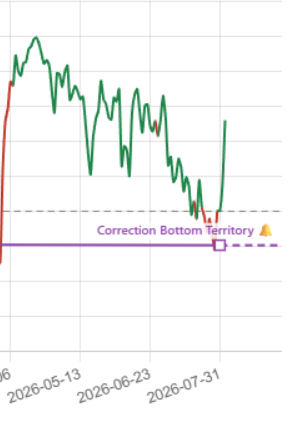
On the 28th-29th of July we got a signal in our system for a potential bounce, and on the same dates, 17 tickers were proposed by our Prioritization-Selectivity engine to focus on.
Focusing on 15-30 tickers is different from focusing on 50 or 100 in moments of uncertainty.
Studying never stops. The creation of all these tools was was done to save more time, increase clarity and performance. Kind of sealing my current intuition and experience into a ''bottle'' and then keep progressing . Studying and observing is the only path to remain competitive and adjust in markets imo. But this year I studied a bit less than the previous in order to build all these
💫Emotions aren’t as big of a deal as you might think. No one is emotionally unbreakable. Emotions are natural and can’t be avoided. We are human.
✅Problems in trading don’t arise from emotions themselves, but from large psychological swings caused by frequent surprises.
✅The more you know your system, the more you learn what to anticipate. This reduces the surprises that cause psychological swings and lead to many trading struggles.
- @stamatoudism
Sad to have missed presenting at this year's TraderLion Conference due to travel - vacation
It’s truly an incredible resource for aspiring traders, packed with great insights from so many brilliant traders.
Over 10,000 traders tuned into Day 3 of the @TraderLion Conference 🔥
Great presentations from @Tradestl, @ShakePryzby1 , and @Clement_Ang17
You can watch the replay here 👇
https://t.co/atSq6MFuVD
Yep , we have a 15 step process. A dynamic way of surfacing and categorizing big themes and small themes. We have around 60 big themes and 400+ subthemes. We read everything regarding a company and we categorize it everywhere it belongs. I get surprised always with some catches in the system that I wasn’t aware of regarding companies and also themes suggested by the pipeline (e.x Space Data Centers ) . We ve spent almost a year to fine tune thematics and make the process solid
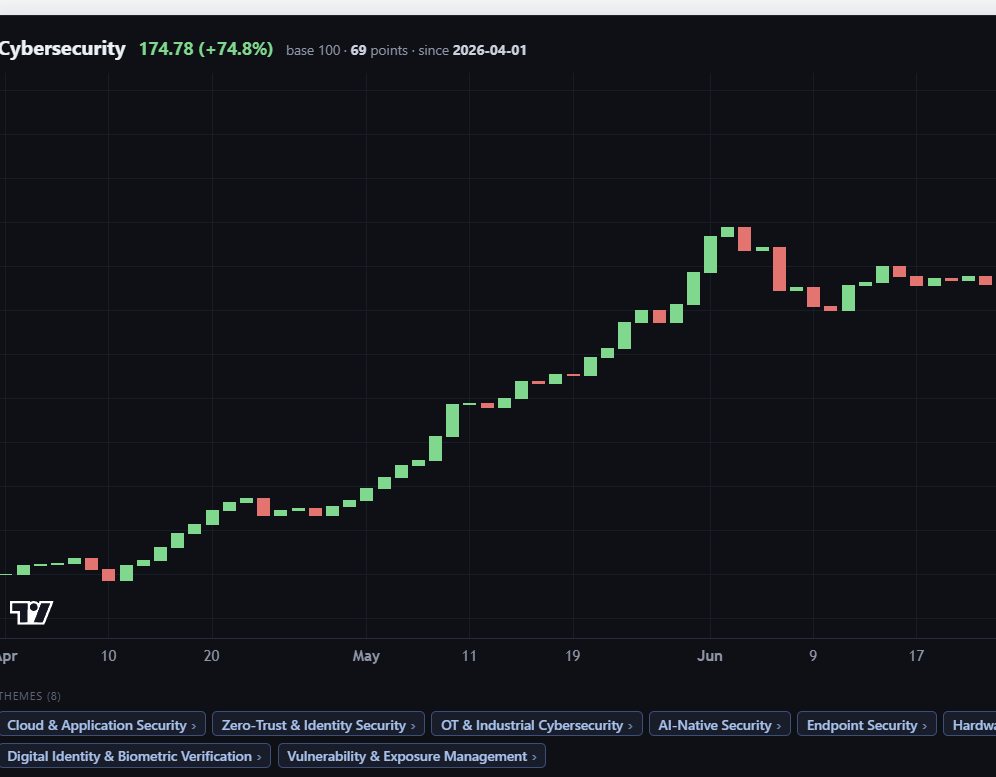
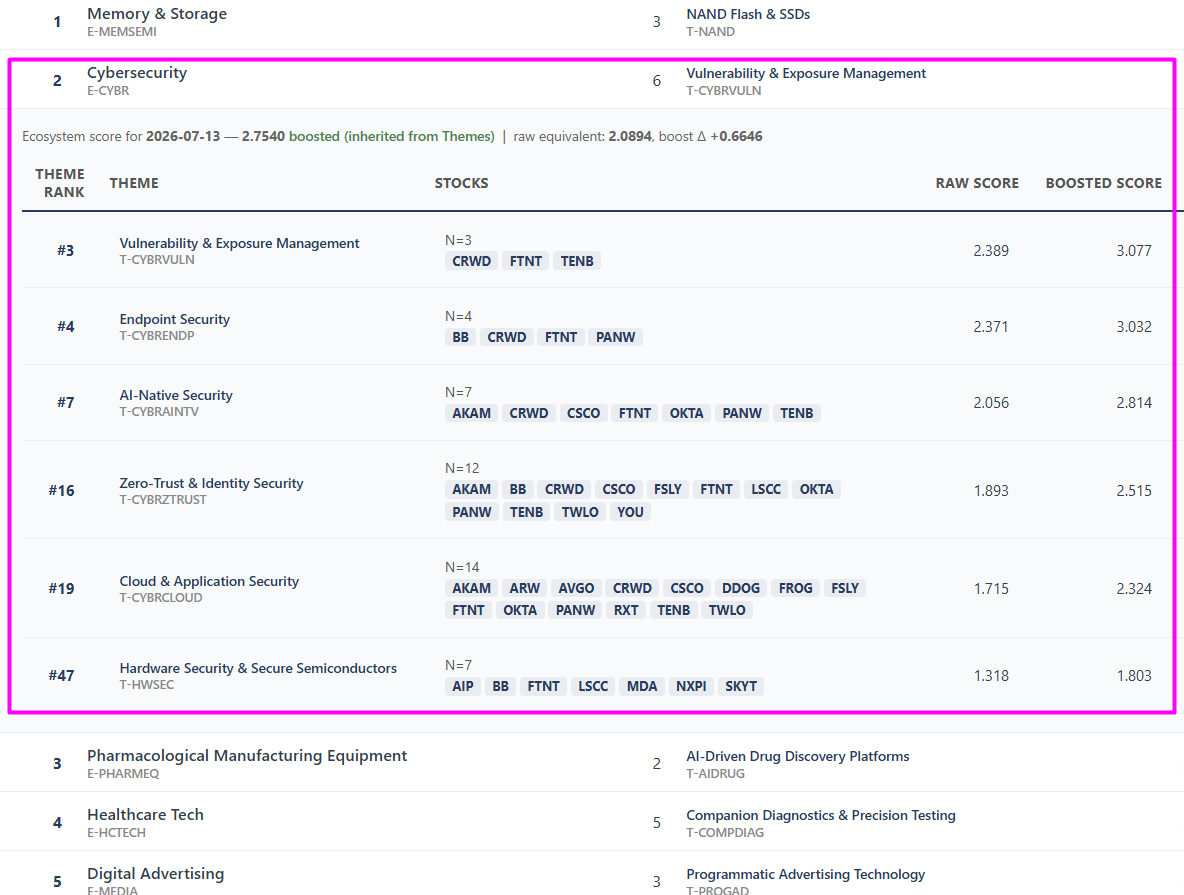
Cybersecurity theme, and its subthemes, have been dominating my lists for months-weeks now. It's a dominant theme for now and also showed resilience during June.
A lot of cyber names like $CRWD, $PANW, $FTNT, and many more are both thematically solid and have had/continue to have a lot of tailwinds.
We'll see if that continues.
Systematizing a lot of things that were done manually before has really enhanced clarity on my end.
@JorgeSaInvest Yes, I invested a lot on this this year. Especially mentally. The results are good and the clarity , ease and time saved is day and night than before