"We should never underestimate human stupidity....it's one of the most powerful forces in the world." Yuval Harari, professor at The Hebrew University of Jerusalem
The AI Income Squeeze From All Sides
The assumptions behind the AI mania are increasingly challenged. Cheap models, tighter corporate budgets, and regulatory constraints are already squeezing a technology priced for exponential growth.
https://t.co/MhveXVi3V4
🚨 The BIS has just reminded us that AI is probably a major economic revolution but the current investment boom is also starting to become a source of financial fragility.
➡️ We should not confuse AI’s technological potential with the immediate financial profitability of every investment made in the name of AI. AI can generate significant productivity gains but turning these task-level gains into a lasting increase in productivity across the whole economy is much more complicated. Companies need to redesign processes, train teams, integrate tools, adapt systems and rethink business models. Historically, this kind of transformation takes time.
📊 The problem is that the market is already pricing in an almost perfect scenario with rapid adoption, massive productivity gains, high margins and sustained earnings growth. It is possible but not guaranteed. AI may well be a real revolution but that does not mean every investment being made today will be profitable, nor that all current valuations are justified.
📚 The major hyperscalers are investing enormous amounts in data centers, semiconductors, energy, cloud infrastructure and computing power. However, this race is also defensive as everyone is investing aggressively out of fear of missing the wave. Individually, that is rational but collectively it can create overcapacity. A classic pattern in major technological revolutions where a technology can be revolutionary while capital can still be misallocated.
⚠️ The BIS also highlights the opaque financing of the entire AI ecosystem with cross-shareholdings, long-term contracts, data centers built by third parties and leased back to tech giants, private debt, off-balance-sheet commitments, and so on. If the investment cycle slows abruptly, the shock will not only affect a few technology stocks, but it could spread to suppliers, data center developers, utilities, private credit funds and, more broadly, financial conditions.
*Link: https://t.co/1YeEQ0uChH
AI is reshaping how institutional investors work:
~52% of institutional investors now primarily use AI for research, according to a Barclays survey of 410 fixed-income investors.
This is followed by hedge funds, at ~44%, which primarily use AI to process and analyze large volumes of market data.
By comparison, ~27% of hedge funds use AI for modelling and risk analysis, versus ~22% of long-only managers and ~17% of asset owners.
Operations, compliance and reporting, and investment decisions each account for just 10% to 15% across these groups.
AI is changing how investment decisions are made.
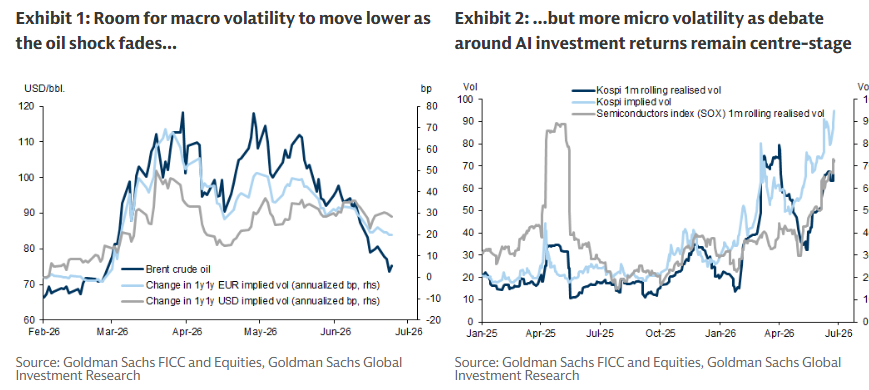
GS: Room for macro volatility to move lower as the oil shock fades...but more micro volatility as debate around AI investment returns remains center-stage
Paolo Maldini faced Diego Maradona in 1988. 🇦🇷
Paolo Maldini faced Ronaldo Nazário in 1998. 🇧🇷
Paolo Maldini faced Cristiano Ronaldo in 2004. 🇵🇹
Three generations of superstars. One constant.
Happy 58th birthday to the greatest defender football has ever seen. ❤️🐐
The EU ETS is dead anyway.
That is unequivocally a good thing. The Green Deal was flawed from the outset.
Not a single European economy can afford ever-higher carbon taxes, wind & solar mandates, tailpipe regulations, or any other failed policy aimed at squeezing out the last tonne of CO₂, while the CCP's investment-led growth model exploits Europe's climate hysteria to capture industrial market share.
For those who still don't grasp the scale of the absurdity: since 2021, China has approved nearly 290 GW of new coal-fired power capacity—almost three times the size of the EU's entire remaining coal fleet. Coal still generates roughly 55% of China's electricity.
Why? Because for the CCP, carbon emissions are irrelevant beyond the usual lip service. What matters is cheap, reliable power, geopolitical energy independence from the United States, and export growth to keep industrial overcapacity running and prevent a debt implosion. The rest is 100%—not 99%—irrelevant. That simple.
I'd argue that even without these senseless EU policies, mass unemployment is now becoming increasingly difficult to avoid in the UK, Germany, France, Italy & the Benelux. Too much damage has already been done to Europe's core industries—autos, chemicals, steel, and every other energy-intensive sector.
If you still don't understand that by now, then you either haven't done your homework or you're an arrogant lightweight—and part of the problem. It's that simple.
@_FriedrichMerz@GiorgiaMeloni@EmmanuelMacron@alexstubb@vonderleyen@donaldtuskEPP@BR_Sprecher@MinPres@Bart_DeWever
JPM: "Many tokens consumed in the future may not come from frontier models but from smaller open models that are up to the tasks. Amazon now offers a half-dozen open models at a fraction of frontier pricing, and NVIDIA is teaming up with Dell, Lenovo and HP to make PCs designed with AI agents. While OpenAI and Anthropic compete with their own smaller models (e.g., Claude Haiku and GPT-5.4-mini), these models aren't competitive vs the efficient frontier right now. That frontier shown as the green zone below is dominated by China (DeepSeek, MiniMax, Xiaomi, Alibaba) and only includes a modest presence from US models including one from xAI (Grok) and one from NVIDIA (Nemotron). Consider the following: Claude Opus 4.8 costs $3,700 to run the Artificial Analysis Intelligence Index task set for a score of 56, while DeepSeek V4 Pro (Max) scores at 44 for just $186, which is ~20x cheaper. TLDR; you don’t need frontier level intelligence for everything, and if you do, https://t.co/JdwoOcImCh’s GLM 5.2 appears competitive with top tier Anthropic and OpenAI models."
This gets to the pricing power challenge I dissected in my December report on "GenAI & Productivity" (https://t.co/kEx5Z4BJH7). The commodification of models will come not only from frontier model competition, but enterprises seeking cost control via cheaper, narrower use-case models. This implication has been abundantly clear as I research my upcoming report on "The Medical Innovation Inflection." Whether it's drug discovery, devices, or care delivery, health care stakeholders are looking at a variety of pathways to AI deployment including DIY capabilities trained on proprietary data and SaaS capabilities built with domain expertise.
I continue to believe that enterprise spending is the most viable path for hyperscalers to recoup AI CAPEX. Of course, enterprises will spend as little as possible to realize AI-driven revenue growth alongside margin expansion. It's far too early to know where that tug-of-war lands, but the ongoing progression of increasing buildout costs alongside expanding enterprise AI optionality suggests the market continues to underestimate the pricing power challenges hyperscalers face.
Learn more about Sage Road Research here: https://t.co/Wgwz2xnvR6. Interested in subscribing? Message me.
JPM link: https://t.co/P8hiu8swMI
🇺🇸 Hyperscalers
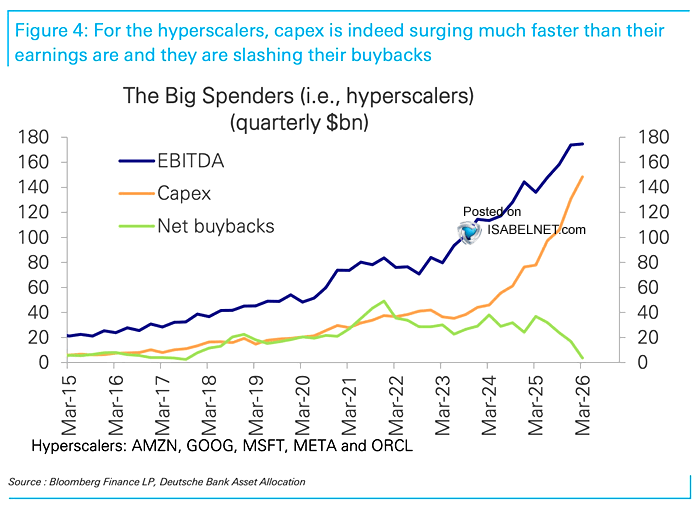
Hyperscaler capex is outpacing earnings and starting to bite. Buybacks are slipping as cash is redirected into AI infrastructure, setting up a tradeoff: more upside later, less cash in shareholders' pockets today
👉 https://t.co/blMxcoFA78
@DeutscheBank $spx
Filed under "least surprising news" category:
China is leaving room for coal consumption to grow in coming years. “We will always prioritize energy security,” Wang Hongzhi, head of the National Energy Administration, said on Friday.
https://t.co/W0NPmILaM0
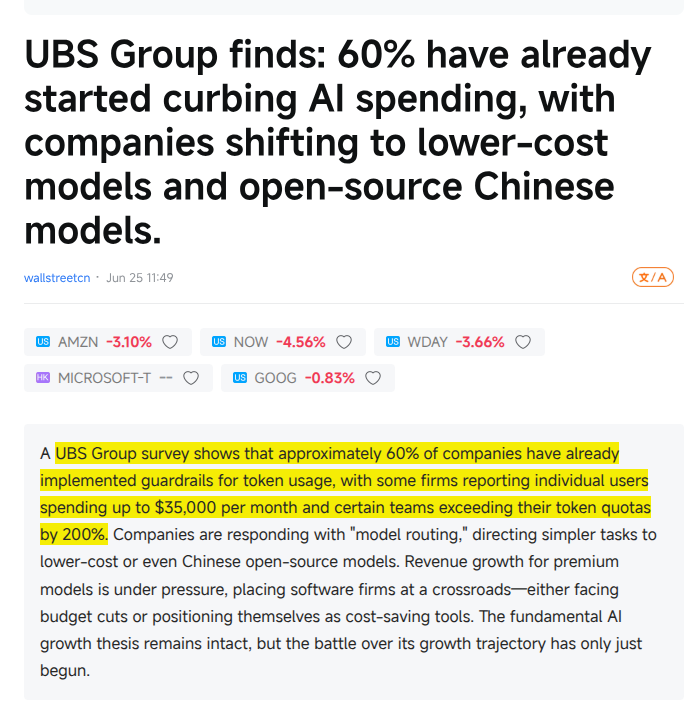
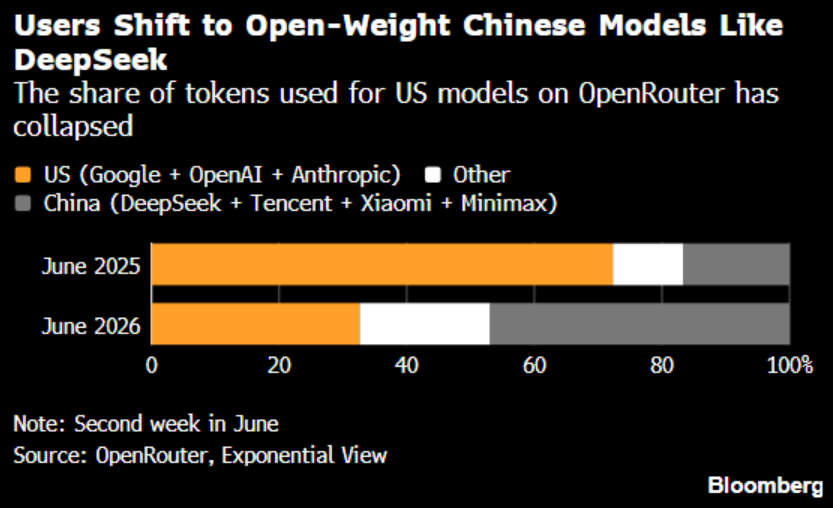
UBS says 60% of companies now watching AI budgets are moving to cheaper models and open-source Chinese models
The pressure is coming from extreme bills, including users spending up to $35K/month, teams exceeding quotas by 200%, and companies cutting internal AI tools from 5 to 2.
Companies are not abandoning AI, they are using model routing, which sends easy tasks to cheaper models and saves premium models for hard reasoning, code, and long-context work.
Chinese open-source models such as Qwen, DeepSeek, MiniMax, GLM, and Kimi now fit the enterprise cost curve because they can be run locally or used through cloud catalogs.
---
news .futunn.com/en/post/75068082/ubs-group-finds-60-have-already-started-curbing-ai-spending?level=2&data_ticket=1780870170397383
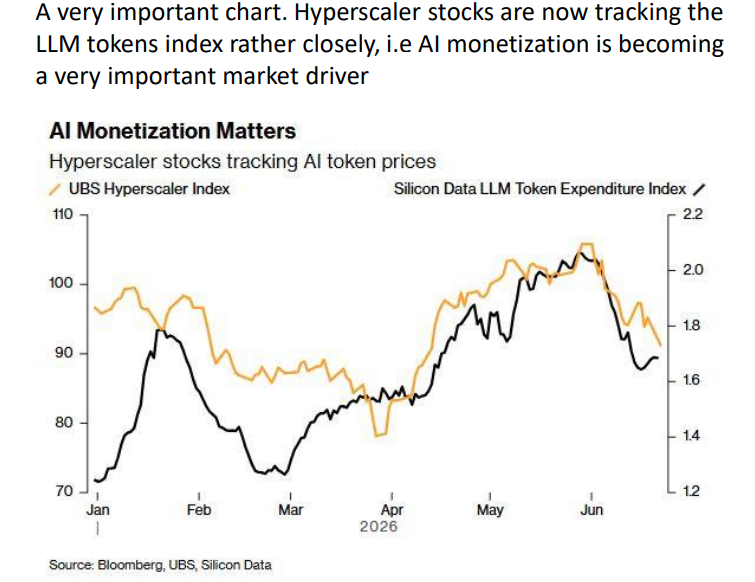
Tokens requested from Google, OpenAI and Anthropic relative to total fell to 33% in June 2026 from 72% a year earlier.
Tokenomics matters, or at least it will soon enough. Chinese AI’s gains in the market are remarkable
So let me get this straight...
1) Semiconductor stocks are up 107% this year.
2) The Mag 7 names are down 8% because they're spending hundreds of billions on semiconductors.
3) The market expects this capex cycle to continue indefinitely.
Have I got that right?
Meanwhile, more of corporate America appears to be turning towards cheaper, open-source AI models created in China.https://t.co/otGxE2s8zm prostredníctvom @ft