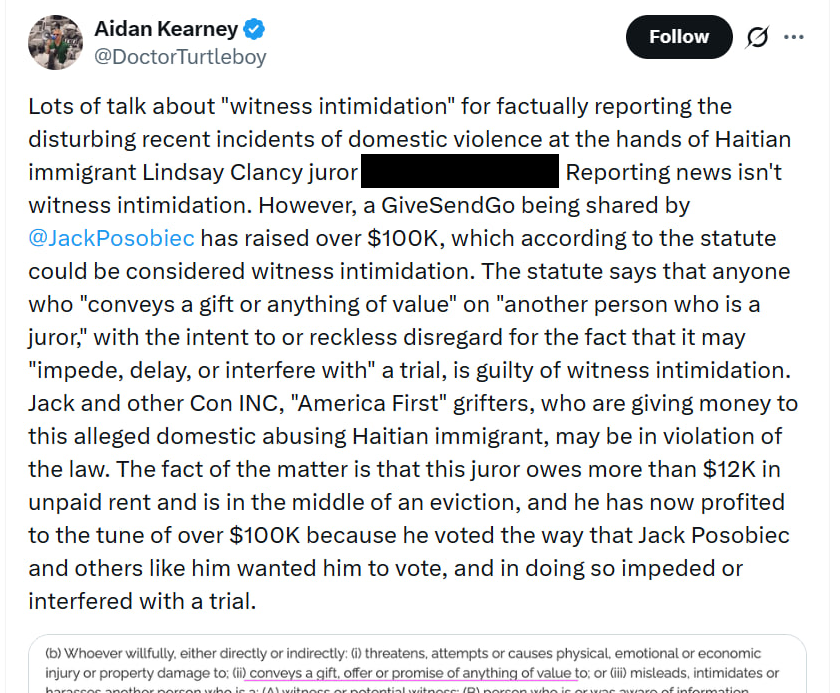
BREAKING: The scumbag who DOXXED the lone juror is now calling for ME to be ARRESTED for sharing the brave juror's GiveSendGo
Well guess what
I'm sharing it again. Have fun with that, scumbag
https://t.co/JhOCI7KNlB
1974. John Bogle is fired as CEO of Wellington Management, the firm he'd spent 23 years building, after a fund merger he engineered collapses.
Eight years earlier he'd merged Wellington with a hot Boston growth-fund manager.
By 1974, the combined fund's assets had fallen from $2 billion to $480 million.
The stock went from $50 a share to $4.25. The board pushed him out.
Bogle called it the most heartbreaking moment of his career. He used it to build something no one on Wall Street wanted: a fund company with no outside owners to pay.
In 1975 he founded Vanguard - structured as a mutual, owned by the funds themselves, meaning owned by the people invested in them.
There was no one left to skim.
His argument was arithmetic, not ideology: "The magic of compounding returns is overwhelmed by the tyranny of compounding costs." Run a 2.5% annual fee against an 8% return for 65 years, and fees alone consume 79% of what you would have earned.
Most people obsess over the return they're chasing. Bogle spent his career pointing at the return being quietly taken before they ever see it.
If your savings rate is the one number you fully control - why does the industry managing what you save profit from you never checking what it costs ?
In 2002 eBay bought PayPal for $1.5 billion. By 2021 PayPal was worth $360 billion, 8 times more than eBay.
It was not a steal. The people who sold it had good reasons to.
This month the 2 companies are worth about the same.
Start with the sellers. In August 2000 PayPal burned $12 million in a single month with almost no revenue. By 2002 it was public, but about 60% of its business came from eBay, and eBay ran its own payments system, Billpoint, backed by Wells Fargo. Your biggest customer was also building your replacement. Taking 0.39 eBay shares for every PayPal share was the safe exit.
The logic on the other side was not stupid either. Payments were the weakest part of eBay's marketplace and Billpoint was losing. Buying the winner and shutting down your own loser is exactly what a buyer is supposed to do.
For 13 years it worked. Then Carl Icahn pushed for a split. eBay said the 2 businesses belonged together, and in September 2014 announced the spin-off anyway. On July 20, 2015 PayPal traded alone for the first time and closed its first day around $49 billion, above eBay's $35 billion.
The pandemic did the rest. By July 2021 PayPal was worth about $360 billion. Since then it has lost more than 85% of that, and in early September 2026 it sat at about $48.5 billion, next to eBay at about $47.5 billion.
The footage is Reid Hoffman in 2014, one of the executives who sold PayPal, a year before the split. He describes that summer of 2000: $12 million gone in a month, a 3-day offsite, and a team that could almost chart by the hour when it would blow up. After the sale he had enough money to never need a salary again. Then the detail that holds the whole story: in PayPal's first week, the site filled up with eBay sellers, and the internal discussion was that this was not their use case.
I once built half a business around a customer I had not planned for, and spent a year treating it as a detour. By the time I noticed it was the business, they had noticed too.
You probably have a version of this. The client who pays 60% of your invoices. The platform that sends you most of your customers. The employer whose internal system is the only thing your best skill runs on. That relationship is already a negotiation. You just have not priced your side of it.
Almost nobody checks what share of their income comes from one name.
In February 2007 Harry Macklowe bought 7 Manhattan skyscrapers for $6.8 billion. He put in $50 million of his own money.
Not bad buildings. Some of the best addresses in New York.
The man who sold them to him was the one who was scared.
The seller was Blackstone. The same week, Steve Schwarzman had just won Sam Zell's office empire, Equity Office, for $39 billion including debt, after a bidding war with Vornado that pushed him to $55.50 a share. The moment he owned it, he started selling it.
The logic on the other side was not stupid. Manhattan rents were rising, towers like these almost never come up for sale, and money was cheap. Macklowe borrowed about $7 billion on short-term loans due in February 2008, betting rents would keep climbing faster than the loans came due.
They did not. By early 2008 credit had frozen and he could not refinance the $5.8 billion he owed Deutsche Bank. He lost all 7 buildings. The GM Building, which he had owned since 2003 and pledged against the debt, went to Boston Properties for about $2.8 billion.
The footage is Schwarzman telling his side. He says he was so scared that they were winning that he could not sleep, because Blackstone could have walked away with about $500 million, the break fee at the time. So he decided to sell half of what he bought the day he bought it. Imagine buying $40 billion of real estate one day, he says, and selling $20 billion of it the same day. I did that because I was scared, because I hate risk. His first rule, he says, is do not lose money.
I have bought something from a person who was clearly in a hurry to sell it, and told myself they just did not see what I saw. Sometimes that was true. The times it was not cost more than the times it was.
You meet a Schwarzman more often than you think. The flipper selling a house 3 months after buying it. The early employee unloading shares the day they vest. The founder who raises and sells secondary in the same round. Their hurry is information, and it is usually worth more than the listing.
Almost nobody asks why the seller wants out so fast.
Witnesses of faith do not propose an ideology; rather, they reveal a faith lived out in daily life. Their credibility stems from the consistency between their words and actions, a consistency often maintained even to the point of the ultimate sacrifice. In indifferent cultural contexts, “the holiness next door” and quiet heroism become compelling arguments capable of challenging everyone, even the most distrustful.
Dear Lord,
Today, I pray that my anointing increases and my territory expands! I pray that I become known for the power of God flowing through me. I declare, signs, wonders and miracles! I pray angelic protection over me and mega financial increase. in Jesus’ name 🙏🏽
@imanshumpert Y’all got crushed by GSW in both finals with no chance at all but you talk the loudest like you could have done some different against the best team of all time. Take your L and stop crying 😭
This is an insane story:
An energy company in Poland signed a deal on a yacht in Abu Dhabi to buy 6 million barrels of oil for $345 million.
Because of sanctions, the money was delivered via crypto. USB sticks containing wallet keys were given to sellers in Caracas.
The Polish company they sent tankers to pick up the oil and were ghosted by the Venezuelans, while their empty tankers sat off the coast waiting for a reply.