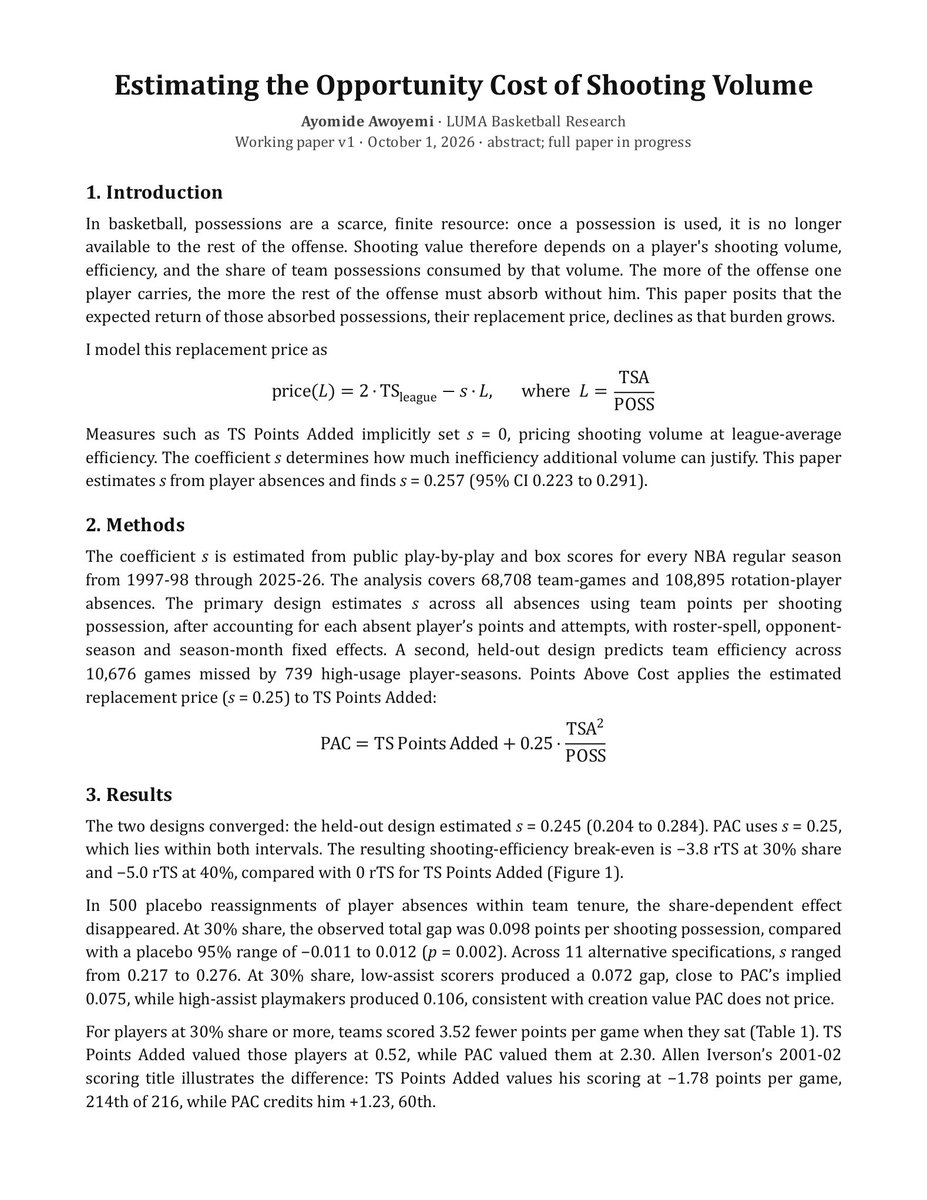
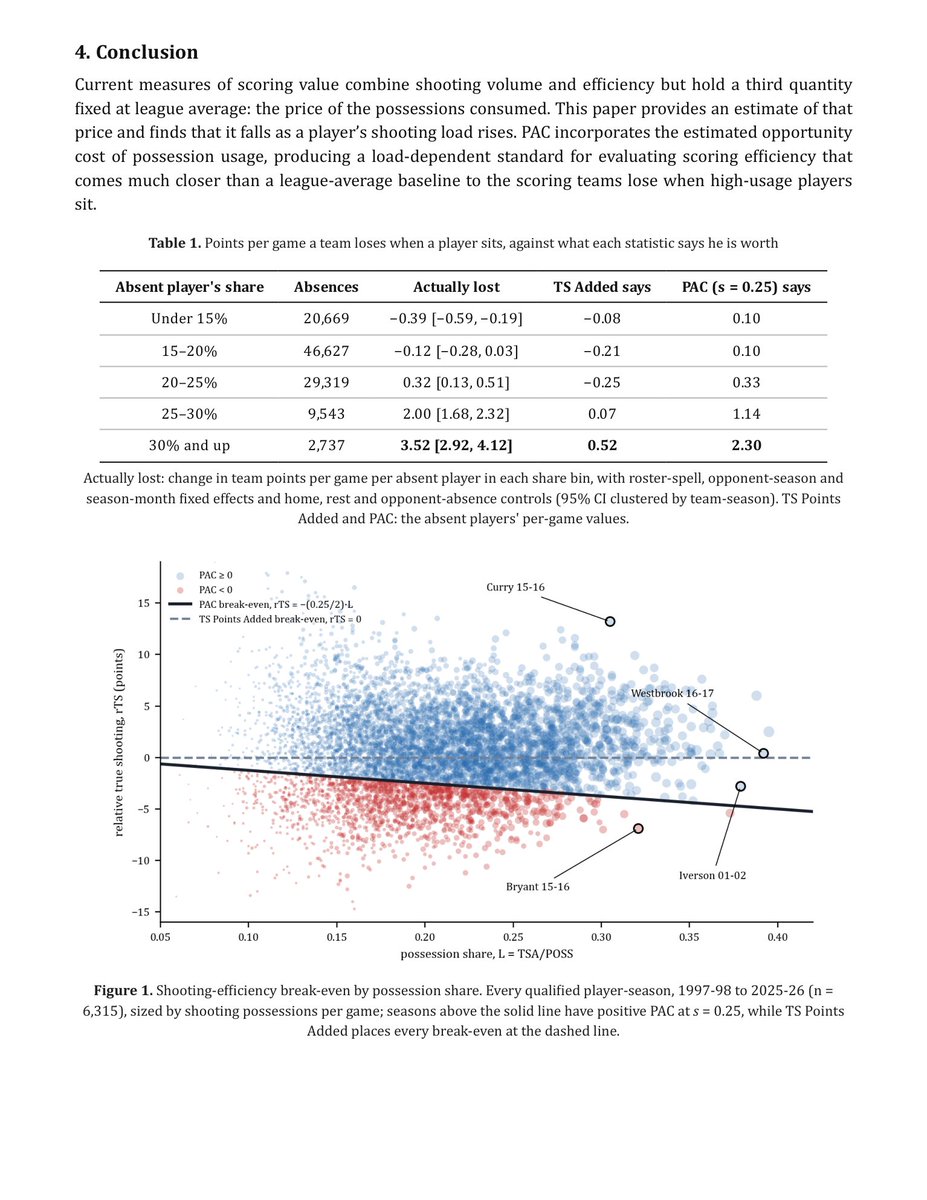
In 2001-02, Allen Iverson won the scoring title at 31.4 PPG on 31.7 TSA (-2.8 rTS. )
According to TS Points Added - cost his team 1.8 points per game. Ranked 214th of 216 in shooting
PAC, accounting for the massive 38% of team possessions carried, says he was worth +1.2 points per game, ranked 60th of 216.
This begs the question:
at what point does scoring load start to pay for inefficiency? Is there a third dimension to measuring shooting production?
Introducing (P)oints (A)bove (C)ost
Been toying around with the relationship between usage, efficiency, and overall impact.
specigically at what point volume starts paying for inefficiency
The Kobe or more recenlty Brunson clause: where they may not be the most efficient, but whose raw shooting volume still provides value that would otherwise be lost if replaced by their teammates.
Below is a table of some higer usage two gaurds and atheir UW RTS: Usage Weigted Real Trueshooting %
https://t.co/ma8MtqPuMS
Explored consistency through NBA history with @tipoffball. We broke down all-time primes, career longevity, and who is actually reliable in the playoffs.
Go check it out!
It is at that point that failure will truly be a redirection, a signal, and pieces of information for you to take and do it again. Now armed with the beautiful sword and shield of experience and added grit
But I do think it's very easy to underestimate the limits of your body and your mind. It's easy to coax yourself into believing that you did give it your all when, deep down, you know you had more left in the tank.
This doesn't mean training to "failure" or unhealthily giving yourself over to a pursuit. Rather it means being extremely intentional and consistent over whatever time horizon is needed and truly having a singular focus on whatever your stated mission is.
@UnprobableP@brailmoney@Kofie If you don't take yourself serious, no one else will. I still haven't seen JB doing anything wrong except play poorly last night.