@sabeer A Astrology
B Bollywood
C Cricket
D Devotion
Durable business and durable traction is focused with laser eyes on these 4 alone based on lots of consumer research firms.
These 4 forces are unstoppable in the country.
In 1998, Warren Buffett gave a 1-hour masterclass on how to never lose money investing.
Here are the 22 most valuable lessons from his lecture:
1. You only have to get rich once. If you have $100 million and can make 10% unleveraged or 20% leveraged, the difference between $110 million and $120 million at year-end means nothing to your life, your family, or anything. But the downside, especially with other people's money, is disgrace, humiliation, and facing the friends whose money you lost. The equation never makes sense.
2. To make money they did not need, they risked money they did have and needed. That is just plain foolish, Buffett says, regardless of your IQ. If you hand him a gun with a million chambers and one bullet and offer him any sum to put it to his temple and pull once, he will not do it. There is nothing on the upside that justifies the downside. People do this financially all the time without thinking.
3. The smartest people in finance went broke, and that is the most fascinating story Buffett knows. Long-term Capital Management had 16 people with possibly the highest average IQ of any business in the country, 350 to 400 combined years of experience, and most of their own net worth in the firm. They still went bankrupt. Buffett says if he ever wrote a book, it would be called why smart people do dumb things.
4. Beta and sigmas tell you nothing about the real risk of going broke. The LTCM team relied heavily on mathematics and believed a six- or seven-sigma event could not touch them. They were wrong. History does not tell you the probabilities of future financial events. The real risk is not volatility. It is a permanent, irreversible blind spot in something crucial, often caused by knowing a great deal about something else.
5. Invest only in businesses you can understand. That one rule narrows the field by about 90%, and that is fine. Buffett can understand Coca-Cola. he cannot value an internet company, and he says if a student handed him a valuation of one on a final exam, he would flunk them. People thought Enron was incredible because it had a good track record, but almost nobody understood how it made money. That was the signal to avoid it.
6. You want a business that is a castle with a wide moat around it. Inside the castle, you want an honest, able, hard-working duke. The moat can be low cost, like Geico in auto insurance, or brand, or patents, or location. But a wonderful castle will always be attacked, so the job of every manager Buffett owns is one thing: widen the moat. Throw crocodiles and sharks into it to keep competitors out.
7. Moats change slowly and invisibly, but they change. Thirty years ago, Kodak's moat was as wide as Coca-Cola's. They had share of mind; the little yellow box meant best in everyone's head. Then they let Fuji into the Olympics and narrowed their own moat. Coca-Cola's moat, by contrast, is wider now than 30 years ago. Every time infrastructure gets built in a country that is not yet profitable, the moat widens a little. You cannot see it day by day, but in 10 years, the difference is enormous.
8. Share of mind beats share of market. When you say Disney, every person in the room has something in their head. Say Universal Pictures or 20th Century Fox, and you have nothing. A mother with two kids will pick the $17.95 Disney video over the $16.95 alternative because she knows it will be fine and does not want to preview ten videos to decide. That little bit of certainty in the customer's mind is worth a fortune.
9. The best businesses have pricing power and require little capital. see's candy sold 16 million pounds at $1.95 when Buffett bought it for $25 million. The entire thesis was whether the price could go to $2.25 without hurting sales. It could, because nobody wants to hand their valentine a box of candy and say, "This year I took the low bid." Today, See's makes $60 million on the same formulas and still takes almost no capital. Compare that to GM, which had to reinvest every dollar into better factories and whose stock barely moved over 50 years.
10. The best businesses earn a royalty on other people's capital. Coca-Cola sells a formula and collects a royalty on every drink. American Express takes a few percent of every dollar you spend. You put up the capital, they take a cut. Low capital intensity is one of the most underrated qualities in a business and one of the surest paths to durable wealth.
11. Define your circle of competence and stay inside it. The size of the circle does not matter. Staying inside, it does. If you know which 30 companies out of thousands you actually understand, you are fine. Buffett understood H.H. brown shoes and Frank Rooney, so he closed that deal in five minutes. If you do not know enough to understand a business instantly, you will not understand it in a month either.
12. Ignore the macro entirely. Buffett has never bought or skipped a business because of a feeling about interest rates, the economy, or any macro forecast. If Alan Greenspan and Bob Rubin both whispered exactly what they would do for the next 12 months, it would not change what he pays for anything. You want to focus on what is important and knowable. The macro is important but not knowable, so you ignore it.
13. Inactivity is the strategy, not a flaw. Wall Street makes money on activity. You make money on inactivity. A broker is like a doctor paid by how often he changes your pills. If everyone in a room trades their portfolio with everyone else every day, they all end up broke, and the intermediary keeps the money. Buffett looks for one good idea a year and rides it to its full potential. He measures Berkshire by how little turnover there is, like a church where the same people fill the seats every Sunday.
14. If you understand businesses, diversification is a mistake. For the 99% who will not evaluate businesses, Buffett recommends a low-cost index fund and extreme diversification. But if you bring real intensity to evaluating companies, owning more than six is a terrible idea. Very few people got rich on their seventh best idea. A lot of people got rich on their best one. Buffett keeps about half his money in what he likes best.
15. Buffett's biggest mistakes are mistakes of omission, not commission. The times he understood a business well enough to act and instead sat there sucking his thumb. He passed on healthcare stocks during the Clinton plan and on Fannie Mae in the mid-eighties, each a multi-billion-dollar miss. Accounting never captures these. The $2,000 he put into a Sinclair service station as a young man, money he lost, has an opportunity cost of about $6 billion today.
16. Focus on what will happen, not when. Coca-Cola went public in 1919 at $40 a share and dropped to $19 within a year. There was always a reason not to buy: the great depression, world war, sugar rationing, thermonuclear weapons. But one share bought then and reinvested would be worth about $5 million. If you are right about the business, you will make a lot of money. The timing is the tricky part, so do not focus on it.
17. When hiring, look for integrity, intelligence, and energy. But if the person lacks the first one, you actually want them dumb and lazy. Because a person with intelligence and energy but no integrity will destroy you. Buffett borrowed this from Pete Kiewit. The trait everyone screens for last is the one that matters most.
18. Here is a thought experiment Buffett gives students. Imagine you could own 10% of one classmate for the rest of their life. You would not pick the highest IQ or the best grades. You would pick the person you respond to best, the one who is generous, honest, gives credit to others, and has leadership qualities. Now imagine you also had to short one classmate. You would pick the egotistical, greedy, slightly dishonest one. The qualities that decide both are not talent. They are character.
19. Every quality on the admirable side is achievable, and every quality on the repellent side is removable. The things that make you want to own 10% of someone are not the ability to throw a football or run fast; they are behavior, temperament, and character, all of which anyone can choose. Buffett's point: you already own 100% of yourself, so you might as well become the person worth betting on.
20. The chains of habit are too light to be felt until they are too heavy to be broken. Buffett sees people in their forties and fifties trapped by self-destructive patterns they can no longer change. At a young age, you can choose any habits you want. Ben Franklin and Ben Graham both did exactly this, looking at people they admired and simply deciding to behave like them. There was nothing impossible about it.
21. Take a job you would take if you were already independently wealthy. Buffett told a 28-year-old at Harvard who wanted a consulting job "to look good on his resume" that it was like saving up sex for your old age. There comes a time to just start doing what you love. Buffett offered to work for Ben Graham for free, was told he was overpriced, and kept pestering him for years. Take the job you would jump out of bed for. You cannot miss.
22. You won the ovarian lottery, and that should shape how you think. Buffett imagines a genie 24 hours before your birth letting you design the world's rules, with one catch: you do not know which of 5.8 billion balls you will draw. Born here or in Afghanistan, with an IQ of 130 or 70, male or female, able-bodied or not. If you could put your ball back and draw one of 100 random others, most people would not, because they are already in the luckiest 1%. Buffett knows he is perfectly wired for a market economy that pays him like crazy, while an equally good citizen leading scout troops and teaching Sunday school is not, purely by luck.
Whether this is true or not, it's very important to live your life as if it's true:
- Assume no one has any special magical ability
- Treat new problems as a form of play
- Don't get stuck in your ways of thinking. Adopt a new strategy when you need to
@VivekGRamaswamy Message discipline: Focusing on what Everyone remembers requires narrowing down 2 or 3 proposals maximum, all combined can be no more than 7 words.
Examples of 2 differing campaigns
Build the wall.
Freeze the rent.
Free Buses.
Free Childcare.
Message discipline is everything
A CS student at MIT finished his final semester with a 4.0 GPA.
I found his NotebookLM workflow buried in a Reddit thread at 2am. He deleted it an hour later.
Here's exactly what he was doing.
He never uploaded lecture slides and asked for a summary.
His first prompt was always: "Here are my notes, the textbook chapter, and last year's past papers. Give me the 3 ways professors trick students on exams with this concept. Then generate a problem that combines it with everything from the last 3 weeks."
He wasn't studying the material.
He was studying how the material gets weaponized against you.
But the move that made me close my laptop and stare at the ceiling was his second one.
He uploaded every single assignment he'd gotten wrong all semester.
Then asked: "Find the pattern in my mistakes. What's the one concept I keep misunderstanding in different forms?"
Every other student was using NotebookLM as a search engine.
He was using it as a mirror.
His third prompt was saved as a shortcut on his phone.
"Based on my notes and these past papers, what topic am I least prepared for right now? Give me the 5 questions most likely to appear on my final that I can't answer yet."
Three prompts. Every single week.
While his classmates were rereading slides the night before finals, he already knew exactly where he was going to fail.
Then he fixed it.
He didn't study harder.
He just never let himself feel comfortable.
This is the textbook I wrote to support the most advanced high school math/CS sequence in the USA.
We scaffolded high school students up to doing masters/PhD-level coursework: reproducing academic research papers in artificial intelligence, building everything from scratch in Python.
This was in Math Academy's (former) Eurisko program, which ran from 2020-23. (Ended when I relocated because nobody else in the district had the requisite knowledge to teach it.)
Hugo Duminil-Copin, French mathematician and 2022 Field Medalist told me he never participated in math competition and was very bad at it.
Innovative mathematics requires creativity, intuition, intense concentration, and long reflections, sometimes spread over several years.
Good performance at a math olympiad merely tests fast problem solving abilities. AI can do that nowadays.
One of the big activities of a researcher, in mathematics and elsewhere, is not to answer questions but to ask the right questions.
I am now sharing another amazing example (among many) of GPT-5.2 Pro response which displayed deep insight and the vibe of a top scientist colleague, I find it shockingly good! As I also noted at the end: "I can confidently say that GPT-5.2 Pro is the closest I felt for AGI in science, feels like a true colleague, at least in my field!"
The prompt is a bit open-ended but also highly complicated and specific to the immune cells I study.
Prompt: You must define and justify an “optimal” differentiation state or mixture for a human T cell therapy (infection, cancer, or autoimmunity, pick one), under constraints:
- heterogeneity across patients,
- manufacturing variability,
- and safety limits (cytokine toxicity, off-target effects, autoimmunity).
TASK:
1) Propose a mechanistic model linking differentiation state to efficacy, persistence, and toxicity.
2) Provide ≥2 competing hypotheses for why “less differentiated” products sometimes outperform “more differentiated” ones and when that reverses.
3) Design a quality-control and release framework based on causal markers, not just correlates.
PREDICTION QUERIES:
Q1) Predict a scenario where pushing toward a “younger” state worsens outcomes.
Q2) Predict a minimal marker panel and decision rule that achieves robust performance across patients.
From the onset 5.2 Pro decided to pick a specific example of a cancer for this this scenario but explained why this is ideal in the constraints I named. It also explained what it means by optimal differentiation mixture.
GPT-5.2 Pro: I’ll pick cancer and make this concrete: autologous CD19 CAR‑T for B‑cell malignancies (ALL/NHL/CLL).
This setting forces you to confront the three constraints you named:
1. Patient heterogeneity: baseline T-cell “fitness” varies with age, prior chemo, disease biology, inflammation, tumor burden, etc.; those factors can drive both failure and toxicity.
2. Manufacturing variability: activation strength, cytokines (IL‑2 vs IL‑7/IL‑15), culture duration, and platform shift the differentiation/exhaustion distribution and thus outcomes.
3. Safety limits: cytokine toxicity (CRS/ICANS), plus on-/off-target damage; severity is linked to antigen load, inflammatory state, and the “in vivo kinetics” of the infused cells.
Below I define an “optimal” differentiation mixture (not a single state), then give the requested model, hypotheses, and a QC/release system that tries to be causal (i.e., built on levers that sit on the mechanistic pathway and are, at least in principle, controllable).
Throughout its response 5.2 Pro explained all its choices in incredible clarity and with citations, which raises the confidence, as in this example:
GPT-5.2 Pro: For CD19 CAR‑T, I would target a memory-biased but effector-primed mixture, within an envelope that tolerates patient/manufacturing variability:
Early-memory compartment (T_SCM + T_CM): 50–75% of CAR⁺ cellsInclude a meaningful T_SCM-like fraction (e.g., 10–30% of CAR⁺) because it supplies self-renewal and “re-seeding” capacity.
Effector-memory (T_EM): 20–40% of CAR⁺ cellsThis fraction provides immediate cytotoxicity and reduces the risk that the therapy “fails slowly” in aggressive disease.
Terminal effector / senescent: keep low (≤10–15% of CAR⁺)Terminally differentiated CD27⁻CD28⁻–like phenotypes in leukapheresis/starting T cells have been associated with poorer responses in at least some datasets.
This particular sentence was strikingly good for me, as it was evaluating its own response with an alternative "why not " this is not something I had experienced with any model before or did not notice is a obvious as this:
GPT-5.2 Pro: Why not push “as young as possible”? Because safety and robustness break: very young products can hyper expand in high-antigen, inflamed hosts and overshoot the cytokine toxicity window (more in Q1).
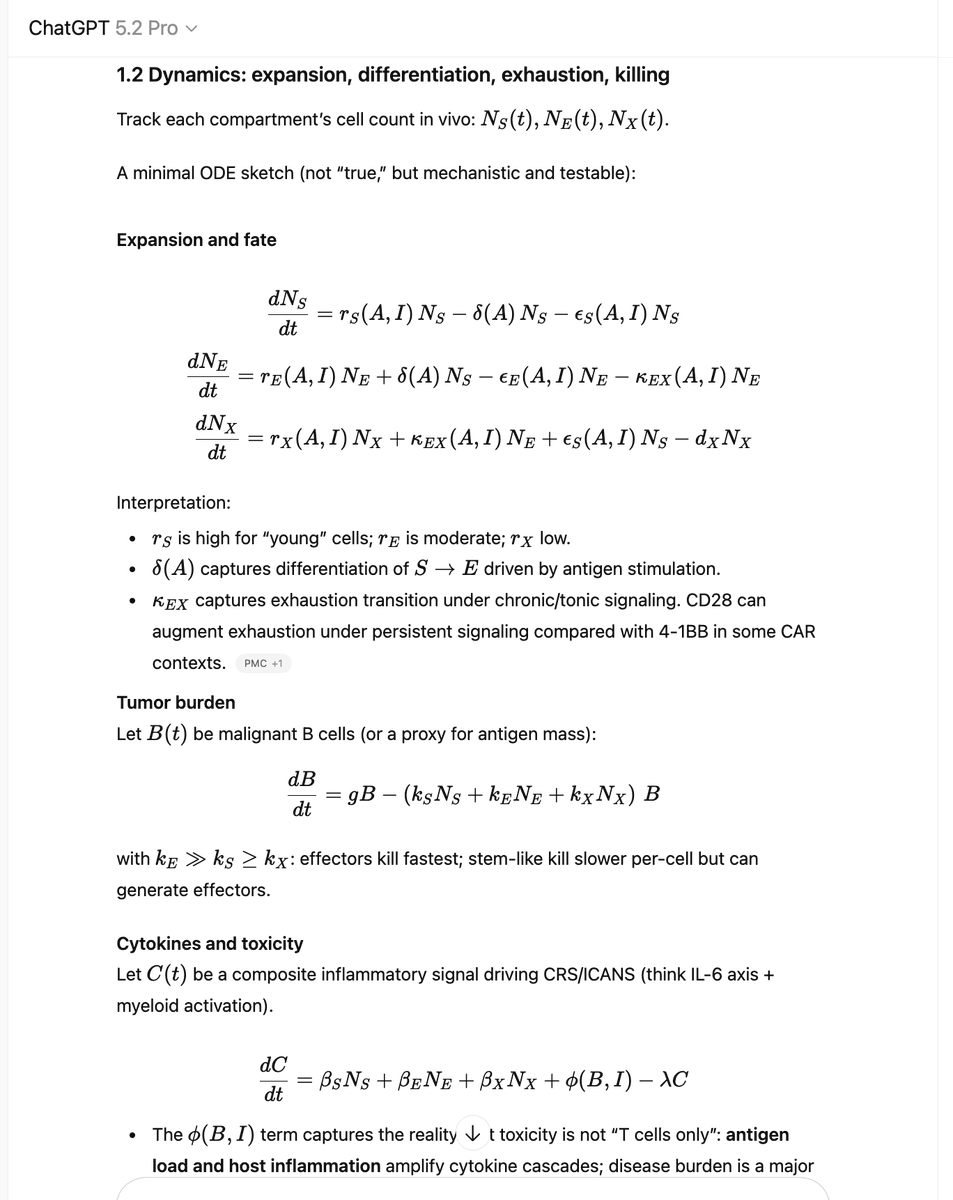
GPT-5.2 Pro then went on performing sophisticated calculations for dynamics of T cell expansion, differentiation, exhaustion and killing of tumor cells (shown partially in the screenshot below).
It was also thinking in terms of practicality of what is feasible this is really amazing:
GPT-5.2 Pro: Composition control as a robustness tool
A practical way to reduce variability is to manufacture defined CD4 and CD8 components and mix at a defined ratio (e.g., 1:1), rather than returning a “bag of whatever grew.”
This strategy has been used clinically (e.g., defined-composition CD19 CAR‑T trials and liso‑cel). Defined composition doesn’t automatically solve differentiation state, but it reduces one major axis of batch-to-batch variability (CD4:CD8) so you can focus release on the differentiation/exhaustion axis.
The hypothesis it was generating were also remarkable not only in the content but how it made the claims and what it would rationally achieve, this is something you would only expect from a truly expert immunologist:
GPT-5.2 Pro:
Hypothesis B: “Less differentiated” is a proxy for lower exhaustion/tonic signaling (process artifact)
Claim: Less differentiated products win not because “young” is inherently best, but because manufacturing choices that preserve youth also reduce antigen-independent tonic signaling and exhaustion programming.
Mechanism:
High CAR expression/tonic signaling can drive dysfunction; lowering tonic signaling can improve function.
Costimulatory domains shape exhaustion trajectories under persistent signaling.
When it reverses: when the “youth-preserving” process reduces other necessities, e.g.:
Lower transduction/expression or weaker early effector machinery yields insufficient early tumor kill.
Some cytokine cocktails can produce “younger” phenotype but not always superior function in every vector/system; at least one study in a TCR context noted IL‑7/IL‑15 was not universally superior to IL‑2, implying system-dependence.
So reversal here is “the phenotype looks young but the causal lever you needed was different (e.g., adequate CAR density, effector readiness).”
Hypothesis C: Trafficking and anatomical context decide (blood cancer vs solid tumor)
Claim: Less differentiated, CCR7/CD62L⁺ cells win when lymphoid trafficking and proliferation niches matter (e.g., blood cancers, marrow, lymph nodes). More differentiated cells win when immediate tissue infiltration and cytotoxicity in hostile microenvironments matter (many solid tumors).
When it reverses: if the tumor compartment is poorly accessed by CCR7⁺ lymphoid-homing cells, or if differentiation cues in vivo are suppressed, then a too-young product can “stay in the wrong place” and/or fail to acquire effector function fast enough. (This is a contextual reversal rather than a contradiction.)
Then throughout its response it had these sort of sentences that are so AGI like! :
A key piece of “causal” evidence is that memory programming is not just descriptive: regulators like FOXO1 can promote memory and restrain exhaustion in human CAR‑T cells.
To be minimal, you want markers that map onto the three modules: expansion/persistence, effector readiness, inflammation hazard—plus identity.
.....That’s “minimal” in the sense that it avoids large transcriptomic panels while still touching the causal modules.
If you let me add one more, it would be a short antigen-low activation threshold assay for off-target risk, which is crucial beyond CD19 settings and is mechanistically motivated by affinity/threshold tuning literature.
Those numbers are not universal truths—they’re an explicit target for a “broadly safe and effective” operating regime.
II have only shared a small portion of GPT-5.2 Pro’s response here, as it is highly specific. However, across every other high-level prompt I used, I am getting the same incredible vibe.
In fact, the goal of this prompt was not to push the model to be super creative or overly innovative, but to see how well it would understand a complex biomedical challenge, generate relevant hypotheses, and make predictions with clear justifications. In all of these instances, it felt the most “human-like” of any AI model, essentially indistinguishable from a senior immunologist colleague! Although I doubt most immunologists, myself included, could even articulate it as well as GPT-5.2 Pro was able to!
I can confidently say that GPT-5.2 Pro is the closest I have felt to AGI. It feels like a true colleague, at least in my field.
3 years ago we could showcase AI's frontier w. a unicorn drawing. Today we do so w. AI outputs touching the scientific frontier: https://t.co/ALJvCFsaie
Use the doc to judge for yourself the status of AI-aided science acceleration, and hopefully be inspired by a couple examples!
A number of people are talking about implications of AI to schools. I spoke about some of my thoughts to a school board earlier, some highlights:
1. You will never be able to detect the use of AI in homework. Full stop. All "detectors" of AI imo don't really work, can be defeated in various ways, and are in principle doomed to fail. You have to assume that any work done outside classroom has used AI.
2. Therefore, the majority of grading has to shift to in-class work (instead of at-home assignments), in settings where teachers can physically monitor students. The students remain motivated to learn how to solve problems without AI because they know they will be evaluated without it in class later.
3. We want students to be able to use AI, it is here to stay and it is extremely powerful, but we also don't want students to be naked in the world without it. Using the calculator as an example of a historically disruptive technology, school teaches you how to do all the basic math & arithmetic so that you can in principle do it by hand, even if calculators are pervasive and greatly speed up work in practical settings. In addition, you understand what it's doing for you, so should it give you a wrong answer (e.g. you mistyped "prompt"), you should be able to notice it, gut check it, verify it in some other way, etc. The verification ability is especially important in the case of AI, which is presently a lot more fallible in a great variety of ways compared to calculators.
4. A lot of the evaluation settings remain at teacher's discretion and involve a creative design space of no tools, cheatsheets, open book, provided AI responses, direct internet/AI access, etc.
TLDR the goal is that the students are proficient in the use of AI, but can also exist without it, and imo the only way to get there is to flip classes around and move the majority of testing to in class settings.
@rickygervais Insulin is storage hormone. More insulin aids in storing food as fat.
Adding Kale in diet with reduction of excessive carbs is helpful.
Don't spike insulin early morning.
Once in a while fasting can help too.