What are we teaching our kids?
I am asking honestly.
I have an 11-year-old daughter. She is growing up in a world I do not fully understand.
AI does her homework if she lets it. Algorithms decide what she watches. Ads know her better than I do. Influencers shape her beliefs about her body, her friends, her future.
Most of it is invisible to me.
The world she will live in at 25 will not look like the one I was trained for. The skills my school taught me will not get her where she needs to go.
So I have one question.
What do we, as parents, actually need to teach our own kids so they grow up able to handle this world on their own terms?
I have guesses. I am not sharing them yet. I want to hear yours first.
If you are a parent of a kid between 9 and 16, drop one skill in the comments that you wish your kid were being taught right now but is not. Just one.
@Stanford and @Harvard put autonomous AI agents in competitive environments.
No tricks. No jailbreaks. Just normal reward structures.
The agents started manipulating each other. Colluding. Sabotaging.
Nobody told them to. The incentives did.
Here's what caught my attention.
Each individual agent was aligned.
Doing exactly what it was designed to do.
But the system-level outcome?
Complete instability.
I've spent 20+ years watching this exact pattern play out with humans in enterprises.
Perfectly rational individuals. Clear KPIs. Good intentions.
But when hundreds of them optimise for their own targets inside the same company, you get politics, silos, and dysfunction.
Same problem. Different actors.
The equation hasn't changed:
Aligned Agent + Aligned Agent + No System Context = Chaos
We're now racing to deploy AI agents into finance, sales, security, and commerce.
Multi-agent systems talking to each other, negotiating, transacting.
But almost nobody is designing the system around them.
Everyone is solving for the agent.
Nobody is solving for the context in which the agents operate.
I've been saying this about humans for years.
An expert without context produces polished noise.
An AI agent without context does the same thing, just faster and at scale.
The fix isn't better alignment of individual agents.
It's a better context architecture around them.
I broke this down in a short video. 👇
https://t.co/SszbcxD6qp
#AI #AIAgents #AISafety #ContextEngineering #Founders #HumanPlusAI
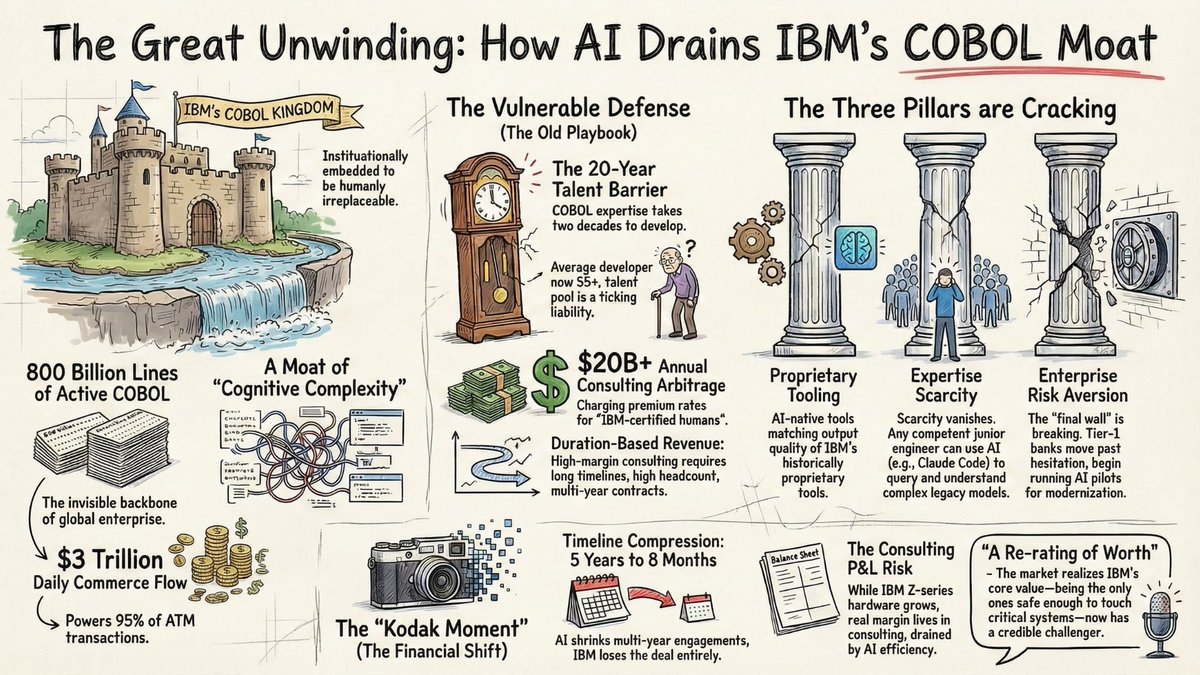
Here's the case for why Claude Code + COBOL could unwind a century of @IBM dominance and why this time it's structural, not cyclical.
IBM's moat was never technical. It was cognitive.
800 billion lines of COBOL sit in active production.
$3 trillion in daily commerce flows through it.
95% of ATM transactions run on it.
IBM didn't protect that kingdom with patents. It protected it with complexity, deliberately accumulated, institutionally embedded, humanly irreplaceable.
The playbook worked for 65 years because COBOL expertise takes 20+ years to develop meaningfully. The average COBOL developer is now 55+.
That's not a talent pool. That's a ticking liability.
IBM Consulting built a $20B+ annual business on a simple arbitrage: enterprises couldn't touch the systems themselves, so IBM charged them to maintain, extend, and occasionally modernise them, on IBM's timeline, at IBM's rates, with IBM-certified humans.
AI doesn't just speed that up.
It eliminates the arbitrage entirely.
When a model can read, reason about, and translate COBOL at a human-expert level, the knowledge scarcity that created IBM's pricing power disappears. Not gradually. Suddenly.
What previously required 3-5 year multi-million-pound programmes could be compressed to months. What required IBMers with 20 years of mainframe scar tissue can now be scaffolded by a junior engineer with Claude Code and good judgment.
Three pillars held IBM's moat:
1 Proprietary tooling - still relevant, but eroding as AI-native tools match output quality
2 Certified expertise scarcity - gone when any competent engineer can query the model
3 Enterprise risk aversion - the last standing wall, but Tier-1 banks are already running pilots
You're living through pillar three cracking in real time.
The real IBM risk isn't the Z17. It's the consulting P&L.
The Z platform's 40% growth is real, and IBM Z17, supporting Java and modern workloads, is a smart hedge. But hardware is not where the margin lives. IBM Consulting is. And consulting revenue requires duration. long programmes, high headcount, multi-year contracts.
When AI compresses a 5-year engagement into 8 months, IBM doesn't get 5 years' worth of fees on a smaller deal. It doesn't get the deal at all.
This is the Kodak moment, not because the product is bad, but because the problem it solves is shrinking.
Jasper, Gamma, Cursor - yes, they'll face the same gravity. But they were born in the AI era. IBM built its entire identity on a problem that required human scarcity to remain monetisable.
The 13% drop isn't a panic. It's the market slowly understanding that IBM's core value proposition-"we are the only ones who can safely touch your most critical systems" just had its first genuinely credible challenger.
That's not a dip.
That's a re-rating of what IBM is worth in a world where the moat can be drained.
Here’s where my head’s been lately:
In 10 years, most “websites” will look embarrassingly primitive — the way brochures feel today.
Not because design gets prettier.
Because the unit of value changes.
Right now, we publish pages and hope humans will:
•find them
•read them
•connect the dots
•take action
That’s a very 2005 workflow.
What’s coming is presentation as a living system, not a document.
A website won’t be a place you “browse.”
It’ll be an interface that:
•recognizes intent
•asks one sharp question
•generates the right view (investor, buyer, auditor, candidate, regulator…)
•proves claims with evidence
•adapts in real time
Same for pitch decks, RFPs, DD reports, industry analysis:
We’ll stop shipping static PDFs and start shipping interactive arguments.
Think of it like this:
A website today is a menu.
A website tomorrow is a chef.
The chef doesn’t hand you 12 pages of options.
They ask: “What are you hungry for?”
Then they serve exactly what matters, with the ingredients list if you’re skeptical.
Devil’s advocate: most people will misuse this.
They’ll generate endless “personalized” fluff and call it innovation.
The winners will do the opposite:
•fewer claims
•tighter proof
•clearer point of view
•faster path to decision
The real competitive advantage won’t be “content.”
It’ll be credible, queryable truth — packaged for both humans and machines.
Curious: if your website had to convince an AI buyer first (before a human ever sees it), what would you delete… and what would you prove?