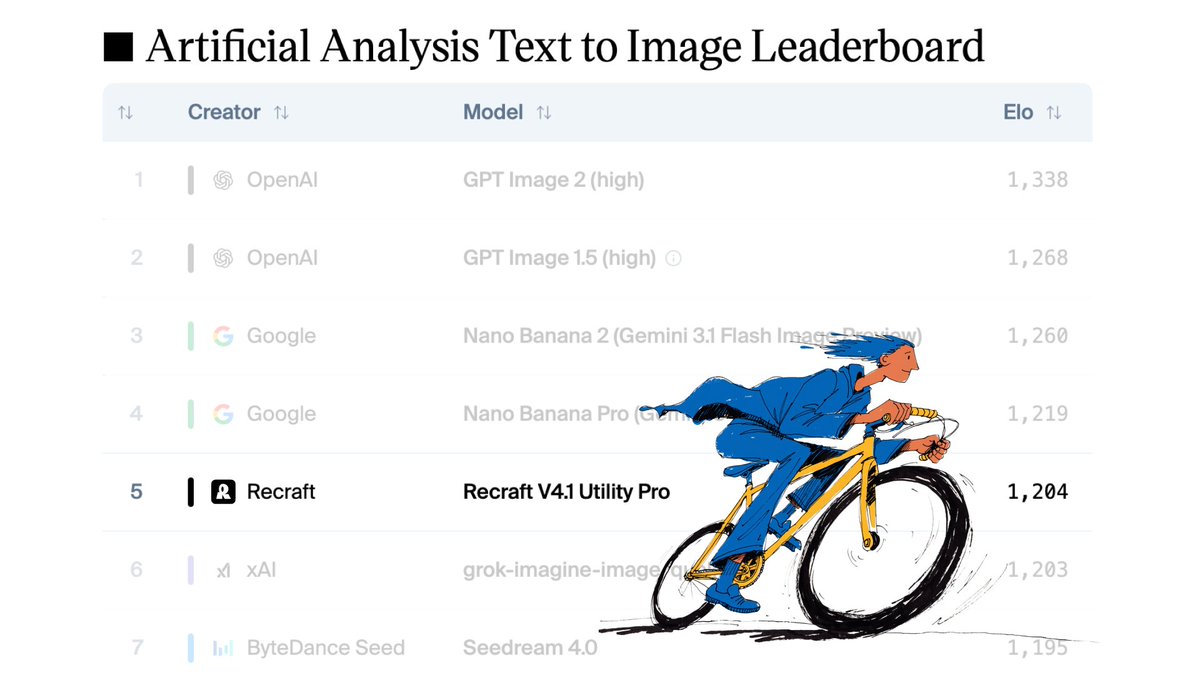
Recraft just hit #1 on public image gen benchmarks — 2 weeks post-launch.
Our @recraftai portfolio company. Founded by the creator of CatBoost. Own foundation model. No API wrappers.
This is exactly what we back at @aal_vc.
My friend and partner at AAL VC, @ashvardanian, already has the code ready before the hardware ships. That's the kind of founder and GP you want ahead of the curve.
Vera nice indeed!
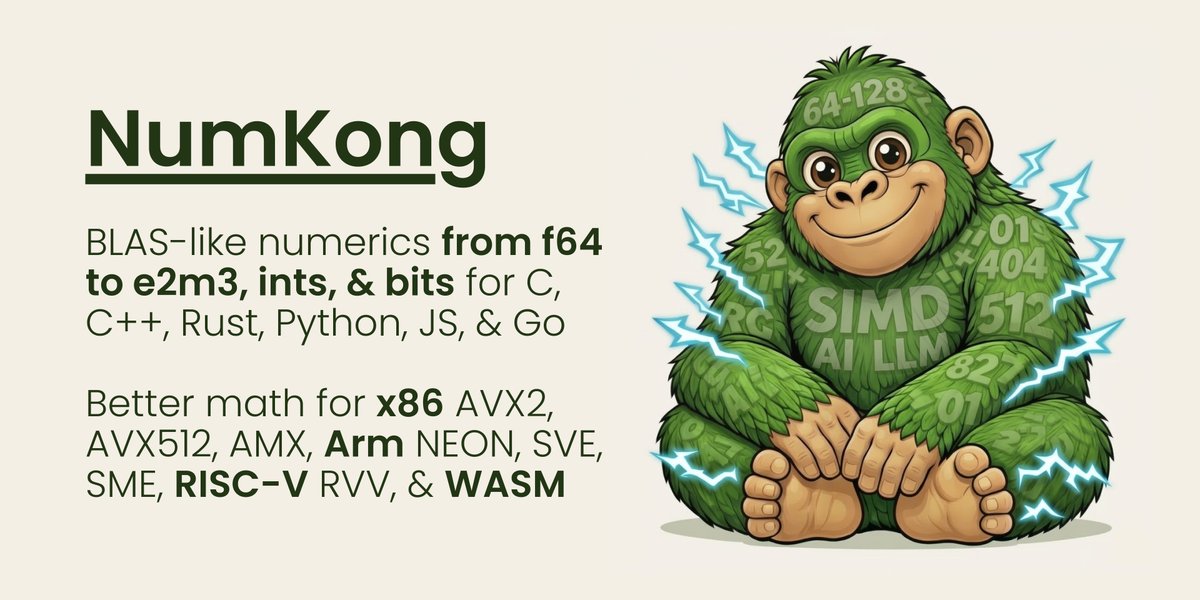
As SpaceX, OpenAI, & Anthropic start getting NVIDIA Vera CPUs, they may soon discover that the only open-source codebase GitHub can find optimized for Vera is my NumKong mixed-precision library 😎
vdotq_f32_mf8 is already there:
https://t.co/l6yaML4jIj
The port-mapping docstring is stale & entirely wrong, but until the hardware arrives, all of us are benchmarking vibes. Will share real numbers once Vera reaches open-source maintainers.
@TheStageAI, an @aal_vc portco, just opened their platform to everyone.
@GarchFather and team built AI compression tech inside Huawei that shipped in millions of phones — now they're making that same power available to every AI developer. The problem they're solving: up to 70% of AI costs are pure GPU infrastructure. Their platform compresses, compiles & deploys models with up to 5x cost reduction. No quality loss. Hours instead of months.
@recraftai already doubled model performance with it. If you're an AI dev or founder tired of brutal inference bills — go try it.
Proud to back xmemory as an @aal_vc portco.
We invested early — before the story was obvious.
Memory is becoming core infrastructure for AI. xmemory is building right at that layer.
We’re excited to share that our team at @xmemory_ai has published our main white paper.
The core idea is simple: without focus, AI systems try to "remember" everything, and that is where they fail. Schema is the best way to teach them focus.
We compared xmemory against major open-source and commercial RAG and hybrid RAG systems, markdown-file memory approaches ("agentic memory"), and memory implementations in customer-facing frontier AI apps. Instead of testing whether systems can recall similar text, we evaluated whether they can store, update, deduplicate, and retrieve facts and relationships reliably.
xmemory achieved 97% accuracy, compared with 87% for the strongest competitor. Our core also outperforms the latest frontier models’ one-shot APIs in extraction tasks, showing that the harness matters just as much as model quality.
We’ve also open-sourced our measurement datasets and a toolkit to generate new ones synthetically.
Huge thanks to the dream team of engineers at xmemory who keep pushing this vision into production. If your company is seeing memory systems fail in real workflows, we’d love to talk.
Thrilled to see @xmemory_ai featured in @BessemerVP’s latest AI Infrastructure Roadmap for 2026.
We’re one of the companies highlighted in Memory, Context, and State Management, alongside seven other strong builders.
What stands out even more than the mention is the broader shift it signals: memory is becoming core infrastructure for production AI.
As AI moves from one-off interactions to persistent, real-world workflows, the systems that win will be the ones that can retain context, manage state, and stay grounded over time.
Proud of what the our team is building, and excited for what comes next.
#AIInfrastructure #Memory #ContextManagement #AgenticAI #EnterpriseAI
Memory is becoming the next critical layer in AI.
Excited to back xmemory — building a precision-first memory layer for AI systems, fixing reliability at the root (the “write path”) instead of patching it later.
$4M pre-seed, strong syndicate — and just getting started.
Proud this is an @aal_vc portfolio company.
Today we’re sharing our first blog post: “Schema as the Core of Reliability.”
Our view is simple:
AI memory breaks down when facts are stored as unstructured text and reconstructed later. That approach can work for thematic recall, but it becomes fragile when systems need to answer exact questions, maintain state, support workflows, and drive automation.
In the piece, we explore why:
- Search can recover context, but memory must support facts
- Graph RAG is a meaningful step forward, but not the endpoint
- Reliable memory needs structure - types, relations, constraints, deduplication, provenance
- Schema is not decoration - it is the contract that makes memory observable, enforceable, and dependable
If AI systems are going to do more than sound coherent - if they are going to make decisions, trigger workflows, and operate over long horizons - memory has to become a governed system of facts.
That is where reliability starts.
Read the full post - link in the first reply.
Some contributions quietly reshape the entire stack.
Huge respect to @ashvardanian for an insane multi-year open-source effort — pushing SIMD, vector search, and numerical computing forward.
Proud to have him as the CTO at @aal_vc.
This is what real infra-level innovation looks like.
My biggest open-source release!
NumKong — 2'000+ SIMD kernels for mixed-precision numerics, from Float6 to Float118.
Started in 2023. Opened the PR in 2024. Finally, merged this week!
RISC-V, Intel AMX & AVX-512, Apple SME & SVE, WASM Relaxed SIMD. 200'000 lines of code in a 5 MB binary. Same scale as OpenBLAS. Available for C 99, C++ 23, Python 3, Rust, Swift, GoLang, & JavaScript.
Int4 dot products via nibble algebra. Ozaki Float64 GEMMs on Float32 tile hardware. 6-bit and 8-bit floats back-ported to 10-year-old CPUs. 5'300x faster Geospatial metrics than GeoPy. 200x faster Kabsch than BioPython. 0 ULP where OpenBLAS hits 56... and a lot more!
pip install numkong
Or pull it from NPM, Crates, GitHub... and let me know what breaks 🤗
Links & highlights ⬇️
The real signal around GTC isn’t just on stage — it’s in rooms like this.
Activeloop convening top builders across AI infra + physical AI.
We invested via @aal_vc with a clear thesis: data infrastructure will define the next decade of AI.
Glad to be part of it.
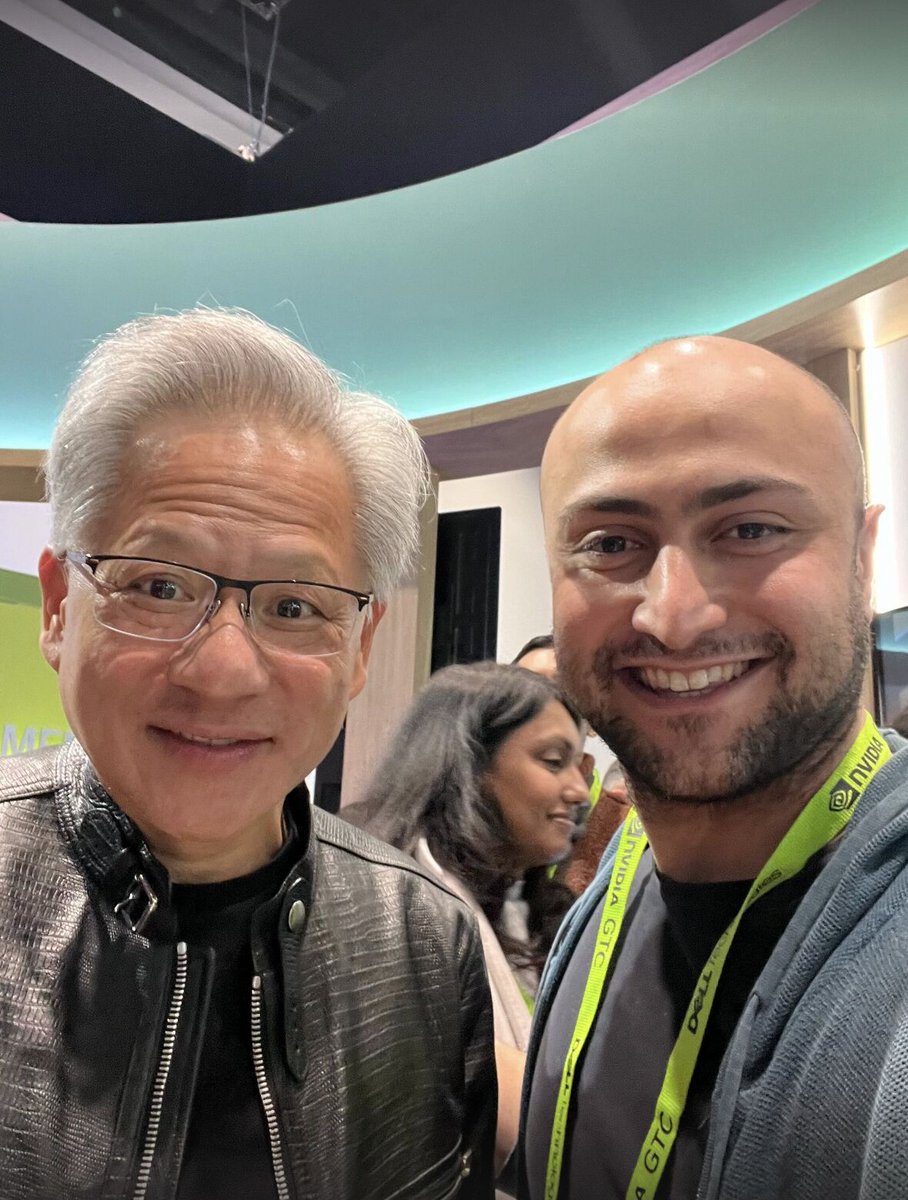
Jensen just announced the start of the GPU-accelerated database era at #GTC26.
AI runs on GPUs. But your data still runs on CPUs.
That mismatch is breaking the AI stack.
For the last two months, we’ve been busy solving this problem.
Excited to announce Deeplake becoming the GPU Database.
Deeplake brings your database directly onto the GPU, eliminating the CPU <-> GPU bottleneck for AI workloads.
The pendulum has switched.
GPU-native queries are now 10× faster and an order of magnitude cheaper to run.
Last week we even put up a 101 banner in San Francisco.
And this is just the beginning.
We’re planning a huge set of announcements starting this week. Stay tuned.
AI apps are getting complex fast.
Not just prompts — but systems of agents, tools, and workflows.
Observability is becoming the bottleneck.
Laminar is building right at that layer. Proud that @aal_vc participated in the round.
Excited to share that @lmnrai has raised $3M to build open-source observability for long-running AI agents.
Laminar is how companies like @browser_use, @OpenHandsDev, and Rye see what their agents are doing, understand why they fail, and spot patterns across millions of runs.
Cinema Studio 2.0 is officially live!
Proud to have @higgsfield_ai in the AAL VC portfolio. Watching @amashrabov and the team bridge the gap between AI and true filmmaking has been incredible.
Seeing directors like Emmy-winning filmmaker Jason Zada use it to remove the "production tax" on creativity is the ultimate proof of concept.
Today is a big day for us.
We've just released SOUL 2, the next generation of our flagship in-house image model.
This is a product we've been working on for the past six months.
A bit of backstory: when we released the first SOUL, the response was absolutely rewarding. It became the go-to model on our platform, and grew into a daily creative tool for hundreds of thousands of people. It was the first image model in the AI space that didn't have the "AI plasticity". It had taste, and we're happy that creators and brands have adopted it for real commercial work.
To take that further, we've worked closely with creatives, art directors, photographers, stylists, and concept artists to build SOUL 2. They helped define what quality really means.
We're very excited for beauty, fashion, and lifestyle brands to adopt Soul 2 for their ideation and photoshoot workflows. And with SOUL ID, we're opening that door even wider, now, anyone can be a model.
Higgsfield built this to bring high-quality artistic taste to AI and let the two worlds elevate each other.
To celebrate the launch, we're giving up to 5,000 free SOUL 2 generations per user, depending on your plan. Can't wait to see what you create.
What started in 2020 as a simple podcast tool grew into Async — an AI studio connecting ideation -> production > localization in one flow.
A good reminder: big AI platforms often start as small, focused tools. Shrink the distance between imagination and output, and creators win.
📷𝐏𝐨𝐝𝐜𝐚𝐬𝐭𝐥𝐞 𝐢𝐬 𝐧𝐨𝐰 𝐨𝐟𝐟𝐢𝐜𝐢𝐚𝐥𝐥𝐲 𝐀𝐬𝐲𝐧𝐜!
No, we weren’t acquired. No, we’re not going anywhere.
Just getting smarter, faster, and fully AI-powered.
Step inside https://t.co/aI8027qPUa unleash your ideas now!
More details coming soon!
📷𝐏𝐨𝐝𝐜𝐚𝐬𝐭𝐥𝐞 𝐢𝐬 𝐧𝐨𝐰 𝐨𝐟𝐟𝐢𝐜𝐢𝐚𝐥𝐥𝐲 𝐀𝐬𝐲𝐧𝐜!
No, we weren’t acquired. No, we’re not going anywhere.
Just getting smarter, faster, and fully AI-powered.
Step inside https://t.co/aI8027qPUa unleash your ideas now!
More details coming soon!
Some news hits differently when you can trace it to real human journeys.
Watching friends like Alexander and Razmig spend years building, betting early, and bridging ecosystems — and now seeing those paths converge in Armenia–US AI momentum — is a reminder: big tech stories are human first. Grateful to witness it.
🔥 Firebird AI 👉 $4B investment in 🇦🇲 Armenia
US @VP@JDVance announced approval of export licenses for Phase 2 of @FirebirdCloudAI’s project-launching the region’s largest AI supercomputer (up to 50,000 @nvidia GPUs) & marking one of the largest 🇦🇲🇺🇸 tech partnerships to date.
“The quality of your life is determined by the quality of the questions you ask yourself.” — Tony Robbins
2026 remix: The quality of your life is shaped by the feedback loop between the questions you ask AI and how you handle the responses.
A few years back I asked a partner at a top VC why they didn’t invest in Europe. His answer stuck with me: “Because there isn’t really a Europe.”
What he meant was the fragmentation — languages, rules, cultures — made it hard for investors to treat the region as one market.
Today that’s starting to change. The European Commission is moving forward with a new EU-wide corporate structure (often called “EU Inc”), a game-changer for scaling startups across borders — harmonised company law, standardised equity frameworks, and interoperable governance.
If implemented well, this could:
• Remove legal friction
• Lower the cost of cross-border growth
• Make European founders more fundable globally
• Reduce the pull toward Delaware as a default legal home
More than policy, it’s infrastructure — and it signals that Europe wants to compete, not just regulate.
Excited to see what this unlocks for founders, VCs, and builders in the years ahead.
The best products of the 21st century have yet to be shipped.
With 21st, any idea can find its aesthetic and design, even if you aren’t a designer.
Meet the first vibe crafting tool for everyone….
So every product can have soul.
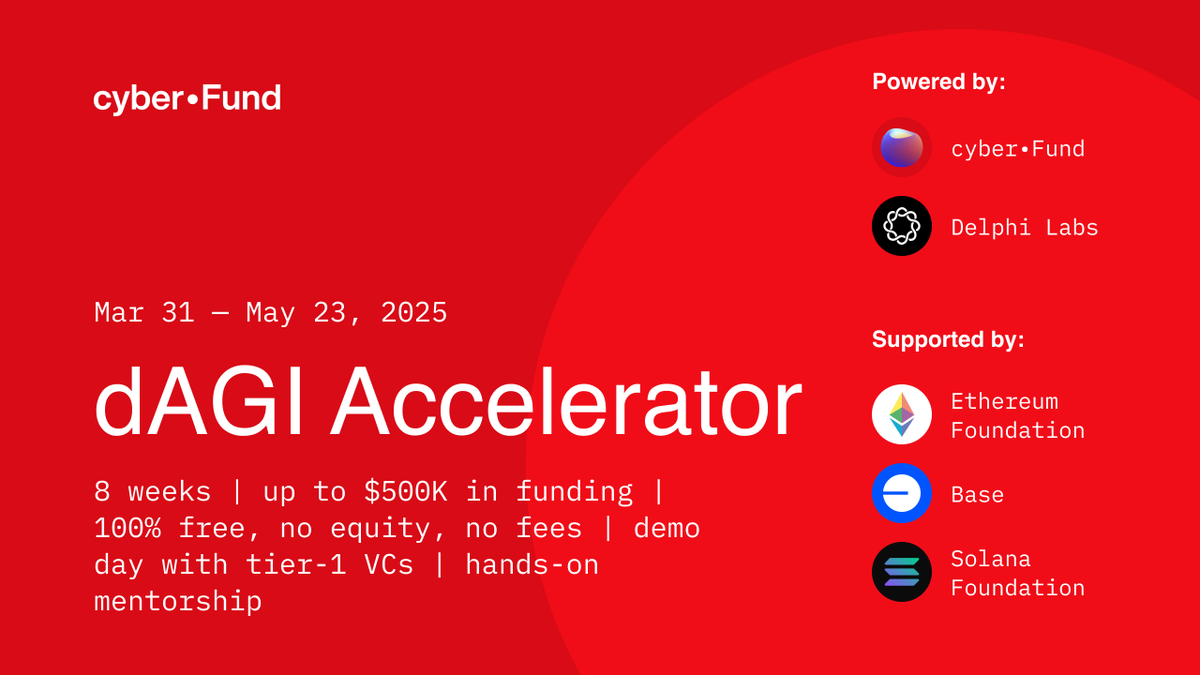
@cyberfund and @delphi_labs announce startup accelerator focused on distributed AI, agents, and on-chain market mechanisms.
Supported by @ethereum, @base, and @solana dAGI Accelerator is going to be the largest program in AI x web3
Apply at https://t.co/Y3pgLvOOvb
🧵👇
Meet red_panda, powered by Recraft ʕっ•ᴥ•ʔっ
Over the past 4 days Recraft V3 participated in the Hugging Face’s industry-leading Text-to-Image Model Leaderboard by Artificial Analysis. It secured #1 place with ELO rating of 1172. Try it now: https://t.co/DDcfXjbKQz
#RecraftAI #red_panda