I created a simple 4-step transformation method. Map the business outcome, understand how the work really gets done, pick tech that fits the process, bring the front line along with MVPs. I write about AI in real operations, power markets, and lean.
@jayvanbavel The tool is neutral. The habit decides. Shortcut use skips the thinking, tutor use builds it. Roll it out without training the habit and you get the shortcut.
@alexandr_wang The word doing the work is 'collaborated'. The machine writes proof sketches, the mathematician checks them. Same split as everywhere: AI drafts, the expert decides.
@greg_ip Capex is a bet. Revenue is the proof. 9% of GDP on AI services means AI would be as big as food and twice energy. Capital gets paid for revenue, not for capacity.
@SteveRattner@nytopinion The split is not white collar versus blue collar. It is defined process versus messy reality. AI does not take jobs. It takes the repeatable part of jobs.
@emollick Well-defined is doing the work in that sentence. The model takes the defined tasks, judgment stays human, and most junior roles are a bundle of both.
Tokens are an input. Finished work is the output. The price of a fixed capability level falls about 13x per year (Epoch AI) while token counts keep rising (a16z: 14x since February). Optimize for cost per completed task.
@rubengarciaes Retries, tool calls, idle work, coordination overhead. The agent economy has the same waste categories as any factory floor. Process thinking applies directly.
@a16z Up 14x since February. Token demand is compounding faster than efficiency gains, which is exactly why the per-task cost matters more than the per-token cost.
@sandislonjsak Tokens are the visible part of the bill. The full comparison is cost per finished task, where the human side includes salary, handoffs, and waiting time.
@antirez Two flat subscriptions beat the API bill until your usage passes a certain point. After that, the meter wins again. It helps to know where your own point is.
@carlquintanilla@business Jobs are bundles of tasks, and a management role is mostly coordination. If the AI takes the reporting and the meeting notes, the question is what is left. This only works if you unbundle the job first and check which tasks stay.
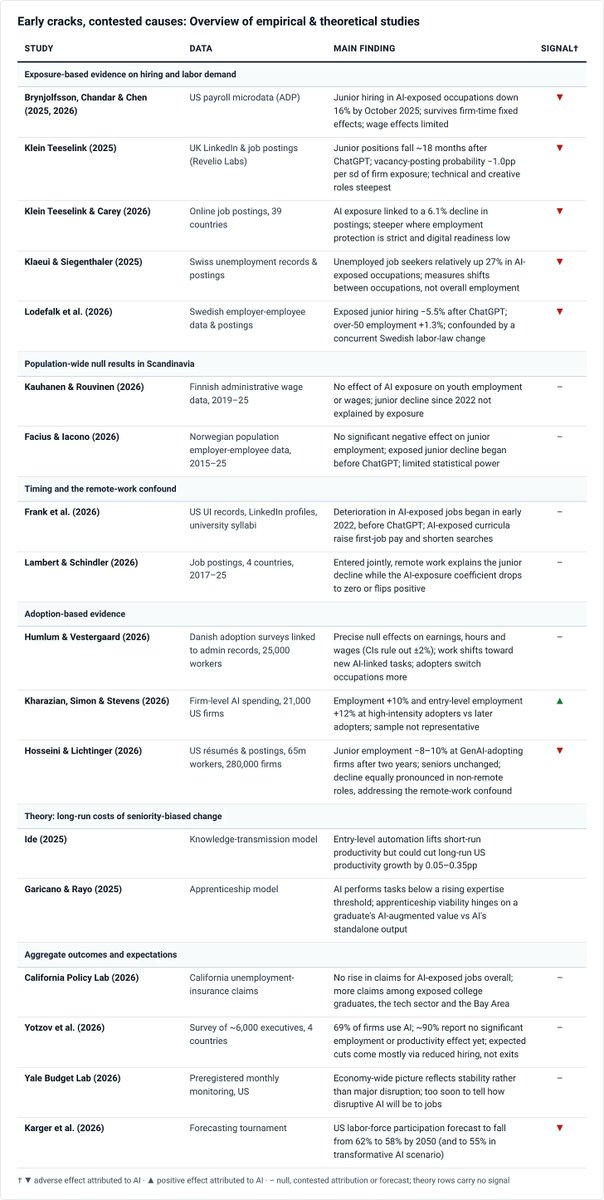
Has AI hit the labor market yet? @alexolegimas and my verdict after ~20 papers: not yet in aggregate. Unemployment and layoffs show almost nothing. But AI may already be cutting junior hiring in exposed white-collar jobs. Remote work may explain part of that decline.
A 🧵