Steve Kerr says coaches who stay awake at night regretting their decisions are really just struggling with their own ego, and says no decision is as important as you think it is in the moment and what really matters is the reasons you have to make those decisions
“I mean, that took me a long time, and I think the last couple years, honestly, I’ve done a much better job with that. I remember reading a couple years ago just the idea that if, as a coach, you’re up all night because of a decision that you made, all that is ego. If you think that your decision as a coach for one play or two plays was so important that the entire game was decided on that, that’s just your ego talking.”
“When I read that, I was like, ‘You know what, that makes perfect sense.’ I learned how to go a little easier on myself. I’ve also learned that every game you make decisions that either work or they don’t work. As long as you have good reasons to make those decisions, then you have to live with the results.”
“And I think part of living with the results is giving yourself a break, just like you give your players a break. Take the pressure off, turn the page, and move on to the next one.”
MSc no. 2 done & dusted! Eternally grateful to @samjermyn , @DrSkillAcq & the top man that is @AlanDunton for their support & expertise. @MScSkillAcq_MTU is the 1st of its kind in the world & I feel immensely privileged to be among an outstanding first cohort to experience it
Seeing the reaction to @DeclanBogue's piece and my own tweets, there is alot of annoyance/anger at the currrent developemt squad system. More than I'd thought.
I will ask one question. If the goal of these squads is to produce more senior players, how effective have they been?
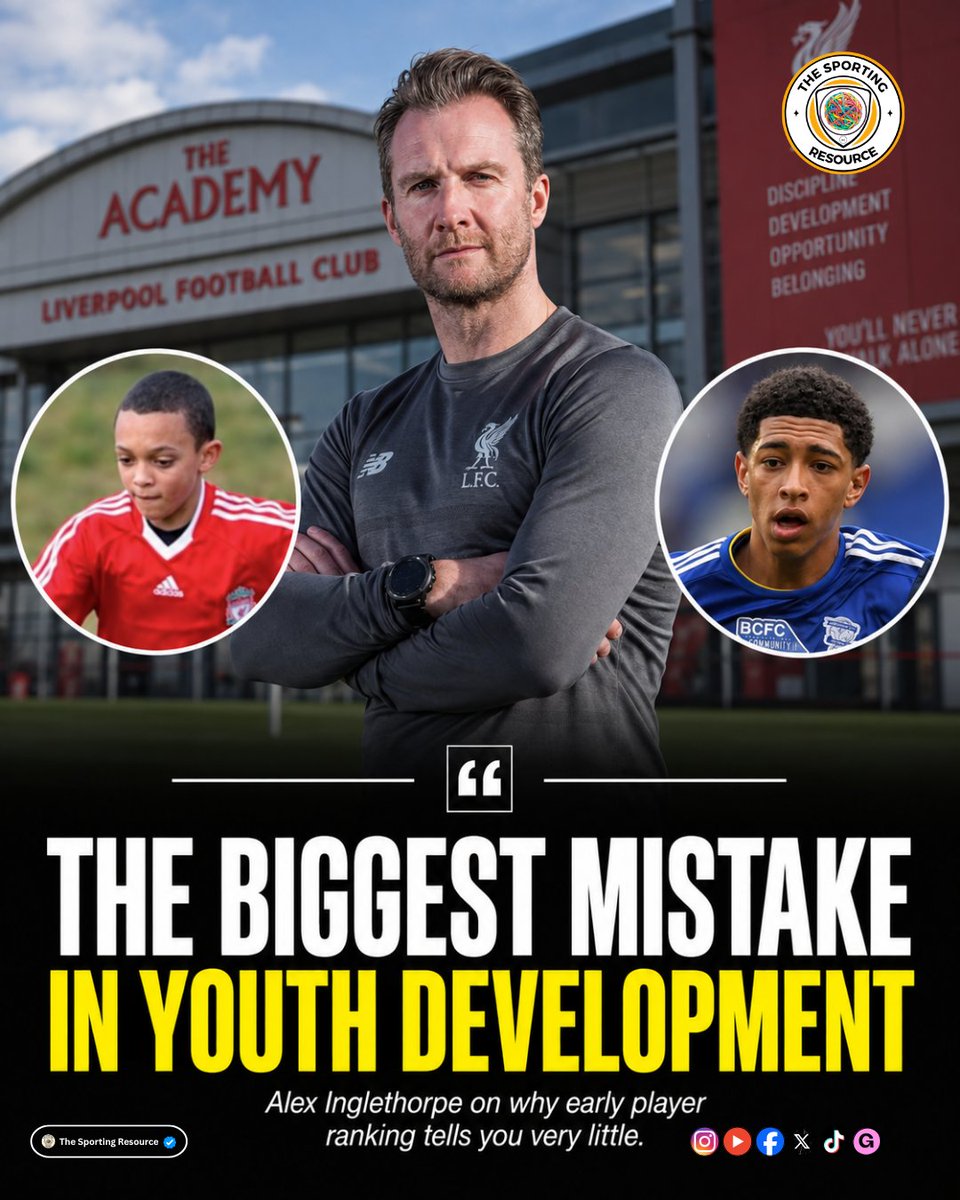
Alex Inglethorpe, Liverpool’s Academy Director, is blunt about early ranking in youth football:
"It can tell you very little about what a player may eventually become."
He discussed this on the High Performance Podcast, using examples from players he had seen develop across academy football.
• Trent Alexander-Arnold wasn’t number one in his group.
• Conor Bradley wasn’t number one in his group.
• Jarell Quansah wasn’t number one in his group at that stage.
You could keep going, every now and again, you get the obvious one.
• Jude Bellingham at Birmingham.
• Wayne Rooney at Everton.
Players who stood out early and continued to stand out, but they are not the only route to the top.
Harry Kane is another useful example.
⤷ At Tottenham around 13, Inglethorpe described him as being somewhere around the middle of the group rather than one of the obvious leading players.
Then Brad Friedel watched him and made a simple observation: “He finishes like Robbie Fowler.”
→ "No big backlift"
→ "Hits the ball hard"
→ "Finds the corners"
That comment changed how Kane was being viewed and that is the wider point. Young players do not develop in a straight line. Physically, technically, psychologically and socially everything can fluctuate.
So judging a player too heavily on where they sit in the group at 9, 11, 12 or 13 risks confusing their current level with their future potential.
The player at the top may stay there and the player in the middle may have far more development ahead of them. The player struggling today may simply be dealing with a physical, technical or experiential gap that looks very different several years later.
The danger is when adults become obsessed with the podium rather than the trajectory.
• Who is currently best?
• Starts all the time?
• Scores most?
• Looks physically dominant?
• Appears furthest ahead?
Those things can be useful information, but they just should not become a verdict.
Inglethorpe’s message is a useful reminder:
"Stop treating a child’s current position in the group as a prediction of where they will finish."
Look at the direction they are moving in.
Rather than focusing too heavily on where a young player is at that moment, look at the direction they are heading, their behaviours, the habits they are developing, how they learn, how they respond to challenge, and how much development may still be ahead of them
This came from Alex Inglethorpe’s appearance on the High Performance Podcast - @mrjakehumphrey :
https://t.co/FsrANpbxzd
We originally shared this post last year, but with more than 10,000 new followers since then, many of you may not have seen it.
As we age, muscle power declines more rapidly than muscle strength, potentially increasing the risk of debilitating falls. This raises an important question: Should older adults prioritize power training in addition to traditional strength training?
Our systematic review and meta-analysis, led by @ExerciseBiology, compared power training—performing the lifting phase of an exercise as fast as possible while controlling the lowering phase—with traditional, slower-velocity strength training. The analysis included 20 randomized controlled trials involving 566 older men and women (mean of ~70 years of age).
Results showed that power training produced a statistically significant advantage across multiple measures of physical function. Although the overall magnitude of the effect was relatively modest (SMD = 0.30), these improvements could conceivably be practically meaningful and potentially help reduce the risk of falls in older adults.
Importantly, power training does not require specialized or unconventional exercises. In most studies, participants performed traditional resistance exercises, with the key distinction being an instruction to lift the weight as fast as possible during the concentric phase while maintaining control during the lowering phase.
Take-home: Traditional resistance training remains highly beneficial for older adults, but performing the lifting phase with maximal intended velocity may provide an additional benefit for muscle power and physical function without compromising strength or muscle development. This doesn’t mean that power training needs to be performed across all sets all the time; simply devoting a portion of training to
I’d the that the certainty of the evidence was relatively low, with most studies involving small samples and relatively short (~12-week) interventions. Thus, the findings should be considered promising rather than definitive.
https://t.co/PFh9lmhqv8
@mrcolmcrowley Hi Colm, fair question. 🙌🏻 It doesn't look like they counted the failed efforts in this particular study. Would be an interesting one though, but maybe too open to subjective interpretation too?
1st Touch: control of a fast moving ball using the hurley, where the ball touches the hurley once and is then caught.
Despite being often stated as the most important skill in hurling a study published earlier this year showed on average it occurs only once per player per game.
@ppoleary Very true, still, what a player believes or perceives as adequate preparation needs to be taken into account too. God knows there’s plenty of random stuff going on in other sports that “prepare” players too 🤛🏻
@drjohnmccarthy Hi John, the main aim of the study was to compare different skill executions in varying positional areas on the pitch as well as differences in League compared to Championship. They didn't go into detail on what these skill executions led to though. 👍🏻
Athletic development for a 5-year-old shouldn’t look like athletic development for an adult.
At 5–11, the focus should be much simpler:
Run. Jump. Hop. Stop. Crawl.
Do lots of it, in lots of different ways, and make sure they enjoy doing it. 🧵
The study suggested coaches focus on the development of both the jab lift and catching skills as methods of gaining possession as previous findings showed winning teams have a greater number of possessions compared to losing ones.
Traditional coaching:
“I know the solution → I teach the solution → players reproduce it.”
Complex-systems coaching:
“I know the principle → I create the problem → players explore → solutions emerge → I adjust the environment → the team becomes more adaptable.”
I think it’s time for pro and college coaches who design and implement these activities to step forward and explain why.
What we are all interested in is the rationale behind the activity.
I feel a lot of football coaching is just conditioning and not game related.