In a letter to Biden, progressive groups warn a "Cold War mentality" dooms climate action, but the best thing U.S. & China can do is meet their own carbon goals; competition will do that better than cooperation w/out compromising security or human rights.
https://t.co/mtHxrrkI50
As I told the @WSJ for this piece, compressing the sensor-to-shooter cycle is one of the defining trends of the ongoing war in Ukraine at the tactical level. Notably, Russian forces appear to have encountered difficulties in recent weeks sustaining a rapid tempo in closing kill chains. https://t.co/ZzgHejuNBf
Shashank picked up on my idea of the "Belloc syndrome" that our vision of the future of warfare in the US and Europe, built on accelerated kill chains, masses of networked manned and unmanned systems, multi-domain operations, information superiority and the rest, triggers: "Whatever happens, we have got the Maxim gun, and they have not." Our belief in inherent technological and tactical superiority convinces us that we are going to win no matter what and lets us lose operational art (which I doubt AI decision-support tools will replace any time soon) and the ability to fight successfully at the operational level of war, meaning the ability to conduct a campaign that goes beyond working down target sets and to link that campaign to successful war termination at the strategic and political level. It does so because our technologically driven understanding of warfare creates the illusion that there are no or perhaps fewer tradeoffs to prioritise and no need to solidly define clear objectives, which is what strategy is actually about.
Lots of confusion about how China is able to cut seaborne oil imports so drastically. I think a significant blind spot in most analysis is China's stockpiles of refined products. These are reported in China's official energy data. 🧵
https://t.co/acQhxG9YzD
Naval War College Review
Volume 79, Number 2 (2026) Spring 2026
The Naval War College Review shifts its focus to artificial intelligence and drone warfare in this Spring 2026 issue.
Full Issue: https://t.co/fNVwJz5aQ3
Counterintuitive reality: Iran may be winning the war strategically
The regime is consolidating power, fracturing the U.S.–Gulf coalition, and driving global energy shocks.
Meanwhile Washington believes escalation will restore control.
History suggests the opposite
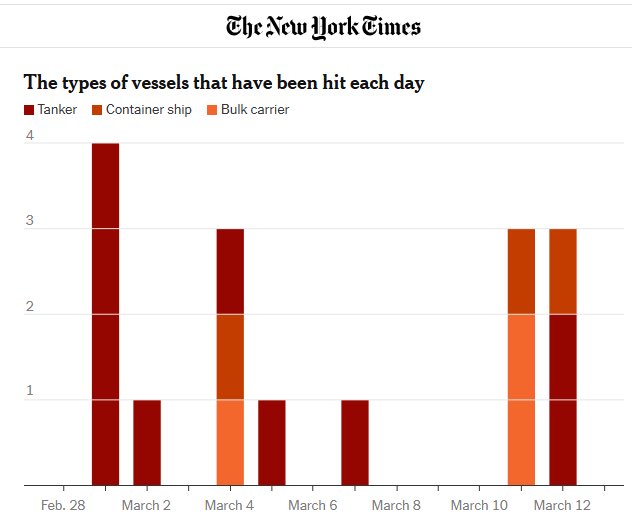
Iran hit 16 vessels so far in Strait of Hormuz. That’s all it takes for Iran to control 20% of the world’s oil and become an oil hegemon — the number 1 strategic outcome US has sought to prevent in Middle East since 1970s. Iran is not weakening— it is gaining power.
The @WSJ’s @yarotrof just published a story on a war game I participated in back in December 2025, in which I played the Russian chief of the general staff and developed a plan to establish a humanitarian corridor in the Baltics using four combined-arms armies and additional forces. https://t.co/2Qx88GuljF
I believe everyone is entitled to their own views and also understand that people may apply different standards of inference and judgment. That said, this thread misreads the sources I cited and applies standards of evaluation that are inconsistent with the publicly available evidence.
Let me start with the factual misreading of my sources.
Regarding the claim that I relied on a single photo to argue that Zhang Youxia turned his back on Xi Jinping at the 2025 Two Sessions: anyone who clicks my original link will immediately see that it is not a photo but a video, and that Zhang Youxia’s behavior involved having his back to Xi Jinping throughout, rather than a momentary or accidental action. This account clearly did not click the link and instead brushed it off as a “joke.” What is especially striking is that the person took the time to search for a still image online but did not bother to open the linked video.
The video I cited in my China Brief article is here:
https://t.co/WMk0iRXX4Z
On the Substance of the Argument (Which I Respect, but Disagree With)
(1)
We all know that Xi Jinping places paramount importance on political authority, and Zhang Youxia would certainly be aware of this. I recognize that Zhang has repeatedly referenced the CMC chairman responsibility system and consistently praised Xi Jinping in the past. However, in major CCP political settings, this language is not optional—it is a mandatory element of personal political signaling and cannot simply be omitted. Just as the 20th Party Congress report had to mention the CMC chairman responsibility system, it could not be skipped. In Zhang Youxia’s previous speeches at the Two Sessions, he did include it. In 2025, he did not.
(2)
As for the possibility that the readout was shortened, that would have been a decision made by editors at official state media. It is difficult to believe that editors would deliberately delete the most fundamental principle governing the PLA—the CMC chairman responsibility system.
(3)
In the readouts of Central Military Commission members’ speeches at the 2025 Two Sessions, the CMC chairman responsibility system appears in the remarks of He Weidong and Zhang Shengmin, but not in those of Zhang Youxia and Liu Zhenli. It is difficult to believe that PLA Daily editors would remove the CMC chairman responsibility system from Zhang Youxia’s and Liu Zhenli’s remarks while retaining it in those of He Weidong and Zhang Shengmin. I find it far more plausible that Zhang Youxia simply did not say it, which is why PLA Daily did not include it.
(4)
As for the argument that one must examine the full speech text: in the absence of any publicly released video of Zhang Youxia’s remarks, even the full readout could have been edited. Yet the text retains repeated references to Xi Jinping, along with various laudatory descriptions and policy phrases, while the seven-character phrase 军委主席负责制 is omitted. That is difficult to reconcile.
(5)
My article does note that “building a frugal military” appeared in Zhang Youxia’s November 2025 People’s Daily article. However, it is indisputable that Zhang did not include it under the section labeled key tasks (重点任务). This stands in clear contrast to the emphasis placed on the issue in Xi Jinping’s Two Sessions remarks and in the defense section of the 15th Five-Year Plan report. You are free to argue that Zhang still personally considered frugal military construction important, but you cannot deny that he did not categorize it as a “key task.” That is an inference on one side; it is a matter of record on the other.
Some people may be misunderstanding my argument.
In the article, I did explain that Xi Jinping moved against Zhang Youxia because Zhang did not follow his directives, which naturally involves issues of suspicion and power consolidation. In Chinese discourse, this is framed as trampling on the CMC Chairperson Responsibility System. More importantly, this defiance was linked to force-building and war preparedness, especially differences over how to approach the 2027 timeline.
I do recognize that political purges do occur within the CCP, but I don’t think they happen without specific reasons—unless we assume that Xi simply woke up one morning and decided, out of the blue, to purge Zhang Youxia. If that were the case, an obvious question would be: why not do it earlier?
Unfortunately, some reactions seem to be based mainly on the headline or the summary, rather than on the full argument presented in the article. I think this may be an issue with how I presented the argument, and I apologize for any confusion.
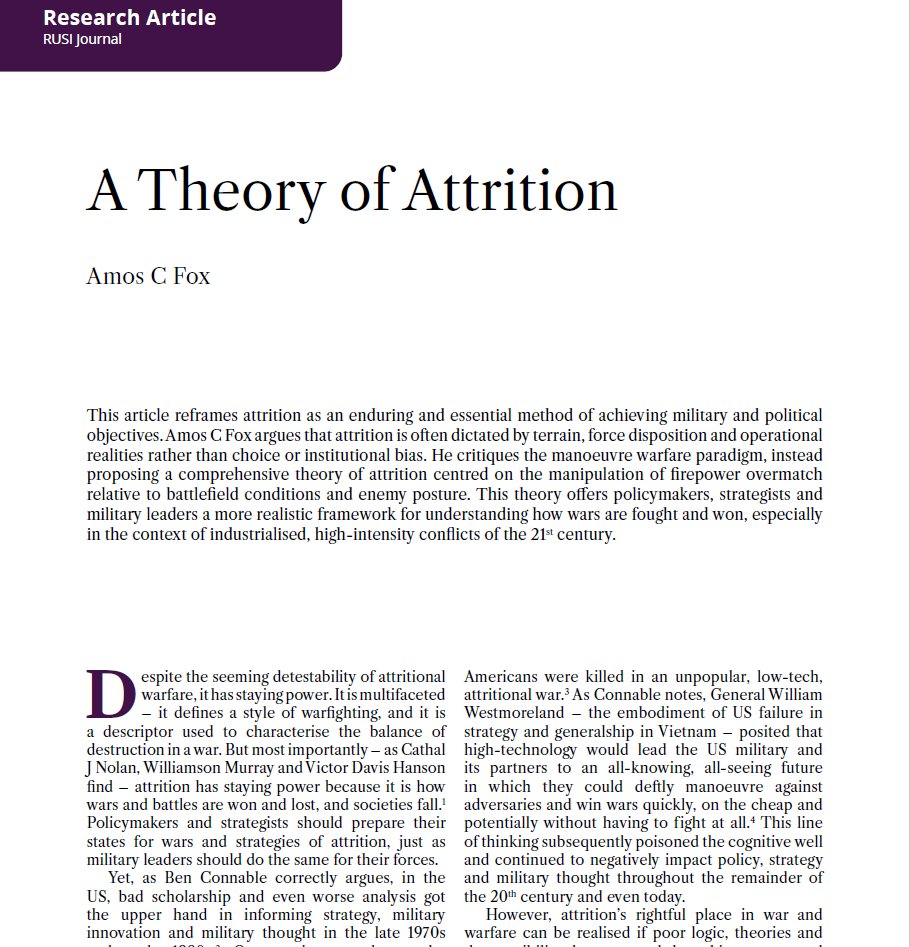
My latest peer-reviewed article - "A Theory of Attrition" - is available.
Thanks to @RUSI_org Journal for publishing this article.
You can find it here. Send me a message if you can't access it.
https://t.co/vASWj9FRkl
Some very brief thoughts on the Navy force design discussion: "But I think as a whole the direction the US Navy’s force design is going is defensible if you understand how these pieces go together."
https://t.co/jTyT4NuZjl
In which we take a hard look at Multidomain Operations and ask whether it is genuinely the right framework for 21st-century conflict—or a concept rushed into service without adequate intellectual or empirical grounding.
I have directed a new Frigate class as part of @POTUS Golden Fleet. Built on a proven American design, in American shipyards, with an American supply chain, this effort is focused on one outcome: delivering combat power to the Fleet fast.
@BDHerzinger @nstratm I don't think the practical half of the course could be effectively delivered online. In any case the demand is recognized and they are working to expand convenings.
China is developing a new CG (guided-missile cruiser) with a displacement of 25,000 t. It features an integrated electric propulsion system and is equipped with laser weapons, electromagnetic railguns, and naval mid-course interceptor missiles, the HQ-19 anti-ballistic missile.
Just published in digital form: the revised, expanded, and illustrated history of the Naval War College, 1884-2009, now in two volumes:
https://t.co/KsZrcE94Oj
Many thanks for this canonical chronicle of @NavalWarCollege history, @JHattendorf!
It's wonderful to see the @ChinaMaritime Studies Institute's founding & early years documented in "Filling a Critical Gap" on pp. 546-549:
https://t.co/QiZHwX45Ar
I posted related memories on the 20th anniversary of #CMSI's founding within the #NavalWarCollege on 1 October 2004:
https://t.co/6CfIBneAGf