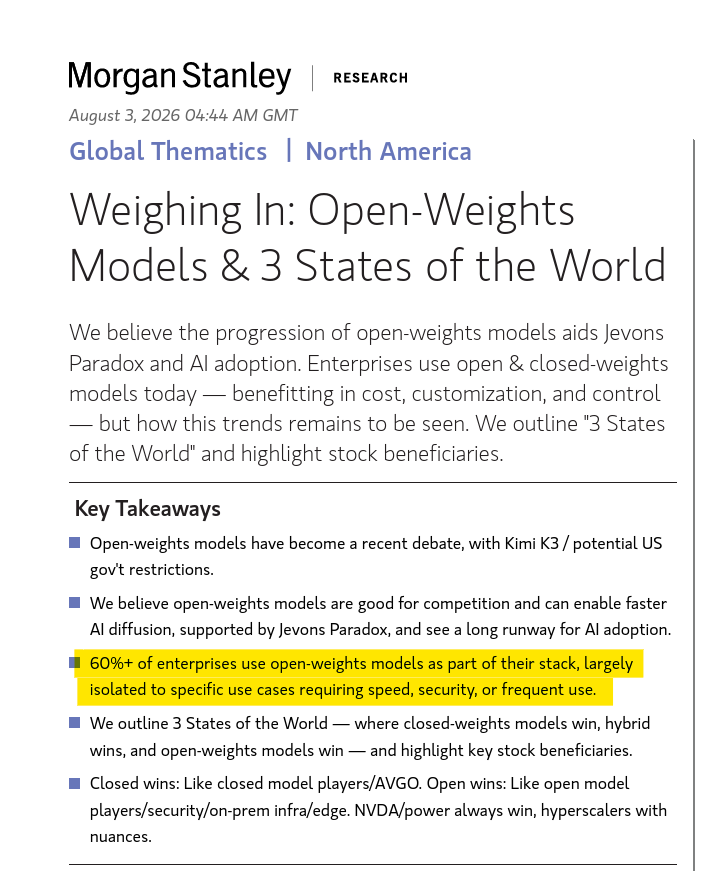
LTAs are now percolating down to next tier. This will benefit many players including but not limited to WFEs ( $AMAT $ASML $LRCX ), Substates / Chemicals ( Shin etsu, Ohka Kogyo), Adv packaging ( $AMKR ASE)
Microcosm of where AI/Semi as a theme is right now. What breaks this?
Having a MOAT in business commands a premium.
If another company can come in on day one and take away meaningful market share from you, the MOAT is not there.
$PLTR, $SPCX, $GOOGL, $META, $AMZN, $TSLA, $AAPL and $NVDA are great examples of businesses that are highly insulated from their competitors because they have businesses that are extremely sticky and hard to surpass.
Invest in companies where even if there are competitors, you thrive because their products and services are second to none.
Here is my full portfolio for 2026:
1) AI enablers
These are, of course, stocks that aid the AI buildout.
We have already run massive numbers, but I think that will continue to happen (for now).
So, here's my list of stocks that I'm betting on doing well:
$MU, $NBIS, $CRWV, $SIVE, $KEEL, $OPTX, $ASYS, $AAOI, $BRUN, $MRLN, $SHMD, $AXTI, $AIP, $IREN.
2) AI beneficiaries
These stocks bank off the fact that people have been rotating to AI enablers.
And, as a byproduct, have been oversold.
Many of these stocks are consolidating at very attractive levels, although they are only getting better business wise.
So, I'm buying them.
Here's my list:
$NOW, $DDOG, $CRM, $TEAM, $SHOP, $RDDT, $ZETA, $HUBS, $FIG, $DUOL.
3) AI distributors
These stocks are companies that will distribute open source AI in the best manner possible.
They're less risky, less rewarding.
But I still think they're worth holding in a portfolio.
Here's my list:
$META, $AAPL, $GOOGL, $AMZN, $MSFT, $SPOT, $SNAP.
4) Crypto
As I've previously stated, this industry has had so much FUD spread around it.
Yet it's still consolidating above its previous all time high level.
Now is the time to be buying crypto related stocks (and crypto), in my opinion.
Here's my list:
$HYPE, $PURR, $CYPH, $ZEC, $BTC, $SOL, $COIN, $HOOD, $MSTR.
5) Robotics
I'm not buying humanoids.
Not yet at least.
I am buying the parts that humanoid robots need.
Because demand for those will increase no matter what, in my opinion.
Here's my list:
$AMBA, $OUST, $VPG, and most importantly $HSAI.
Everyone has been asking.
So I delivered.
Every stock position is split equally.
If you hold this portfolio, you should do very well.
Until next time, I'll be posting exits/entries on these names soon.
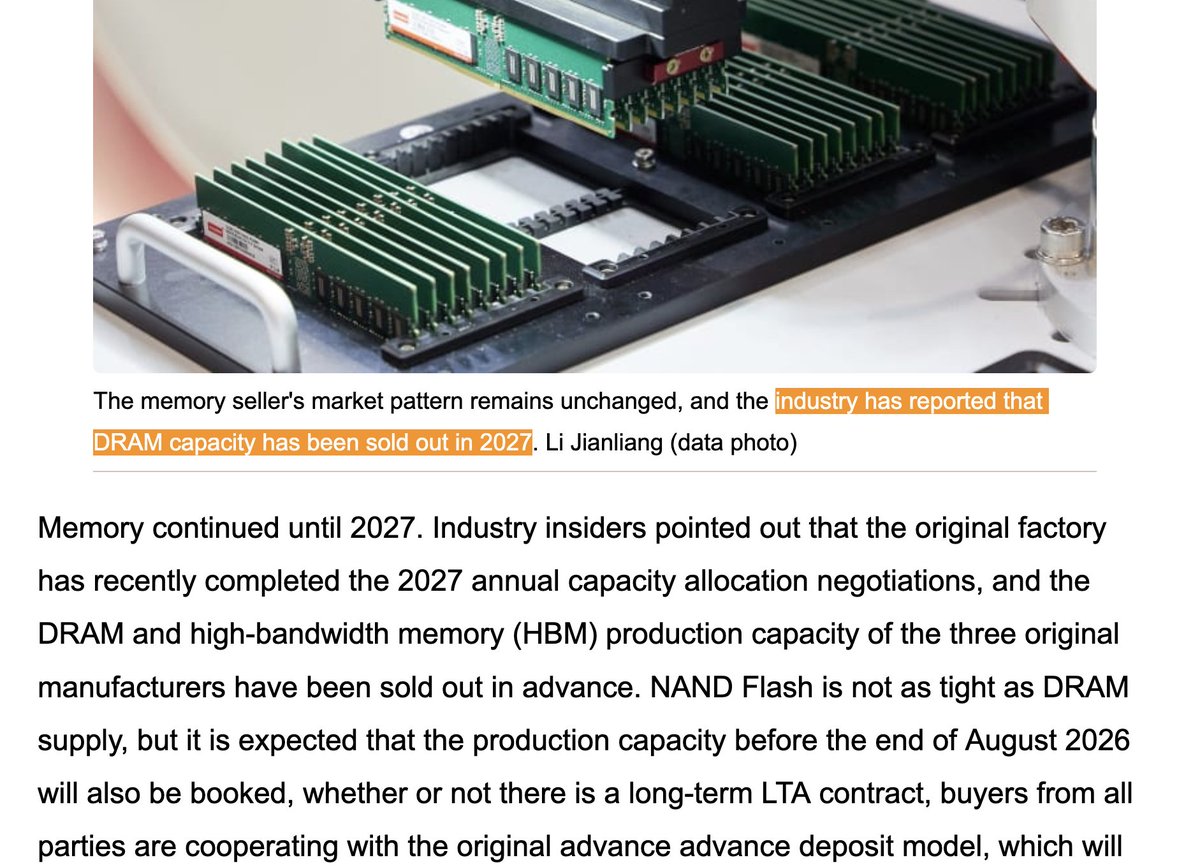
SK Hynix, $MU , and Samsung have sold out of 2027 capacity for DRAM/HBM.
$SNDK, Samsung, Micron current annual NAND capacity has been sold out, with Kioxia and SK Hynix expected to finalize allocations by August 2026.
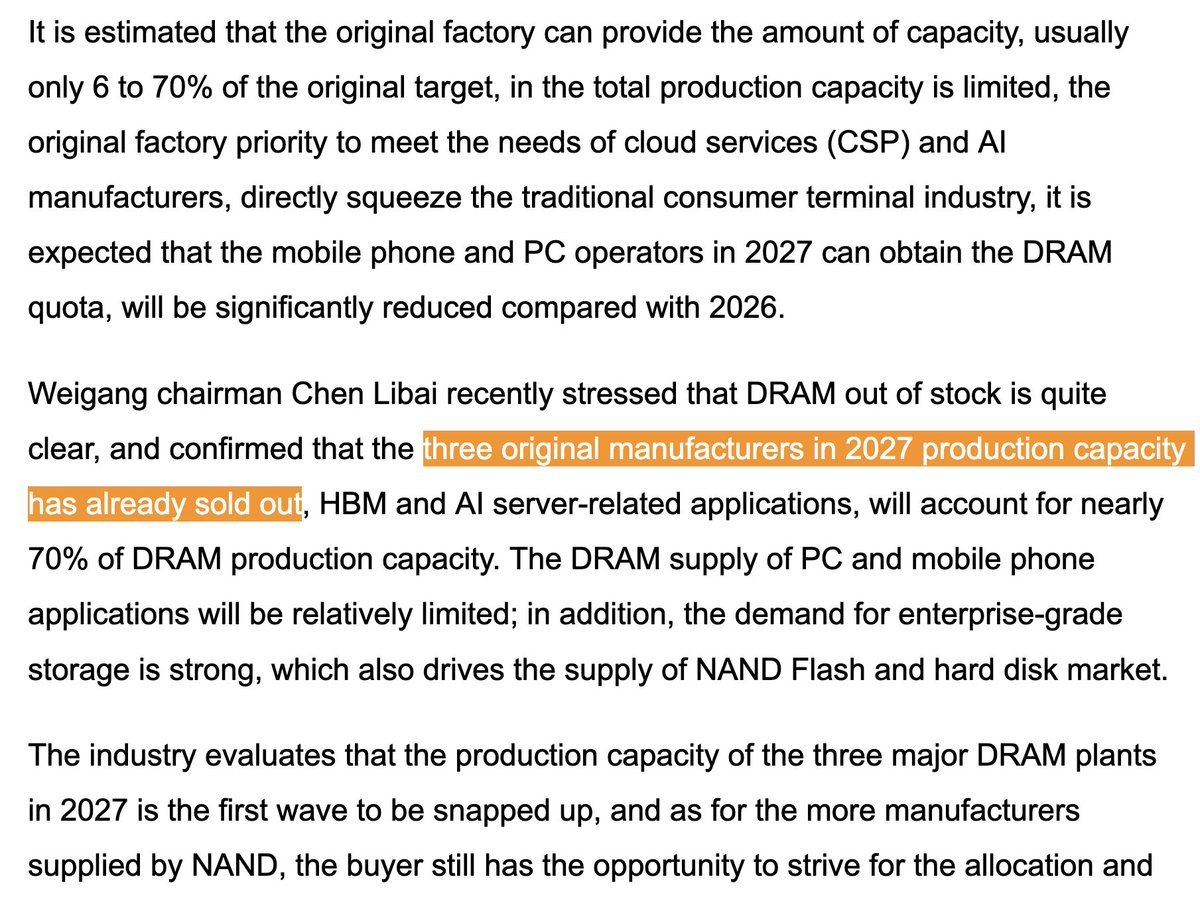
- Customers are being allocated only 60–70% of the volumes they initially requested
- industry insiders pointed out that 2027 will enter the most severe moment of memory shortage
- Allocation amounts are mostly decided, but final shipment pricing will be determined closer to delivery
Source: Digitimes, citing industry sources.
Hard to see those memory "oversupply" claims in early-mid 2027 when they're all sold out of capacity already.
The AI bubble callers just got destroyed by a single chart and here's exactly why.
GPU rental rates have been climbing steadily all year even as more compute capacity keeps coming online and that combination is the opposite of what you'd expect if AI infrastructure were being overbuilt.
Since January, A100 rental rates are up 23%, moving from $1.30 to $1.60 per GPU hour, while H100 rates climbed 25% from $2.15 to $2.70.
B200 rates jumped even harder, up 27% from $4.40 to $5.60, after briefly spiking above $6 in March, and even the newer H200 chip has risen from around $2.60 in May to roughly $3 today.
Here's why that matters so much because if AI data center capacity were actually outrunning demand, prices for renting these chips should be falling since more available supply normally pushes prices down.
Instead, prices are grinding higher across every single chip generation tracked, from the oldest A100 all the way to the newest B200, which is strong evidence that demand for AI compute is still outpacing the massive buildout everyone keeps calling a bubble.
The A100 and H100 are now multi year old chips that should theoretically be getting cheaper and less relevant as newer hardware ships, yet their rental prices keep climbing too.
That pattern suggests something structural is happening because better optimizations are extending how long these older GPUs stay useful, letting operators squeeze more revenue out of the same chip over a longer period of time.
That has a knock on effect that matters enormously for how investors should think about depreciation.
If a GPU can generate strong rental income well past the three year window Wall Street typically assumes for AI hardware, then all those worries about AI infrastructure companies over depreciating their assets and destroying margins start to look overblown.
This is exactly why I remain so bullish on Nebius because rising GPU rental rates make every deployed GPU more valuable over time.
Bullish on Nebius, make sure to follow @MelvinInvests for more AI infrastructure insights, and if you want to see exactly what I'm buying as an analyst at Milk Road Pro, you can check out the link below for more.
These 10 stocks will dominate entire market in the long run.
1. $TE | Second-largest American-owned solar module maker by U.S. capacity. Key catalyst is Austin solar-cell production launch.
2. $NBIS | Full-stack AI cloud and GPU infrastructure provider.
3. $PLTR | AI software leader serving governments and enterprises. Q2 2026 revenue surging 93% YoY.
4. $HOOD | Global financial brokerage, crypto, prediction markets and private markets.
5. $AAOI | U.S.-based optical networking supplier powering AI data centers. Key catalyst is its 800G volume ramp and expanding 1.6T transceiver production capacity.
6. $IREN | Vertically integrated AI cloud and data-center operator.
7. $CIFR | Industrial-scale AI and HPC data-center developer transitioning beyond Bitcoin mining. Key catalyst is initial Barber Lake and Black Pearl capacity delivery expected in September 2026.
8. $CCXI | Humanoid-robotics leader Agility Robotics.
9. $SNDK | NAND flash and enterprise SSD leader benefiting from AI-driven storage demand.
20 Best Plays — Strong Fundamentals
Foundry / Equipment
$TSM — record foundry demand, 3nm/2nm leadership, Strong Buy consensus street-wide
$ASML — raised 2026 guidance twice; gross margins improving to 54–56%
$AVGO — guiding AI semi revenue +200% YoY to $16B this quarter
Memory
$MU — guiding to a ~$50B revenue quarter, HBM demand still outstripping supply
$SNDK — enterprise SSD/NAND pricing power intact post-earnings
$AAOI — optical component demand tracking hyperscaler buildout
Networking / Photonics / CPO
$CRDO — 1.6T interconnect ramp, flagged as a top August networking name despite pullback
$COHR — optical/photonics diversification into AI datacenter
$POET — CPO licensing pipeline still the long-duration story
$MRVL — custom silicon/networking design wins with hyperscalers
NeoCloud
$CRWV — GPU-cloud demand still exceeding supply per capacity commentary
$NBIS — European AI cloud expansion continuing
$IREN — diversifying from mining into AI compute hosting
Nuclear / Energy (Silicon-to-Substation)
$CEG — nuclear PPAs with hyperscalers remain the anchor thesis
$OKLO — SMR pipeline still expanding on data center power demand
$VRT — thermal/power infrastructure order book intact
$GEV — grid equipment backlog benefiting from AI power buildout
Space / Physical AI
$RKLB — launch cadence and government contract wins
$ASTS — direct-to-device satellite commercial rollout progressing
Mega-cap Anchors
$GOOG — hyperscaler capex raise despite the negative FCF quarter narrative
$PLTR — AI software/infra demand pull-through, flagship long-term position
Korea, Eugene Investment & Securities: On the NVIDIA Rubin Ultra HBM despec
NVIDIA appears to be discussing a plan to configure the main version of Rubin Ultra with a 2 die structure, HBM4 8Hi, and 8 stacks, and to add an HBM4E 8Hi version at a later point. Assuming NVIDIA's 2027 CoWoS capacity allocation is 1,200k, NVIDIA's accelerator output is estimated at 9.9M units and Rubin Ultra output at 1.6M units. If Rubin Ultra shifts from HBM4E 12Hi 384GB to HBM4 8Hi 192GB, NVIDIA's 2027 HBM demand would be revised down by roughly 10%, from 24.1bn Gb to 21.6bn Gb, and total HBM demand could decline by about 4%. Of course, this assumption does not reflect the possibility of a further expansion in accelerator output.
That said, we judge this despec to be a strategy for producing more accelerators out of a limited pool of HBM bits, as the increase in HBM supply from DRAM makers has failed to keep pace with the speed of TSMC's front end and back end capacity expansion. DRAM makers find it difficult to expand HBM capacity flexibly because of the extreme shortage in commodity DRAM. With consumer set makers in smartphones and PCs experiencing production disruptions due to memory shortages, it is also not easy for memory makers to cut allocations to these customers any further.
DRAM updates:
1/ Everyone knows 2027 memory is sold out. That's not the news. The news is the 2027 allocation round already closed, quietly, in July and August.
2/ Nobody is publicizing their allocation.
3/ Deposits are now universal. Even small buyers who'll never get a 3-5 year LTA are wiring cash upfront to hold a slot.
4/ Volume is locked, price is not. 2027 DRAM and NAND ASPs get set near shipment. Anyone assuming LTAs cap the upside has it backwards. The suppliers kept the optionality.
5/ Fill rates running 60-70% of what buyers asked for. HBM and AI server now take ~70% of DRAM capacity, up from ~60% earlier this year. PC and phone get the leftovers.
6/ NAND 2027 is closed at Samsung, Micron and SanDisk. Kioxia and SK Hynix by end of August.
Bears will say it's priced in. What changed is the mechanism. The only question left is ASP. Volume is done being a question.
DigiTimes: 2027 DRAM/HBM capacity already sold out
According to a DigiTimes report, annual 2027 DRAM and HBM capacity has been fully booked out ahead of schedule.
NAND flash supply isn't as tight as DRAM, but bookings are expected to be completely filled by the end of this month.
Per sources cited by DigiTimes, companies aren't openly acknowledging that they need to lock in memory by this month — because they worry that if more players pile into the scramble for supply, their own allocations will shrink.
Manufacturers also typically deliver only 60–70% of the volumes buyers originally requested, as memory makers prioritize demand from CSPs and AI majors. As a result, the DRAM volumes smartphone and PC makers can secure in 2027 are expected to fall markedly versus 2026.
DigiTimes, citing industry sources, noted that with capacity now effectively almost entirely sold out, companies that have yet to finalize their volumes could face an even more acute "can't buy it even if you want to" situation in 2027.
The report added that elevated memory prices are set to become the norm. While the sharp price spikes driven by the fight for allocation may subside — meaning the magnitude of 2027 price increases could be more moderate — the overall supply shortfall and the cost burden on the finished-goods industry are unlikely to be resolved in the near term.
Morgan Stanley: Cloud CapEx
Cloud Capital Expenditure (Capex) Surges
> Massive Uptick in 2027 Forecasts: Following recent US hyperscaler earnings, consensus for 2027 cloud capex has jumped significantly. The forecast is now tracking at approximately $1.2 trillion, a growth of around 30% year-over-year. This is a dramatic increase of about $170 billion and 15 points higher than predictions made just before the recent earnings.
> A "too conservative" Consensus? While the current forecast predicts a slowdown in growth (to 29% Y/Y) for 2027 after an incredibly strong 2026, the report suggests this may be an underestimate. Morgan Stanley's own estimate is even higher at $1.4 trillion. The authors also note that aggregate estimates for the top 14 spenders have gone up in each of the last ten quarters.
> The AI Impact: The sharp increase in spending, which is ~4x the historical capital spending intensity average for the sector, is clearly fueled by investment in artificial intelligence. The text notes that the current 2027 growth forecast of 29% implies that non-AI cloud capex growth would be just 7%.
> Historical Spending Patterns: A historical chart shows the highly cyclical and recently explosive nature of this spending. Growth was modest for years, with negative growth as recently as 2019 and 2023, before skyrocketing to a projected 97% in 2026 and then potentially cooling to 29% in 2027 (though, as mentioned, that 29% figure is up significantly from a forecast of 14% just a month ago).
$GOOGL $AMZN $MSFT $META
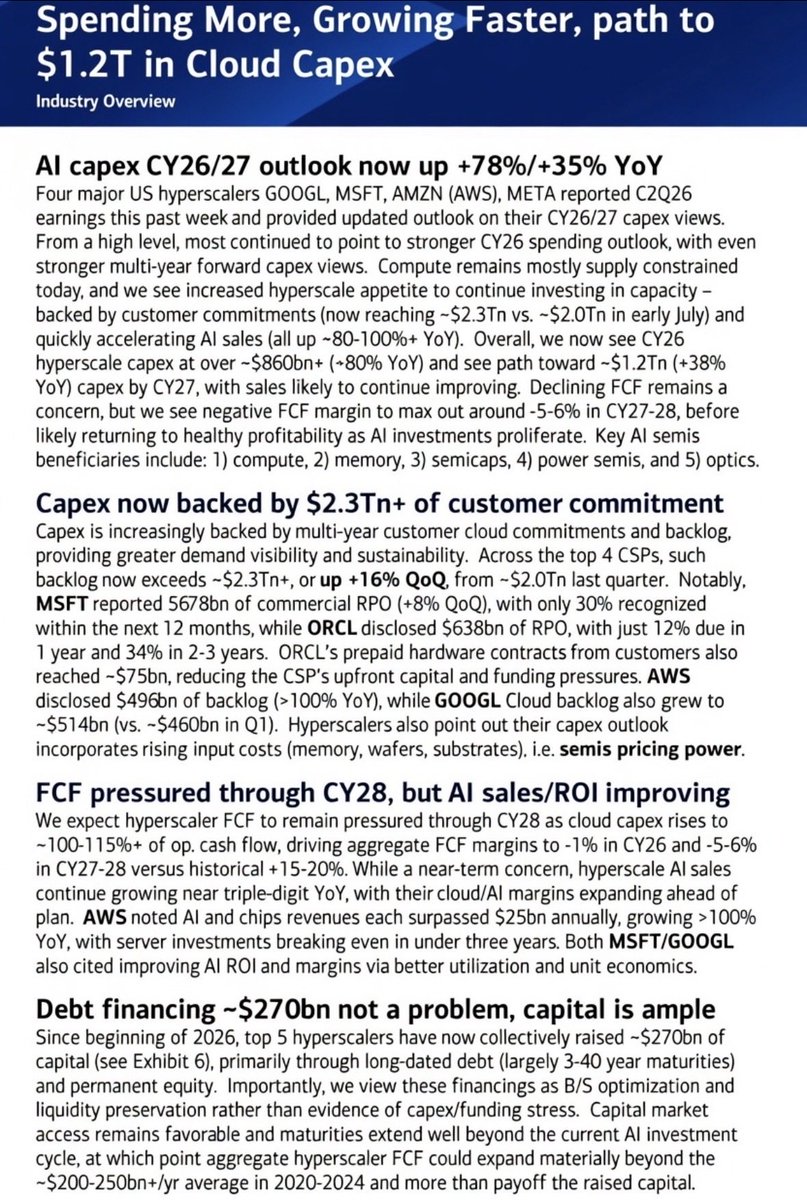
Why are hyperscalers PUMPING today? Bank of America just laid out the bull case
This dropped after all 4 reported earnings last week, and it reframes the whole "capex is scary" debate. Here's the breakdown:
1. The spend is going vertical
BofA now sees $860B+ of hyperscaler capex this year (up 78%) with a path to $1.2 TRILLION in 2027
Sounds terrifying until you see what's behind it...
2. The capex is already pre-sold
Customer commitments across the top 4 clouds just hit $2.3 trillion, up 16% in a single quarter:
Microsoft: $678B (only 30% recognized in the next 12 months)
Oracle: $638B
Google Cloud: $514B
AWS: $496B (up over 100% YoY)
They aren't building on hope. The demand is signed before the data centers exist.
3. The ROI is already showing up
AI sales at the hyperscalers are growing 80-100%+ YoY. AWS said its AI and chips businesses each passed a $25B run rate, and that server investments break even in under 3 YEARS. Microsoft and Google both cited improving AI margins and unit economics too
4. The "how do they pay for this" fear
They've raised ~$270B of capital since January, mostly long-dated debt (3-40 year maturities). BofA's said that's balance sheet optimization, not funding stress as capital access is wide open
The only bit of concern here is Free cash flow goes negative.
BofA sees FCF margins around -1% this year and bottoming at -5% to -6% in 2027-28 before turning back up. That's why these stocks have been so volatile, the market hates watching the cash pile shrink even when the spend is contracted
But zoom out and this is the picture: 4 companies spending $1T+ a year on compute that customers have already committed $2.3 trillion to buy. That's not a bubble, that's a moat getting deeper every quarter
And BofA names the beneficiaries: compute, memory, semicaps, power semis and optics. Same themes I've been posting about for months
I remain long this entire theme and think the hyperscalers and their suppliers are meaningfully bigger companies in 5 years, as long as AI demand keeps compounding (the backlog says it is)
You can see exactly how myself and the 4 other Milk Road PRO analysts are positioned for this with real-time portfolios and research. It's $1 to try it out (insane price just to check it out). Link in bio
Enjoy!
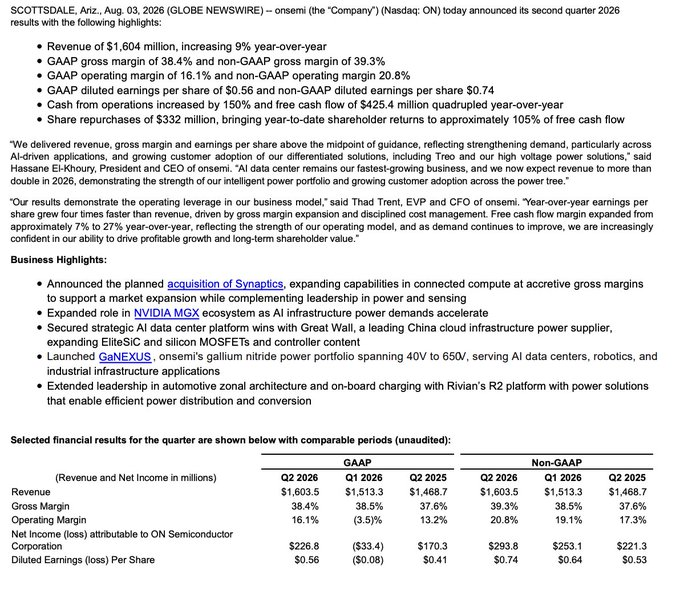
On Semiconductor posted a solid Q2 and the AI data center momentum is clear.
Revenue reached $1.60 billion, up 9% year over year. Non-GAAP EPS came in at $0.74.
Free cash flow quadrupled to $425 million. Power Solutions grew 19%.
Q3 guidance cleared consensus.
The key line from CEO Hassane El-Khoury stands out: “AI data center remains our fastest-growing business, and we now expect revenue to more than double in 2026.”
It is expanding its role inside the NVIDIA MGX ecosystem and secured platform wins with China’s Great Wall.
It also launched the GaNEXUS gallium nitride portfolio covering 40V to 650V for AI data centers, robotics, and industrial use.
The planned Synaptics acquisition further extends its reach into physical AI across power, sensing, compute, and control.
Shares rose about 6% after hours.
Power semiconductors are becoming one of the cleaner ways to participate in the AI infrastructure buildout.
It is not only about GPUs and memory.
#Semiconductors