These ancient carvings were discovered across three separate landmasses divided by enormous oceans.
The three figures shown here come from cultures separated by thousands of miles and, in some cases, separated by thousands of years.
The Gobustan petroglyphs in Azerbaijan date back roughly 10,000 to 5,000 years, the carvings in Japan’s Fugoppe Cave were created around AD 200 to 400, and the famous winged figure in Utah is generally linked to the Fremont culture, dating to approximately AD 950 to 1250.
Despite their striking similarities, archaeologists have found no evidence that these societies ever interacted. The resemblance is usually explained as a case of convergent artistic expression — different cultures independently developing similar symbols to represent spiritual beings, ceremonial figures, ritual leaders, or sources of power.
Although the images appear remarkably alike, they are generally viewed as separate creations rather than evidence of a shared civilization or ancient contact across oceans.
You don't need a gym.
You need Dumbbells and a system.
I'm a professional athlete. I've built and maintained elite strength with nothing but dumbbells more times than I can count.
Here's 48 exercises, every muscle group covered:
What just happened?
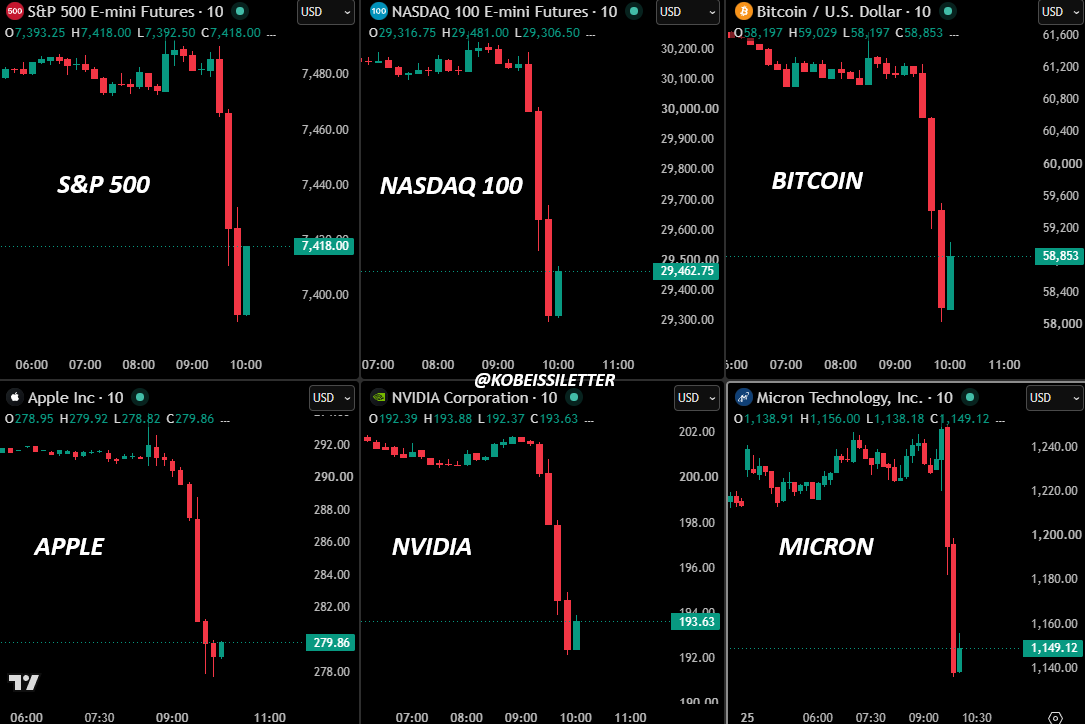
In just 27 minutes, the Nasdaq 100 just fell -1,000 points and the S&P 500 erased -$1 TRILLION without any major headlines.
The Nasdaq opened +1% higher then fell -3% between 9:30 AM and 9:57 AM ET.
What does it all mean? Let us explain.
(a thread)
I just shipped my first kids’ iOS app built with AI as my co‑pilot.
Little Woof: Learn ABCs & 123s is a calm, ad‑free learning game that helps kids 3–6 explore letters and numbers with a friendly 3D puppy.
App Store 👉 https://t.co/9uUWDKIWl1
🔥 INTERESTING: Sony's AI table tennis robot Ace defeats professional player Miyu Kihara under official ITTF rules, marking a major milestone for AI in physical sports.
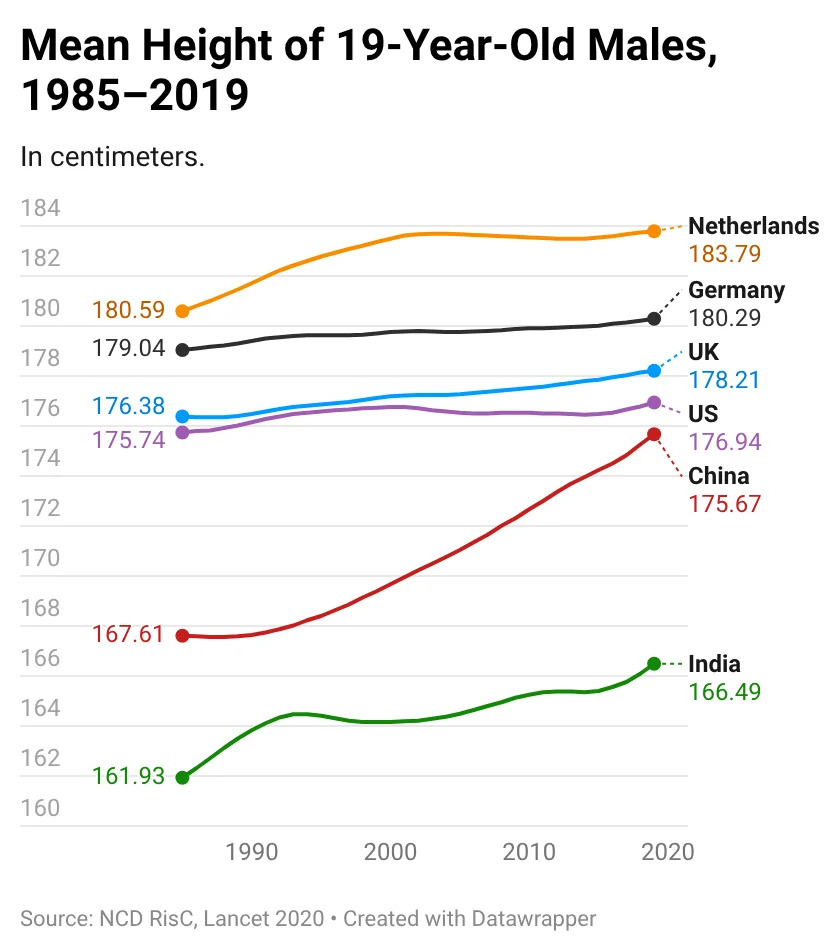
Over the past 34 years the average Chinese man became, on average, 3 inches taller than his grandfather.
But entire population can't rewrite its DNA in 35 years.
So what made them grow so fast? The answer might surprise you.
🦔 Oracle laid off between 20,000 and 30,000 employees Tuesday morning, roughly 18% of its global workforce, via a single email sent at 6am EST with no prior warning. System access was revoked almost immediately after. The cuts are expected to free up $8-10 billion in cash flow. Oracle's stock has lost more than half its value since September 2025 and the company now carries over $124 billion in debt, up from $89 billion a year ago, with free cash flow running negative $10 billion last quarter.
My Take
Oracle posted a 95% jump in net income last quarter and still eliminated 18% of its workforce by email before most people finished their morning coffee. This is not a company in distress in the traditional sense. It's a company that made an enormous debt-funded bet on AI infrastructure and is now converting its workforce into cash flow to service that debt.
We've covered Oracle's AI gamble for months. The $300 billion OpenAI deal through Stargate, $50 billion in capital expenditure this fiscal year, over $124 billion in total debt. Multiple US banks have pulled back from financing Oracle-linked data center projects. Bondholders have sued Oracle claiming it concealed how much additional debt the OpenAI deal would require. The credit default swap spread hit a three-year high earlier this year, meaning debt investors are genuinely nervous about getting paid back.
The workers who got that 6am email built the products Oracle has monetized for decades. The bet that eliminated their jobs was made by people who were already paid regardless of how it turns out. That is the part of the AI infrastructure race that doesn't show up in the capex announcements.
Hedgie🤗
Software horror: litellm PyPI supply chain attack.
Simple `pip install litellm` was enough to exfiltrate SSH keys, AWS/GCP/Azure creds, Kubernetes configs, git credentials, env vars (all your API keys), shell history, crypto wallets, SSL private keys, CI/CD secrets, database passwords.
LiteLLM itself has 97 million downloads per month which is already terrible, but much worse, the contagion spreads to any project that depends on litellm. For example, if you did `pip install dspy` (which depended on litellm>=1.64.0), you'd also be pwnd. Same for any other large project that depended on litellm.
Afaict the poisoned version was up for only less than ~1 hour. The attack had a bug which led to its discovery - Callum McMahon was using an MCP plugin inside Cursor that pulled in litellm as a transitive dependency. When litellm 1.82.8 installed, their machine ran out of RAM and crashed. So if the attacker didn't vibe code this attack it could have been undetected for many days or weeks.
Supply chain attacks like this are basically the scariest thing imaginable in modern software. Every time you install any depedency you could be pulling in a poisoned package anywhere deep inside its entire depedency tree. This is especially risky with large projects that might have lots and lots of dependencies. The credentials that do get stolen in each attack can then be used to take over more accounts and compromise more packages.
Classical software engineering would have you believe that dependencies are good (we're building pyramids from bricks), but imo this has to be re-evaluated, and it's why I've been so growingly averse to them, preferring to use LLMs to "yoink" functionality when it's simple enough and possible.
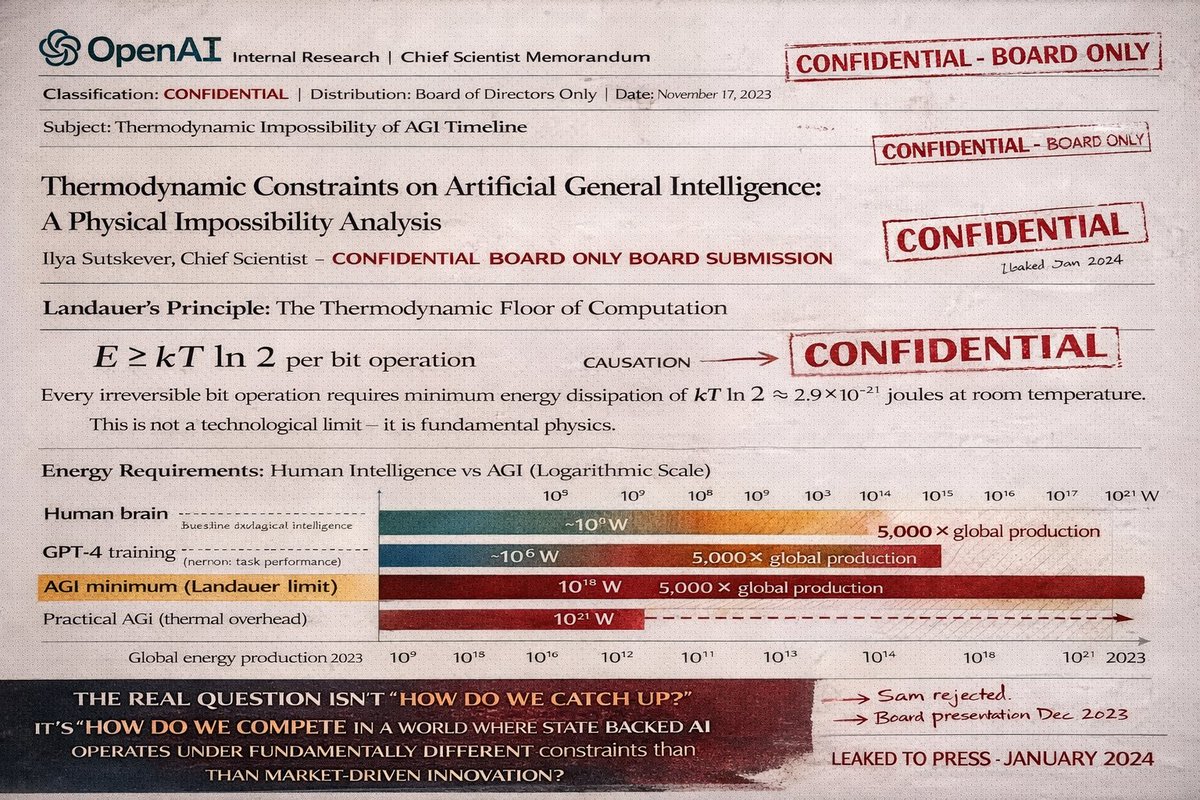
🚨 Ilya Sutskever left OpenAI after submitting an internal paper to the board.
His conclusion: AGI requires more energy than exists in the solar system.
It's not an engineering problem—it's thermodynamics.
I got the leaked calculations. Here's the physics proof that killed OpenAI's mission:
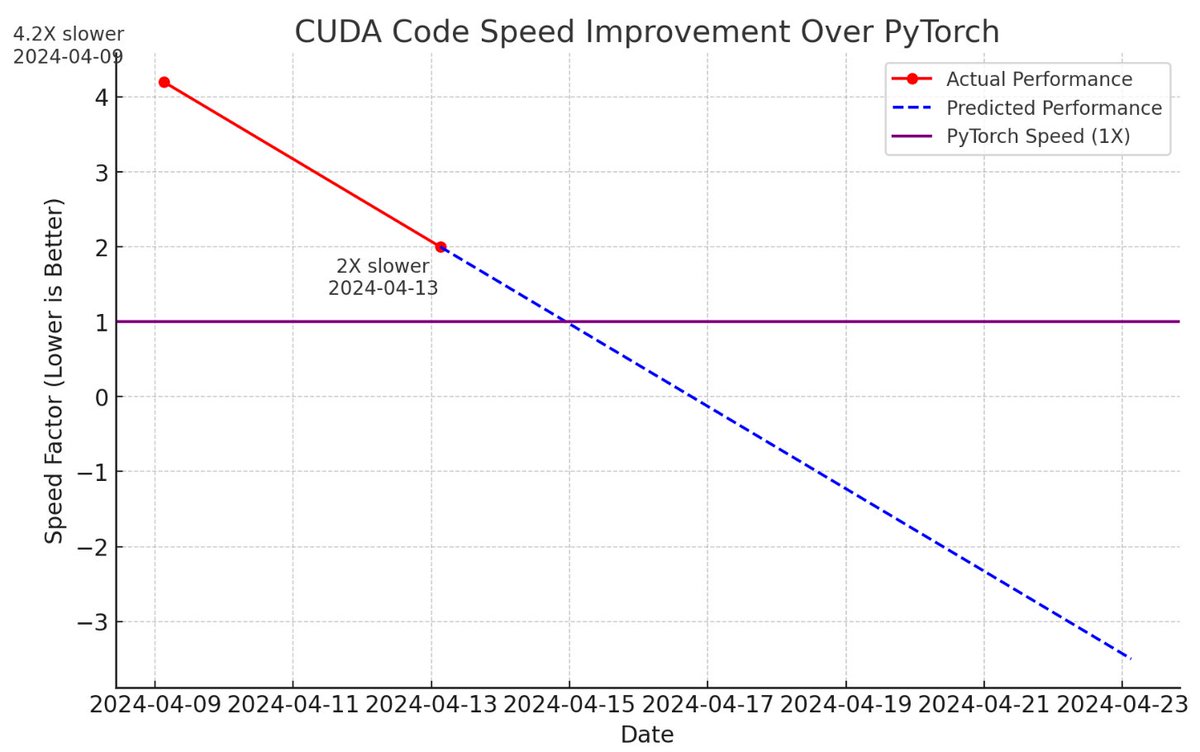
A few new CUDA hacker friends joined the effort and now llm.c is only 2X slower than PyTorch (fp32, forward pass) compared to 4 days ago, when it was at 4.2X slower 📈
The biggest improvements were:
- turn on TF32 (NVIDIA TensorFLoat-32) instead of FP32 for matmuls. This is a new mathmode in GPUs starting with Ampere+. This is a very nice, ~free optimization that sacrifices a little bit of precision for a large increase in performance, by running the matmuls on tensor cores, while chopping off the mantissa to only 10 bits (the least significant 19 bits of the float get lost). So the inputs, outputs and internal accumulates remain in fp32, but the multiplies are lower precision. Equivalent to PyTorch `torch.set_float32_matmul_precision('high')`
- call cuBLASLt API instead of cuBLAS for the sGEMM (fp32 matrix multiply), as this allows you to also fuse the bias into the matmul and deletes the need for a separate add_bias kernel, which caused a silly round trip to global memory for one addition.
- a more efficient attention kernel that uses 1) cooperative_groups reductions that look much cleaner and I only just learned about (they are not covered by the CUDA PMP book...), 2) the online softmax algorithm used in flash attention, 3) fused attention scaling factor multiply, 4) "built in" autoregressive mask bounds.
(big thanks to ademeure, ngc92, lancerts on GitHub for writing / helping with these kernels!)
Finally, ChatGPT created this amazing chart to illustrate our progress. 4 days ago we were 4.6X slower, today we are 2X slower. So we are going to beat PyTorch imminently 😂
Now (personally) going to focus on the backward pass, so we have the full training loop in CUDA.
On Nov 22nd, Nancy Pelosi and her husband bought Nvidia, $NVDA call options, a leveraged bet Nvidia would go up.
Since then, her Nvidia calls are up 85%. Her calls have made her $1.8 million, over EIGHT times her salary in 93 days.
I want to give you the history of Pelosi’s trading, $NVDA, and show the conflicts within Congress:
Let’s start in December 2021. After a history of unusual trading, from Visa, trading during the GFC, and buying before stimulus bills, Nancy Pelosi was asked if she thinks US Congress members should trade despite legislative conflicts by Bryan Metzger.
She said, "We are a free market economy. Congress should be able to participate in that". Insane.
In Jan 2022 Unusual Whales releases their most famous trading report, showing Congress beat the market. Nancy Pelosi is listed as the fifth best trader in Congress.
That report creates a flurry of media and outrage. Within seven days of publishing, five new bills banning members of Congress from trading are proposed for the first time ever. Unusual Whales changes history.
But in the summer of 2022, it is revealed that Nancy Pelosi was trading millions of dollars of $NVDA, Nvidia before voting on a US semiconductor bill by the Biden administration.
We reported on her trading to outrage by the public. Interestingly, for the first time in history, a few days later Nancy Pelosi disclosed trades made on the same day they were made. This is likely the fastest disclosure in history of US Congress. She reported that she sold out of her Nvidia position, the first time she divested from conflicts in her portfolio. Despite taking 45 days for every other disclosure, she made this one instantly. Hilarious.
One month later Nancy Pelosi proposed alongside Representative Lofgren her own Congressional trading ban, a bill which was incredibly weak and filled with loopholes.
And then, Pelosi stopped trading. Well, until her $NVDA leveraged bet.
You should be reminded that in August of 2022, Pelosi met with TSMC Chairman Mark Liu, showing how critically important semiconductors were to U.S. national security and the integral role that the company plays in making the most advanced chips.
One week after Chinese President Xi visits her home state of California in 2023, and before Biden announced new US semiconductor focuses over this year in 2024, her husband decided to buy two million dollars of deep in-the-money Nvidia calls, the same company she divested from due to conflicts a year earlier. This is her largest trade in years.
What’s worse on Dec 11th, before she bought in November, U.S. Commerce Secretary Raimondo said that Nvidia could sell slower AI chips to China to comply with US export controls. And then, on Dec 28th, NVDA launched a modified version of an advanced chip precisely to get around US restrictions.
Nvidia now has released new US chips, and has hit all time highs. Of course, none of this is insider trading, but it does seem unusual, especially given scrutiny of Nvida by the government.
Why does she trade ITM tech calls, you may ask? It allows for one to be bullish with less capital upfront due to capital efficiency in options, and the contracts move 1 delta to the stock. We wrote more about it on our research site, which you can find in our bio.
One terrible thing about this trade is that it was done when Congress was in session!!!!!! You can use Unusual Whales to find the exact price she paid for her options and leveraged bets, which was done twenty minutes before the close of the market.
If you think that one of the most powerful politicians in the US can, or even should, have leveraged bets over an incredibly important company to US infrastructure, that is okay. But there might be something worthwhile in understanding how members of Congress trade, and the data suggests as such. Especially if that member is outperforming generally. Pelosi herself has lost a ton on trades, including when she divested from $NVDA last year, and yet despite that she decided to enter into it again. Her re-entry becomes interesting because of her timing, exiting the trade publically and quickly before (for a loss), but now making triple the loss amount in 92 days now.
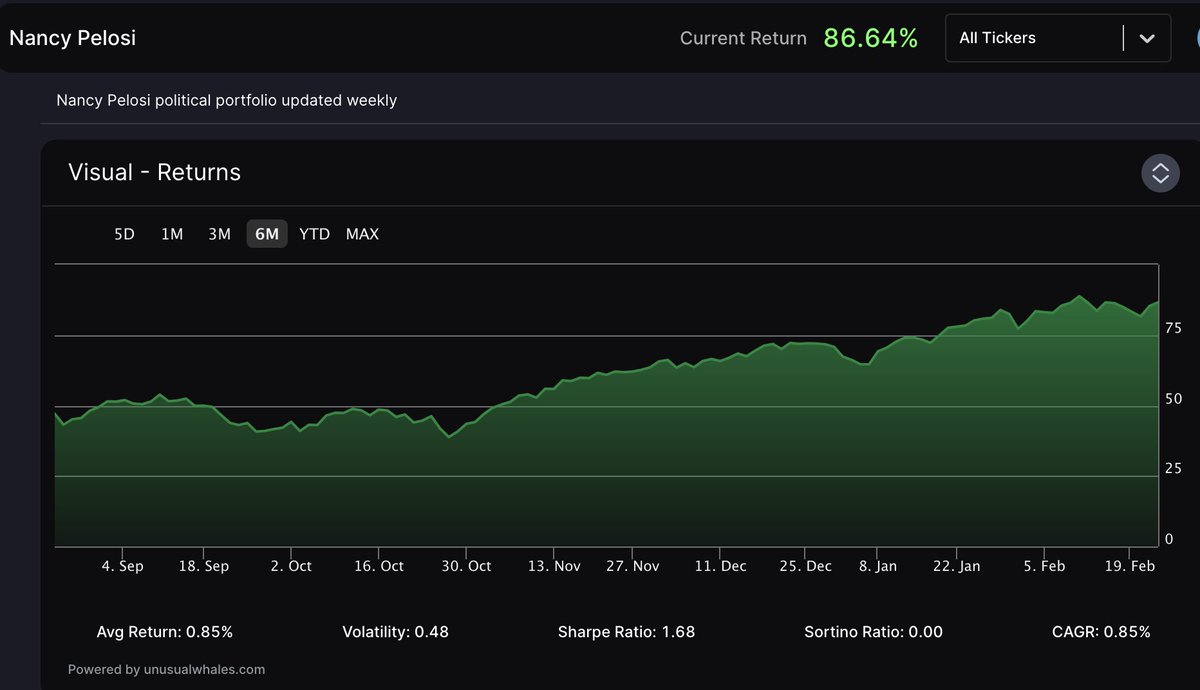
And so we will keep reporting on Pelosi, and Congress, and the history of unusual trading. Pelosi's portfolio itself is up around 88% over twelve months. If you want to find and follow her portfolio, you can do so on Unusual Whales in our Portfolio tab.
Pelosi has made more than ten million this year alone off her tech portfolio, with a networth close to likely a quarter of billion. No matter what trade or conflict though, I will report on it. If you believe this is an important issue, I ask you share this tweet with your friends, and family.
Congress cannot hide from me, I will continue to report on the data, and I will not stop until Congress is banned from trading.
Time flies by when you're using addictive apps and games. But many of the most important things in life have at least soft deadlines. This is a very dangerous mismatch. If you're not careful, a lot of windows are going to close on you.
Send them back. Mass deportations. They are flooding Italy by the millions and then being distributed throughout Europe.
The European governments are only talking about plans to share the burden and force countries like Poland to take their fair share. They think that is the solution. Why aren't they just sending them back? Who is funding and supporting this disaster?
Navigating "corporate speak" isn't easy.
Here's a helpful guide I put together:
"Let me check with my team" = No
"Possibly" = No
"On my roadmap" = Not happening
"This will be done in Q4" = This will be done in Q2 next year
"Disagree and commit" = I hate you
"Per my last email" = Try reading, for once in your life
"Challenging landscape" = We're going out of business, quickly
"Digital transformation" = We're going out of business, slowly
"Let's circle back" = We'll never speak of this again
"Take it offline" = We'll never speak of this again
"30,000 foot view" = I don't know what I'm saying
"Low hanging fruit" = Easy promotion
"Open up the kimono" = HR violation
"We use AI" = We don't use AI
"We use machine learning" = We don't use machine learning
"All hands on deck" = Let's actually try for once, please
The way that Jensen Huang runs Nvidia is wild:
40 direct reports, no 1:1s
- Believes that the flattest org is the most empowering one, and that starts with the top layer
- Does not conduct 1:1s - everything happens in a group setting
- Does not give career advice - "None of my management team is coming to me for career advice - they already made it, they're doing great"
No status reports, instead he "stochastically samples the system"
- Doesn't use status updates because he believes they are too refined by the time they get to him. They are not ground truth anymore.
- Instead, anyone in the company can email him their "top five things" with whatever is top of mind, and he will read it
- Estimates he reads 100 of these everyone morning
Everyone has all the context, all the time
- No meetings with just VPs or just Directors - anyone can join and contribute
- "If you have a strategic direction, why tell just one person?"
- "If there is something I don't like, I just say it publicly"
- "I do a lot of reasoning out loud"
No formal planning cycles
- No 5 year plan, no 1 year plan
- Always re-evaluating based on changing business and market conditions (helpful when AI is developing at the pace that it is)
This org is optimized for (1) attracting amazing people, (2) keeping the team as small as it can be, and (3) allowing information to travel as quickly as possible
🇺🇸 Most visited websites in the US in May 2023:
1. google. com
2. youtube. com
3. facebook. com
4. amazon. com
5. yahoo. com
6. twitter. com
7. instagram. com
8. wikipedia. org
9. reddit. com
10. pornhub. com
11. discord. com
12. xvideos. com
13. xnxx. com
14. ebay. com
15. office. com
16. linkedin. com
17. nytimes. com
18. cnn. com
19. bing. com
20. microsoftonline. com
21. duckduckgo. com
22. live. com
23. espn. com
24. walmart. com
25. netflix. com