In Cyberpunk, they had to shut down the internet because of evil rouge AIs. Everything ended up being run on local networks instead of a World Wide Web
That just seems to be the way we are going honestly
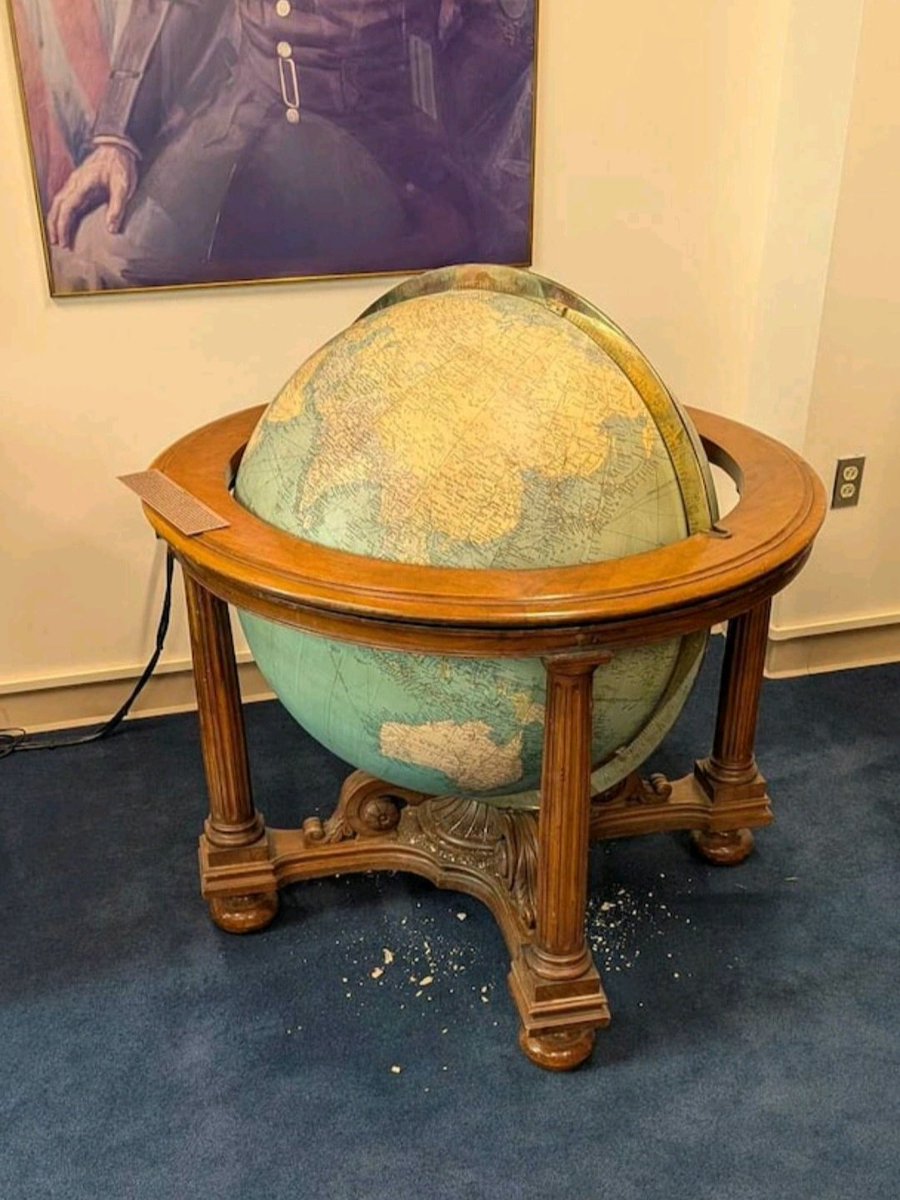
Pete Hegseth demanded his team to bring Eisenhower's globe in his office, despite warnings that only historians should move the iconic globe.
His staff dropped it and broke it.
Before "street da'wah," there was business da'wah.
It was one of the most effective tools for bringing people to Islam. Muslims simply abiding by our rules of trade and commerce, and becoming financially successful because of it.
No lying.
No deceptive sales tactics.
No special rules for us and different rules for others.
No matter what.
Hundreds of millions of people around the world, from Indonesia to West Africa, are Muslim today largely because of truthful, sincere merchants.
In the modern world, Muslims still haven't realized the full potential of commerce as a means of da'wah.
This means that the Andalusians in the Islamic era, most of whom were converted locals, actually had significant North African ancestry, one that was much greater than that of modern-day Spaniards. However, their North African/Berber ancestry was not directly linked to the (fairly well-documented) Berber settlements during the Islamic era, but rather dates back somewhat further.
For me in History one of the most annoying things in modern nationalist narratives is that (both modern Turkish nation-states building and Western, Greek historical accounts) have a tendency to downplay the direct continuity between the Eastern Roman Empire and the Ottoman Empire.
It is an absolute historical fact, and i say it again an ABSOLUTE FACT that for the early and classical Ottomans, claiming the Roman legacy wasn't an afterthought, it was central to who they were!
For centuries, the Ottoman Muslim elite, scholars, and citizens living in Anatolia and the Balkans referred to themselves as Rûmî—literally meaning "Roman". To Arab, Persian, and even Chinese contemporaries, an Ottoman person or good was referred to as "Rûmî" or "from Rome".
How can one ignore that the Ottomans inherited and retained vast parts of the East Roman system. Even the Orthodox Church: Mehmed II restored and protected the Ecumenical Patriarchate of Constantinople, integrating the Greek Orthodox hierarchy directly into the imperial governance model (the Rum Millet).
Meanwhile in the 19th century and 20th century, Western historians framed "Rome/Byzantium" as strictly European/Christian and the Ottomans as an "alien, Asiatic force," erasing the cultural and political synthesis that actually occurred. While the idiocy of the Kemalists played directly into that narrative copying it into their own historical teaching.
Modern linguists largely agree that the Arabic word ṣirāṭ (meaning “path”) is a loanword ultimately from Latin strāta, borrowed early on into the Arabic language.
The linguist Abū Ḥātim (d. 322) writes that it is narrated from a multitude of early authorities such as Ibn ʿAbbās, Mujāhid, Saʿīd b. Jubayr, ʿIkrimah, and ʿAṭāʾ that ṣirāṭ is of the Roman language (i.e. Latin).
This etymology reportedly being pointed out by Ibn ʿAbbās et al. is especially interesting given how early they were, and given that strāta did not enter Arabic directly, but rather through Classical Syriac ܐܣܛܪܛܐ (esṭraṭā).
Cognates of this root also passed into Germanic languages, giving us the English word street.
What’s the relevance?
In Latin itself, strāta is an ellipsis of the phrase via strāta (“paved/stretched road”). This is relevant because it tells us that strāta (and by extension, ṣirāṭ) is not just any path—it is a clear, paved, unmistakable road engineered for travel (such as the Strata Diocletiana). Thus, in Qurānic usage, ṣirāṭ perfectly describes “the straight path” (al-ṣirāṭ al-mustaqīm)—meaning the course of guidance clearly ordained by God for humans to follow.
Other words for “way” or “path” in the Qurān, such as ṭarīq and sabīl, do not necessarily carry this connotation of being clearly paved and identified. For example, the word ṭarīq specifically comes from the root ṭaraqa (“to strike”) and refers to oft-trodden paths frequently struck by human feet. By contrast, a ṣirāṭ is established by its structure rather than its traffic. This is why the Qurān asserts that the majority of people are often not on the path of guidance (Q 6:116, Q 12:103).
Like ṭarīq, the word sabīl also has a connotation of an oft-traversed path. Lexicons mention that asbala—a verb from the same root—means that the number of travelers on a route has increased (وأسْبَلَتِ الطَّرِيقُ: كَثُرت سابِلَتُها). The word sābilah also shares the same root and refers to temporary passersby (مارّة). In contrast to this, the believer does not simply pass by the straight path; rather, it is a long-term path intended for his lifelong spiritual journey.
Hence, the Qurān accurately uses ṣirāṭ as the ideal word to describe the straight path, because it denotes a permanent, divinely engineered path whose validity does not depend on the volume of traffic or the varying movements of the passersby.
وبالله التوفيق
1598 China Ming firearms manual showing an Ottoman musketeer firing a matchlock. China adapted the Ottoman design after learning it from Ottoman envoys in Beijing. What is interesting is that the Ming keept calling Ottomans "Lumi" which means Roman.
“嚕密” / “魯密” (Lumi) is the Chinese transliteration of Rūm, the term used for the Ottoman Empire (and earlier for the Eastern Roman Empire).
It reads:《嚕密人打放圖》 (“Diagram of the Rumi People Firing”), from Zhao Shizhen’s 1598 firearms manual Shenqi Pu (神器譜, “Treatise on Divine Weapons”).
The Lumi (or Lu-mi for roman) musket was a longer, heavier Ottoman-style matchlock. Zhao Shizhen a late Ming dynasty firearms expert, inventor, and military writer praised it as having better range and power than the Japanese "niaochong" which was common in East Asia at that time.
@incelgr0yper@frossfross1 You literally worship a “sand monkey” as your GOD you cumskin😭. How does it feel knowing you’re racist to your own God lmaoo. And nice cope to deal with how your ancestors got completely mogged during the crusades.🤫 No surprise you’re an incel like most christians hahaha
@MattisRedacted@AsmohB Red herring because you can’t take how this single pic sums up how badly your ancestors got completely mogged.😭😭😂😂 Absolutely pathetic. Can’t expect better from someone actually dumb enough to believe in the trinity though
@Kastor64909096@MattisRedacted They didn’t stop, they got stopped, dumbass Imao. Morocco smashed the portugese empire in a single battle and took a bulk of its nobility as slaves, causing it to collapse after they invaded North Africa. spain also got spanked by the Ottomans in North Africa😭😭😂😂
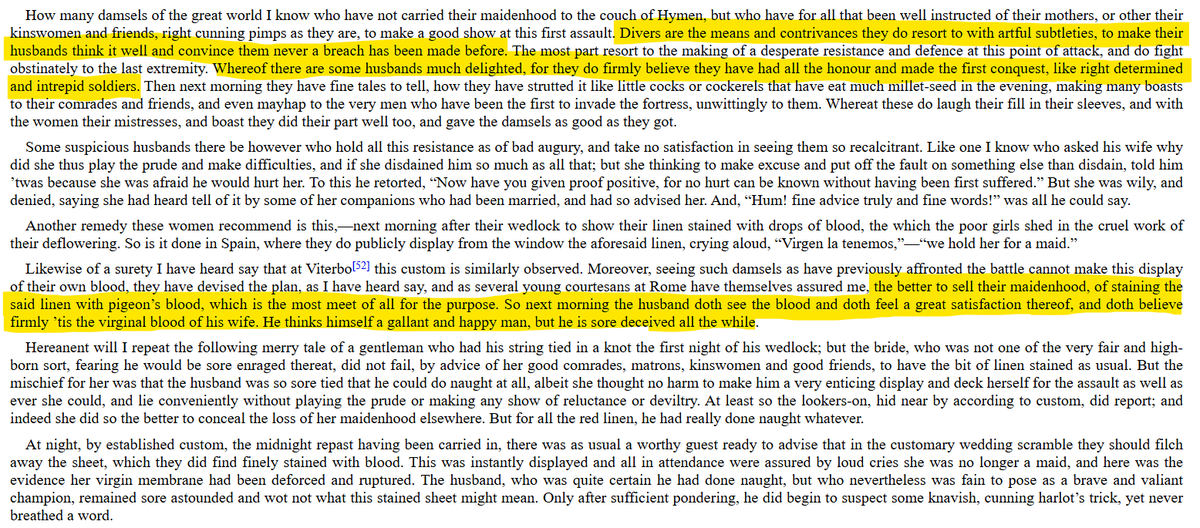
@TS47TS47 This is proven in their own texts too btw, like in Pierre de Bourdeille's Book of Ladies where he enlightens us on the reality of sexual activity in 16th century Christian Europe and how the women would trick men by faking their virginities. These guys are natural dayooths 😭 🤣
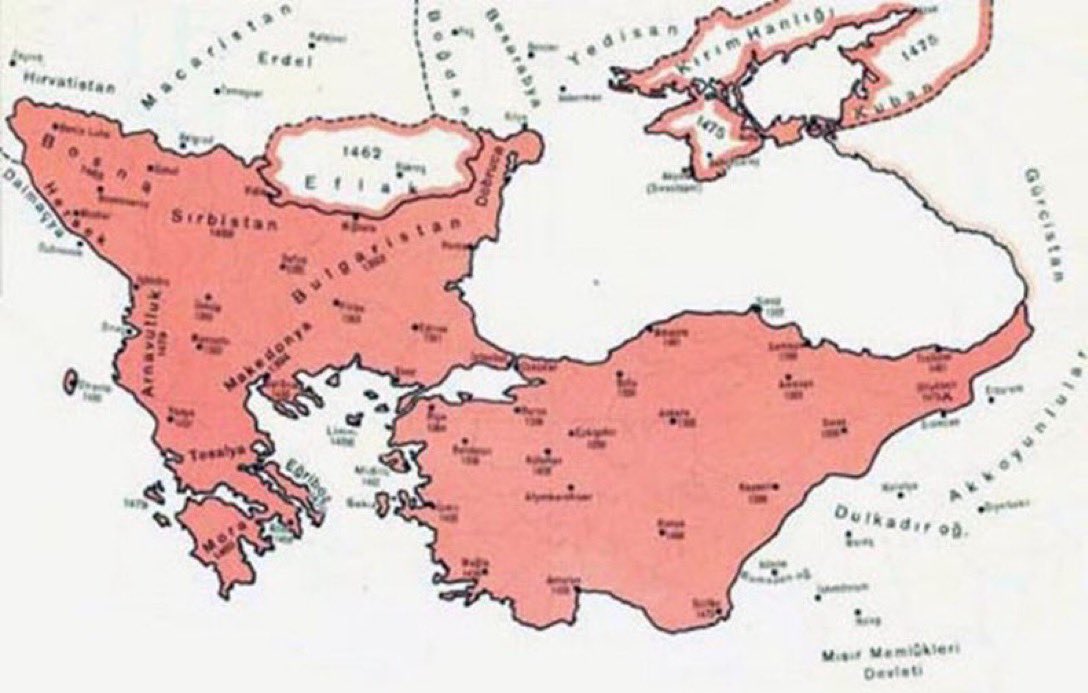
Fatih Sultan Mehmet vefaat ettğinde Osmanlı İmparatorluğu'nun sınırları.
Avrupa ve Asya kıtasındaki toprakların yüzölçümü hemen hemen aynıydı ve hedefte ise İtalya vardı.
(1481)