We recently started a writing group in the @EQ_Geoazur team. We meet weekly for 2 hours to write together and share tips on scientific writing. In this recorded seminar, I explain my process to write a (collaborative) scientific paper: https://t.co/arayfEzb49
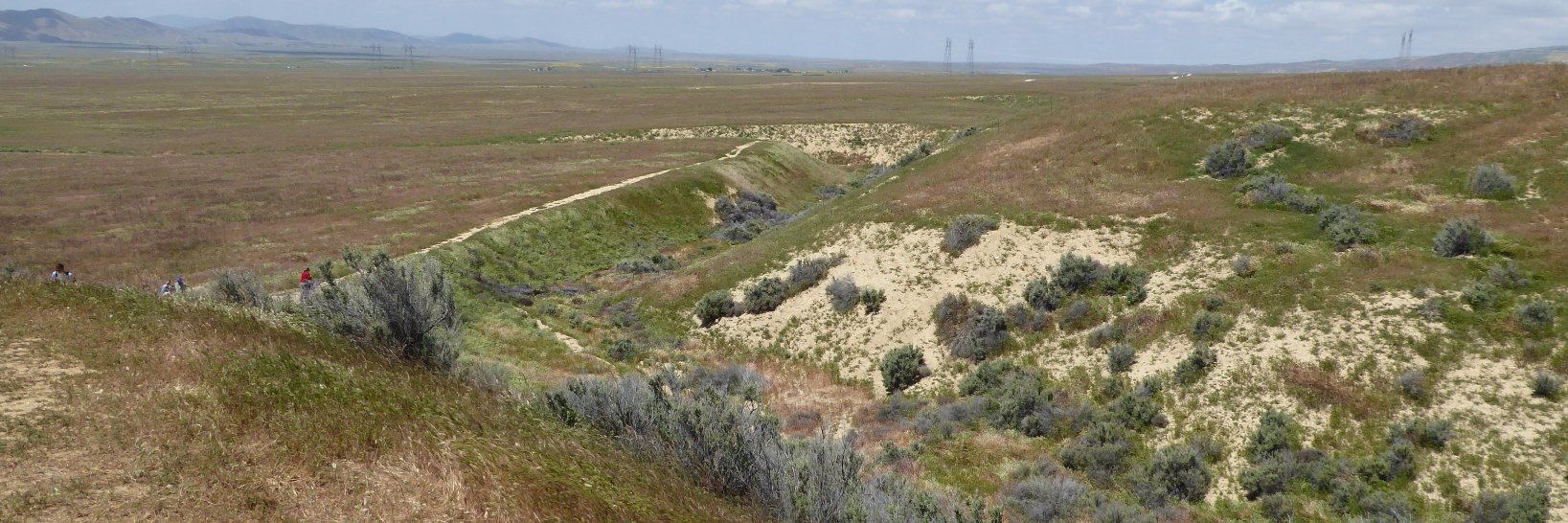
Unique outcrop exposures of reservoir-scale normal faults intersecting the principal strand of the Moab Fault provide insights into the 3D geometry and displacement transfer mechanisms of an oblique relay zone! Please check our new Open Access paper: https://t.co/ShdpCc3KnJ
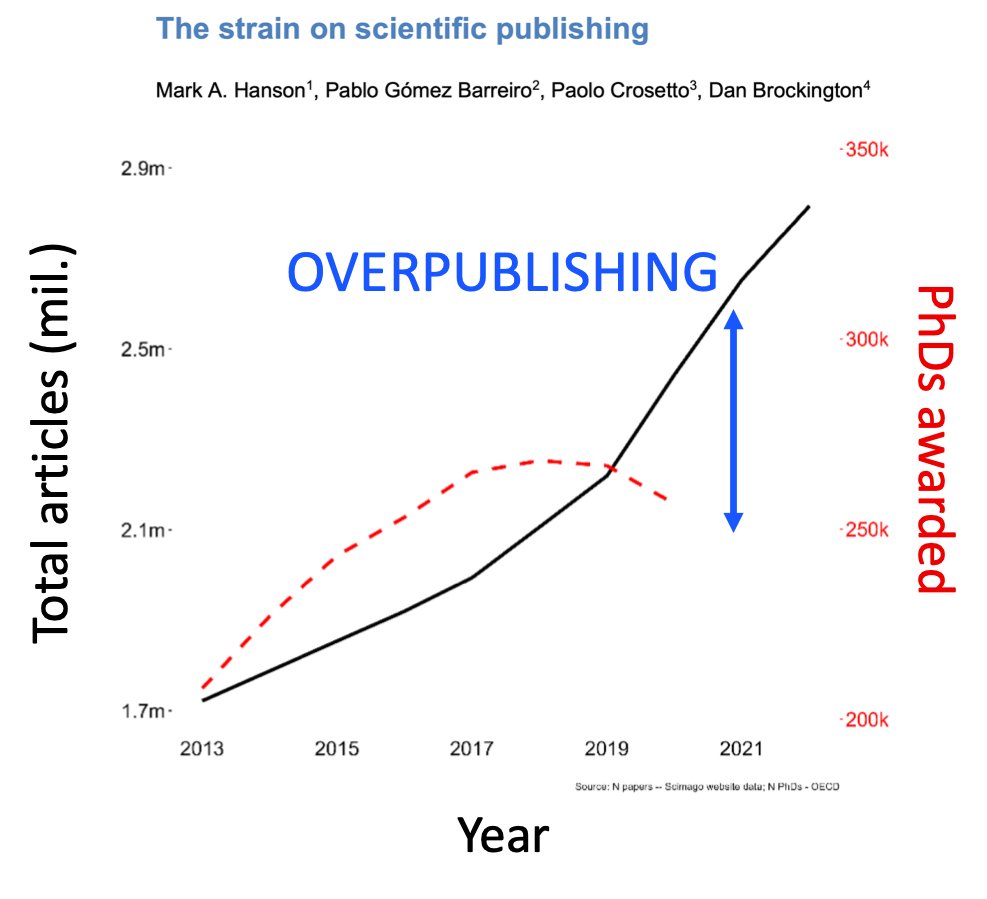
Overpublishing puts enormous stress on students and PIs.
And brings tons of money to publishers in STEM.
A new study shows that the number of papers is increasing FASTER than the number of #PhD graduates.
It’s an amazing work with very useful statistics. Huge kudos to the authors!
▫️
Main outcomes:
1️⃣ In 2022 the number of articles is 47% higher than in 2016. The amount of writing, reviewing and editing workload per scientist is increased enormously.
2️⃣ “Special issues” is a strategy for publishing lots of papers with reduced review time. This is possible due to the “publish or perish” pressure and clearly benefits the publishers.
3️⃣ The publishing time varies widely!
MDPI = 37 days. Frontiers = 72 days. Elsevier = 134 days. Springer = 157 days. Nature = 185 days.
4️⃣ The article rejection rates do not seem to correlate with publisher growth. However, rejection rates decline with increased use of special issue publishing.
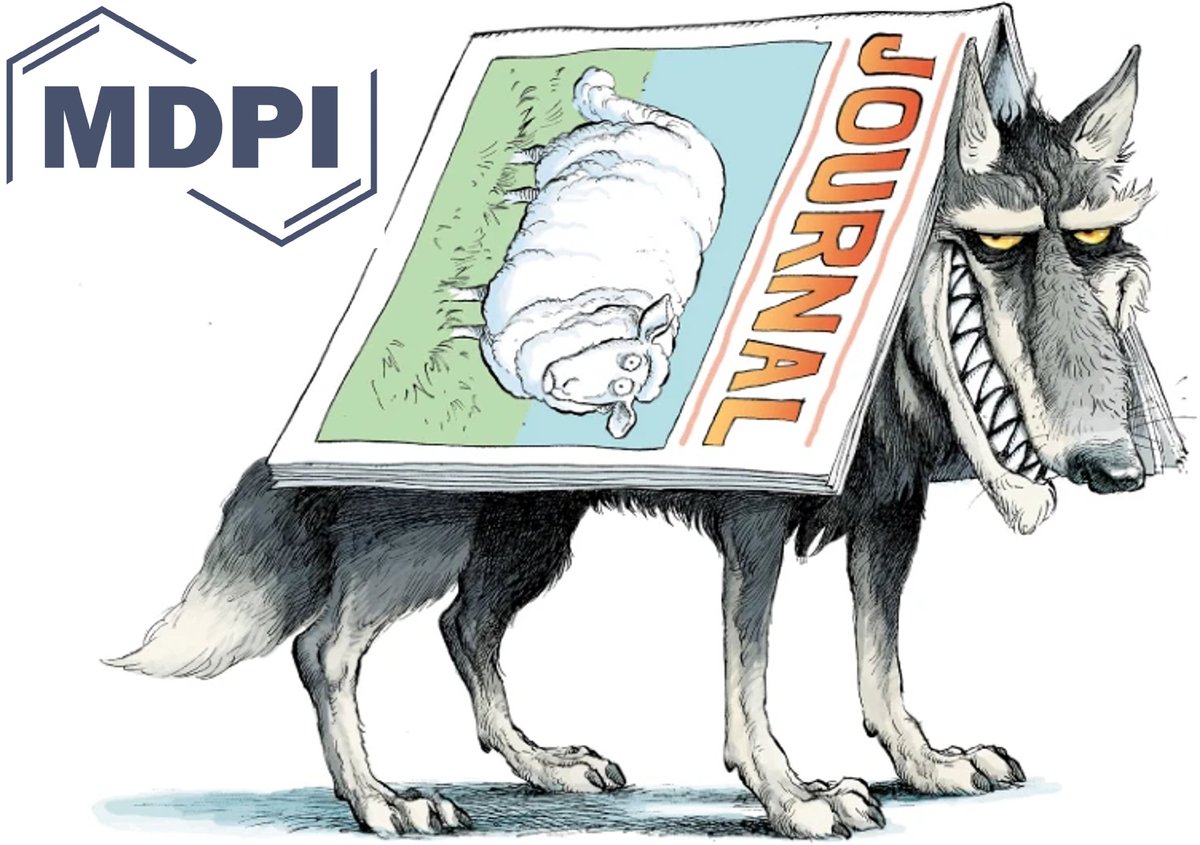
5️⃣ Certain for-profit gold-open-access publishers create an increasing number of special issues, with uniquely reduced turnaround times, and in specific cases, high impact inflation and reduced rejection rates.
6️⃣ The authors suggest a new metric - Impact Inflation, which is reflected in self-citation within the same journal. For example, MDPI has a high impact inflation due to excessive self-citation compared to other publishers.
Conclusions and my opinion:
- Scientists have to spend a lot more time on reviewing and writing than before (on average).
- The more papers are published, the more the quality is compromised.
- Scientific progress has become partially bound to the business models of publishers and their revenue (a sad reality today).
- There is a huge lack of transparency. Much of these data had to be ‘web-scraped’ from numerous sources in order to get a full picture. We clearly need regulators to mandate open access to publisher’s statistics.
- Reduce the number of special issues! Those typically have low standards.
▫️
Science, publishing and funding make a trio that is very hard to disentangle.
However, research quality is controlled by the community.
This is why preprint + community review can make a big difference.
#AcademicTwitter #AcademicChatter
Ding et al. simulate various scenarios to analyze a backward rupture branching during the 2023 Kahramanmaraş earthquake, and show it can occur by both direct and indirect triggering depending on the fault's initial stress and friction conditions.
Read 👉https://t.co/6nfqNy3hTq
New open access article on the impact of variable fault geometries and slip rates on earthquake catalogs from physics-based simulations of a normal fault. https://t.co/8UYcGrBMTO
🔔New paper alert! @EGU_NHESS
Seismogenic potential and tsunami threat of the strike-slip Carboneras fault in the western Mediterranean from physics-based earthquake simulations 🌊🌊
J.A. Alvarez @joseveligeo et al.
Free to read link:
https://t.co/kDg5gZ50rV
Pre-registration is now open for the October 2023 School on Subduction Zone Processes in Cargèse, Corsica: https://t.co/UqZyJ2PpU8
Travel grants are available for early career researchers.
@billy_andrews@MirelandMark This is a nice question. This paper might help you on the quantitative aspect: https://t.co/ZYI8Dm5RQZ
Evidence of linkage could help you identify the origin.
Ανακοινώνουμε τη δημιουργία Υποτροφίας εις μνήμη του Βάιου Βλάχου για την ενίσχυση της κατεύθυνσης Τεχνικής Γεωλογίας και Περιβάλλοντος του ΠΜΣ Εφαρμοσμένη και Περιβαλλοντική Γεωλογία του Τμήματος Γεωλογίας @Auth_University.
Ανοίγουμε 🧵 όπου δίνουμε περισσότερες πληροφορίες:
@KlingerYann Great work :-). Nice to see similar patterns of displacement partitioning as observed along a normal fault in geological timescales: https://t.co/YiJG3GHa0Y
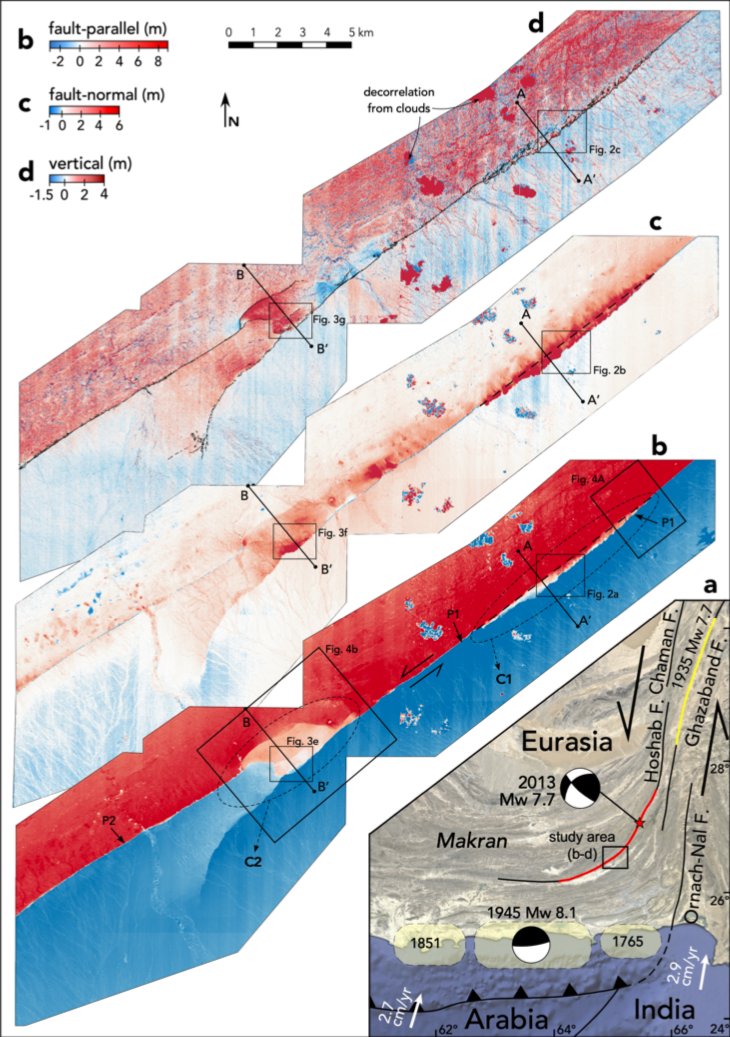
Interested in #earthquake, surface ruptures, fault geometry, and off-fault deformation. Check the new paper by Antoine et al. about M7.7 Balouchistan Eq. using #micmac image correlation.
https://t.co/5kBrl3VIMM