How do you make reading DNA faster, cheaper and scalable enough to transform medicine?
That question sits at the heart of the breakthrough behind the 2026 Wolf Prize in Chemistry, awarded to Pascal Mayer, Shankar Balasubramanian and David Klenerman.
Their work helped turn DNA sequencing into a massively parallel process, dramatically reducing the cost and time needed to read genetic information, and helping make large-scale genomics possible.
But what does that actually mean? How does next-generation sequencing work, and why was this such a major leap forward?
Watch the video to see the science behind the breakthrough and understand how three researchers helped change the way we read the human genome.
@Cambridge_Uni
New paper out in Nature from the Todd Hyster Lab: “Pyridoxal photoenzymes for asymmetric radical–radical cross-couplings" with Novartis.
Congratulations on the great work Cole, Suhao, Yao, Saim, Claire, Greg, Simon, Todd:
https://t.co/jrg4L6duAf
Happy to share our latest work, now published in Nature!
Ligand-enabled remote C–H activation converts abundant saturated fatty acids into desaturated lactones.
https://t.co/cCpMO9idcM
https://t.co/Yl6ERXsAPG
Thanks to @NandanNilekani Foundation, @ANRFIndia@iitbombay@dm_lab
Ligand Design Enables Introduction of Nonaromatic Arylating Agents in Palladium-Catalyzed C–H Arylation of Arenes | Journal of the American Chemical Society https://t.co/N5vpUVyxea
We are delighted to announce that a collaborative project between ACTREC–Tata Memorial Centre and IIT Bombay, led by Dr. Vikram Gota along with Postdoctoral Fellow Dr. Archana Kumari Redhu, and Prof. Debabrata Maiti along with PhD scholar Mr. Anirban Pal, was selected among the top 21 global innovations (from 1,175 proposals worldwide) under the WHO H2I Open Call at the WHO Global Traditional Medicine Summit 2025, New Delhi held during 17-19th December, 2025.
The selected project, “TechnoHeritage Ayurveda: Data-Driven, IoT-Powered Innovations Enhancing Safety, Evidence & Sustainability in Traditional Therapies,” focuses on AI/ML-enabled scientific validation of phytochemicals, with translational potential in oral cancer and integrative oncology. The work explores how phytochemicals may modulate cancer-relevant molecular and genetic pathways, particularly those implicated in disease progression and treatment resistance. By combining traditional medical knowledge with modern data science, the project aims to generate robust, reproducible evidence aligned with global regulatory expectations and WHO frameworks.
Held in the presence of the Hon’ble Prime Minister Shri Narendra Modi and WHO Director General Dr. Tedros Adhanom Ghebreyesus, the Summit provided a global platform for this recognition, marking a proud milestone for India in evidence-driven traditional medicine innovation.
Social Impact:
This innovation addresses a major public health challenge by enabling affordable, effective, and low-toxicity treatment options for oral cancer, particularly in low- and middle-income settings. Current chemotherapeutic drugs are costly, cause severe systemic side effects, and frequently fail due to the development of drug resistance. The proposed approach integrates traditional medicinal knowledge with advanced AI-driven discovery to identify bioactives that can be used either as standalone therapeutic options or in synergy with existing chemotherapies to enhance efficacy and overcome resistance. This strategy can reduce treatment failure while maintaining or improving quality of life, preserving essential functions such as speech and swallowing, and lowering financial burden. At a societal level, it strengthens sustainable healthcare systems, supports responsible use of traditional knowledge, and empowers communities through ethical benefit-sharing, advancing inclusive, human-centered cancer care.
#AIML #Ayurveda #TraditionalMedicine #WHOH2I #MinistryOfAyush #DrugDiscovery #CancerResearch #HealthInnovation #IITBombay #ACTREC #TMC #MinistryOfAyush #WHO #EvidenceBasedMedicine #PMO #HealthcareInnovation
Ministry of Education, Government of India, New Delhi
Exciting deep dive into C-H activation strategies from @HartwigGroup at @UCBerkeley. Discover how this powerful approach is transforming diverse fields of chemistry, enabling more efficient synthesis and paving the way for breakthroughs in materials, pharmaceuticals, and beyond.
Prof. Debabrata Maiti @maiti_iitb from @iitbombay pioneer in C-X bond transformations, including C-H functionalization, bioinspired catalysis, heterocyclic chemistry, photocatalysis, and electrochemical bond formation.
Register now! https://t.co/5YZ1pjysze
@VPolshettiwar
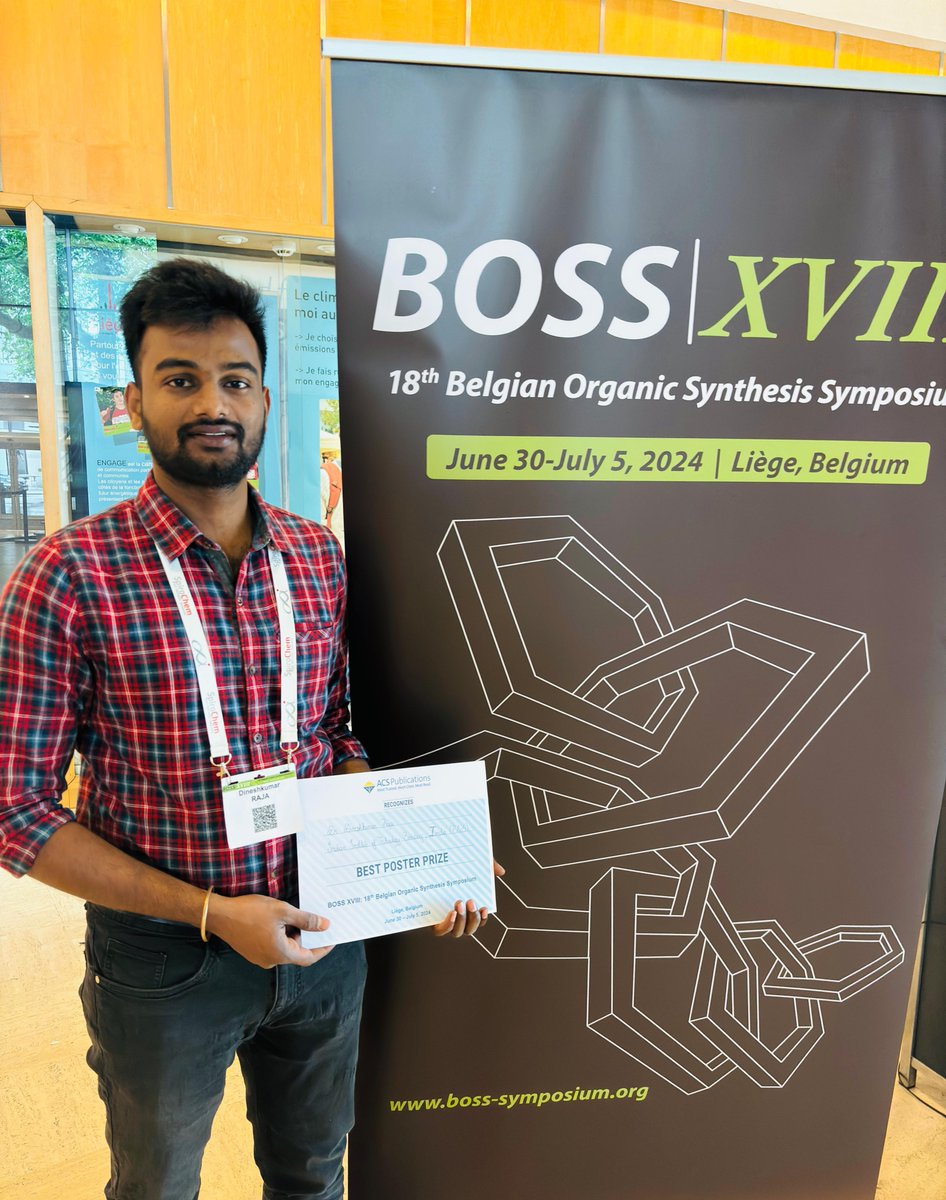
Huge congrats to Dinesh @Dineh_Rajaa @dm_lab for his award-winning 🥇 poster on Pd induced photo-catalysed cross-electrophile coupling at @BOSS_Symposium#BOSSXVIII. Thank you friends @GloriusFrank and colleagues for visiting the poster.
🎉Exciting news! Registration for ISCHA 2024 is NOW OPEN! Don't miss the chance to connect, discuss & learn from the experts in the field. Secure your spot today. REGISTER NOW !🚀
Click here👉 https://t.co/S2yDnZ2kzR
@maiti_iitb@basker25071980@iitbombay@IITKanpur
Explore @dm_lab methods in creating diverse unsaturated units from cyclic carboxylic acids via Pd-catalysis @NatureComms
Distinct decarboxylative reactivity of aliphatic carboxylic acids in C-H activation: Unlocked 🔓
Thank you all the contributors.
https://t.co/v8Geu9GIVf
📢7th International Symposium on C-H Activation will be held at @iitbombay
Join world's esteemed experts to discover cutting-edge research, foster collaboration and shape the future of organic synthesis in C-H Activation
Don't be late. Follow us on @ischa2024 for more updates.
🚀@NatureSynthesis
Dive into our @dm_lab & @p_bhaumik latest work:
“Enantiodivergent synthesis of isoindolones catalyzed by a Rh(III)-based artificial metalloenzyme."
Thank you Prof. Tom Ward Group @UBasel for the unconditional help and support.
https://t.co/fpVrKWUhw2
♨️off the Press @NatureCatalysis, @dm_lab@serbonline.
Now you can cross-couple two aryl halides by single metal.
This new method of cross-electrophile coupling exploited both the excited & ground state chemistry of palladium bypassing transmetalation.
https://t.co/9WxLWyk1YL
Congratulations to the Winners of Shanti Swarup Bhatnagar Prize (SSB) for Science and Technology 2022: Chemical Sciences:
Dr Akkattu T Biju, IISC, Bengaluru
Dr Debabrata Maiti, IIT Bombay (Mumbai)
@DrJitendraSingh@CSIR_IND@dgcsirIndia@iiscbangalore@iitbombay
Excited Pd-catalyst performs the magic trick for the cross-electrophile coupling! Rational ligand design helps to improve the selectivity of a cross-coupled product. Now on @ChemRxiv.
https://t.co/sc5eqh1TEt
New ligands design are ongoing to strengthen this 🆕route to biaryls!
Many congratulations, Prof. Debabrata Maiti
@ClimateIITB for receiving the 'Impactful Research Award' & 'Research Dissemination Award' from Industrial Research and Consultancy Centre (IRCC)
@iitbombay.
It is quite rare for a faculty getting two IRCC awards in a single year👏🎊