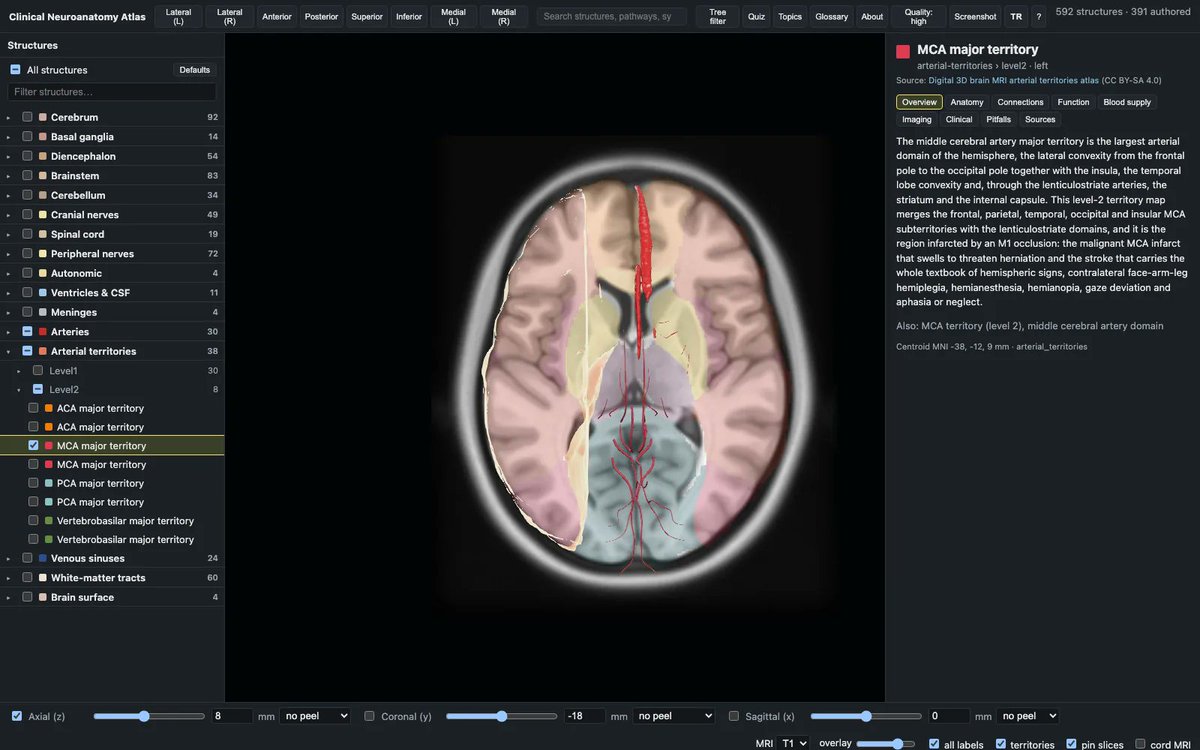
A 3D neuroanatomy atlas that runs in a browser. Everything is in MNI152 space, the same coordinates as the template MRI, so the model and the scan correspond and you can move between them.
https://t.co/4bCy6eMjAW
Thank you Fable 5.1 and GPT Astra @OpenAI@AnthropicAI
I have finally achieved 30FPS holographic glasses free gesture based colorized segmented medical imaging from a basic black and white DICOM
GPT-6 Astra is seriously impressive. 🤯
It’s not just good at coronary arteries — it can also handle complex cardiac anatomy.
One example: atrial septal puncture, a key technique for ablation procedures.
And the crazy part?
It can reproduce the procedure in 3D with ICE/echo-guided visualization, without dedicated clinical simulation software.
A 3D coronary wiring simulator for CTO treatment is also becoming possible with AI.
We might be looking at a completely new way to teach complex cardiovascular procedures.
Clinical education is about to get very interesting. 👀
Follow @Hyde_ai3 for more AI + medical tech breakthroughs.
Can @OpenAI Images 2.5 create heart sounds?
Step 1: GPT-6 Pro + image gen: "create a spectrogram of aortic stenosis"
Step 2: New GPT-6 chat: "here's a PNG. output the audio represented here."
It’s not perfect, but pretty impressive for prompt -> PNG -> audio.
Wow, just wow! 😮 This is amazing!
I’m also now building incredible biological simulations that are far beyond what I could create just a few months ago.
This is the ultimate dream of AGI that we hoped for & predicted in biomedical research, and now it’s actually happening!
Today, I’m incredibly proud to launch https://t.co/dh7gdeozUr @SurgeonAIonX
For much of my career, I’ve been thinking about one central question:
𝗛𝗼𝘄 𝗱𝗼 𝘄𝗲 𝗱𝗲𝗺𝗼𝗰𝗿𝗮𝘁𝗶𝘀𝗲 𝗮𝗰𝗰𝗲𝘀𝘀 𝘁𝗼 𝘄𝗼𝗿𝗹𝗱-𝗰𝗹𝗮𝘀𝘀 𝘀𝘂𝗿𝗴𝗶𝗰𝗮𝗹 𝗲𝗱𝘂𝗰𝗮𝘁𝗶𝗼𝗻?
Talent is universal. Opportunity is not.
Where you live, where you train, who teaches you and what resources you can access still have an enormous influence on the surgeon you can become.
AI gives us an opportunity to change that.
is the AI companion for every surgical career—from medical student to trainee, surgeon, and consultant/attending, anywhere in the world.
But we didn’t want to build another question bank, course or static learning platform.
We wanted to build an intelligent surgical learning ecosystem.
At its heart is 𝗘.𝗟.𝗟.𝗔, 𝘁𝗵𝗲 𝗘𝗱𝘂𝗰𝗮𝘁𝗶𝗼𝗻 𝗟𝗲𝗮𝗿𝗻𝗶𝗻𝗴 𝗮𝗻𝗱 𝗟𝗼𝗴𝗶𝗰 𝗔𝗴𝗲𝗻𝘁, our AI surgical education companion, supported by a connected suite of technologies:
𝗦𝘂𝗿𝗴𝗲𝗼𝗻𝗢𝗦: the operating system for your surgical education, bringing learning, assessment and development together.
𝗦𝘂𝗿𝗴𝗲𝗼𝗻𝗚𝗣𝗦: the Guided Progress System that understands where you are, where you want to go and helps navigate the journey.
𝗦𝘂𝗿𝗴𝗲𝗼𝗻𝗜𝗘: the Intelligence Engine, transforming data, learning activity and performance into personalised insights.
And our 𝗦𝘂𝗿𝗴𝗶𝗰𝗮𝗹 𝗔𝗰𝘂𝗺𝗲𝗻 𝗜𝗻𝗱𝗲𝘅(𝗦𝗔𝗜), our proprietary AI-driven approach with a unique algorithm for understanding development across six domains: Knowledge, Clinical Reasoning, Decision Making, Operative Understanding, Evidence-Based Practice and Professional Practice.
Together, they allow us to move beyond simply asking, “Did you get the answer right?”
We can begin asking:
“𝗪𝗵𝗮𝘁 𝗸𝗶𝗻𝗱 𝗼𝗳 𝘀𝘂𝗿𝗴𝗲𝗼𝗻 𝗮𝗿𝗲 𝘆𝗼𝘂 𝗯𝗲𝗰𝗼𝗺𝗶𝗻𝗴?”
We are starting with surgical education and examinations, but our ambition is much bigger.
A lifelong AI companion that learns with you, grows with you and supports you throughout an entire surgical career.
From your first anatomy lesson.
To your first operation.
To your exams.
To independent practice.
And eventually, to helping teach the next generation.
This has been a huge journey for our team, and today is only the beginning.
One intelligent companion.
One connected global community.
One mission.
To empower every surgeon, everywhere.
𝗦𝘂𝗿𝗴𝗲𝗼𝗻.𝗮𝗶— 𝘁𝗵𝗲 𝗔𝗜 𝗰𝗼𝗺𝗽𝗮𝗻𝗶𝗼𝗻 𝗳𝗼𝗿 𝗲𝘃𝗲𝗿𝘆 𝘀𝘂𝗿𝗴𝗶𝗰𝗮𝗹 𝗰𝗮𝗿𝗲𝗲𝗿.
Welcome to the future of surgical education.
We are live.
The platform is here:
https://t.co/LaxmjeV5jz
I launched Grok Bot for 24 hours, gave it 3 jobs, and stopped treating AI like a chatbot.
I had it scan live X + web data for emerging AI products, research what people were actually saying about them, filter the obvious engagement bait, compare sources and turn the strongest signals into a structured brief.
At the same time, I could have separate research paths looking at competitors, code or market opportunities instead of forcing everything through one conversation.
That’s the difference I underestimated. I don’t want to sit inside a chat writing another prompt every 5 minutes. I want to define the objective, give the agent access to the right tools and data, let it execute, then step back in when judgment or approval is actually needed.
The old workflow was prompt → answer → copy → repeat.
The workflow I’m moving toward is assign → execute → verify.
Once AI stops waiting for your next message, it stops feeling like software you use and starts feeling like work you delegated.