🧠 | LA PROLETARIZACIÓN COGNITIVA
Un nuevo informe de Anthropic ha dado dimensión a las amenazas de la IA sobre la actividad intelectual. La presión sobre la base productiva ya no es la única; la expropiación del conocimiento de la clase profesional ha comenzado y es alarmante:
1/ La fase de captura: Expropiación de capital cognitivo
La distancia entre la capacidad teórica (área azul) y la ejecución real (área roja) no refleja una "adopción lenta"; muestra la fase de acumulación primitiva de datos: el porcentaje de saber experto que las corporaciones ya han logrado privatizar e indexar.
En computación y administración, donde la capacidad supera el 90%, los modelos no están "asistiendo" al trabajador; están extrayendo la lógica operativa de su función para sustituir la masa salarial por renta de cómputo.
2/ La descalificación del trabajo de "cuello blanco"
La ilusión del refugio meritocrático se ha derrumbado: los perfiles con estudios de posgrado son cuatro veces más propensos a ubicarse en el tramo de máxima exposición que los roles manuales.
La IA ejecuta una subsunción real del trabajo intelectual:
-Programadores de Computadoras: ~74.5% de saber expropiado
-Servicio al Cliente: ~70.1% de saber expropiado
-Entrada de Datos: ~67.1% de saber expropiado
-Registros Médicos: ~66.7% de saber expropiado
-Analistas Financieros: ~57.2% de saber expropiado
3/ Degradación de la renta y precarización de plataforma
El "desempleo masivo" no aparece en las estadísticas tradicionales porque el impacto inicial no es (aún) la cesantía, sino la devaluación del valor de la hora de trabajo.
El profesional no es despedido de inmediato; es degradado a la condición de corrector precarizado del algoritmo que lo reemplazará. No hay estabilidad y esto no es una sensación: hay una reconfiguración de facto hacia una economía de gig economy de alta cualificación.
4/ El tapiado generacional de la reproducción social
El bloqueo en las tasas de contratación de jóvenes (22-25 años) en sectores expuestos corta la transmisión del saber técnico. Al eliminar los puestos de entrada (entry-level), las corporaciones han destruido (y destruirán más) las vías y las escalas de ascenso social.
Con ello, se consolida una tendencia hacia una gran masa de graduados hipertitulados pero estructuralmente excluidos de la estructura formal de ingresos y derechos.
5/ Tecnofeudalismo y pérdida de soberanía estatal
La contracción de rentas altas erosiona los ingresos impositivos, pero el riesgo de fondo no es meramente fiscal: es de gobernanza.
Si la infraestructura cognitiva de la economía y la administración pública pasa a depender de clústeres privados de cómputo, el Estado pierde autonomía política.
6/ Este es el punto crítico
La respuesta no puede limitarse a esquemas de contención como la Renta Básica; exige discutir la propiedad social del software, la fiscalidad al capital algorítmico y la soberanía sobre la infraestructura de cómputo.
El debate del siglo XXI no es ni debe ser sobre cuántos empleos destruirá la tecnología, sino quiénes serán y cuáles son los límites que las sociedades puedan construir a tiempo a los dueños de las infraestructuras que programen el trabajo humano.
📝 Informe completo: https://t.co/RLX1wf2DKO
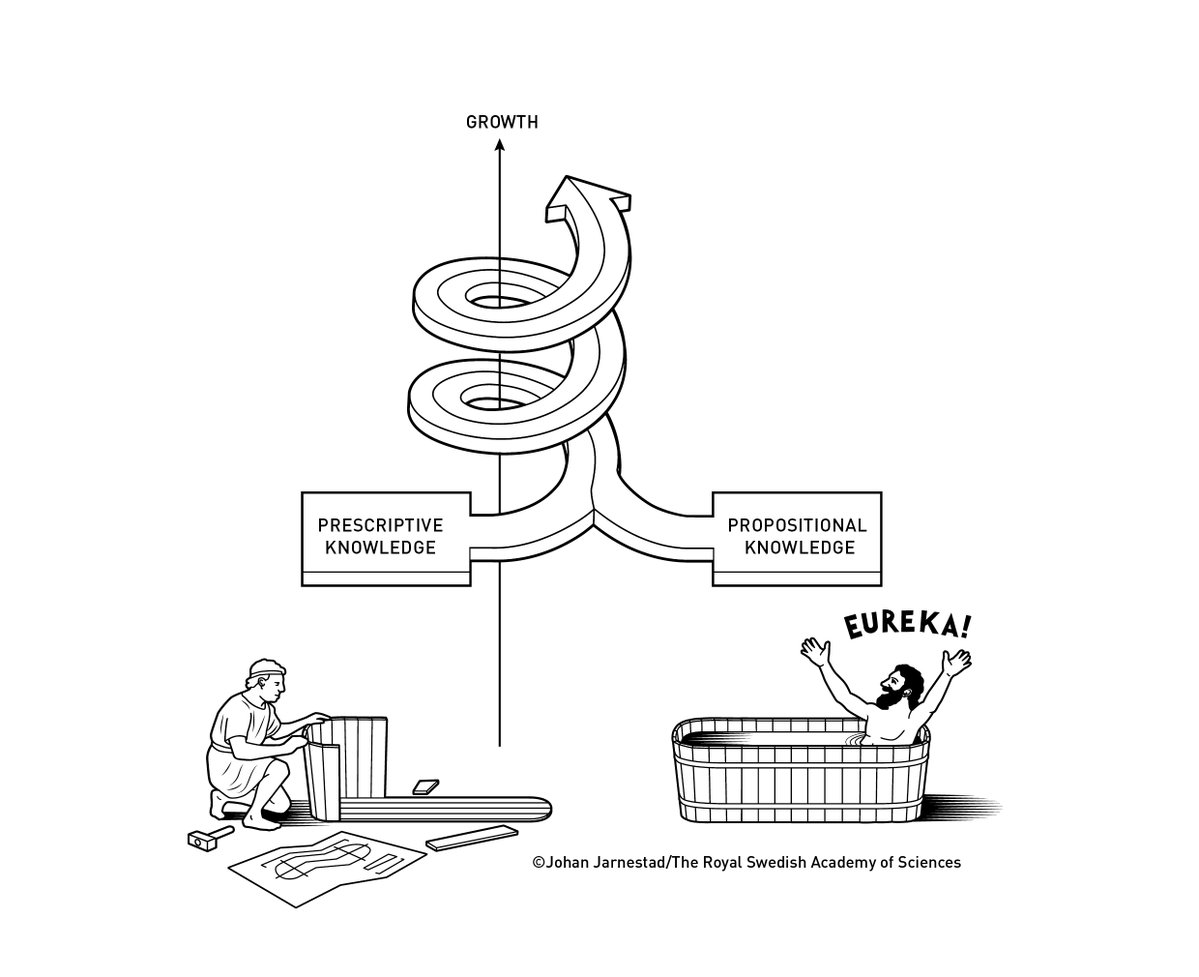
What creates sustained economic growth? This year’s laureates used different methods to answer this question. Through his research in economic history, Joel Mokyr – awarded the 2025 prize in economic sciences – has demonstrated that a continual flow of useful knowledge is necessary.
This useful knowledge has two parts: the first is what Mokyr refers to as propositional knowledge, a systematic description of regularities in the natural world that demonstrate why something works; the second is prescriptive knowledge, such as practical instructions, drawings or recipes that describe what is necessary for something to work.
Mokyr used historical sources as one means to uncover the causes of sustained growth becoming the new normal. He demonstrated that if innovations are to succeed one another in a self-generating process, we not only need to know that something works, but we also need to have scientific explanations for why. The latter was often lacking prior to the industrial revolution, which made it difficult to build upon new discoveries and inventions. He also emphasised the importance of society being open to new ideas and allowing change.
#NobelPrize
Who/what/is the intention in your mind when you post to social media? If you’re not able to answer that, your thinking is 100% under someone else’s control.
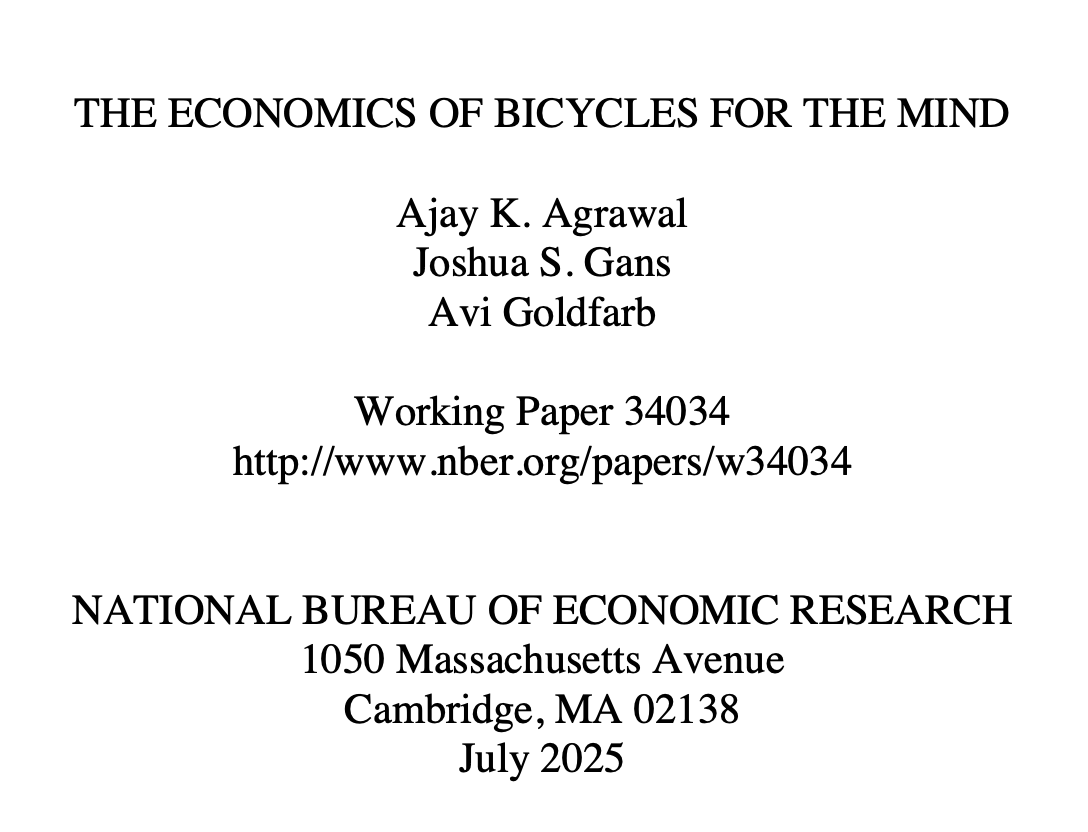
Everyone "knows" that as AI gets better, humans become less valuable. Except three economists just proved the exact opposite using math from 1973 and Steve Jobs.
And it explains something that's been driving researchers crazy...
Why did computers make inequality WORSE but ChatGPT is making it BETTER?
The data is bizarre. In the 1990s, computers widened wage gaps everywhere they appeared. But study after study shows AI helping struggling workers more than experts.
I spent the morning with this research paper and... the answer flips our entire mental model.
Think about how you use ChatGPT. You don't just type once and walk away, right? You iterate. You refine. You spot opportunities to improve.
That back-and-forth? That's the key to everything.
The researchers decomposed ALL cognitive work into three parts:
Implementation (doing the task)
Opportunity judgment (seeing what could be better)
Payoff judgment (knowing what actually matters)
Here's where it gets wild...
AI is really good at implementation. Like, scary good. A junior coder with Cursor can suddenly write like they have 5 years experience.
But that's not the interesting part...
The better AI gets at implementation, the MORE valuable your judgment becomes. It's multiplicative, not substitutive.
Imagine you're a designer. AI can now execute any design in seconds. But knowing WHICH design to make? When to iterate? What the client actually needs? That's all you.
The math proves something counterintuitive: as tools get more powerful, the gap between someone who can spot opportunities and someone who can't gets BIGGER.
But wait - why is AI currently reducing inequality then?
Because we're in phase one. Right now, AI is compensating for skill differences. The struggling workers get huge boosts. The experts? They were already good at implementation.
Phase two is coming though...
Once implementation is basically free (think: anyone can code, design, write), the ONLY thing that matters is judgment. Who sees the opportunity? Who knows what's valuable?
And that's when inequality explodes again. The paper even calculates the exact turning point.
Here's what broke my brain: better AI makes full automation LESS likely, not more.
Why? Because automated systems have fixed judgment. They can't adapt. A radiologist AI might be 99% accurate, but it can't realize "wait, this patient's case is weird, I should think differently."
The flexibility to adjust your judgment in real-time? That's uniquely human. And it gets MORE valuable as the tools improve.
Even crazier: this changes how teams should work.
The paper shows that as AI improves, control should shift from people who are good at DOING to people good at SEEING opportunities.
We're already seeing this. That study about Microsoft's Kinect? Machine vision experts suddenly mattered less than generalists who could spot novel uses.
You know what this reminds me of? The shift from craftsmen to designers during industrialization.
The machines could make anything. The value moved to knowing WHAT to make.
We're about to see the same thing with cognitive work.
Next time you use ChatGPT, try this: instead of focusing on getting it to do the task perfectly, focus on recognizing opportunities to iterate.
That skill - seeing what could be better - that's your moat.
The researchers call it "opportunity judgment" and it's about to become the most valuable skill in the economy.
Quick test: Give two people the same AI tool and the same task. The output difference? That's pure judgment. And that gap is about to get a lot wider.
One finding haunts me: the paper shows task-based predictions (like "AI will replace X jobs") are missing the point entirely.
They measure what people do TODAY. But the whole point is that AI changes what the job even IS.
A lawyer's job won't be "writing contracts." It'll be "knowing which contract variation creates the most value in this specific situation."
Completely different skill.
The paper maps out exactly when to automate vs augment. The formula is complex but the intuition is simple:
If judgment variance is high → augment If tasks are predictable → automate If stakes are high → definitely augment
Here's my take: we're training for the wrong future.
Everyone's learning to prompt better. But prompting is just implementation. The real skill is recognizing when the output could be better and knowing what "better" means for your specific context.
Schools teaching "AI literacy"? They're teaching people to be better bicycles. We should be teaching people to be better riders.
(That's literally where the paper's title comes from - Jobs called computers "bicycles for the mind")
Last thought that changes everything:
The paper proves that in high-judgment work, making AI 10x better might make humans 100x more valuable.
Because you can iterate faster. Test more ideas. Explore more opportunities.
Your judgment gets amplified.
So the question isn't "will AI replace me?"
It's "am I developing the judgment to ride increasingly powerful bicycles?"
Because the bicycles are about to get VERY fast. And the gap between good riders and bad ones is about to become a chasm.
What patterns are you starting to notice in your field that others are missing?
That's your future edge. And it's about to matter more than ever.
/end
PS - If you're curious about the math, the paper actually derives the exact inequality curve. It's U-shaped. We're at the bottom of the U right now. The climb up is coming.
Makes you wonder what other "obvious" things about AI we have completely backwards...
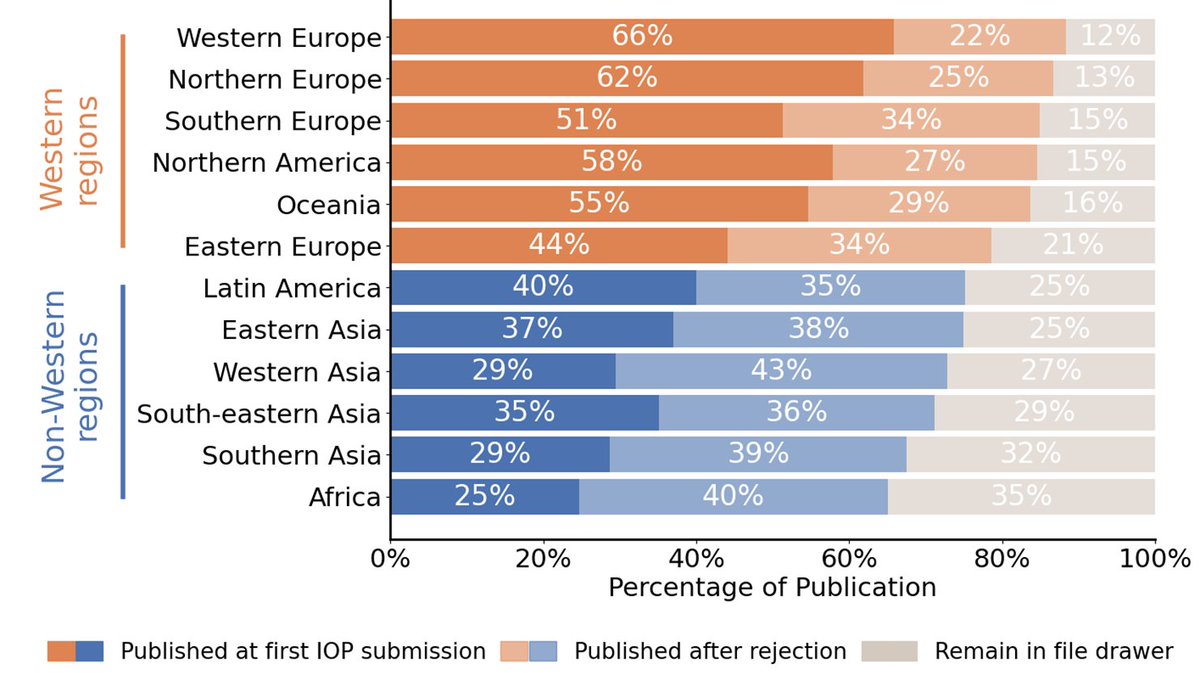
People assume that every scientific paper, no matter how good/bad, is eventually published somewhere.
We studied fate of 126K papers rejected from 63 journals and found that
1. Many papers never published
2. Especially papers by authors from non-Western countries
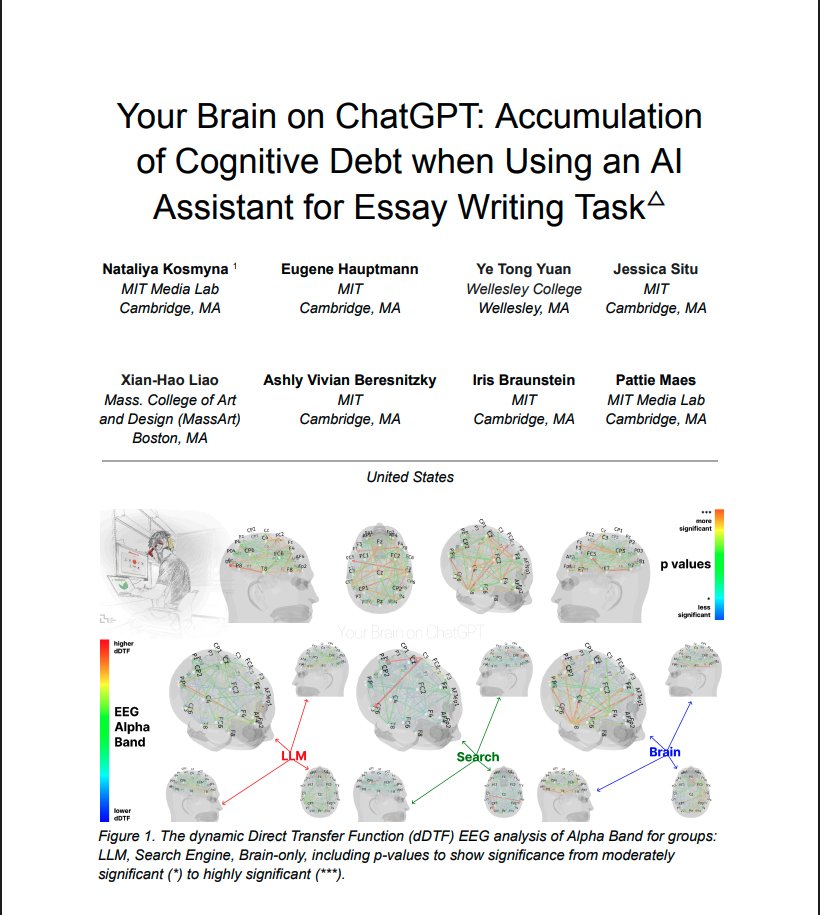
BREAKING: MIT just completed the first brain scan study of ChatGPT users & the results are terrifying.
Turns out, AI isn't making us more productive. It's making us cognitively bankrupt.
Here's what 4 months of data revealed:
(hint: we've been measuring productivity all wrong)
The health indicator no one talks about = the strong desire to work and build things. Whether for the intrinsic love of the work, the rewards, or both. Yes we need sleep and (some need) recreation but drive is at least as important as any other metric.
Might seem extreme, but keep in mind @DrShannaSwan has been studying and talking about this for years. BTW: Federal funds (taxes) supported the work. The takeaways are pretty clear. There is no way to completely avoid these endocrine disruptors, but one should make some effort.
@lexfridman Have you read Asimov’s Foundation books?
They pose an interesting question: if you knew a dark age was coming, what actions would you take to preserve knowledge and minimize the length of the dark age?
For humanity, a city on Mars. Terminus.
New Huberman Lab podcast out now: IMPROVE SKIN HEALTH & APPEARANCE•
•Sun Exposure Facts: Aging, Cancer, Etc
•Sunscreen: Safety, Mineral vs Chemical
•Phototherapy
•Peptides, Collagen & Skin Rejuvenation
•Acne, Psoriasis, Eczema
•Nutrition, Rx Meds
https://t.co/dIBFpApUDx