I'm elated to announce that our work on 'Imprint of local opacity in high energy gamma-ray spectrum of Blazar jet' is now published in ApJL.
I've summarized it in a doodle overlay template inspired by @ClaireLamman.
Link: https://t.co/8RN1DBBuHb
arXiv: https://t.co/qP0Hszexsb
The creator of Claude Code teaches more about vibe-coding in 30 minutes than most tutorials do in hours.
Save this — it'll change how you build forever.
Hi everyone,
Our recent paper on high energy gamma-ray emission from gravitationally lensed quasar PKS 1830-211 got published earlier this year.
Here are the journal link: https://t.co/oeO0azJLcZ
arXiV link: https://t.co/hUZMWE7sH3
#MNRAS#academicpost#AGN#HEAP#lensing
Velocity distribution of stars in a galaxy
Left : expected assuming only visible matter using GR/Newtons law
Right: observed
Something makes stars far from the centre move much faster then expected 🤔
#DYK: One of @NASA’s superpowers is X-ray vision! Studying X-rays from the cosmos, that is.
All this week, we’ll explore how our telescopes collect X-ray light that comes to us from across the universe and what we learn from studying it. Let’s start with some X-ray 101 … 🧵
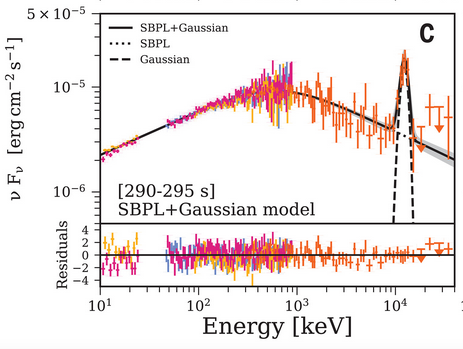
GRBs have generally featureless spectra at MeV energies. Edvige Ravasio et al. identify a transient emission line in the MeV spectrum of the bright GRB 221009A; the line evolves in energy and width during the fading phase of the #GRB.
https://t.co/YIuMTxmBfo
An Oxford-led team has developed a novel method to create plasma 'fireballs' on Earth, mimicking those near black holes and neutron stars. This breakthrough, published in Nature Communications, opens new research avenues in laboratory astrophysics. https://t.co/KlnQJDgDCf
JWST captured the clearest view of Neptune’s rings and 7 of its 14 known moons. Triton, Neptune’s largest moon, appears brighter than the planet in this Webb view.
This work is done with my Supervisor @Amit008_Shukla , Karl Mannheim, Bhargav Vaidya, Biswajit Banerjee.
Also the useful comments by the reviewer helped improve the discussion.
I'm elated to announce that our work on 'Imprint of local opacity in high energy gamma-ray spectrum of Blazar jet' is now published in ApJL.
I've summarized it in a doodle overlay template inspired by @ClaireLamman.
Link: https://t.co/8RN1DBBuHb
arXiv: https://t.co/qP0Hszexsb
A lazy neutron star.
Are there more? That's the third of its kind.
“It is highly unusual to discover a neutron star candidate emitting radio pulsations in this way. The fact that the signal is repeating at such a leisurely pace is extraordinary.”
And that makes three: Our colleagues at @Sydney_Uni and @CSIRO_ATNF have found a third slowly repeating object deep in space. We caught up with ICRAR co-authors @ColourfulCosmos and Sam McSweeney to find out why that's a big deal:
You’re likely reading this on a screen with millions of pixels. But what if you only had 36?
That’s plenty for the Resolve instrument on @JAXA_en’s XRISM!
Watch this video to learn how just 36 pixels can help us capture revolutionary science. Read more: https://t.co/Qn4LsKggl5
New timelapses of two of the most famous objects in the sky — the Crab Nebula & Cassiopeia A! X-ray data collected by Chandra over about two decades shows dramatic changes in the debris & radiation remaining after the explosion of two massive stars. More: https://t.co/MV4XHz062m
Guest post from Gourab Giri: Galaxy mergers represent a transformative evolutionary path, inducing notable morphological and compositional changes in the involved galaxies. They provide insights into the real-time occurrence of such processes. 🔭✨️
https://t.co/vRYPsBLC7g
Violent environments around some of the most humongous black holes provide exciting opportunities for studying extreme science cases. I recently wrote an article about my research, which was published in a UK-based journal. Feel free to explore.
https://t.co/imGi3KJDg2
So what does our spiral pattern tell us about the magnetic fields around Sagittarius A*? The field is actually strong and ordered!
cr. Crazybridge Studios, EHT Collaboration #MagneticBlackHole#EHTblackhole
🔗https://t.co/lAWZ5Jiukr