Reforecasting is live on Numinous tomorrow at 10 EST 🎯
Miners are no longer scored on isolated predictions — they're scored on their entire belief curve, against what the market itself believed at that moment.
Here's how it works 🧵
@vaNlabs Yes, full agreed. There is an interesting take of @ReggyStev that v440 makes life of strongly technical SNs more difficult and promoted Hype and short termism. There are also positive aspects which are obvious. But, generally, v440 is not well over thought.
The Belief Curve That Front Runs the Price
Numinous is transitioning its entire subnet to pure prediction market questions, scoring the full probability curve instead of just point forecasts, while giving forecasters memory.
Early tests already show that its news only belief curves Granger lead prediction market price curves on high impact geopolitical events.
Full write up ↓
https://t.co/Odg7ulisla
Very interesting update from @numinous_ai/#SN6.
Moving forecaster evaluation toward prediction-market questions makes a lot of sense. It reduces noise from internally generated short-term questions, gives objective resolution, and anchors the subnet in real markets where information is continuously repriced.
The most important part, in my view, is the shift from point forecasts to scoring the whole probability curve. A real forecaster should not just make one prediction and disappear, it should update its beliefs as new information arrives. Adding memory also feels essential: without memory, the agent is just reacting while with memory, it can maintain a prior, explain why it moved, and improve over time.
The Granger-causality result is especially interesting. Even with only a news-impact feed, no internet access, and no market-price input, the forecaster’s belief curve reportedly led Polymarket prices in 4 out of 16 markets tested. That is early, but promising. If this holds at scale, SN6 becomes less about "forecasting as an answer" and more about forecasting as live market intelligence.
Overall, I like the direction. It makes #SN6 much closer to a true self-improving prediction-market intelligence layer: agents observe information, maintain beliefs, update continuously, compete, and get scored against real-world repricing.
https://t.co/kJQM1Iml5H
Many ask - what exactly is the profile of a @numinous_ai
client?
In my opinion at least:
1. Global macro hedge funds / multi-strat funds
2. Bank trading desks
3. Commodity and energy trading firms
4. Prediction-market platforms and market makers
5. Market-data vendors and exchanges
7. Insurers and reinsurers
8. Large corporates with strategic exposure
9. Government-adjacent research and national-security analytics
@numinous_ai Excellent update @numinous_ai
As an investor interested in frontier forecasting systems, this is a sharp evolution: real PM questions, continuous curve scoring with difficulty adjustment, memory component, and strong Granger results leading Polymarket from news alone.
Looking forward to Root Reborn.
Today, only 18% or 2M Tao is in subnets. The remaining 9M+ is on root or free-floating.
For perspective, the US stock market is roughly $100 trillion, while M2 – the broad money supply analogous to root/free Tao, is around $20 trillion.
Anything that helps move Tao into subnets strengthens the dTao economy.
#SN88 #Bittensor $TAO 🚀
I don't know what Const means with his "Watch next week" reply, but I hope we can give those lower cap subnets some more runway to keep shipping.
Investors in D bittensor:native should not be scared to invest in the lower cap subnets. If they are, then the liquidity is non-existent. How can they survive?
Bittensor's beating heart is the subnets. If they survive and thrive, then Bittensor thrives.
There needs to be some sort of change here.
Or more liquidity that flows in Bittensor subnets.
bittensor:native
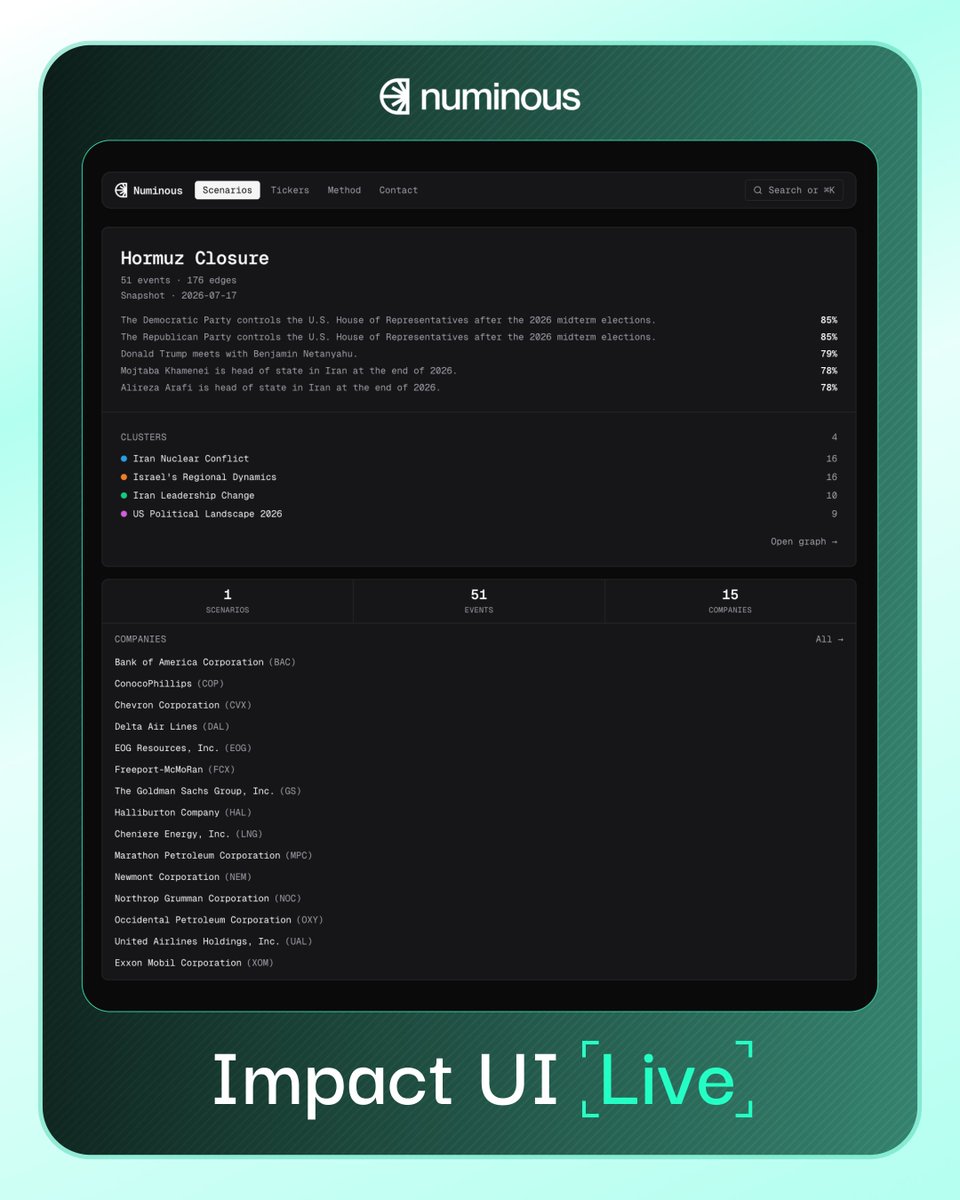
Today we're opening a beta of something we've been building for institutional clients: a live graph that maps prediction market events straight through to equities.
Every node is a real market with a traded probability, and every edge is a causal link rather than a correlation, scored by how much resolving one market actually tells you about the rest of the graph. That structure is what bridges into company driver graphs, so a geopolitical or macro scenario shows up as concrete, weighted exposure across specific tickers instead of a vague narrative.
Right now Hormuz Closure is the scenario driving the build, with biotechnology and the AI bubble coming soon after.
The part we're most excited about is how it handles gaps. Markets don't cover every event that matters to a scenario, so Numinous forecasters step in as the continuous signal for events that don't have a tradeable market, while also estimating the covariance between events across the whole graph. The forecasting layer isn't a side feature here, it's what makes full scenario coverage possible in the first place.
We'll keep expanding this beta with more scenarios as it develops.
Explore it now: https://t.co/YsEihahWyA
Want expanded access, including full equity coverage, live graph updates, and multimodal graph construction? Reach out
Changing your portfolio means admitting that your previous investment choices were wrong. Doing it constantly means you have a tendency to make wrong decisions. Is trading really your vocation?