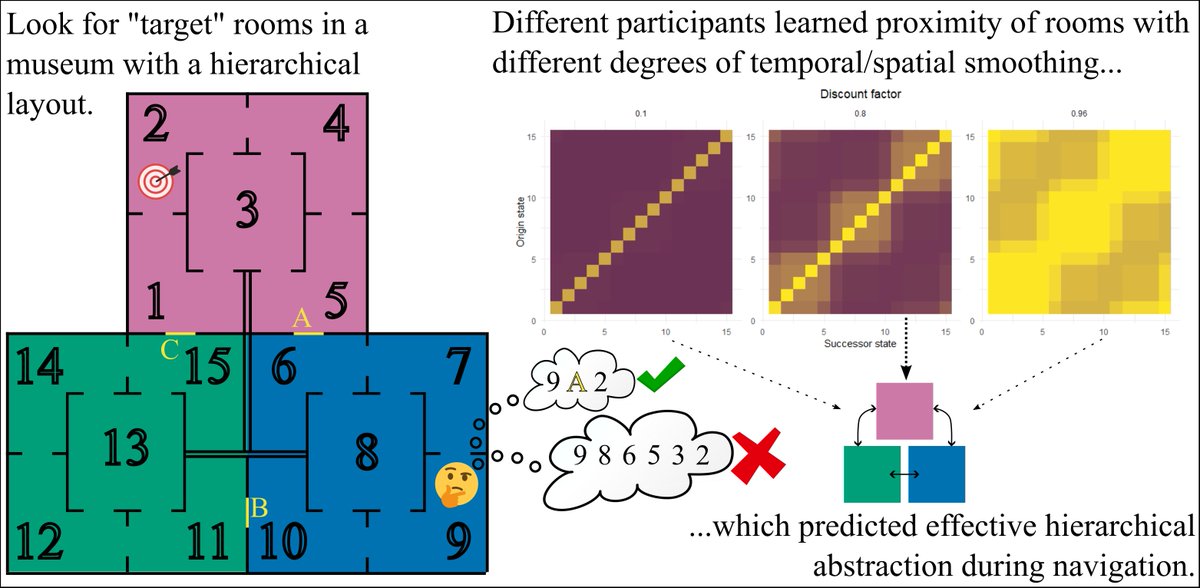
Excited to announce our new work finding that individual differences in predictive learning (e.g. Successor Representations) show a strong relationship with hierarchical abstraction during decision making, now out in @PLOSCompBiol! Read on👇or visit https://t.co/eBw4fcomtN
I have been a board member at Ghent University for the past four years. The events of the past few weeks have saddened me on many levels. I cannot speak for the board or the university itself, but I can speak to my own perspective.
Academic freedom lies at the heart of the pursuit for truth and universities have a duty to protect it. Especially when doing so is uncomfortable.
Universities also employ people from all walks of life, cultures and of various racial backgrounds. Those people can clash, sometimes as a result of racial prejudice. Ghent University also has a duty to act against that. One that is, in fact, mandated by law.
The Cofnas-case lies at the intersection of these two duties. And while some seem to favor one horn of this dilemma to the complete detriment of the other, reality might require that we strike an unhappy balance.
Many colleagues in academia seem worried that this case is about ideologically driven retaliation against a whistleblower. I think that is an incorrect assessment, but in any case: there are strong whistleblower protections at the EU level, at the Belgian level and within UGent itself. If Nathan Cofnas believes he is being targeted because of whistleblowing, he should certainly make use of the protections that are available to him.
To me, it seems the issue is whether Cofnas' viewpoints and public commentary rises to the level of racism, and if so, whether that should be protected by academic freedom or not. No matter your viewpoint on those questions, there are people with equally firm opinions on the other side and some form of resolution must be found.
Many people doubt that the process to find that resolution can be conducted fairly. They fear that universities have been ideologically captured. I can only speak to Ghent but while there certainly are colleagues with strong political opinions and activist tendencies, the overwhelming majority strive to conduct their teaching and research without embroiling themselves in politics.
Yes, our rector is a former left-wing politician, but the president of our board is a former center-right-wing politician. Our board has catholics and atheists, representatives of professors, technical staff, students and postdocs. About a third of the board are non-academics from various backgrounds, selected to represent society as a whole. Some of my colleagues in the board have come out publically in support of academic freedom. Others favor the other side. Both perspectives are at the table, and in my estimation, at roughly equal proportions.
Importantly, while Ghent University's board might debate the broader topic, it will not adjudicate the Cofnas-case. And neither will our rector. Our regulations stipulate that our rector can apply temporary suspensions to keep the peace, but actual disciplinary decisions are made by a fully independent panel in which the majority of members are external to the university and which is presided upon by a (potentially former) magistrate.
Due diligence requires investigating the issue. At the moment, Cofnas is not fired, nor is there any certainty that he will be. His current suspension is temporary (for seven days) and can't be extended without further disciplinary steps. Right now, we are at the step of a pre-investigation that looks into whether any regulations have been broken.
I can only ask for some grace and some patience. Moral disagreements are a fact of life. We need to be able to have these discussions without going for each other's throat and turning every disagreement into yet another political spectacle.
Mark my words here. I'm not exaggerating. Nathan Cofnas is a Zionist, a hereditarian supremacist and part of the heavily-funded 'Dark Enlightenment' movement, initiated by Nick Land and fronted by Thiel, Yarvin and Tech Bros. They seek the end of democracy and a shift to technocratic population control. Jason Arday was a carefully selected vulnerable target, the first of a campaign designed to discredit the university system and eventually all public institutions. This system, poorly managed by naive, comfortable liberals, is currently being targeted by private equity. It will take more than DEI vanity to defend it. The left must toughen up its intellect and its politics. This is a serious, rich and powerful enemy operating at a global level, probably more powerful, and certainly cleverer and more insidious, than anything we saw in the 1930s. https://t.co/ziYvckbHup
Contrary to many EU-doomsayers, I predict the EU will rapidly reemerge over the next decades as the most advanced and powerful regional power on the planet. On one condition: that we defend it.
Here’s why. Very long thread:
1/8 👇🧵
Thrilled to announce our new paper in JEP: General!
https://t.co/wZPVysuAJI
We show how proactive control declines while reactive control remains robust across the lifespan with multiple measures in a novel Stroop paradigm. A very rich, open dataset for future modeling projects!
Being a grad student is peak human existence. The end goal of all political and technological progress should be allowing everyone to be a grad student forever
Postdoctoral Research Position #2, Ghent University, Belgium
The successful candidate will train recurrent neural networks to learn the generative structure of existing behavioral, EEG and MEG data sets. https://t.co/3UkC3GvKq1
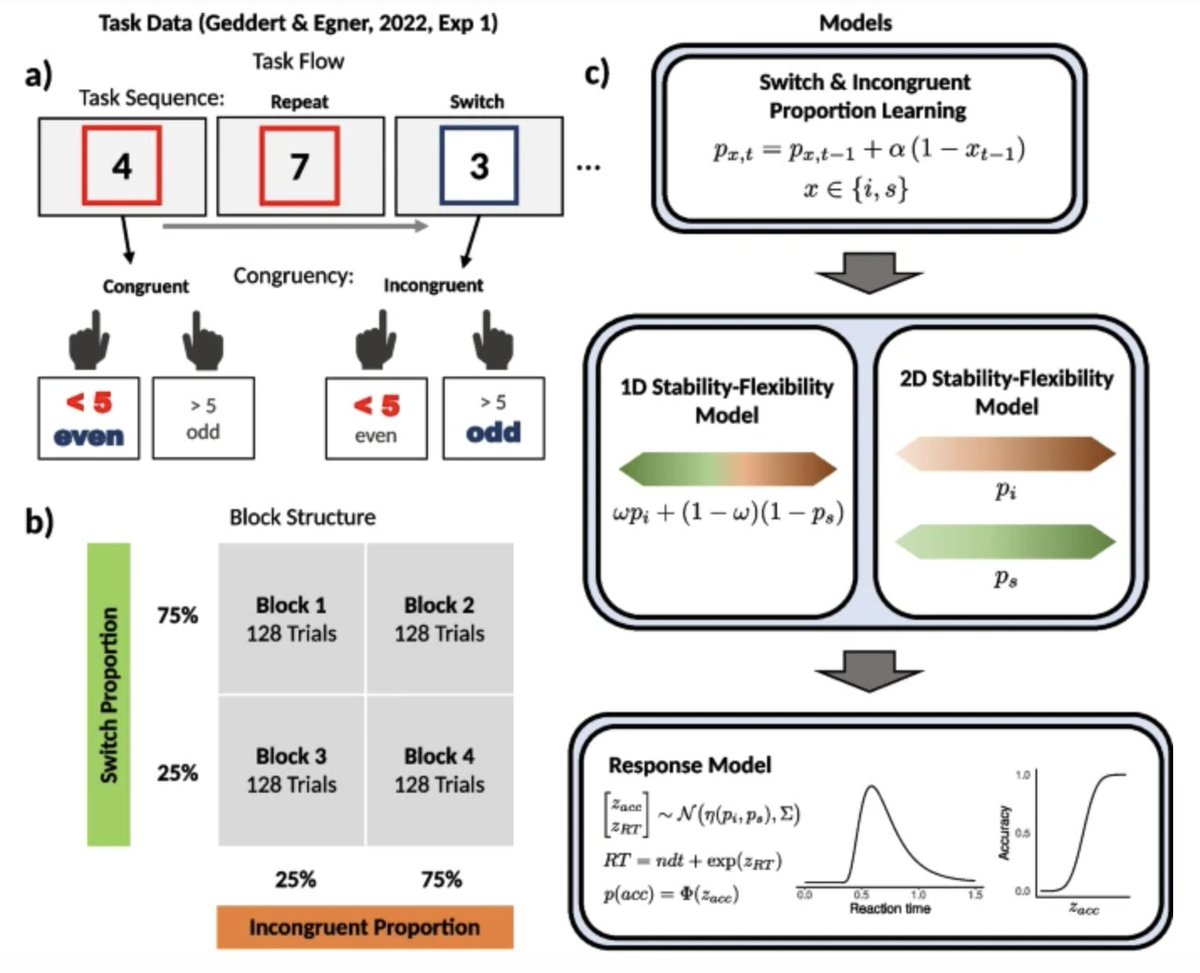
New paper, fronted by @RaphaelGeddert and Seth Madlon-Kay, in Psychonomic Bulletin & Review: "Modeling of control over task switching and cross-task interference supports a two-dimensional model of cognitive stability and flexibility".
Free read link: https://t.co/Kl1lvhdkNv
New preprint! Statistical structure skews object memory toward predictable successors. Model simulations show how this bias can arise from the backward expansion of hippocampal representations. w/co-first Cody Dong, @MarlieTandoc & @AnnaSchapiro https://t.co/Om8lAU8z0h
Less than 10 days to apply to the last edition of the Analytical Connectionism summer school!
Deadline: April 18th 🚨
Apply here https://t.co/JPQAey3K6n
Where? London, UK. When? Aug 25-Sep 5.
We are looking for two PhD students at our institute in Munich.
Both postions are open-topic, so anything between cognitive science and machine learning is possible.
More information: https://t.co/wBE0mau7p3
Feel free to share broadly!
I am SO excited to share my latest #preprint with collaborators @RobbRutledge, @zebkDotCom, @MartinJChadwick, @summerfieldlab, and others from DeepMind:
"Increasing happiness through conversations with artificial intelligence"
https://t.co/RGmAAGeqBS
A short 🧵
1/7
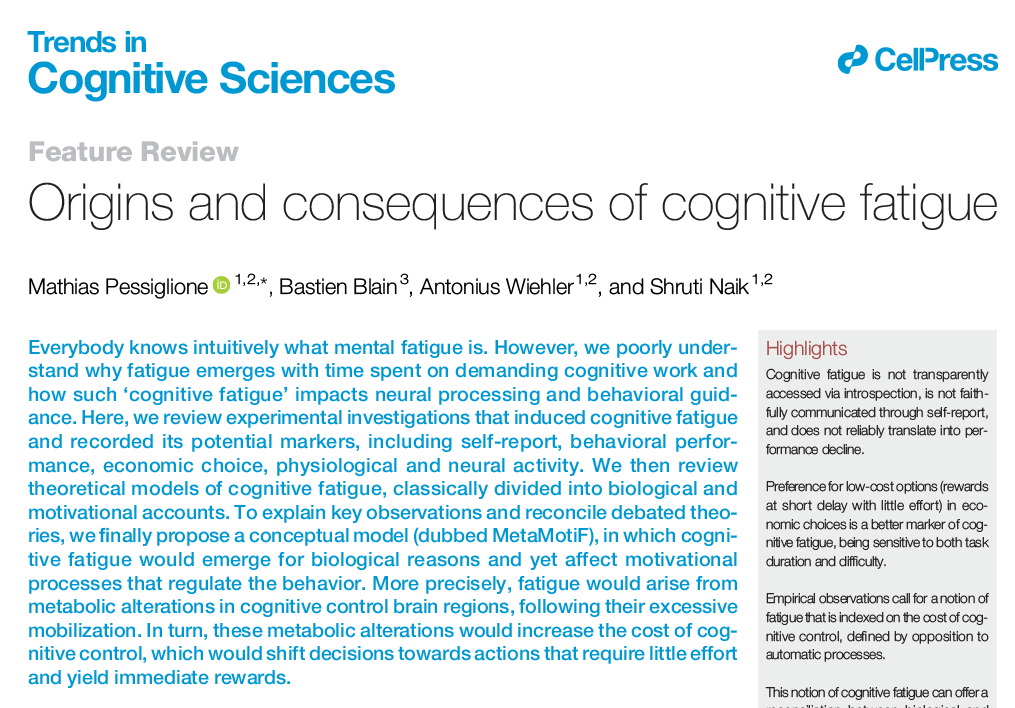
Origins and consequences of cognitive fatigue
Feature Review by Mathias Pessiglione, Bastien Blain (@Bastien__Blain), Antonius Wiehler (@ntonius_w), & Shruti Naik
Free access before May 20: https://t.co/PX4n0F9Zr0
People display consistent recency and primacy effects in behavior and neural activity across perceptual and value-based judgments https://t.co/YXILtj6xat