Luke Gromen on why Bitcoin might keep stalling around $58k-72K: big players can satisfy demand with paper bets instead of buying real #Bitcoin, which holds the price back.
It's worked on #gold for years, but he doesn't think it lasts forever with Bitcoin…
【Why Great Traders Seem To Change Their Minds So Quickly】
Beginner traders cling to their own predictions.
Great traders execute according to scenarios.
From the outside, this difference can make it look as if great traders change their minds very quickly.
But that is not what is happening.
They are not constantly changing their opinions.
They are not trading from opinions in the first place.
■ Predictions And Scenarios Are Completely Different
Many beginner traders look at a chart and think like this.
"It should go up from here."
"There is no way it goes down from here."
"This pattern should definitely continue."
That is not a scenario.
That is a prediction.
A prediction fixes the future.
A scenario defines what you will do no matter how the future unfolds.
These two are completely different.
Great traders are not declaring the future.
They are simply executing the actions they already defined when specific conditions appear.
If buy conditions appear, they buy.
If the stop loss condition is reached, they cut the loss.
If the take profit condition is reached, they take profit.
If the trailing condition is met, they manage the trade according to that rule.
If the conditions are not met, they do nothing.
They are not changing their opinion.
They are only executing the actions that were prepared from the beginning, in order.
A plan that says "if it rains, I will use an umbrella" is not a prediction that says "it will definitely rain."
Trading scenarios are the same.
"If this happens, I enter."
"If this happens, I cut."
"If this happens, I let it run."
"If this happens, I pass."
This is not for predicting the future.
It is for keeping your actions from collapsing no matter what the future does.
■ Beginners Are Watching The Same Action Through The Wrong Game
Imagine a trader takes a long position.
To a beginner, it looks like that trader bought because they predicted price would go up.
Then price immediately falls and reaches the stop loss condition.
The great trader cuts the loss without hesitation.
A beginner watching this may think.
"You just said it would go up, and now you already changed your mind?"
"Is it really okay to change your opinion that quickly?"
"Isn't that a lack of consistency?"
No.
It only looks that way because the beginner is watching one trade as a win or loss game.
The beginner's objective is to win the trade in front of them.
So if they buy, they want price to go up.
If it does not go up, it feels like the prediction was wrong.
If they cut the loss, it looks like they changed their opinion.
But that is not what great traders are looking at.
They are not acting to make the trade in front of them win.
They are executing a structure where, after repeating the same conditions, profit remains as the total of wins and losses.
So a stop loss is not a failed prediction.
It is part of the scenario.
Passing on a trade is not hesitation.
It is part of the scenario.
Taking profit is not a mood.
It is part of the scenario.
Beginners are looking at one result.
Great traders are looking at what remains after repetition.
That is why the same action has a completely different meaning.
To a beginner, a stop loss looks like "I thought it would go up, but I was wrong, so I changed my mind."
To a great trader, a stop loss is simply the execution of a pre defined action that says "under this condition, I cut here."
If you do not understand this difference, great traders will always look inconsistent to you.
■ "But If You Enter, Doesn't That Mean You Think The Trade Will Win?"
Some people will probably think this.
"But if you enter, doesn't that mean you are predicting that this trade will win?"
No.
Imagine a system with a 40% win rate, good risk reward, and positive expectancy.
If you repeat this system enough times, losses will appear more often than wins.
In a small sample of around 10 trades, short term randomness can skew the result even further.
So one trade at a time, losing is more common than winning.
Then is the trader using this system entering every trade while predicting, "This trade will win"?
No.
They fully understand that this one trade has a high enough chance of losing.
In some cases, they may even enter while thinking, "This trade can easily lose too."
And they still enter.
Because they are not trying to predict the single trade in front of them.
They are betting on the structure where, when the same condition is repeated, the total of wins and losses leaves profit in the end.
In other words, great traders are not predicting that the trade in front of them will win.
They understand what remains when that action is repeated.
That is why they are not surprised by one stop loss.
They do not make noise after one loss and say, "My prediction was wrong."
They do not see one win and think, "I was right."
That one trade is only a sample.
There are winning samples.
There are losing samples.
There are skipped samples.
There are samples where nothing happens.
Only when all of them are included does the system reveal its true nature.
Great traders understand this very well.
■ Scenarios Exist So You Can Lose According To Them
I was once told, "What do you do if you lose by following your scenario?"
That way of thinking is completely wrong.
Listen carefully.
Scenarios exist so you can lose according to them.
Traders have no choice but to act without knowing the right side of the chart.
No matter how much you prepare, you do not know whether the next single trade will win or lose.
No matter how good the condition looks, a loss can still happen.
That is exactly why your actions for losing must also be decided in advance.
Where do you enter?
Before entry, what condition tells you the scenario is no longer valid?
After entry, where do you cut the loss?
Where do you take profit?
What condition makes you pass?
What condition makes you do nothing?
You decide these things in advance.
And because you understand that profit remains only when you keep repeating that entire sequence of actions, you do not have to get pushed around by the movement in front of you.
Great traders seem to change their minds quickly.
But in reality, they were never dependent on opinions from the beginning.
They are not protecting a prediction.
They are protecting a scenario.
And that scenario includes not only the future where they win, but also the future where they lose.
That is why they can cut losses quickly.
That is why they can pass without hesitation.
That is why they can manage profits by rules instead of mood.
That is why they can repeat the same conditions.
Consistency is not clinging to your first prediction.
Consistency is continuing to follow the actions you defined in advance.
What you must protect is not your prediction.
It is your scenario.
Do not trade from opinions.
Trade from scenarios.
📚 Content for serious traders
https://t.co/tMFssKR6Oz
Thank you for reading.
"Confirmation" is one of the great paradoxes of trading: wait for it, and the opportunity may run away from you, or the risk/reward can then become sub-optimal. But anticipate it, and it may never happen, and you can find yourself underwater.
Navigating the uncertainty of trading, managing the tension that exists at the "Act" point, dealing with the internal friction it creates: that is where trading is pure art, and definitely not science.
Novice and aspiring market speculators think the magic is found in trade identification.
The "what" and "when" components of trading -- while necessary -- represent only about 5% of a trader's "edge."
Yet aspiring traders spend 80% of their time, energy, hopes and fears on trade identification and the next trade.
The real landmine in trading is self-sabotage. Dealing with human emotions is the battle line that matters.
You want to know yourself, I mean really know yourself -- the good, the bad and the ugly?
Become a trader.
This is why all the trading services who talk about their last trade (made 250% on XYZ) is such an absolute joke.
Trading services who talk about their winners are trading services you must avoid at all costs.
The real enemy in trading is self.
You want to know your biggest enemy to trading success? Well, just look in a mirror. It is you, not what you know or don't know, that keeps you from gaining traction in trading.
After three to five years of experience a person should know what they need to do to be profitable. The challenge is actually doing what you know you must do.
The task is overcoming self.
Trading is not an intellectual activity. It's an emotional one.
The decisions that cost you money aren't analytical failures. They're emotional ones. Fear. Greed. Ego. The inability to pull the trigger. The inability to let go.
Over-intellectualising pulls you toward analysis and perfectionism and away from the one thing that actually matters: taking risk.
The best traders don't eliminate the emotional side. They learn to work with it. Ignore it at your peril — it's always there, and it will always find you.
Your capital can grow even when you did the wrong thing.
Your capital can also decrease even when you did the right thing.
Short term changes in capital teach you nothing.
Do not use them as the measure of whether things are going well.
Every time you do that, you are only teaching yourself that short term results matter.
In other words, you are educating yourself to become a trader who cannot succeed.
The only things you should measure yourself by are whether you executed according to the rules, and whether those rules were properly prepared and have positive expectancy.
BREAKING:
The Netherlands just told its citizens to go to hell.
They just approved a 36% tax on unrealized gains.
You didn't sell anything.
You didn't make a single euro in cash.
Your portfolio went up on paper.
The government sends you a bill anyway.
67,000 citizens petitioned against it.
Parliament approved it anyway.
No cash to pay the tax? Not their problem.
Asset crashes after you paid? Not their problem.
This is not tax policy.
This is the government treating your paper gains as their income.
Before you've made a single euro.
The most talented Dutch investors are already leaving.
The most ambitious builders are already gone.
Capital goes where it is treated best.
And right now that is anywhere but the Netherlands.
2028 is coming. Plan accordingly.
No more 70% crashes. But also no more parabolic blowoff tops.
That's the trade-off almost nobody is pricing in.
@JSeyff (Bloomberg's ETF analyst) laid it out on NEF: the four-year cycle isn't dead, its amplitude is collapsing.
If you don't take the blowoff-bottom risk, you don't get the blowoff top either. The crashes shrink, and so do the melt-ups.
The reason is maturation. Six years ago the debate was "will the US ban Bitcoin?" Now it's which week the Clarity Act passes. JP Morgan, Morgan Stanley, the ETFs, they're all in. The existential risk is off the table.
From a volatility lens, that's the whole story: as structural risk leaves, the sigma extremes compress on both sides.
The ~60K bottom holding with higher lows is the evidence, not the disappointment.
"You could publish my trading rules in the newspaper and no one would follow them. The key is consistency and discipline." —Richard Dennis
The rules were never the hard part. Following them is the entire game.
We know from history that the higher bond yields go, the more positively correlated equities and bonds become. If the 10-year yield continues to rise to 5% or beyond, stocks and bonds could become even more correlated than they are now, which brings back the Fed Model was a powerful valuation driver.
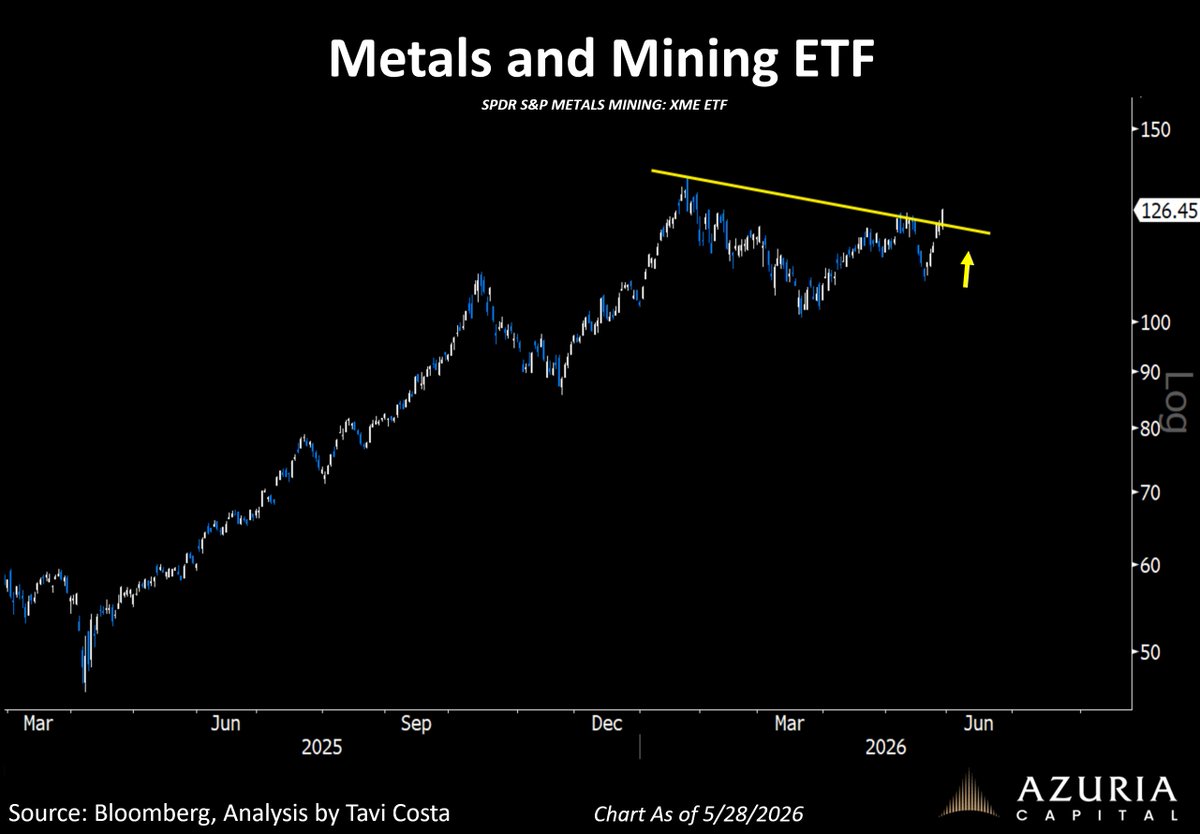
The Metals and mining ETF broke out today.
Copper miners are leading the way with copper itself now entering what looks like a true price-discovery phase.
Also worth noting that the ETF below includes several steel producers as well.
Overall, this is a very constructive development for the industry in my view.
https://t.co/u4CIp7K2HH
Bill Maher asks how Mississippi is kicking California’s ass in education, and Texas is “blowing them away” in green energy for “way less money.”
“Did you know that a black fourth grader in Mississippi is two and a half times as likely to be proficient in math and reading as one in California? Mississippi is kicking our ass in education and for way less money. We’re 37th in fourth-grade reading, they’re ninth.”
“Texas is kicking our ass in green energy. The average time to get solar panels connected there is three to four months. About 1,000 days faster than it took me. Remember when I was trying to get my solar hooked up? It would have been quicker to build a windmill.”
“Texas has passed California in solar and blows away California when it comes to wind and energy storage. How does a state with no pro-climate policies produce better climate results than a state where here, even though we have so much better bumper stickers on our Priuses?”
“I’ll tell you why. Because you’re allowed to build there because every third person in Texas isn’t someone whose job it is to make sure nothing gets done.”
“Democrats, these are your issues: education, race, the environment.”
“And I say this with love: you’re losing to the Waffle House, car-on-the-lawn states.”
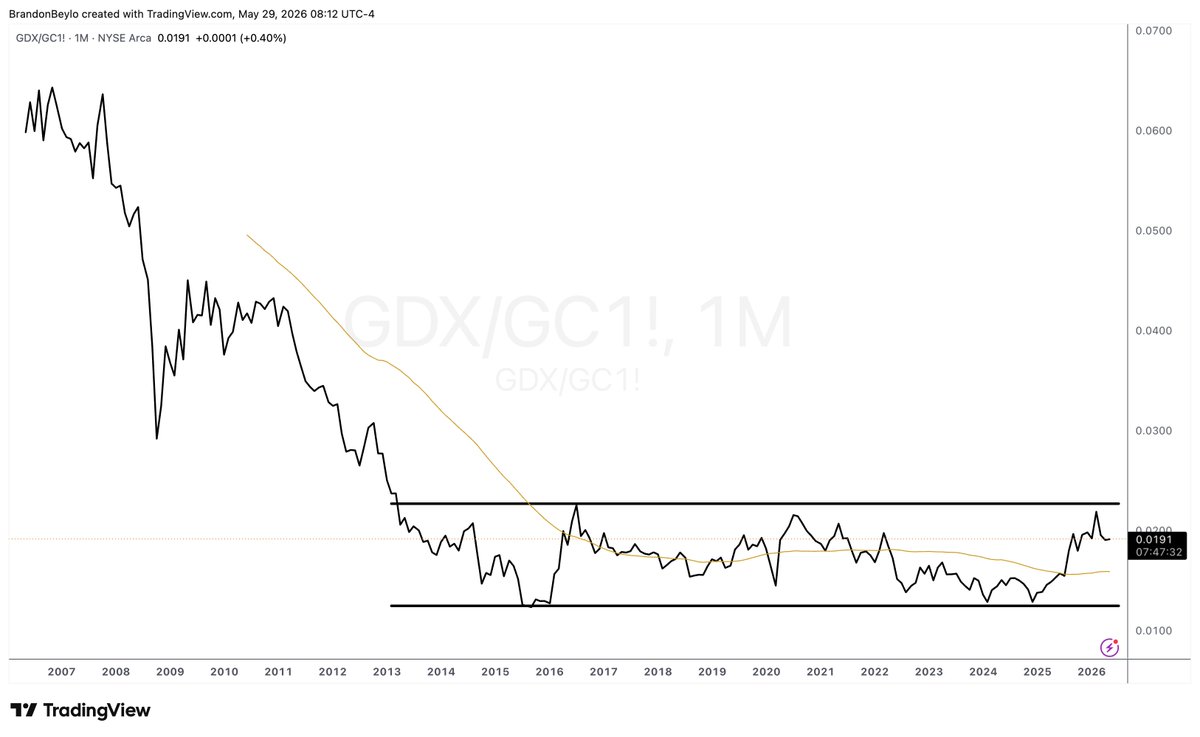
Gold Miners are quietly building a large base versus the underlying gold price.
A base breakout would likely trigger the next leg of the gold miner bull market.
Nobody cares because it's not AI or semis.
$GDX
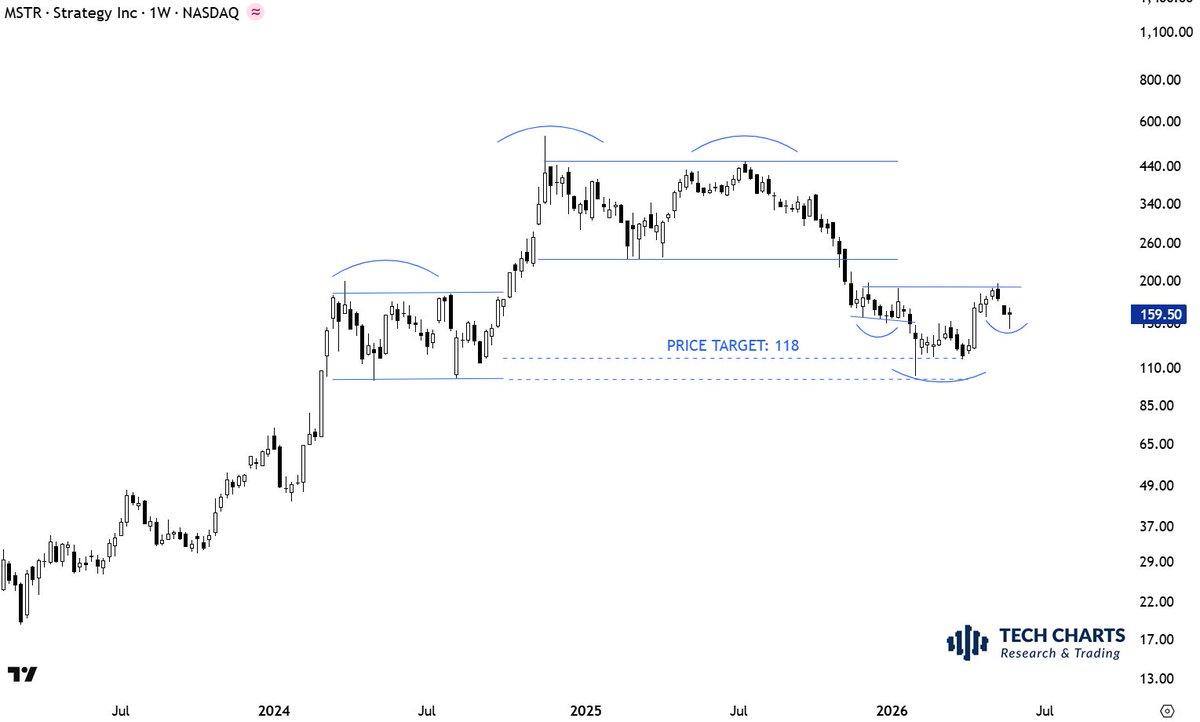
Again, from the rules of symmetry between shoulders in time and price,
this is Bayesian Thinking.
If I see .... then I will have higher conviction. $MSTR