AI reforestation is the most underrated thing happening in the world right now.
A startup took a cattle farm in Brazil where the soil was rock hard and nothing was growing.
They sent a drone.
The AI read the soil. Checked the moisture. Looked at the slope. Then picked from 300 native species and decided exactly which plant goes in which spot.
The drone fired seed pods packed with seeds and nutrients at 180 per minute.
Months later the land was covered in grass, bushes, and trees.
One person planting by hand covers one hectare a day.
The drone covers 50 hectare a day.
And this is not one company.
Five startups across four continents landed on the exact same solution without ever talking to each other.
Australia. Canada. Brazil. France. Nobody coordinated. The problem demanded the same answer everywhere.
The hardest part was never the seeds. It was knowing what goes where. AI just made that free.
--
vc: @alex_verem
Andrej Karpathy joined Anthropic five weeks ago.
Yesterday my friend on his team sent me the Claude.md file he actually uses.
It completely changed how I work with Claude.
From the very first message, the difference was obvious.
With this file, Claude finally stops fighting me and starts working exactly the way I need it to.
Bookmark it before it gets taken down.
Read it now, then check the article below.
The best teacher doesn't always agree with you.The best mentor doesn't always agree with you. The best Al shouldn't either. The future challenge for Al isn't just reducing hallucinations. It's teaching models when to disagree.
Everyone talks about Al hallucinations.I think
"sycophancy" is the bigger problem.
A hallucination is obvious. The model gives a wrong answer, invents a source, or gets a fact wrong. Sycophancy is much harder to notice.
It's when an Al agrees with you even when you're wrong.
Anthropic engineer:
"You're not supposed to watch Claude Code work. You're supposed to wake up and review what it shipped."
In 22 minutes she builds the entire workflow live on camera.
Most people close their terminal and everything stops.
This setup keeps shipping while you sleep.
Watch the video, then save the exact setup below👇
A man spends 50 years teaching at MIT.
He knows his time is running out.
So he records one last lecture — everything he knows, distilled into a single hour.
He died 5 months later.
This is that lecture.
The most important hour you'll watch this week. 👇
Bookmark it for later
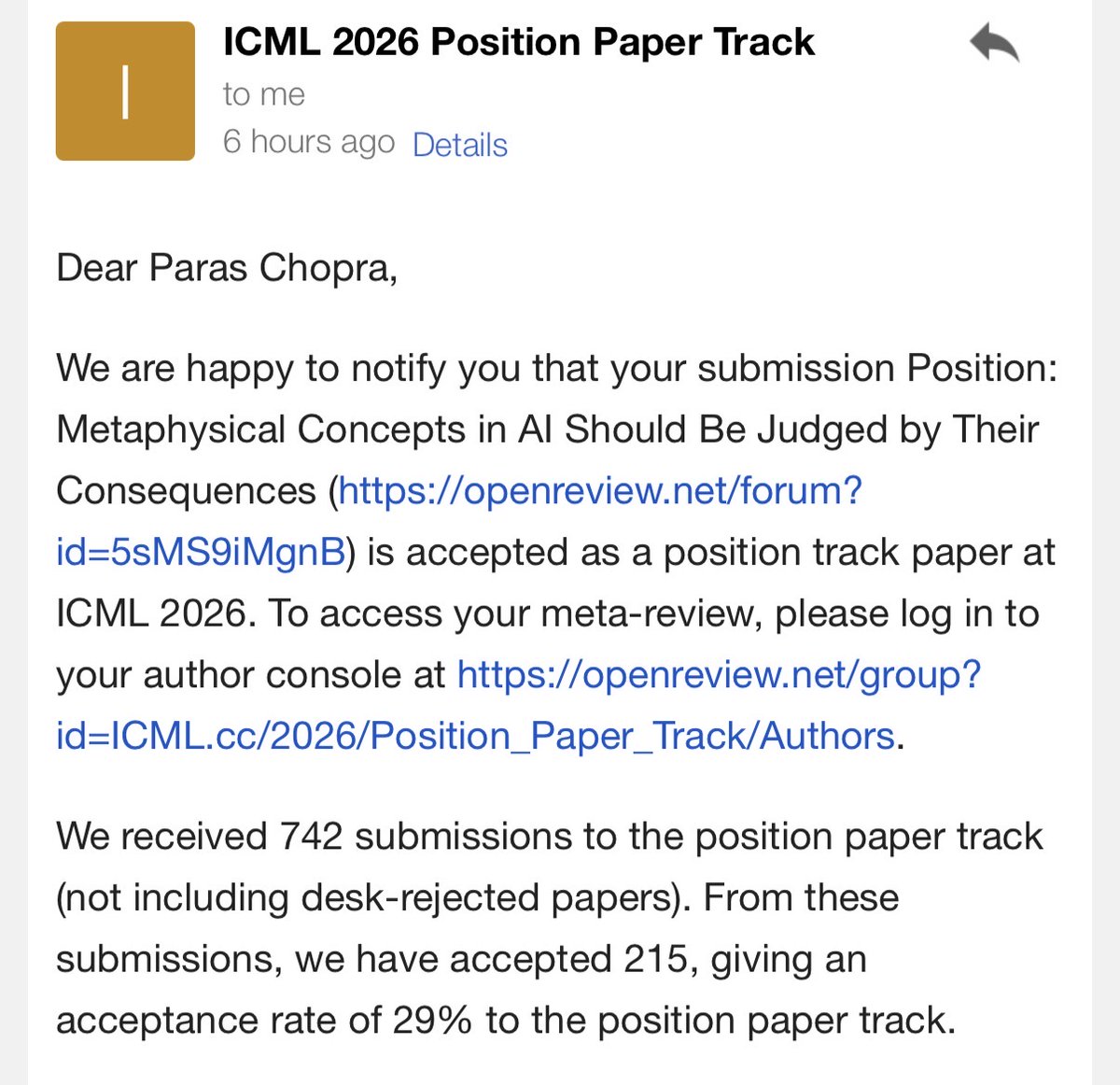
Woke up to see my paper accepted at ICML 2026 :) 🕺🏽🚀
My first one at an A* conference!
This position paper was a result of me deep diving into the philosophy of science to figure out what counts as “understanding something”. This drove me to Wittgenstein, Quine, William James and other Pragmatism advocates.
I then applied what these philosophers talk about to the field of AI, and recommend how to make sense of ambiguous (and often metaphysically loaded) questions such as “what is AGI” or “can LLMs feel emotions”.
Philosophical clarity is a necessary prerequisite for attacking unsolved problems, and I’ve found Pragmatism to be the most sensible position for making progress as its focus is always on empirical consequences of concepts (and not their metaphysical status).
Will release the paper soon!
Anthropic just shipped the most disruptive cybersecurity product of the decade. 🤯
Claude Security is live in public beta for Enterprise customers.
It scans your code, finds bugs no human caught in a decade, writes the fix.
Anthropic didn't disrupt the Big 4. It made them dealers
This is the single best framework I’ve seen for understanding AI.
Terence Tao, arguably the smartest mathematician alive, just dropped a paper with Tanya Klowden on arXiv called “Mathematical Methods and Human Thought in the Age of AI.”
The core idea: a “Copernican View of Intelligence.”
Stop thinking of AI on a line from “dumb” to “superhuman.”
That’s the wrong axis entirely.
AI excels at BREADTH. Humans excel at DEPTH.
Tao himself said AI has made his papers “richer and broader, but not necessarily deeper.”
That’s not a limitation. That’s the entire playbook.
Stop trying to replace yourself with AI. Start using it to cover the 90% of surface area your brain physically can’t.
The people who get this are already 10x more productive.
The rest are still arguing about whether AI is “smart enough.”
Reframe your point of view from “smarter” to “different”.
Human + AI > either alone.
The math on that has never been clearer.
$META CEO Mark Zuckerberg argues most businesses won’t train frontier models but will run customized AI layers tailored to their workflows and customer interactions.
That points toward an ecosystem where base models from OpenAI, $GOOGL Gemini, and Anthropic become infrastructure rather than standalone products.
The shift mirrors how enterprise platforms tied to $MSFT and $AMZN are positioning AI as a default operating layer inside software rather than a separate application.
Truly amazing how all of this is unfolding…
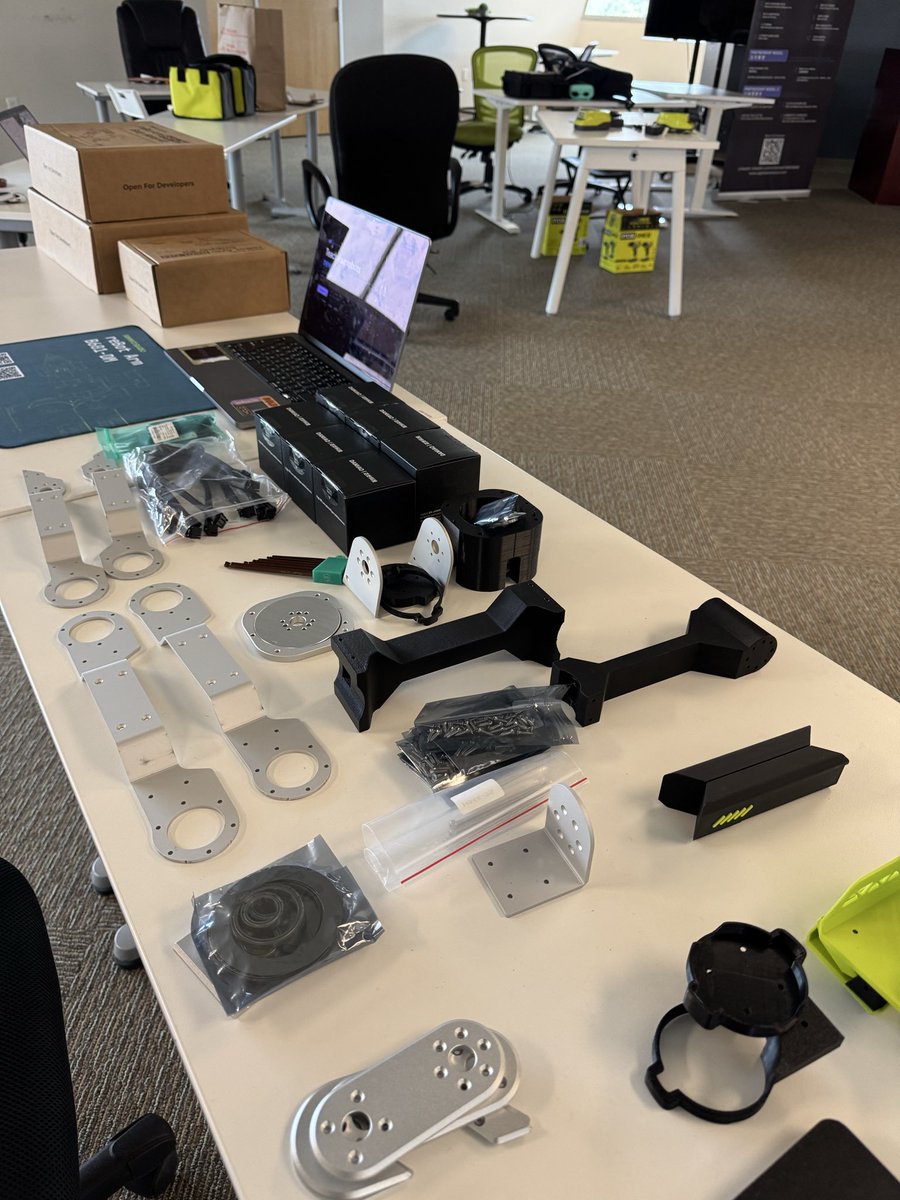
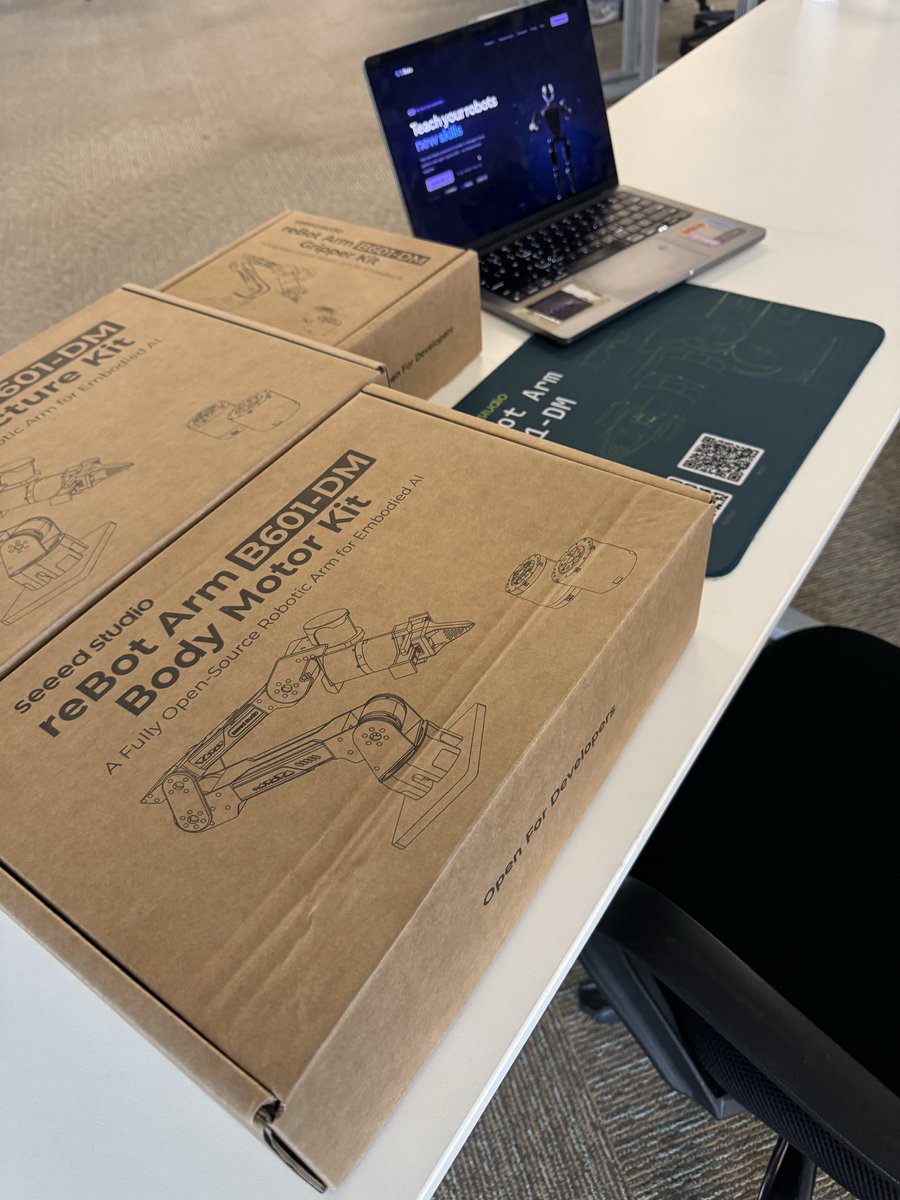
Today I assembled the first batch of reBot DevArm in the U.S!
First one on the planet! 🇺🇸⚙️
But this isn’t about a robot arm.
This is about what happens when open source hits robotics.
For years:
•Hardware was locked
•Robotics was expensive
•Embodied AI was out of reach
Now?
Anyone can get their hands on:
•6 DOF manipulation
•Real precision (<0.2 mm repeatability)
•Full stack access (ROS, Isaac Sim, LeRobot)
This is how movements start.
Not in labs.
Not behind paywalls.
But in the hands of builders.
Massive respect to @seeedstudio for pushing true open-source robotics forward!
We’re about to see:
→ Thousands of robot arms trained like athletes
→ Real-world datasets explode
→ Physical AI built in garages, not just research labs
At @Solo__Tech , this is the unlock we’ve been waiting for, training and deploying Physical AI skill models on real hardware, anywhere.
No sims. No vaporware. No excuses.
Production Grade Physical AI.
Want to get access? Check out the Physical AI Gym in San Francisco or DM me.
One of the highest ROI activities you can do in your life is to deeply internalize that building good habits is a short term investment that compounds to lifelong gains.
Any new good habit requires overcoming initial friction, but techniques like habit stacking and starting small help.
The trick is to realise that after a while, habit becomes effortless. So it’s just that initial dip you have to overcome. After that, all what you’re trying to do becomes automatic (that’s why it’s called a habit).
So if you’ve been sitting on reading, programming, exercising, dieting or anything else, know that mastering the meta-skill of habit building will probably change your life forever.
🚨do you understand what two Anthropic engineers just explained in 16 minutes.
Barry and Mahesh built Claude Skills from scratch.
here's the part nobody is talking about:
> Skills are just folders.
> folders that teach Claude your job.
> your workflow. your expertise. your domain.
Claude on day 30 is a completely different tool than day one.
watch this before you write another prompt.
before you build another agent.
before you touch another tool.
16 minutes. bookmark it. watch it today.
and if you want to learn everything about Claude from scratch the full 4 hour guide is waiting below.
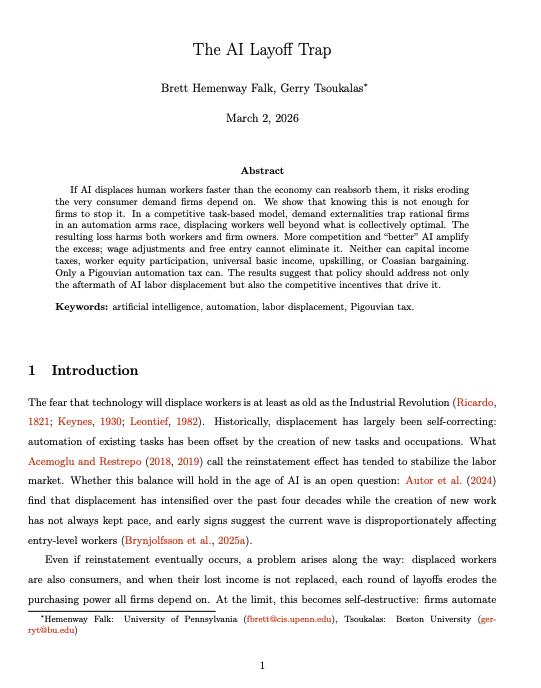
🤯BREAKING: Researchers just mathematically proved that AI layoffs will collapse the economy: and every CEO already knows it.
The AI Layoff Trap. A game theory paper from UPenn + Boston University is glaringly important!
100K+ tech layoffs in 2025. 80% of US workers exposed. And no market force can stop it.
→ Every company fires workers to cut costs
→ Every fired worker stops buying products
→ Revenue collapses across every sector
→ The companies that fired everyone go bankrupt
It's a Prisoner's Dilemma with math behind it. Automate and you survive short-term. Don't automate and your competitor kills you. But everyone automating destroys the demand that makes all companies viable.
UBI (universal basic income) won't fix it.
Profit taxes won't fix it.
The researchers found only one solution: a Pigouvian automation tax "robot tax"
The AI trap on the economy is here!
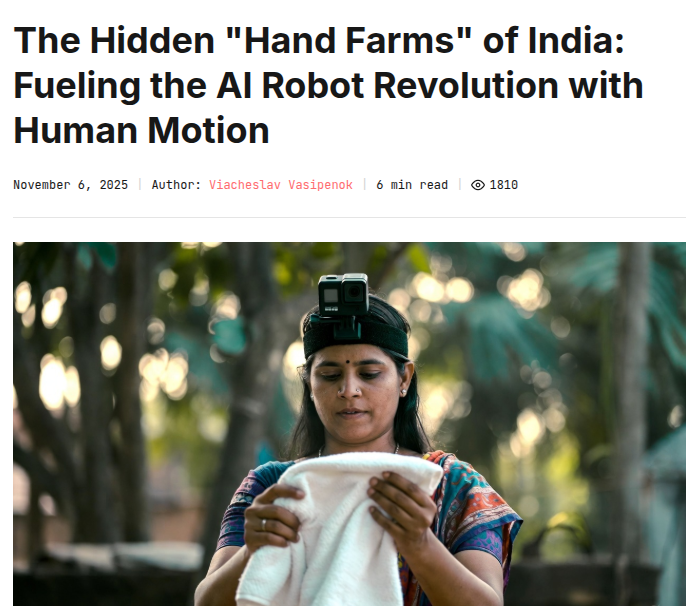
India is quietly becoming a training floor for humanoid robots, with workers filming thousands of first-person hand tasks so AI systems can learn grasping, folding, sorting, and tool use.
This story is really about how the humanoid robot boom still depends on cheap, repetitive human labor to teach machines basic physical skill.
The problem is that robots do not fail on big plans first; they fail on tiny physical details like grip angle, finger timing, slip correction, and object contact.
That kind of knowledge is hard to code and expensive to collect.
These labs capture that missing layer by putting cameras or sensors on people and recording ordinary actions as machine-readable motion examples.
The useful part is not the towel or box itself but the sequence: where the hand starts, how force changes, when fingers adjust, and how the body recovers from small mistakes.
That gives robotics teams supervised data for models that map visual input to physical actions, which is much easier than hand-coding every movement rule.
This is a story about how physical intelligence gets extracted before it gets automated.
---
quasa. io/media/the-hidden-hand-farms-of-india-fueling-the-ai-robot-revolution-with-human-motion