At 32, I discovered the perfect career path in tech to earn a lot of money while working on the most interesting tasks.
Still relevant in the age of AI.
Unfortunately, it’s too late for me to follow this path.
I just created a playbook to help you learn AI engineering.
It gives you:
• Core concepts behind modern AI systems.
• Condensed notes to understand AI engineering stack.
• Must know techniques to build, deploy, debug & scale AI apps.
(24 hours only!)
To get it for FREE:
1. Like, Retweet & Follow @systemdesignone
2. Reply "Playbook"
Then I'll DM you the details.
Enjoy not knowing.
Not everything deserves your attention. You know where you are heading. You know what you want to achieve. If something lies on that path, learn it. If it does not, let it go.
People who are "productive" are not the ones who know everything, but the ones who know exactly what they do not need to know.
There is a quiet wisdom in choosing what to ignore and maintaining a better signal-to-noise ratio.
Last week went like a blink of an eye multiple chill call/intro call with founders and CTOs who has raised like million dollars in funding .....
So many people are talking to you and saying "we raised a million dollars in our recent funding .... " And suddenly you feel $100k might not be a big amount or so .... What I want to say is ...
Learn Kubernetes and its operators and docker image optimization, startups will thank you and hire you while you will be thanking k8s
I have seen people purchase many books, bookmark endless links, and save a ton of papers, and yet end up feeling stuck and doing nothing.
Many are confused and completely unsure of what to choose first, and this stems from the fear of leaving something important behind. Here's what I would recommend...
You just need to start with one. Have a strong bias for action and simply begin. Which one to prioritize is a personal choice, but it should align with what matters most to you right now:
- something that helps with your current work,
- something that supports your future plans, or
- something you are simply curious about.
When you feel overwhelmed, pause and ask yourself: "Why should I spend time on this right now?" If you do not have a clear, strong answer, the default is no. Only move forward if you can truly convince yourself it's worth it at this moment.
Remember, clarity is in saying no.
Hope this helps.
Most tech content is noise. But one YouTube channel is quietly archiving the deepest engineering knowledge on the internet.
I’ve been watching Ryan Peterman’s (@ryanlpeterman) podcasts over the last few months, and the signal-to-noise ratio is absolutely insane. He is sitting down with:
▪️ Turing Award winners (like Leslie Lamport & Mike Stonebraker)
▪️ Bjarne Stroustrup (Creator of C++)
▪️ Elite Big Tech ICs & VPs of Engineering
This isn't just about writing code.
They dive deep into the reality of high-level tech careers : foundational architecture, system design from first principles, and complex trade-offs like Paxos vs. Raft.
If you are serious about computer science, bookmark his channel.
It's the masterclass you won't get in a classroom.
A senior (L7) adds a comment on my doc, I think about it for 10 min and come up with a response. Then I take a step back and think for 1 more hour only to realise how deep and nuanced that comment was.
Please tell me how these people think what they think. It is a privilege to feel dumb honestly because it keeps you grounded and hungry to keep learning.
pro tip: get good at sounding confident even when you know nothing. ask questions when essential, and trust yourself to figure the rest out.
because everything is figureoutable.
Every single day, I am grateful to have connected with the top 1% in the world, who guide me on the right path.
I urge everyone to find someone who believes in your potential - someone who has already done what you want to do.
Have mentors, they will change your life.
After 5+ years in DevOps, the commands I find most useful:
grep -r 'text' ./ → find something in files
curl -I <url> → check if a service is up
kubectl describe → why is this broken
terraform plan → what will this change
git log --oneline → what happened recently
tail -f <logfile> → what's happening right now
Not the fanciest commands but the reliable ones. 🔖
bookmark this!!!
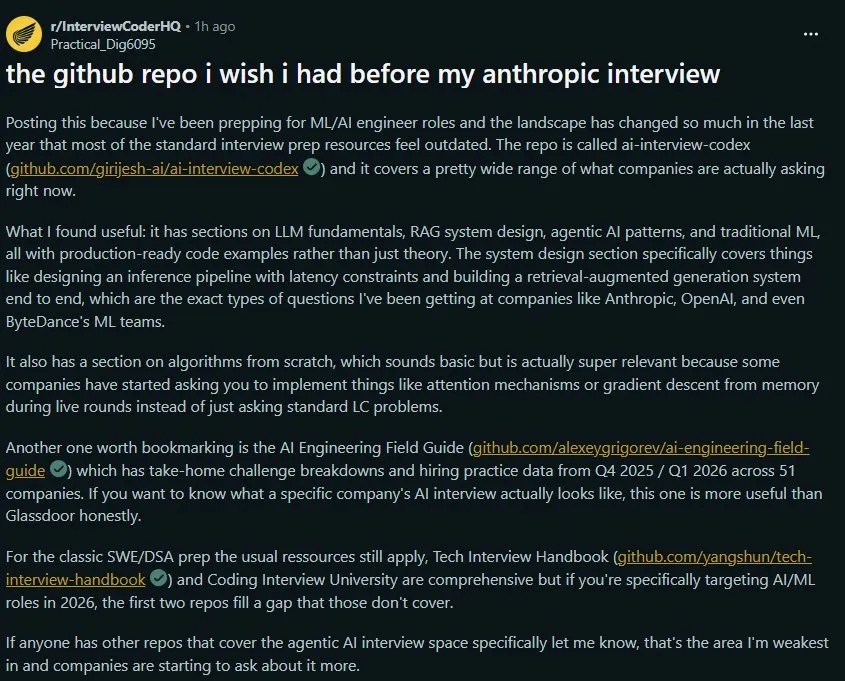
The AI interview meta changed. companies like Anthropic & OpenAI are now asking you to implement attention mechanisms from scratch in live rounds.
free repos that actually cover this 👇
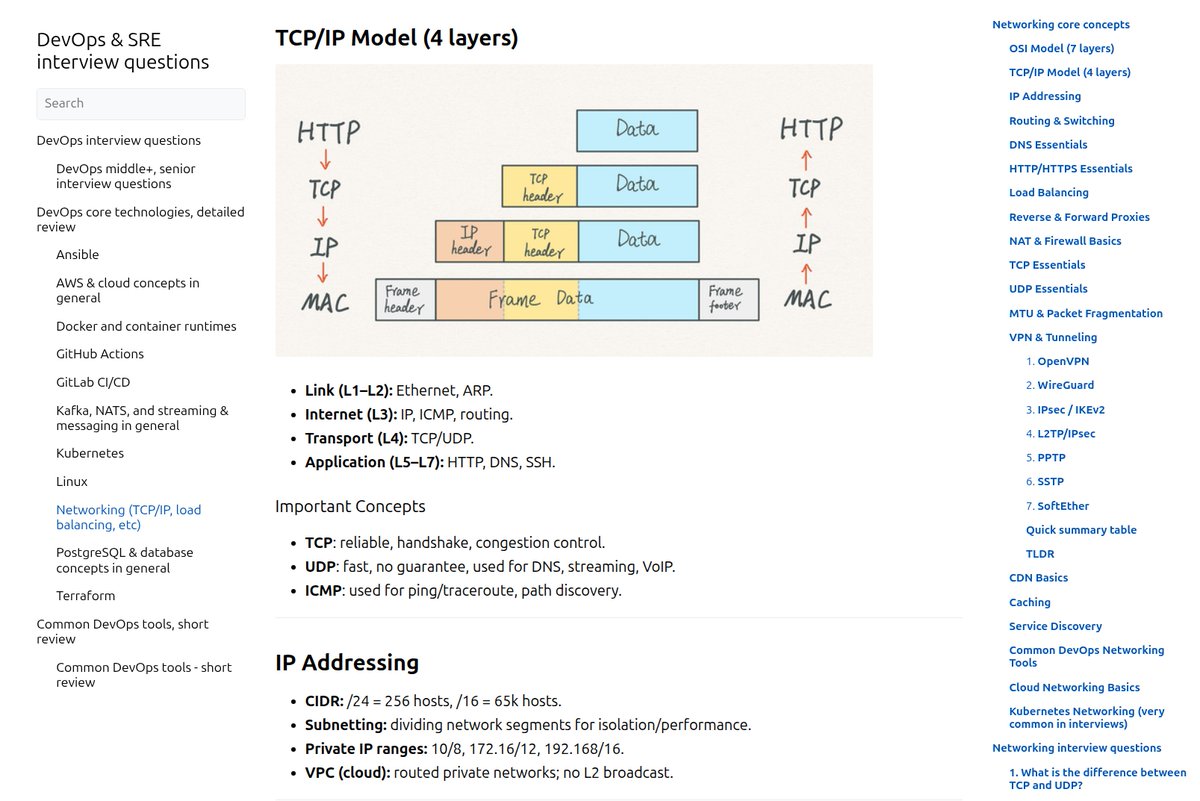
Prepping for a DevOps/SRE interview? Don't sleep on this free q&a hub
https://t.co/SRBCxtjFk3
It's basically a compact roadmap of what you actually need before interview day body-slams you.
Everything's grouped by real stacks - Ansible, AWS, Docker, GitHub Actions, GitLab CI/CD, K8s, Linux, networking, Terraform, Postgres and more. You study by topic, not random trivia that leads nowhere.
How to actually squeeze juice out of it:
- Run topic drills. Pick one area, list internals, then argue with yourself - readiness vs liveness, ingress vs service mesh. Why pick one? Sit with it.
- Turn q's into your own cheatsheets. Canary vs blue/green, retries, timeouts, circuit breakers - written in your words, not copy-paste slop.
- Mix basics with system thinking. For networking don't just memorize ports - trace a request through a 3-tier app and ask where it breaks.
- Tie everything to reliability. Map IAM, VPCs, autoscaling to SLOs and error budgets. The "why" > the "what", always.
- Practice talking through outages. "Service is down" - walk metrics → logs → traces → recovery. That's literally the interview lol.
No fluff no filler, just go
#devops #sre #cloud #k8s #terraform #linux #interview #aws
Kubernetes isn't a scam. People don't just realize what it is, and what it brought to the world. What Kubernetes did to the world is to teach and bring Control System theory to the masses. With control system, you could run software at scale like never before. If you design your software in closed feedback loops, you can have, just like a machine, an ongoing stable system running for 7/24, that can self recover and steer itself.
People trying to use other orchestration systems, had to work and implement all of it themselves. And most of them didn't had proper primitives, so it was very brittle. With Kubernetes, you have /status, the reconciler/controller-runtime framework, requeues and CRD's. If you use all of these together, you can build a feedback loop, and apply control systems knowledge. And with Google's push, it became the winner.
There is a really nice book about it: "Designing Distributed Control Systems: A Pattern Language Approach". It's actually about machines, not software (like how to build proper big machines that can run 7/24). But if you read it, you immediately see how the patterns in the book described, are actually primitives used by Kubernetes ecosystem.
So many web servers are JavaScript, Python, Nginx, and even Redis, but what are they, how do you literally implement them, and how do single-threaded systems handle and deal with multiple connected clients?
I just published the 6th video in my Redis Internals series, where I explain this concept and what it takes to implement it using epoll. In the next one, we literally implement one from scratch.
If you want to learn Redis Internals by literally implementing it, give this series a watch. 6 videos are out now:
1. Why Single-Threaded Redis Is Fast
2. Writing a TCP Echo Server
3. Wire Protocols
4. Implementing RESP
5. Implementing PING
6. Understanding Event Loops
If you are into systems, databases, or backend engineering, this will give you a much deeper intuition for how things actually work under the hood.
ps: This video is part of my highly practical, in-depth, hands-on Redis Internals course, now being released on YouTube. Hope this makes you super curious about databases and engineering.