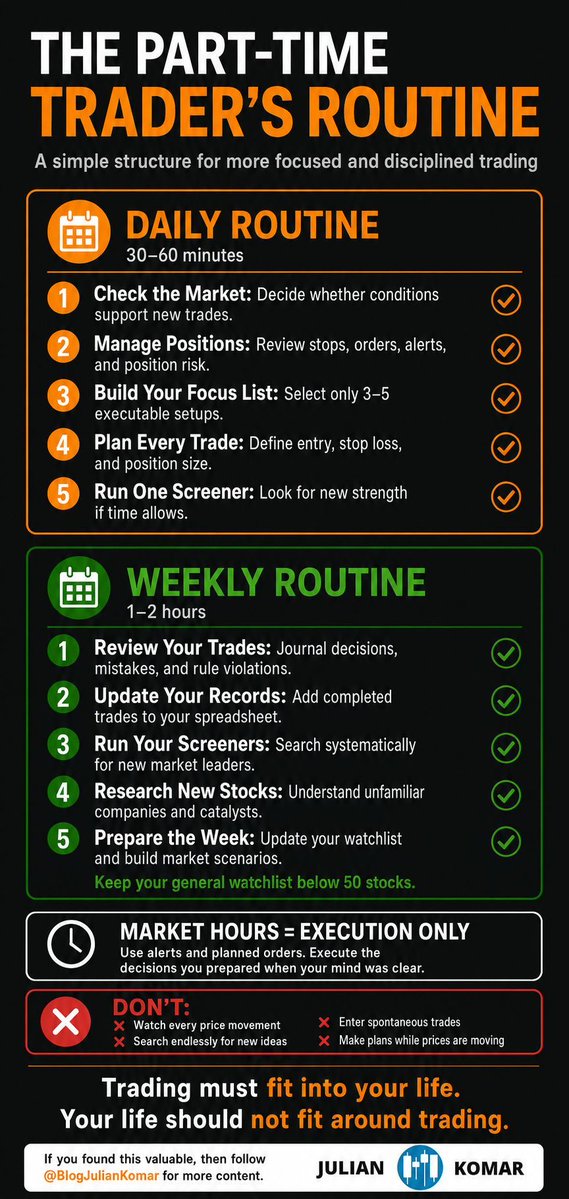
If trading consumes your entire day, your routine is broken.
I have worked with dozens of traders in 1:1 mentoring and taught more than 2,000 traders through my community and video courses.
One problem appears again and again:
They have no clear trading routine. 🫣
1) They open their charts without knowing exactly what to do.
2) They jump between screeners, social media, news, watchlists, and open positions.
3) They spend hours “working”—but still enter unplanned trades, miss important tasks, and make emotional decisions during market hours.
A good routine should give your trading structure without taking over your life.
This is the routine I recommend for a part-time trader 👇
DAILY ROUTINE: 30–60 MINUTES
Do most of your work before the market opens or after it closes.
Your mind is clearer when prices are not moving in front of you.
1) Check the market environment
Before looking for trades, answer the most important question:
Should I trade at all?
I start with my Market Trend Model. When conditions are weak, I reduce exposure or stay in cash. Even the best-looking setup has lower odds in the wrong market.
2) Manage existing positions
Review every position and update:
• Stop-loss levels
• Trailing stops
• Open orders
• Alerts
• Position risk
You should know what you will do before the market forces you to decide.
3) Build your daily focus list
Choose only 3–5 executable setups. Not 20 interesting stocks.
Not every stock that could move someday.
Your focus list should contain the few stocks that are close enough to an entry to require your attention today.
4) Plan every possible trade
Before the open, define:
• Entry price
• Stop-loss price
• Position size
• Setup
• Conditions that would invalidate the trade
If you cannot write down the plan, the trade is not ready.
5) Run one screener if time allows
You do not need to search the entire market every day.
One proven screener (e.g. my Best Winners screener) is enough to identify new strength without turning your preparation into an endless search.
WEEKEND ROUTINE: 1–2 HOURS
Once per week, do the deeper work:
• Journal and review your trades
• Add completed trades to your spreadsheet
• Study your mistakes and rule violations
• Research unfamiliar companies
• Run several proven screeners
• Update your general watchlist
• Build scenarios for the coming week
Keep your main watchlist below 50 stocks.
For a part-time trader, intensive screening once per week is usually enough. Strong stocks and meaningful setups rarely disappear because you did not run ten screeners every evening.
DURING MARKET HOURS: EXECUTION ONLY
This is where many traders destroy the work they did before the open.
- They start searching for new ideas.
- They react to every price movement.
- They enter trades they never planned.
During market hours, your job is simple 👉 Execute the decisions you already prepared.
Use alerts and planned orders. Avoid staring at every candle. A moving market is one of the worst places to make decisions from scratch.
HOW TO MAKE THE ROUTINE STICK
A routine is useless if you only follow it when you feel motivated.
I recommend four rules:
1) Use a fixed trigger
Connect the routine to something that already happens.
For example: “After breakfast, I sit down at my trading desk.”
2) Set a time limit
Without a limit, screening and chart work can consume hours.
A deadline forces you to focus on what matters.
Include something you enjoy
Maybe you enjoy screening, researching companies, reviewing charts, or studying former winners.
Include it. You should not hate the process required to follow your rules.
3) Track your time
Especially in the beginning, record how long your preparation takes.
As your experience and structure improve, you should need less time—not more.
AND WHAT ABOUT AI?
Many traders now use AI because they want to reduce their workload.
That can help—but the order matters.
AI cannot replace experience, knowledge, or independent thinking.
If you do not understand what a good routine requires, you will not know what to automate. AI may simply help you execute a poor process faster.
- Do the work yourself first.
- Understand why each step matters.
- Build a process that produces good decisions.
Then use AI to simplify repetitive parts of that proven process.
I have developed routines with traders who work shifts, manage demanding jobs, raise families, or have schedules that change every week.
We were always able to find a structure that worked.
That is also a major part of what I teach inside MARKET UPDATE Premium and in my 1:1 mentoring: organizing your market preparation, reducing unnecessary decisions, and building a repeatable process.
Because trading has to fit into your life.
Your life should never have to fit around trading.
A clear routine will not make every trade profitable.
But it will help you become more focused, more disciplined, more consistent—and far less dependent on emotions, alerts, and other people’s opinions.
Bookmark this post and build your own daily and weekend routine.
It took me 3 years of time and money before I found a SINGLE trading strategy that was profitable.
In this thread I’ll teach you:
How To Make $500/Day Using A Simple Day Trading Strategy👇
(1/10)
Did you know there is a shadow bank that oversees $21 TRILLION of the world's money?
It has a dominating stake in every major S&P 500 company.
It directs Trillions for the Fed, Central Banks, and Govt Treasuries.
The global financial ecosystem is ruled by this ONE COMPANY.