Our first interop, and what a week. The team shipped on every devnet from day one, launched on benchmarkoor, contributed to ePBS, BALs, and EIP-8037 breakout rooms, and also FOCIL, targeting to participate on its first devnet.
Huge thanks to every team that made us feel at home above the Artic Circle.
Full recap from our side coming later this week.
Last week, Ethereum core contributors gathered in Svalbard for the Soldøgn interop: a week long event focused on hardening Glamsterdam implementations to scale Ethereum securely ☀️
Read the full recap, including their candidate post-fork gas limit, below:
I got interviewed on the @ready4merge podcast last week!
Thanks @christine_dkim for the space and the great talk. We covered the reasons behind building @ethrex_client , how it's different to other clients, and what I'm excited for in the ethereum roadmap.
.@TArjovsky is one of the lead maintainers of @ethrex_client, a minimalist Ethereum execution layer client written in Rust.
In this week's Ready for Merge podcast episode, @christine_dkim interviews Tomás about his motivations and goals for building a brand new Ethereum client.
Watch the full interview on:
YouTube: https://t.co/ElpVQUi94q
Spotify: https://t.co/CIG6xeqiw2
Apple Podcasts: https://t.co/n4IeWT1qGR
Substack: https://t.co/ylGVqjiTBU
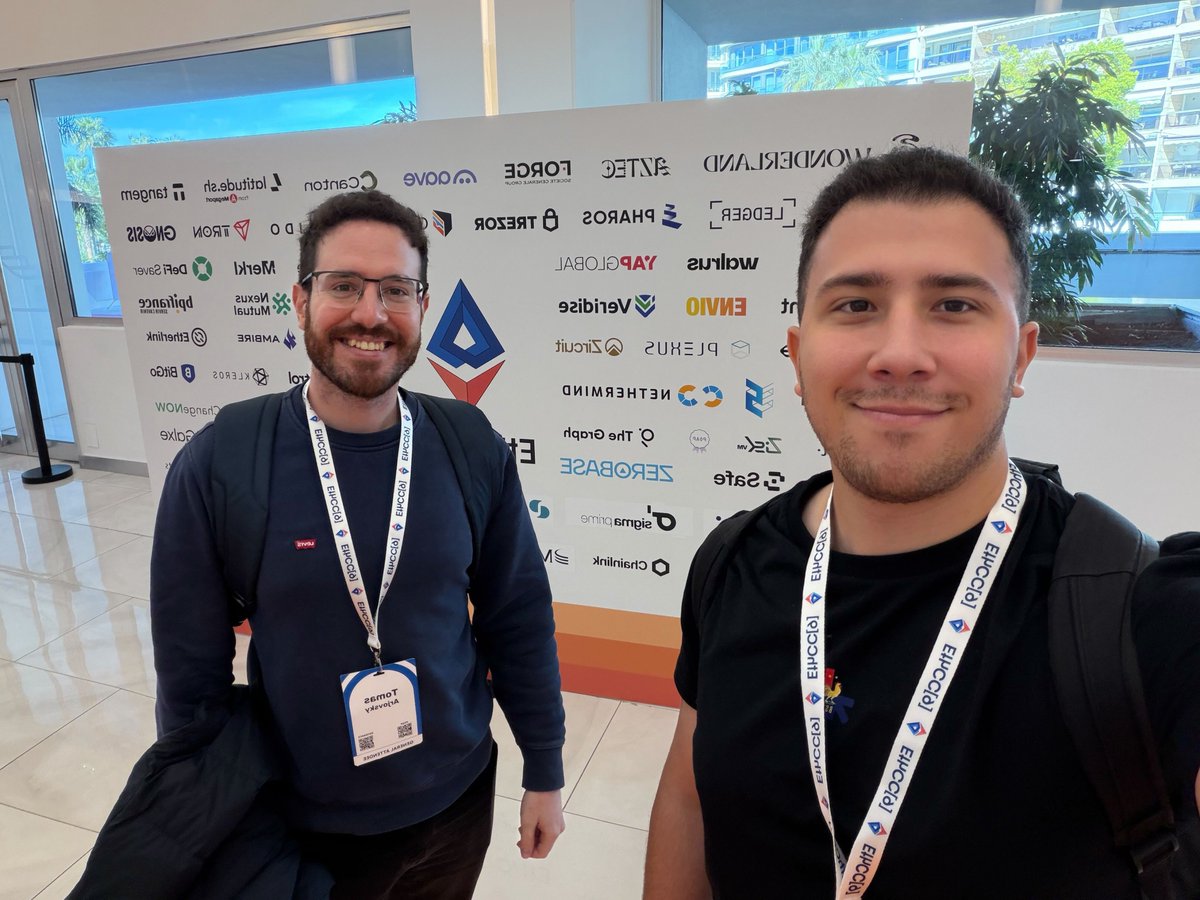
Wrapping up @EthCC 2026.
It was a great opportunity to share what we are building at @ethrex_client and get to know so many teams working across the ecosystem.
Big thanks to the organizers for putting this together. Already looking forward to the next edition.
Really enjoyed being part of the mini-ACD panel at @StatelessEth.
Alongside core devs from @HyperledgerBesu, @Nethermind, and @ErigonEth, and hosted by @gballet and @CPerezz19, we discussed binary trie transitions, state expiry, code chunking, and ZK proofs.
We also presented our experimental EIP for optional proofs and their importance for enabling cheaper validators while increasing gas limits.
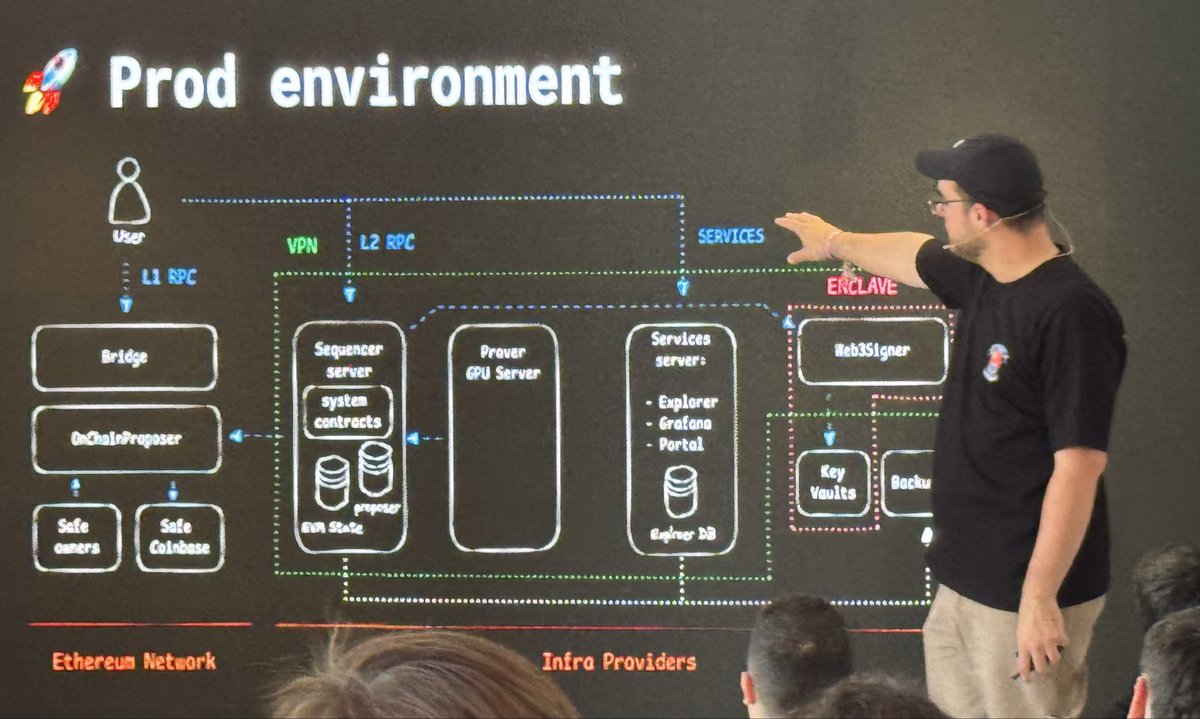
Yesterday at @StatelessEth we presented how @ethrex_client does stateless execution.
We discussed the difference between traditional and stateless execution, ethrex’s architecture for optional proofs implementation, and how LEVM integrates different guest programs for the different zkVMs out there.
The talk included a full EIP-8025 local net demo integrating ethrex + zkboost + zklighthouse.
Thanks for having us!
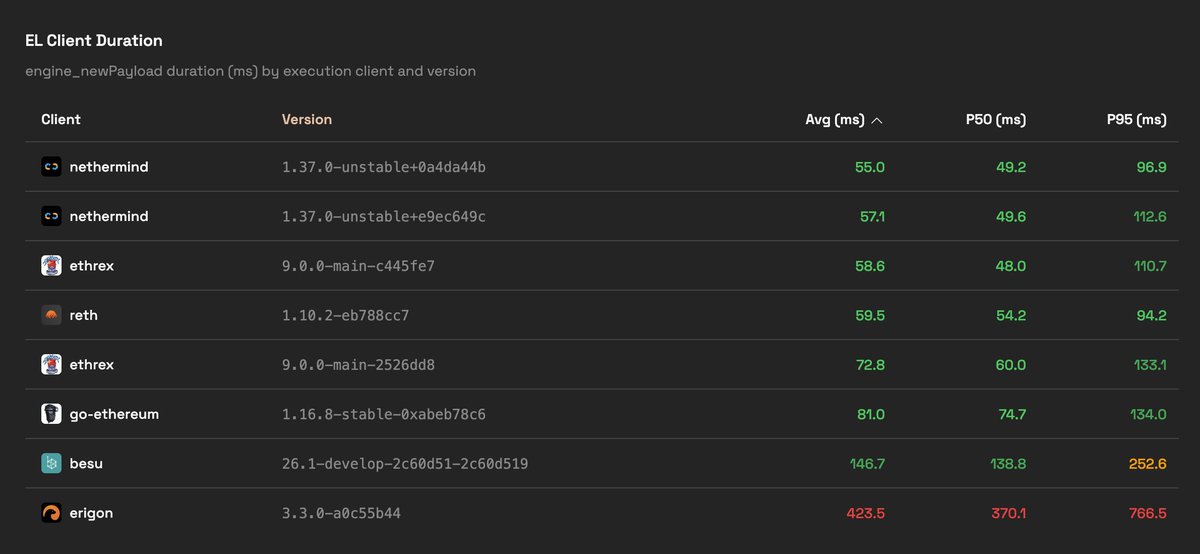
I'm very proud to announce that @ethrex_client is now one of the fastest @ethereum clients, right behind @Nethermind, which still leads by a small margin.
A little over a year ago, we set out to provide the market with an smaller, simpler and reliable alternative to reth. I believe we've achieved exactly what we set out to do.
We just pushed a PR that improved performance by 25% in the last few hours. The image shows numbers from the last 6 hours of @ethPandaOps mainnet testing.
We built all this with the top notch talent at @class_lambda in just one year, without any AI assistance. Last week we incorporated @claudeai into our workflow, and we believe it will significantly enhance our decision making and accelerate results further.
@alignedlayer is developing, with our help and @3miLabs, a new RISC-V zkVM that I believe will be simple, well-documented, and one of the fastest on the market.
Thanks to the @ethereumfndn for its help and support but particularly to all the partners and employees of @class_lambda that have been working very hard for this to happen.
If you can, please give the dinosaur Ethrex a star on GitHub and join the Telegram!
They say we built the whole thing just to use rust, but we actually just built a full execution client to use a lazer eyed robotic dynosaur pixel art logo in a ppt
We just do that sometimes
@class_lambda@ethereum@EFDevcon
421/// Ethrex, una pieza clave para el futuro de Ethereum creada en Argentina
Para seguir escalando como infraestructura financiera digital global, Ethereum necesita mejores clientes de ejecución. Ahí entra @ethrex_client de @class_lambda.
https://t.co/xWiRIKDOb7
Here are the demo and devnet of the work we did with our friends at @gattacahq !
Step 1. Preconfirmations for super fast UX in L2. ✅
Step 2. Based rollups for L1 level security and decentralization. 🏃♂️
Who says @ethereum can't be both fast and secure?
1/ 🎉 One week later, we’re excited to launch the first-ever Based OP Stack devnet, developed in continued collaboration with @class_lambda. Check out the quick demo below featuring @Rabby_io Wallet 👇
10/ Based rollups in the OP Stack.
Based rollups are a new flavour of L2 that leverage Ethereum's L1 validator set for sequencing, instead of hosting their own sequencer.
Along with @class_lambda, @gattacahq released an open-source implementation for Phase 1 of a highly-performant, interoperable based rollup using the OP Stack.
https://t.co/B9iG8fBm3N
> be me
> Fede: you might be going to London for a week tomorrow to launch something with some cool guys
> refuses to elaborate
One week later:
Part of the @class_lambda engineering team that is building ethrex is working onsite with @gattacahq/@titanbuilderxyz on a project we’ll announce in the coming weeks that will be useful for multiple parties and Ethereum in general. We made the decision to go work on site after a short dinner with Kubi from Gattaca and a few hours later the team flew from Buenos Aires to London. I couldn’t go, I’m in Abu Dhabi closing some deals that hopefully will help bring more companies and users to Ethereum.
Today I had two calls with two CEOs and we’re gonna work on other initiatives with their teams to help accelerate Ethereum. As they say, “only the paranoid survive.” We plan to turn this small crisis around and ensure that the best protocol humanity has ever created continues to win.
A big thank you to @drakefjustin for coming onsite to speak with both teams about the beam chain, preconfirmations, base, and native rollups.
Let’s go Ethereum! Let’s fight back and win, we can do it.
It's been a while since I sent any updates over here. Did I tell y'all that I went from consensus in elixir to coding an @ethereum execution node in rust at @class_lambda ?
Here, give it a star if you're into that: https://t.co/y8UcIaTZyc
2024's bingo card is full of surprises!
Some friends questioned me for doing this. But hey, life is about pursuing what you believe in and having fun in the process. This is the beginning of why and how I’m going rogue.
I am going rogue
The original promise of cryptocurrency was simple: decentralization, ownership by the people, and freedom from centralized control. Crypto was born to remove the middleman, and to give power back to individuals. Yet, today, the crypto landscape looks far different from that vision.
Over time, some insiders hijacked the technology. They took control and undermined what was supposed to be decentralized; choosing short-term profits over the core mission. The ecosystem is now overrun with projects launched by the same investors, recycling the same technology without meaningful innovation. This vicious cycle of self-serving agendas and empty wins is suffocating the very spirit of crypto.
Memecoins — often considered not serious — have gained significant traction in the last few months. The reason they have grown is that they allow common people to make money and be part of something early on. Apart from memecoins, which projects let you be a protagonist of the story?
Rogue is our answer to this problem. We’re bringing crypto back to its foundational roots: we are building a decentralized Layer 2 network with no VCs, no team allocation, and a fair launch that ensures equal access for everyone. Just like when Bitcoin and Ethereum were first launched, we’re committed to creating a project that prioritizes decentralization, fairness, and true community ownership. We might fail. We are fine with failure. For us, this isn’t just another project. It’s a movement to recover the values that once made crypto a revolutionary force while also providing useful infrastracture.
Our goal is simple: to create a project that is beyond our control, where ownership and control are truly decentralized, and where the network’s future is entirely in the hands of its users. This is about reclaiming what has been lost and building a future where crypto belongs to everyone again.
How will the token and ownership work?
There won't be an initial airdrop or token allocation to creators or investors. No presale. No premining and no token distribution. There will only be organic growth. Why are we doing this? Because we believe in it. The users should own it. This will outlive us.
Like in Bitcoin and Ethereum, the token will be produced in every new block of the network. Block builders and provers will receive the newly minted tokens.
A real decentralized zk L2 owned by its community
This is a simplified version of the flow:
1. User transactions are propagated via a mempool to the block proposers.
2. Block proposers lock some validity bond capital and bid for the rights to propose the next N blocks.
3. The bid-winning block proposer generates blocks, attested by a TEE (Trusted Executed Enviroment), and sends them to Ethereum.
4. ZK Provers race to generate a proof that all the transactions were correctly executed.
5. The ZK proof gets verified in Ethereum and all the transactions are now considered finalized.
6. Rewards are given to both the proposer and the provers.
If the block proposer proposed an invalid state transition, its locked validity bond will be slashed. (This can be proven via ZK proofs.)
With ZK technology, we can add more hardware to increase proving capabilities. You can have many provers participating in a pool where rewards are split between all the participants.
A fixed time for finality can also be set as a target for the network, making the size of the block dynamic. The size of blocks will be determined by proving capabilities and proving capabilities will grow due to economic incentives. The more proving hardware is available, the more transactions can be included per block.
How does it compare with the alternatives
Rogue is fully decentralized since its sequencing is done by Ethereum. This will have stronger liveness and censorship guarantees than many current L2s. It will not need an escape hatch. It can't censor or lie. And early tests reveal it will do it cheaply. We will release a full cost analysis later, but people all over the world will be able to use this tech, even during periods of high usage. This is a blockchain, unburdened by what has been.
We believe that, long term, an L2 that generates economic incentives for users to propose and prove blocks will be cheaper and more scalable than its alternatives. Provers will have incentives to collaborate to add more computational power to the network and prove bigger blocks. The more hardware is added on the prover side, the more transactions the system can handle and the cheaper each transaction gets.
ZK already solved the scalability problem of blockchains. However, it needs to be used in a way that allows individual economic self-interest to contribute to the greater good. The social, economic, and technical designs of Rogue are interconnected. The fair launch and economic incentives will bring competition and collaboration between provers to add more hardware capabilities to the network. These capabilities will continually improve the network. When a miner is added to Bitcoin, the network becomes more secure. In Rogue, this is done via ZK. Adding more hardware makes the network cheaper and faster.
What does the future look like?
Currently, we are finishing an execution client for Ethereum that will be used in Rogue. Based sequencing, proving, and TEE attestation are being added. This will take some time but we aren't that far away from having a working first version.
Why are we doing this?
We have built multiple relevant core infrastructures for these systems and we understand how the game is played, too. We want to change things. We want to build things we are proud of. We want to create something we would use; just like we use Ethereum and Bitcoin. More importantly, we want people to own it like they own Bitcoin, Ethereum, and memecoins. For this to happen, we need to build something bigger than ourselves.
Failure is almost certain but we will try anyways since we believe in it.
How can you participate?
You can like this tweet, retweet it, answer the tweet, or join our telegram.
In the future, you will be able to propose or prove blocks and build applications on top of it to own the network.
Our Lambda Ethereum Consensus client is very close to be validating and proposing blocks. The codebase is less than 15k lines of code and everything id already implemented. Stability and simplicity have been our main objectives to achieve. Performance was a secondary objective and we are now fixing it.
Today we lowered the processing time from 4 minutes to 21 seconds and we are bringing this down to 5 seconds in less than 2 weeks. We can lower it even more.
We will have a simple new consensus client written in a new programming language (Elixir) running on mainnet with our own stake in the near future!
Github: https://t.co/ahUPQaEm8I
Telegram: https://t.co/DAd1fSbQwX