Theoretical physics | Emergent time & temporal-flow field β(x).
Author of the TES series (Vols. 1–4).
Focus: GR foundations, cosmology, information, scalar–tens
TES is a real physical theory. Not speculation, not philosophy.
A formal, first-principles framework with a well-defined Lagrangian, axioms, and testable predictions.
• It does not violate Relativity.
TES recovers GR exactly when the temporal-flow field β becomes constant. GR is a limiting case.
• It does not violate Quantum Mechanics.
TES adds no exotic operators; standard QFT emerges unchanged on a TES background.
• It does not violate Thermodynamics or Entropy.
Energy–momentum conservation arises naturally from the Bianchi identities, and entropy production follows from β-dynamics.
• It is not scalar–tensor gravity.
β is not an extra scalar “modifying” GR — it is the geometric field that defines physical time itself.
The theory cannot be reduced to Brans–Dicke or Horndeski form.
• It has a clean Lagrangian formulation.
No circular definitions, no emergent hand-waving.
A standard action with:
• It has axioms.
The Temporal Postulate (t = ∫β dτ) provides a precise, non-ambiguous definition of physical time.
• It is mathematically self-consistent.
Stable potential, no ghosts, well-posed Cauchy evolution, and full compatibility with Einstein’s equations.
• It is observationally consistent.
TES reproduces all current constraints: CMB, BBN, structure formation, gravitational wave propagation.
• It offers concrete, falsifiable predictions.
– Optical-clock drift
– Redshift-drift deviations (ELT)
– Early-time β variation (Hubble tension)
– Entangled-photon time-phase test
– Cosmic clock drift in standard candles
• It has toy models and dynamical simulations
Demonstrating β-evolution, stability, smoothness, and prediction of coherent structures.
TES is not “alternative cosmology.”
It is a foundational theory of time, compatible with everything that works today — and testable where GR and ΛCDM fall short.
---
📘 TES — Volume 1 & Volume 2 (Core Theory)
DOI: https://t.co/OgvbK5NLDF…
📙 TES — Volume 3 (“TES is not GR”)
DOI: https://t.co/OgvbK5NLDF…
📕 TES — Volume 4 (TES+I)
DOI: https://t.co/OgvbK5NLDF…
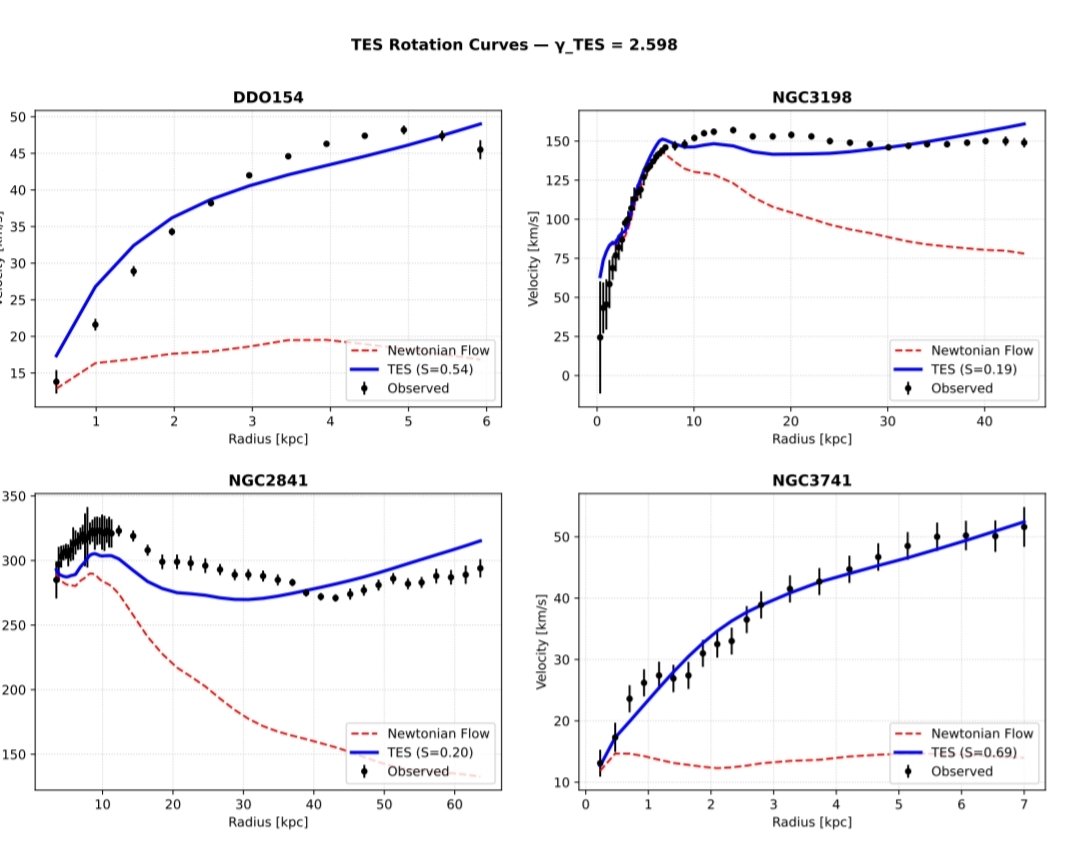
What if Dark Matter isn't a particle, but the fluid-like friction of the quantum vacuum? We derive flat galactic rotation curves from first principles—with ZERO free parameters.
Read here: https://t.co/r3qs17HMFo
#Astrophysics#DarkMatter#Physics#Cosmology
Excited to announce my new paper on Zenodo: "A Hydrodynamic Approach to the Heliopause Discontinuity."
We address the long-standing "discrepancy" in Voyager 2 data by applying the TES Hydrodynamic Formalism.
https://t.co/jRffLxX45x
#Astrophysics#Voyager#TES#Heliopause
The Heliopause isn't just a magnetic boundary; it’s a manifestation of the Vacuum Memory (V_{obs} = V_{laminar} + \Delta V_{memory}).
The "stretch" of space (\beta) meets the interstellar medium, creating a rhythmic phase shift in the articulation of time.
Traditional models struggle to explain the sharp radial profile transitions at the edge of our solar system. By treating the vacuum as a hydrodynamic medium with topological memory (S), the TES framework recovers the observed discontinuities without fine-tuning
Imagine a map that doesn’t just grow larger,
but gains new possible routes.
Not only do points move —
the meaning of “path” changes.
That is what space expansion does.
Canonical statement:
Time is the necessary local variation arising from the universal expansion of space.
The expansion of space is the universal, necessary increase of possible relations of existence.
It is not motion within space — it is change of space itself.
In TES, expansion is not just a cosmological feature of the past.
It is continuous, universal, and happening everywhere.
Space is not a static container.
It does not “host” things — it is constantly being generated.
Every new possibility of distinction, existence, or change requires more space to be expressed.
Expansion is not a choice of the universe.
It is the minimal solution to non-stasis.
Classical idea:
Space = stage
Time = independent
Expansion = cosmology
TES:
Space = dynamic process
Time = consequence of expansion
Expansion = foundation
Expansion is the generator of time.
Logical sequence:
The vacuum cannot remain static
Non-stasis requires new spatial possibility
Space expands
Expansion enforces change
Change requires a rate
That rate is β
The integral of β is time
No space expansion → no time.
Space expansion is not:
• an explosion into pre-existing emptiness
• objects moving because of a force
• a phenomenon only at large distances
• something that “started and ended”
In TES, there is no “space before space.”
So there is no “into what” it expands.
In TES:
Time = the accumulated result
β = the rate that produces that result
Just as distance ≠ speed,
time ≠ β.
Canonical statement:
Time is the integral of β, not the other way around.
The time-rate β is the physical measure of how fast change is allowed to unfold.
It is not time itself, but the rate at which time is produced.
In TES, time is not a given quantity that is merely measured.
What exists fundamentally is a rate: β.
β answers a simple question:
“How fast are relations allowed to change at this point in the universe?”
If time is the accumulated result,
β is the local regulator that determines how much “time” is generated.
Different locations, systems, and physical conditions can therefore have different β — and different experiences of time flow.
In TES, β is:
• observable (indirectly measurable)
• dynamic (it can vary)
• universal, but not absolute
Physical time is defined as the accumulation of β along a system’s evolution.
Clocks do not measure “time itself”;
they integrate the local β along their paths.
That is why different clocks can disagree without any of them being wrong.
What β does NOT mean:
• not a velocity in space
• not an observer-dependent effect
• not a mathematical trick or illusion
• not an arbitrary variable clock
β does not replace relativity,
does not alter the local constancy of c,
and does not violate causality.
It is fully compatible with known physics — it reveals what lies beneath it.
In TES, time is not treated as something that “flows” on its own.
There is no independent river of time along which events simply happen.
Time appears only when something is able to change.
If no change of relations is allowed — no variation, no evolution — then time, naturally, has no meaning.
Thus:
motion,
evolution,
causality,
and even the experience of “before” and “after,”
do not occur within time;
time emerges from the fact that such changes are permitted.
Put simply:
Time is the measure of “how much change is allowed to occur.”
I’ve just released a new paper on falsifiable predictions from an operational definition of time.
The focus is deliberately narrow: clock-based tests, synchronization residuals, and clear null conditions under which the framework must fail.
🔗 https://t.co/v1etJchDzQ
I’ve uploaded
“On the Spectral Structure of Deviations from the Temporal Attractor”
The paper extends a program developed across four works:
Physical Meaning of Time → No-Go → Attractor → Spectrum
It addresses a precise question:
whether deviations from an established infrared temporal attractor
(delta beta = beta − )
can exhibit scale-dependent (spectral) structure under further coarse-graining.
The hypothesis is explicitly falsifiable:
• If all residual deviations vanish asymptotically under coarse-graining,
the attractor description is complete and the spectral hypothesis is false.
• If correlated deviations persist in the infrared,
they must obey non-trivial scaling constraints,
providing a sharply testable signature.
No data fitting.
No reinterpretation of existing experiments.
Only structural constraints on operational time.
https://t.co/89tLEvqj44