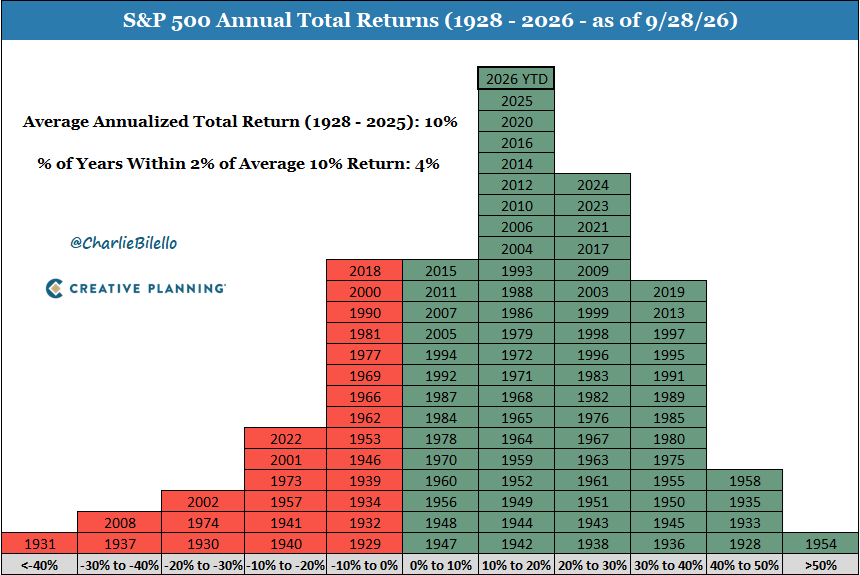
The stock market’s average total return is 10% per year. But don’t mistake that for consistency.
Over 98 years, returns were within 2% of that number just 4 times.
Lesson? Compounding comes in lumpy, unpredictable bursts.
Video: https://t.co/tlL6I4hAsd
Credit is the most important part of the economy—and probably the least understood. It's the biggest and most volatile part.
When borrowers receive credit, they increase their spending. Because one person’s spending is another person’s income, increased spending drives the economy forward and creates a self-reinforcing pattern of economic growth.
Understanding how credit works is key to understanding economic cycles.
#RayDalio #Economy #Credit #Finance
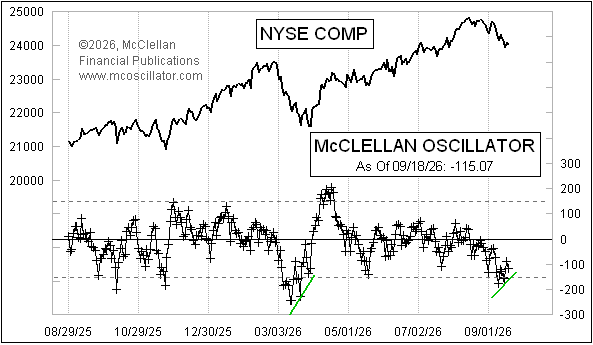
Positive breadth at the close on Monday will bring a 3rd McClellan Oscillator bottom, higher than the last two, which is a powerful bullish signal. We last saw one of those at the March 30, 2026 low.
The desire to own stocks is going off the charts... literally!
This will only worry you if you're wired as a contrarian.
However, since most investors aren't (default evolutionary wiring is herding behaviour), you're most likely a momentum investor and hope that the craziness continues—at least for a while longer—so you can profit as well.
The greater fool theory, they call it.
While oil & equity mkts were flattish last wk, bond ylds hit multi-decade highs in different countries as central banks raised rates. While AI frontier model pacing was initially a concern, that faded by Friday. I expect the upcoming wk to be challenging.
I have some simple portfolio rules including:
1) Don’t Fight the Fed: hiking cycle seems to have begun
2) Don’t Fight the Bond Mkt: Multi-decade highs in ylds
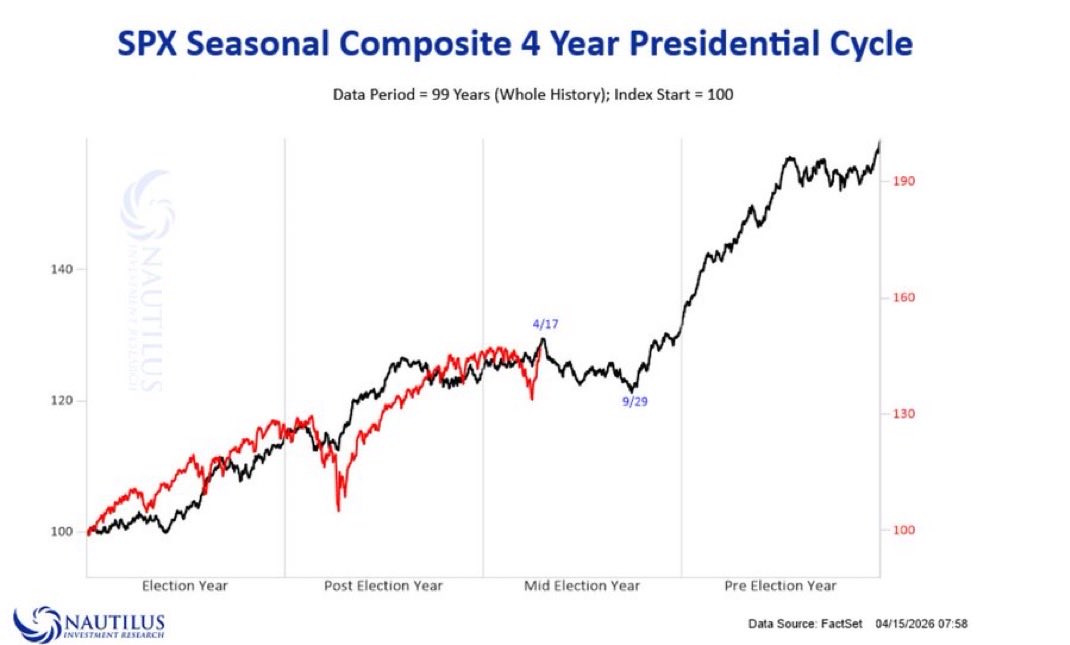
3) Don’t Fight Seasonality: Sept is worst month for hit rate & returns with mid-term yrs even worse
These rules influence how I think about leverage, the ratio of long positions versus short positions, and individual position sizing.
Investing is hard enough without fighting headwinds. As Warren Buffett (a remarkable 61 year run came to an end last week) has said, the market has to keep pitching but you do not need to swing.
For AI, the battle lines seem to be drawn. OpenAI and Anthropic are pushing for regulatory capture while $NVDA & $MSFT are pushing for better testing before models are released. I’m in the latter camp. No product from any company should be released before it is safe.
AI related companies focused on the potential bullish implications in case there was model innovation pacing including:
1) Focus on security
2) Resources deployed for testing
3) Potential for any training slowdown offset by limited hardware capacity being deployed to the infrastructure layer
The SOX index, a representation of the infrastructure layer, rallied 0.8% last week with $IGV (the software ETF) also up 2.8%. Software was led by the security names, the $HACK ETF was up 8.0%, despite the 0.1% decline in the S&P.
Longer-term, my view is that companies do not need the most advanced models for 90% of their workflow and usage will increasingly go towards open weight models. I believe that ultimately the LLM layer is likely to become commoditized. As an example, the ASP per token peaked in late May and has gone down ~50% since then while the number of tokens produced has gone up by ~4x. This is Jevons paradox in action. This should also be supportive of the infrastructure layer.
As the model layer becomes increasingly commoditized, I believe the winners will be those that have the following attributes:
1) strong open weight models
2) distribution capability
3) training data
4) base business that is highly cash flow generative
I believe the following companies have the attributes above to varying degrees:
1) $META (Muse from Meta is the #1 free app on the Apple app store with ChatGPT #2),
2) $GOOGL (I expect a new frontier level model soon that should help the stock)
3) $MSFT (Co-pilot might be the "safe" way ~450M M365 enterprise users choose to access AI. But their 27% ownership of OpenAI does concern me and they do not have the wealth of training data that Meta and Google have.)
Earlier this year, the advent of Agentic AI increased token production by 10-100x. This should keep demand strong for the semiconductor portion of the infrastructure layer.
Given the escalating geopolitical tensions over the weekend and its potential impact on oil/bond yields, this could prove to be a challenging week:
1) Ukraine fired over 1,000 drones at Russia, including "largest ever" attack on Moscow
2) There was a missile attack on Riyadh for the first time since July
On a positive geopolitical note, hopefully something constructive comes from the meeting between Presidents Trump, Xi and the attending business leaders on Wednesday.
All the best in the week ahead.
The commodity supercycle is here.
And it rewards the boring stuff the last decade left for dead.
5 things I keep coming back to:
1. The clock flipped.
For 40 years, falling yields lifted everything asset-light — software, platforms, growth without factories. That tide bottomed in 2020. When the wind that carried you for a generation turns into a headwind, the assets that were “dead money” quietly become the trade.
2. Gold isn’t a bet, it’s a memory.
It compounds nothing — 0.6% real since 1800. You don’t own it for what it returns. You own it for what it protects against. And the buyer changed: central banks now hold more gold than U.S. Treasuries for the first time since 1996. The people who print the paper are quietly choosing the metal.
3. Energy got purified by near-death.
Negative oil in 2020 killed the reckless and left the disciplined. The survivors have fortress balance sheets and finally return cash instead of drilling it into the ground. Sometimes an industry becomes investable only after everyone gives up on it.
4. Copper doesn’t tell stories — it does arithmetic.
The world needs far more than it can dig up, and that gap widens every year to 2040. A higher price doesn’t summon a new mine; it summons one in 15 years. That lag is the engine of every supercycle. It’s the strongest case and the one I’d buy last — because it’s also the most violent.
5. The moat of the future is geography, regulation, and physics.
Nobody codes an app that replaces a proven tonne of copper in the ground. In a world drowning in things that scale infinitely, the scarce thing is the thing you can’t replicate. Boring, heavy, and un-disruptable is a feature, not a bug.
The last decade paid you to own what scaled. The next one pays you to own what’s scarce.
WHAT IF the biggest bubble of our lifetime isn't crypto?
Not AI stocks.
Not real estate.
What if it's the one asset every pension fund, every retiree, every "safe" portfolio is loaded with?
Bonds.
200 years of rate cycles say the same thing:
Every peak lasts 56–67 years.
The 1981 top was 14% yields.
The 2020 bottom was 0%.
39 years of falling rates just ended.
What if we're now at the start of the next 50-year cycle — upward?
Most investors have never managed money in a rising rate world.
Their entire career happened inside the bull.
The unwind has barely started.
And no one is talking about it.
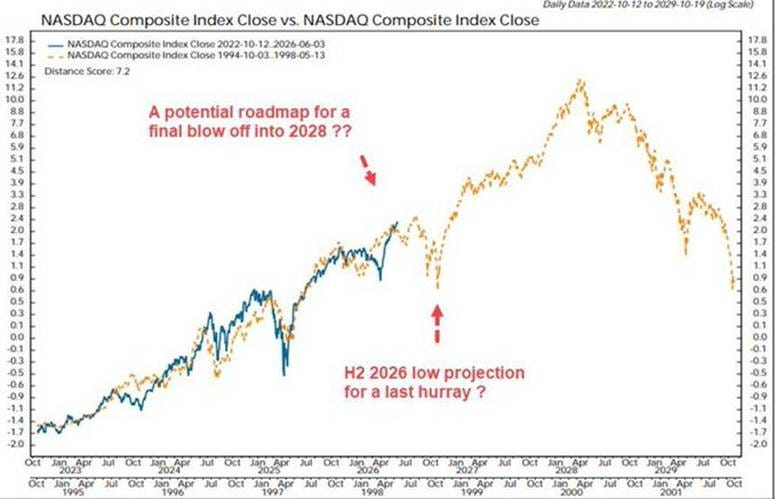
The 1998 rhyme
Long-time readers know I keep one analogue taped above my desk: 1998. I built the full case in The Semiconductor Climax Run, the final part of our semiconductor trilogy, so here I will give you the condensed version — and the chart that keeps the thesis honest.
The 1998 rhyme: Nasdaq 2022–2026 vs. 1994–1998, with the H2 2026 low projection and the final act into 2028
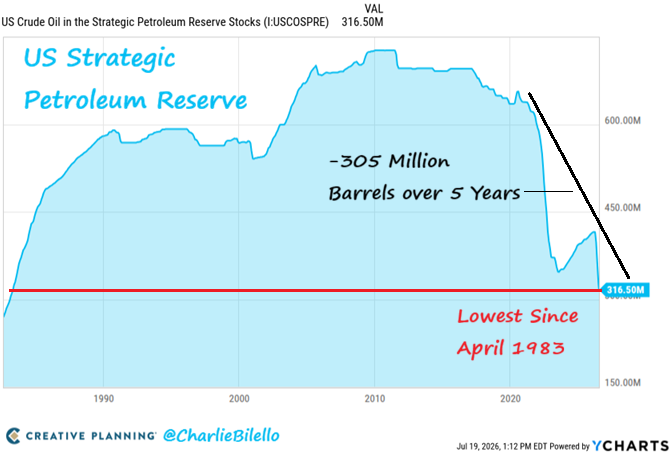
The US Strategic Petroleum Reserve is now at its lowest level since April 1983. Over the past 5 years we've seen a drawdown of 305 million barrels (49% decline).
🚨 We may be looking at the rarest market setup in 50 years.
The S&P 500's four historic drawdowns since 1972:
– 1973 Inflation: -43%
– 1987 Liquidity: -30%
– 2000 Tech: -47%
– 2008 Credit: -55%
Each one was driven by ONE dominant risk.
Right now, all four are present at the same time.
1. INFLATION
A commodity supercycle. Energy, metals, agriculture all in multi-year base breakouts. The Fed's preferred inflation gauge has been above 2% for 18 of the last 24 months.
2. LIQUIDITY
The largest equity supply shock since 2000. SpaceX, OpenAI, Anthropic raising ~$275B combined. Google flipping from $60B/year buybacks to $80B net issuance. Over $1 trillion of IPO and lockup supply hitting the Russell 3000 in 2026.
3. TECH
Semiconductors trading 73% above their 200-day moving average – the largest stretch since March 2000. Climax run signals across the AI complex. Micron, Palantir, SMCI, the SOX index, all showing the textbook O'Neil sell pattern.
4. CREDIT
Apollo, KKR, BlackRock, Blue Owl, Cliffwater, Partners Group – all gating redemptions on their evergreen funds in the last 90 days. The private credit machine is freezing in real time.
Never in 50 years have all four risks been simultaneously present.
But here's the part nobody talks about
While the AI Big 10 has gone vertical, quality stocks have been left for dead.
– Berkshire Hathaway: trailing the S&P 500 by hundreds of basis points
– Coca-Cola, Procter & Gamble, Pepsi: trading at multi-year relative lows
– HEICO, Union Pacific, MSCI: making boring new highs while everyone watches Nvidia
– Healthcare vs. S&P 500: 25-year relative low
The last time this happened?
December 1999. Barron's ran a cover titled "What's Wrong, Warren?" – mocking Buffett for being a dinosaur, for missing the internet, for refusing to pay for growth at any price.
Berkshire was down 19% in 1999 while the Nasdaq was up 85%.
What followed:
– Berkshire +29% over the next 24 months
– Nasdaq -78% over the next 30 months
The setup today
Four historic risks stacked simultaneously, while the boring, durable, cash-flowing businesses that always survive these regimes have been treated like dead money for years.
The math doesn't get more asymmetric than this.
Quality stocks aren't out of style.
They're being orphaned.
That's when generational positions are built.
The boring stuff hasn't worked for a long time.
History suggests that's exactly the moment it starts to.
„Klumpen“ gab‘s schon immer an der Börse: Was heute die Tech-Dominanz ist, war um 1900 der Investitions-Boom rund um Eisenbahnen – die damals sogar noch einen viel größeren Anteil an der Börsenkapitisierung hatten.
[Aus dem neuen Buch von @MebFaber: „Investing in America“]
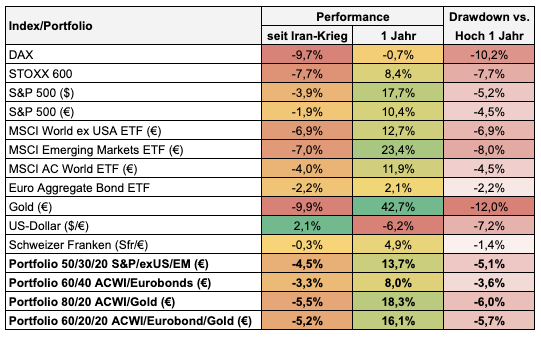
Zur Einordnung, weil mancherorts von #Crash die Rede war: Die Indices/Asset-Klassen, die für die meisten Anleger relevant sind, befinden sich STAND JETZT abgesehen von #DAX und #Gold nicht einmal in einer Korrektur (>10% Rücksetzer vom 52W Hoch) – und diversifizierte Portfolios verzeichnen 4-6% Drawdown.
Wer da nicht mehr ruhig schlafen kann, sollte ernsthaft überlegen, ob die Strategie zur eigenen Risikotragfähigkeit passt. Denn es könnte in der Tat noch viel schlimmer kommen, bevor es irgendwann wieder besser wird.
Based on the news, $NVDA should have rallied on stellar earnings last wk with software hit on Citrini outlining the worst case for AI driving unemployment followed by $XYZ (+19.7% last wk) cutting 40% of its workforce stating AI improvements as the reason.
Instead, Nvidia closed down 6.7% and $IGV (software ETF) closed up 1.0% while the S&P was down just 0.4% for the wk. But to be fair, there was mixed but generally positive performance from some of the important software names that reported earnings during the week. $WDAY was -2.9% last week, $CRM +5.2%, $SNOW -2.4%, $ADSK +8.3% and $INTU +7.5%.
This bounce also occurred despite further financial “cockroaches” to use the CEO of $JPM (down 3.4% last wk) Jamie Dimon’s phrase from October of last year following the failures of Tricolor and First Brands. MFS, which collapsed on Friday, had backing from firms including $BCS (-6.6% last wk), $APO (-12.6%), $JEF (-16.9%) and $TPG (-2.4%.) The dividend cuts by private credit companies $FSK (-16.7% last wk) and $MFIC (-13.1%) impacted the space and their associated parent companies $KKR (-13.3% last wk) and Apollo. Given I view credit as the lifeblood of the economy, this bothers me.
I do not believe we have seen the ultimate lows in software (and potentially disintermediated sectors including financials) for one simple reason, not enough time has passed. Marc Andreessen wrote his “software is eating the world” op-ed for the WSJ in August of 2011. This optimism has generally been justified ever since. But given software stocks peaked in late October of last year as agentic AI became a threat, I doubt 4 months is enough time to truly figure out what companies are in trouble and which are not after at least 14 years of optimism.
Having said that, I believe that the 1% bounce in the $IGV last week despite the above big picture reasons that could have driven it down further, makes a continuation of that bounce potentially likely.
Not all software names will be roadkill as corporations adopt AI agents. Data is the lifeblood of any company and needs to be protected so ultimately the database and security companies should fare better. In addition software for highly regulated industries and those where deterministic outcomes are needed (eg the plane must not crash) are more insulated and could benefit (AI testing the plane design.) But remember, AI agents can communicate with the underlying data and do not need the elaborate GUI interfaces that humans need from many of the software companies in the application layer.
As for $NVDA, despite the market clearly disagreeing last week, I continue to believe that at a 23x CY26 PE versus the S&P at 23x, this continue to be a great risk versus reward for those that still have optimism on AI. Revenue growth accelerated from 56% y/y to 73% over the past two quarters with a forecast for it to accelerate again in the April quarter.
While the memory of massively missed industry forecasts should sit in the back of everyone’s mind from the dotcom bust, I believe we are still in the early stages of the capex necessary to deal with the new workloads generated by recent agentic models. Token generation since the end of last year according to OpenRouter, have more than doubled year-to-date. While others such as $AMD or Cerebras will gain share, with use of custom ASICs by the big hyperscalers, Nvidia remains the gold standard.
$GOOGL is my preferred play on this trend in terms of the hyperscalers with the complete vertical stack as I have outlined in prior posts. $CSCO should benefit from networking the datacenters and the associated corporate network upgrades regardless of who wins. $AAPL should finally have AI capabilities for their 2.5B installed base of devices by year-end and is benefitting from free riding on the enormous capex investments of others.
But I also believe shorts continue to be important as well. Regardless of public commentary, in terms of actions, Nvidia invested only $30B in the latest OpenAI funding round versus the $100B Letter of Intent announced in September of last year. The larger issue for me is OpenAI increased their revenue forecasts by 27% by 2030 but doubled their cash burn to nearly $220B through 2029. This will obviously impact financial services companies who made poor lending decisions to datacenter providers. $CRWV (-10.9% last week) reported a greater Q1 loss than expected while forecasting capex of $30-35B in 2026 vs sales expectations of $12-13B.
As we approach the appointment of a new Fed chairman in mid-May, the market will start to look forward to rate cuts, whether they should happen or not. Remember the Fed did not raise rates despite the highest inflation in roughly 40 years in 2021 and the S&P finished up 27%.
I believe U should also continue to get MESI in terms of positioning. (And yes I believe Messi’s eighth Ballon d'Or in 2023 arguably gives him the edge in GOAT status over Pele my sentimental favorite.) The S&P sectors of Utilities, Materials, Energy, Staples and Industrials are all up between 11-24% year-to-date. These sectors are asset heavy with low obsolescence risk from AI with potential efficiency improvements instead. These sectors, however, are up just 42% on average since the end of 2022 since the launch of ChatGPT and the AI trade versus the 79% advance in the S&P, 117% rise in the Nasdaq and blistering 335% return in the Magnificent 7.
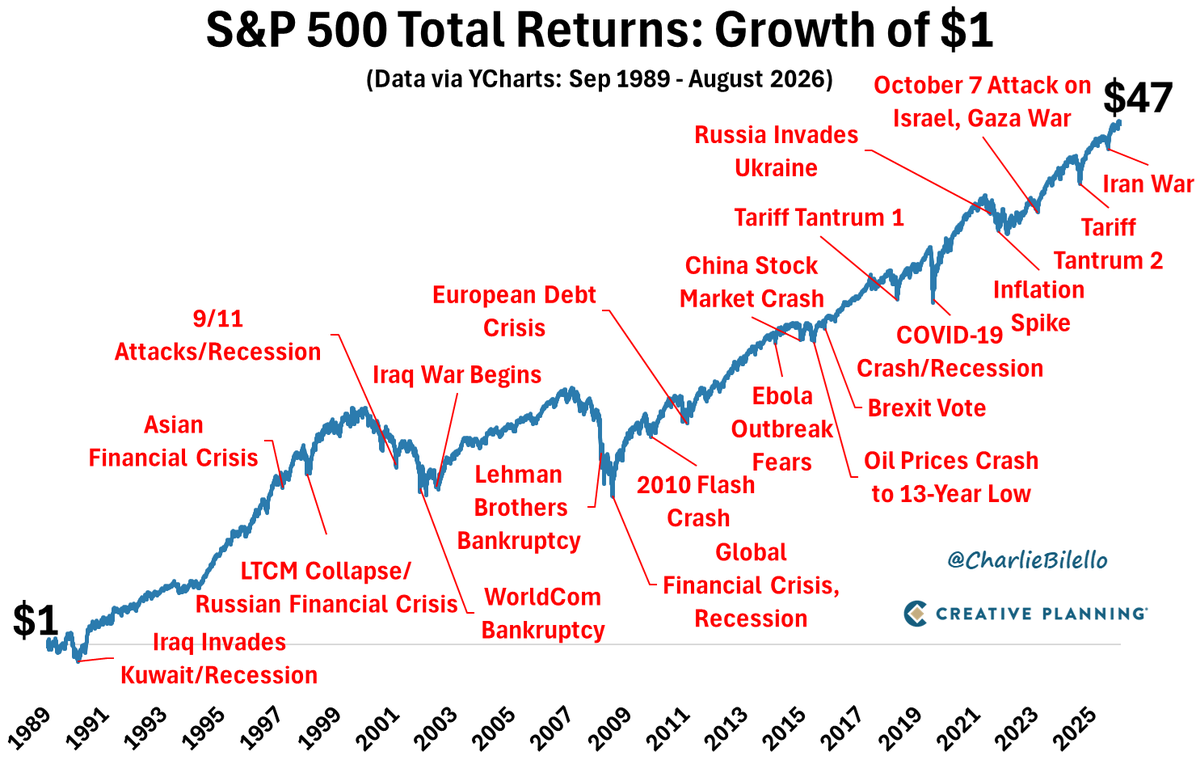
Clearly the reaction to events which will continue to evolve in Iran will color the trading in the market to start the week. But I see violent trading ranges as here to stay within the sectors exposed to AI for the rest of the year. Selectivity will continue to be important as wide dispersions continue.
Best of luck in the week ahead.








![CWRoehl's tweet photo. „Klumpen“ gab‘s schon immer an der Börse: Was heute die Tech-Dominanz ist, war um 1900 der Investitions-Boom rund um Eisenbahnen – die damals sogar noch einen viel größeren Anteil an der Börsenkapitisierung hatten.
[Aus dem neuen Buch von @MebFaber: „Investing in America“] https://t.co/c9DLM0FD08](https://pbs.twimg.com/media/HJ1gb5QXgAAqXZn.jpg)