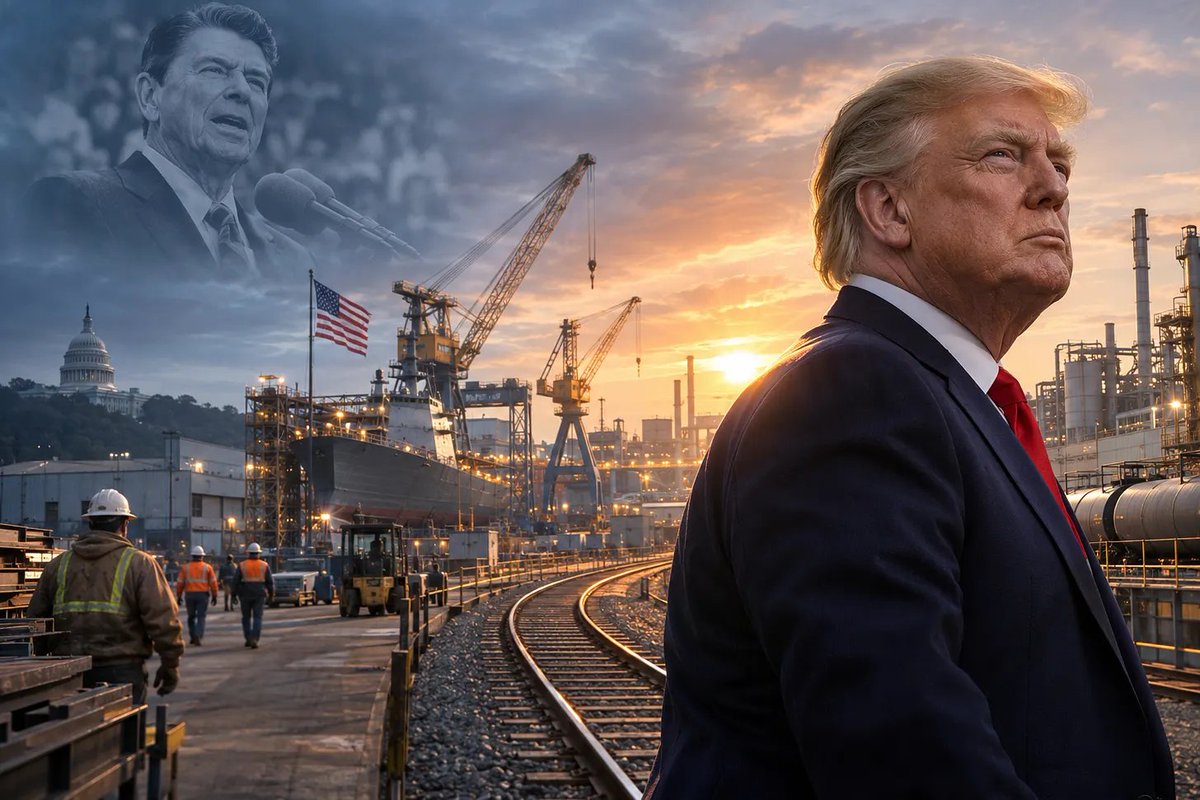
Elon Musk is the Benjamin Franklin of our time - it’s a miracle what he’s doing.
So what do the Democrats want to do with him? Put him in prison.
You better wake up and fight for what’s right, right now.
And the scumbag doomer grifters like Tucker, Alex Jones, Marjorie Taylor Greene, and Thomas Massie are on the side of the Left.
Wake up and know who the enemy of our country is.
After the Midterms, What’s Next? History Tells Us - Losing Congress didn’t stop Reagan, Clinton or Obama. It certainly won’t stop Trump — and the economic boom he’s set in motion could turn 2028 into a very different election, if we don’t screw it up.
If you’ve listened to me for the last year, you know that I’ve been telling you a midterm loss was likely. The President’s party — regardless of party — has lost the midterms all but twice in the last 96 years. And contrary to the current handwringing, that loss has often been as bad or worse as the one this week.
I also told you how we could win. And we could have: we proved that in my home state of Florida, where we held every statewide office and the exact same number of U.S. House seats as before the election. The same can be said for the state in which I grew up, Arkansas. Defeat was likely, but plainly unnecessary.
That teaches us something about 2028. The “we’ve lost forever!” nonsense is repeated every two years, and every two years the out party wins, often by enormous margins, at which point we are promised that the other party is doomed for all time. And the cycle continues.
There is a pietistic variation of that theme: “God has withdrawn His blessing from us,” or even “America is under God’s judgment”, thoughts always accompanied by a shrug of the shoulders and an abdication of responsibility, which fits pretty well since a shrug of the shoulders and an abdication of responsibility came before those events too, and in fact, brought them to pass.
There’s a lot of fight in Democrats. There’s a lot of quit in Republicans, and none more so than Christians. If they actually do find themselves under judgment at some point, that will be why.
This doesn’t mean Republicans will win in 2028. It does mean that they can, and that they can recoup their losses. Remember when the so-called “Blue Wall” was unwinnable? Heck, I’m old enough to remember when every Southern state was unwinnable. And then they became unwinnable for the Democrats. And now the Democrats have won a few, while Trump has repeatedly carried the Rust Belt.
Everything is fluid. Every election is new. Every assertion of some “end of history” is a lie and a sick joke. I am a lifelong student of these things. Forgive me if I’m not one for handwringing. I know too much history for that.
I will grant you this: I know that a loss in 2028 to the Socialists could end America as we know it, because Democrats openly promise to alter every Constitutional balance and to remove every possible restraint on their own power. Their vision of a “fundamentally transformed America” looks a lot like Brazil, and Venezuela, and even China: nowhere left to go and no one left to save us. That prospect should scare you. If it doesn’t, you’re the problem.
But a loss in 2026 means no such thing. History shows us why, and it starts with this: America does not have a parliamentary system. The President is not subordinate to Congress, and never has been.
That’s readily apparent once you recall our recent history.
In both 1982 and 1986, Ronald Reagan faced tremendous midterm losses. As a result, the Democrats made his life harder. They did not stop him from conducting one of the two most successful Presidencies of the entire 20th century, or from doing so right up until his last moments in office.
In 1994, Bill Clinton was wiped out in the midterms, with even greater losses than we suffered this week. Didn’t matter. Republicans provided him the foil with which he rose from a 37 percent approval rating before those midterms to an incredible 73 percent just after he was impeached.
Like the Democrats a decade earlier, Republicans failed to prevent either his re-election or his effectiveness right up to his last day. They even forced him to sign legislation he opposed but for which he then took credit, including welfare reform and four straight years of budget surpluses. However perversely, losing only made him stronger.
In 2010, Barack Obama suffered the most catastrophic midterm defeat since FDR’s wipeout in 1938: 63 House seats and 6 Senate seats. He went on to a thumping re-election against the feckless Mitt Romney. Then he lost another 9 Senate seats in 2014, whereupon he told us that he had “a pen and a phone” and could govern just fine without them. And he did.
Which brings us to Donald Trump, far more a student of history than he is credited for being, but also a man who’s already been through all of this. In 2018, Trump lost 41 House seats and with them the chamber, resulting in his being (ineffectively) impeached not once but twice. Do you think he didn’t know the odds we’d lose in 2026? More to the point, do you think he didn’t spend his four years in exile planning for the two years after that nearly-certain loss?
Hadn’t thought about that, had you? It’s okay: Trump thought about it, and planned for it, years ago.
As readers of my new book Trump’s New World Re-Order know, Trump has focused, in laser-like fashion, on dismantling the world FDR created. In part, that means rebalancing trade and defense abroad in a manner that asserts American interests and increases American exports, wages and jobs.
But at home it has meant re-asserting the President’s Article II powers: if the President can’t direct the policies of the Executive Branch, up to and including firing people who “resist”, then elections are more than a bit meaningless, don’t you think? When you change Presidents, that should result in policy change. At least that’s the idea.
But in the technocratic system FDR created 90 years ago, the “expert class” trumps all of that. Bureaucrats wield full — supposedly separated but factually fused — legislative, executive, and judicial power, pick their own (Democrat) successors, and continue their own chosen policies regardless of who is elected. Needless to say, that arrangement required the nerfing of constitutionally mandated Presidential power; but it really only works for one, and against one, party.
If sometimes it feels like elections change nothing, that’s why. Trump has dismantled much of that system and keeps coming back for more. If sometimes it feels like the Democrats hate for him is rabidly unreasoning, that’s the reason.
So is the Trump presidency over? Not a chance.
Donald Trump has his veto pen, and the Democrats don’t have anything close to the numbers to override it. What he’s set in motion will remain in motion. The most proactive Chief Executive in modern times (and maybe ever) will push that far beyond whatever momentum it may already have.
The tariffs will remain, and with them the growing reindustrialization (though much that was slated for Texas may now go to Florida). The rollout of nuclear reactors, the expansion of energy dominance, the rapid rebuilding of American shipyard capacity, the rebalancing of alliances, the reform of Pentagon procurement, the immigration enforcement, and yes, the steady drumbeat of actual prosecutions will not only continue but grow.
The people saying Trump is done are smoking crack.
All of which brings us to 2028, and with it, to 1982.
Like other Presidents, Ronald Reagan got a shellacking in his first midterms. The last gasp of the Carter era — the 1981-82 recession — was in full swing. Everyone predicted the former actor and California governor would be another one-termer.
Yet the President had already planted the seeds of 1984. The Reagan tax cuts — reducing the top rate from an obscene 70 percent to just 28 — were already enacted and phasing in. The Reagan defense buildup was well underway, resulting in a great industrial expansion. The Reagan deregulatory spree was also in progress. All those things took time to gather steam and to be felt by a public that didn’t see how all the pieces fit together.
Yet by November 1984, Americans could easily see the whole puzzle those pieces had completed. The Boom was undeniable by anyone except the “experts”, who also believed that the Soviet economy was not only strong but stronger than ours.
They were still denying the obvious — in both cases — when I was taking economics just before the fall of the Berlin Wall. Reagan won 49 states (and nearly 50), propelled by the same people who’d turned on him two years before.
That’s 2026 in a nutshell.
The Trump economy created nearly one million new jobs in August and September alone. Most Americans didn’t feel it, but those million people did. Poverty hit its lowest rate in human history; inflation-adjusted median income hit an all-time high. Thousands of factories are either planned or under construction, the fruit of the $18 trillion in outside investment Trump has recruited since taking office.
That gathering boom is ultimately the result of Trump’s tariffs and trade deals, which explicitly exempt companies from the tariffs if they build a plant in the United States, and explictly require our allies to buy American energy and countless other things.
James Carville famously said that “it’s the economy, stupid.” It certainly was in both 1982 and 2026. It also was in 1984, and will be again in 2028.
The number of ways Republicans can blow this is almost infinite, of course, simply because they’re Republicans, long labeled “the Stupid Party” with reason.
But there’s an Evil Party too, one whose evil only grows. It’s the party of institutionalized racism, DEI, censorship, cancellation, and the weaponization of the justice system. It’s the party of post-birth abortion, Lindsey Clancy worship, and castrating children. It’s the party that funded oppressive socialist parties across the world, and that handed the Communist Chinese the keys to the global economy.
When the boom is in full swing, it will be easier to remember those things. Especially after Democrats show their hand (or perhaps their butt) for the next two years.
The 2028 stakes are perhaps the highest they’ve been in American history. Downplaying that would be stupid. We are on the brink of either a Golden Age or a high-tech Dark Age. 2026 hurts. 2028 could be fatal. Don’t confuse the two.
But you will not get handwringing from me. I know the stakes. I also know the history. And above all else, I know how we can win.
Stand with me these next two years as we fight for that victory or die trying. As in the days of Churchill (now dubbed “the chief villain of World War II” by the demoniac Tucker Carlson), for the duration of the struggle I can offer only blood, toil, tears, and sweat. But at the end of that struggle, after we win, there’s that Golden Age to be had, for ourselves and for our grandchildren.
Let us strive together to establish it.
The Midterm is Not the Endterm
It is too soon to calibrate the direction of the post midterm Democratic and Republican Parties.
But if the first 72 hours are any indication—and despite the soon to be Speaker’s denials—the Left is already bragging about subpoenas, and it is intoxicated by the notion of investigations and impeachments.
Heady Democrats have entirely forgotten the politically suicidal fashion of the 2021-4 five civil and criminal courtroom circuses, the Mar-a-Lago raid, and the blue state deballoting efforts.
All that and more fueled the Trump recovery.
Wild talk of multi-trillion-dollar new agendas grows, like socializing the health care system, a renewed Green New Deal, student loan forgiveness, and illegal alien amnesties, along with new punitive income and estate regulations and taxes.
This socialist dream is reminiscent of the 2021 giddy splurging that gave the country a 9.1% inflation rate by midterm year 2022.
Along with the Afghanistan disaster (the Left’s correction for a Middle East ‘forever war”) the inflation would ensure Biden a 40% popularity.
The idea that the Left, which cannot do much real lawmaking without a veto-proof Congress, will try to reach deals with the White House, adopt a 1995 Clinton-like realist agenda, simply claim credit for the growing Trump economy, or moderate its rhetoric is highly unlikely.
Instead, we hear crazy talk of confiscations, new billionaire and millionaire punitive taxes, imprisonments, changing the Constitution—all in full suicidal 1972 McGovern style.
Republicans are blame-gaming each other, which can be constructive if over issues and reforms rather than social media ad hominem. But they need to message far better, about both the administration’s successes and the dangers of a socialist future.
There will be likely be no planned presidential succession, or gentlemanly agreement on a front runner. That’s likely good news. More likely as of now a triangular race between front-runners De Santis, Rubio, and Vance emerges—all of whom are far preferable to any ticket with a Newsom, Harris, AOC, Mamdani, or el-Sayed.
If the Republicans can stay reasonably united, they can ensure permanent presidential vetoes of crazy leftwing legislation, fight back on the Democratic committee inquisitions, and see the economy in the final two years become an asset in recovering their popularity.
Absent in all conversations is that there is increasing evidence that the economy is actually expanding and has the potential to boom in 2027, or at least the data indicate such potential.
The jobs report came out yesterday with a stunning 165,000 jobs created in October (accompanied by the usual journalists’ adverb “unexpectantly”), dropping unemployment to 4.1%.
Revised 3rd GDP stats now show a robust 3.4% growth—likely ensuring at least 3%+ growth for the year.
Third Quarter consumer spending soared 3.8%.
Private domestic investment surged with 19.4% growth.
Just reported last week: median family income in 2025 hit a new record ($87,460)—the highest in 60 years adjusted for inflation. And poverty dipped to its lowest rate (ever 10.2%).
In October manufacturing activity grew faster than at any time in the past five years.
Yes, prices are too high, and final 2026 inflation, given gas hikes, is scheduled to increase by one point (3.7%) from last year’s (2.7%). But it is still lower than the pan-European average (ca. 4+%)—and much lower than the Biden average over four years of 5.1%.
Gas prices are already falling. On November 6 prices fell to a $4.06 average—as global oil transit is mostly back to prewar levels and refineries scramble to handle the increased deliveries.
U.S. companies are dominating all the top 10 rankings in market capitalization/usage in key area such as software, AI, digital media, space, satellite launches, and bio/genetic engineering.
Note that today gas prices are not that much higher than 4 years ago at the 2022 midterm time ($4.06 vs. ca. $3.80), and haven’t once spiked to $5 a gallon as they did in 2022, just four months before the Biden midterms.
Yet oddly, the red wave sputtered in 2022 when the U.S. was in far worse economic shape than this week when the blue wave became a tsunami.
Messaging, media, and communication count, so note:
Four years ago GDP growth was lower than today—even though the pandemic was about over and there was a dramatic return to work and spending.
The inflation rate was almost three times higher in 2022 than now.
Median family income was $14,000 lower than now. The poverty rate was higher in 2022.
The Dow was 20,000 points lower. Foreign investment will likely end the year 30-40% higher than in 2022.
Real wage growth (nominal wages minus inflation) while not great in 2026 is likely to end the year far better than in 2022 (when real wage growth fell 2-3%).
So why would “affordability” have been decisive in the 2026 midterms when it was not in 2022?
The 21% aggregate inflation rate Trump inherited force-multiplied the average 3.15% Trump inflation rate of 2025-6— yet in a way the aggregate first-term Trump inflation rate (7.7% just a third of the Biden total) did not exaggerate all that much the 9.1% inflation rate in 2022.
Messaging, however, matters. The administration did not explain adequately that a 21% rise in prices cannot be lowered without radical deflation or recession, but only ameliorated by medium family income growth and lowering the inflation rate from the Biden 2021-5 averages, both of which occurred in 2025-6, but were forgotten.
Media coverage of the Biden 2022 weak economy were muted, while Trump’s 2-year inflation rate was exaggerated during 2026.
The Iran war became the culprit as a war of choice that made the inherited Biden 21% high prices and the inability to lower were them solely Trump’s fault. Again, there was inadequate explanation of either the economic reality or why the gamble to denuclearize Iran was defensible–with the caveat that stopping the bombing at day 38 and talking with theocrats for seven months was an unfortunate mistake.
The domestic and foreign policy activism of the lame-duck Clinton (1998-2000} and Obama (2014-2016) presidencies increased after their loss of Congress. Indeed, their popularity climbed from a once nadir of below forty to sixty percent approval or above.
There is no reason why the Trump administration cannot have a successful last two years. The economy is growing.
The crime rate is at historic lows.
The border is closed shut. The radical pro-Western political transformation of South and Central America has remade the entire Western Hemisphere.
European NATO is rearming.
Oil and gas production is at highest levels of any nation in history.
The bloated federal work force has been trimmed by over 270,000 jobs.
There is no longer a 40,000-50,000 shortfall in military recruitment. The forced reforms in higher education were long overdue.
The verdict on Iran is still out.
If it is denuclearized, the crippling sanctions continued, the Strait kept open, the provincial opposition armed—and our military gone home— the regime will face an increasingly restive population
2026 was an unequivocal defeat, but 2028 need not be.
If the administration and Congress stay disciplined and united, and can message better, while the Left goes utterly berserk, drunk on their midterm successes, socialism/Islamism, and Trump Derangement Syndrome 2.0, the tide will soon radically turn— as the economy already has.