Happy publication day! THE ART OF HOMECOMING is on sale now!!!
It's 300 pages of writing prompts, guided reflections, hand-drawn coloring pages & #mindfulness exercises to guide you on your journey of waking up and realizing your worth! https://t.co/GVZD9cYuab
Le vieux du quartier m’a dit : « N’oublie pas que la boussole a été inventée avant l’horloge parce que la direction est plus importante que le temps. »
Gratitude isn’t just for the good times. The real practice is finding it in your worst moments.
And I promise you, it’s there.
Gratitude can turn what you thought broke you into the very thing that made you whole.
A Stanford neuroscientist warns high cortisol wrecks memory, enlarges your fear center, and make your brain feel broken.
If I wanted to fix it naturally, I'd do these 8 things every day:
1. Walk barefoot on grass for 5–7 minutes.
Deep inner suffering inevitably arises when the human person is reduced to performance, consumption, or a statistical datum. Many young people today live under the yoke of expectations to perform, immersed in an exasperated competitiveness that generates anxiety, fear of not measuring up, and disorientation.
Peace isn’t about erasing stress or avoiding challenges; it’s about learning to return to calm, clarity & presence even when everything around you feels chaotic. #Mindfulness gives us that superpower.
Find your way to peace with The Art of Untangling: https://t.co/k85SCToySl
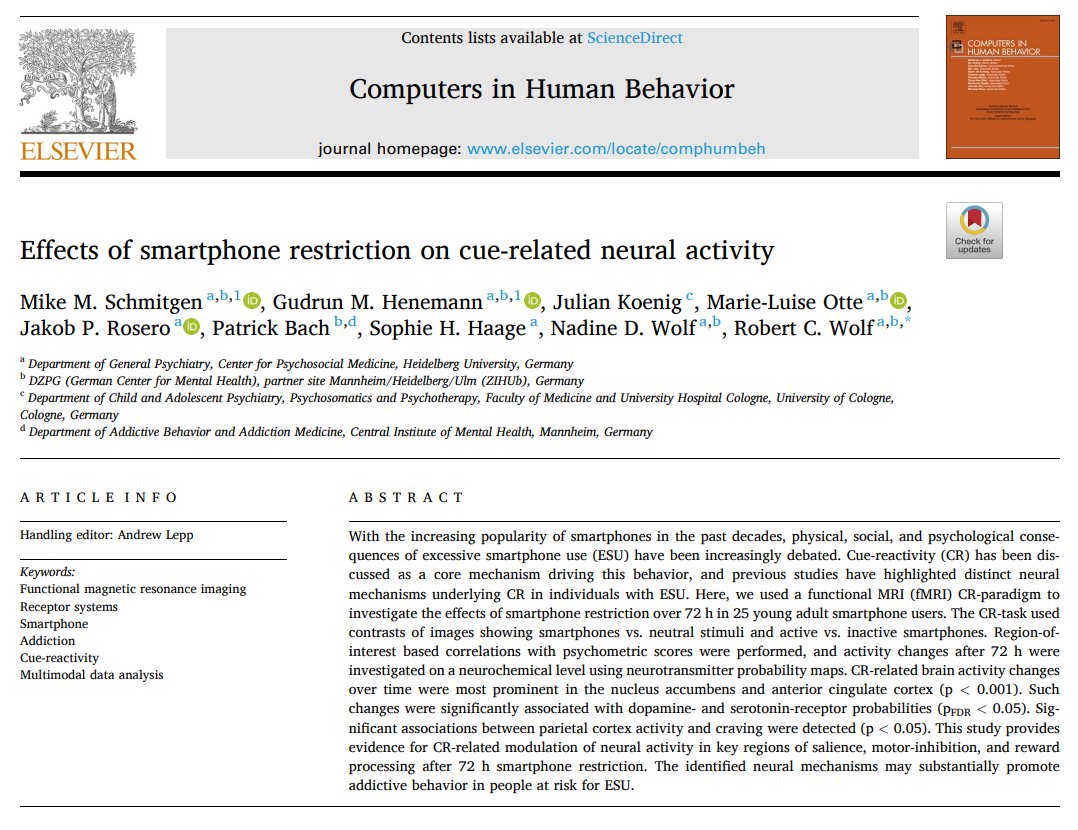
A German neuroscientist published a book in 2012 arguing that smartphones are quietly producing the first generation in human history whose brains will shrink before they turn 30, and the media spent the next decade trying to destroy him for saying it.
His name is Manfred Spitzer.
He runs the Psychiatric University Hospital in Ulm and directs Germany's largest transfer center for neuroscience and education.
The book is called Digitale Demenz, which translates as Digital Dementia, and it became one of the best-selling popular science books in German history almost the moment it was published.
The press hated him for it. He was called Germany's most controversial brain scientist, accused of being a Luddite, a moral panic merchant, and a fearmonger who hated children.
None of that stopped the book from being translated into more than a dozen languages, and almost none of it engaged with the actual neuroscience he was citing.
The phrase digital dementia did not even start with him.
It started with South Korean doctors in the late 2000s, who noticed something strange in their clinics. Patients in their twenties were arriving with memory complaints that had previously only shown up in much older adults. Forgetting numbers they used to know by heart. Losing the ability to recall directions in cities they had lived in for years. Struggling to remember conversations from earlier the same day.
The doctors connected it to the rise of smartphone use, which had hit South Korea harder and earlier than almost any other country on Earth. Spitzer picked up the phrase and built an entire book around the neuroscience that explained it.
The core thesis is brutally simple. The brain behaves like a muscle. It grows when you use it, and it atrophies when you do not. Every cognitive task you outsource to a device is a task your brain is no longer practicing, and the neural circuits responsible for that task are no longer being reinforced. Over time, they weaken in exactly the same way an unused muscle weakens.
Spitzer was not arguing that smartphones would give you Alzheimer's. He was arguing that decades of cognitive outsourcing would produce a measurable decline in the underlying machinery, long before any clinical diagnosis would catch it, and that the decline was already showing up in young adults.
The mechanism is what made him impossible to dismiss. By the early 2010s, there was already deep evidence that the brain physically remodels itself in response to use. London taxi drivers who had memorized the entire street map of the city had measurably larger hippocampi than the average person, which is the brain region responsible for spatial memory.
Musicians who practiced for thousands of hours had thicker auditory cortices. Spitzer's argument was just the dark side of the same finding. If the brain grows in response to use, then it must shrink in response to neglect. And if every cognitive task adults used to perform with their own memory, navigation, arithmetic, attention, and reading was now being handled by a glowing rectangle in their pocket, then the regions responsible for all of those tasks were quietly being underused for the first time in human evolutionary history.
Then the supporting data started landing.
A 2020 study at McGill University tracked 50 regular drivers and measured GPS use. The heavy users had weaker spatial memory than the rest, and when researchers retested a subset three years later, those users had declined the fastest. The same hippocampus London cabbies had built up by ignoring shortcuts was being slowly hollowed out in everyone else by accepting them.
A 2024 MIT study scanned the brains of people writing essays with and without ChatGPT. The AI group showed 55 percent weaker brain connectivity than the group writing on their own. 83 percent of the ChatGPT users could not recall a single line from essays they had written minutes earlier. The damage stayed even when the tool was taken away.
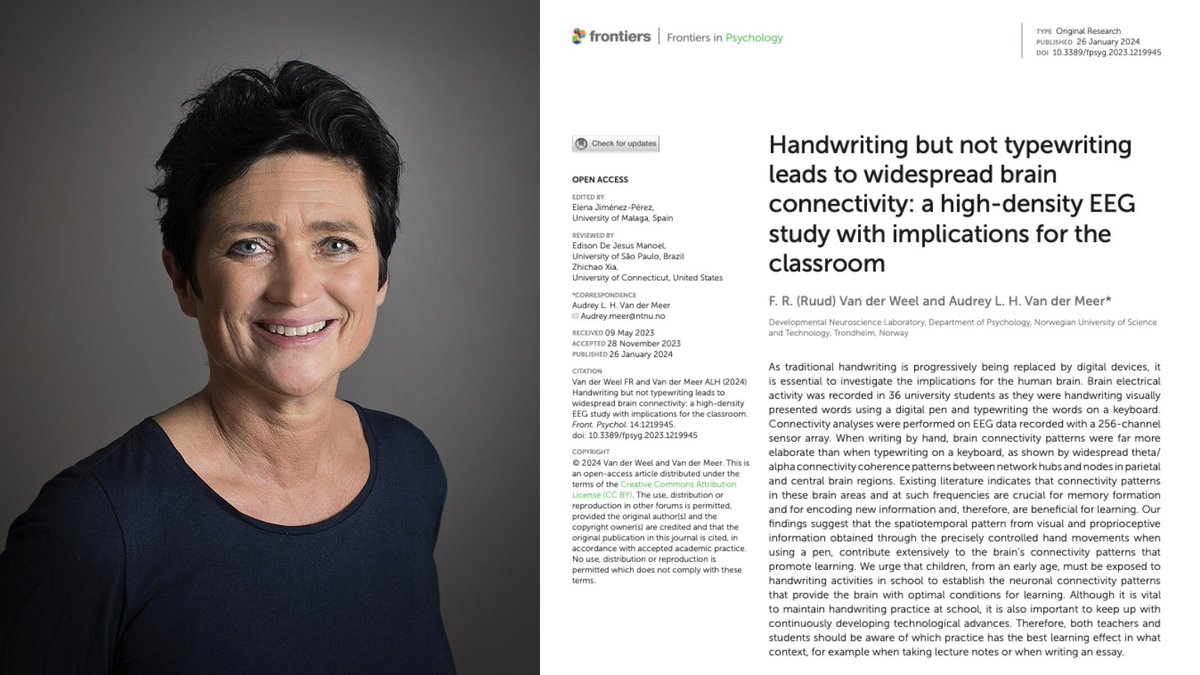
A 2024 paper out of Norway recorded EEG scans of students writing words by hand versus typing them. The handwriting condition lit up the entire learning network. The typing condition produced almost nothing.
Every one of these findings is exactly what Spitzer predicted in 2012.
The most uncomfortable line in his book is the one almost nobody in the German press wanted to print.
He pointed out that the people building these devices were not letting their own children use them. Steve Jobs did not let his kids near an iPad. Bill Gates capped his children's screen time at 30 minutes a day. The senior engineers at Google were sending their kids to Waldorf schools that banned screens entirely.
The people who knew the most about what these products were doing to the developing brain were the ones protecting their own families from them, and almost nobody on the outside was asking why.
The generation he was warning about is now in their twenties.
The first cognitive scans of what we did to them are starting to come back, and the pattern is exactly what he said it would be.
The brain you were born with is not the brain you will die with.
You are training it every day. The only question is which direction.
Bir insan ne kadar zekiyse o kadar çok yardımsever olma eğilimindedir.
Çünkü zeki kişiler, iş birliğinin uzun vadeli toplumsal faydalarını daha iyi görebilirler.
Your brain keeps a folder of cringe memories from a decade ago and opens it at random around 2am. This is survival software running on autopilot, written for a world where forgetting your last mistake could get you killed.
Psychologists call it the negativity bias. In 2001, a psychologist named Roy Baumeister read through hundreds of studies and saw the same pattern repeat everywhere. Bad gets remembered better than good. It hits harder and lingers longer than the good ever does. In studies of marriages, only the negative parts of how couples treat each other predict divorce. The positive parts barely matter.
The mechanism is chemical. When something bad happens, your body releases two chemicals you've probably heard of: cortisol and adrenaline. Picture them as a "this matters, file in red ink" signal. They flood the amygdala, a small almond-shaped part of your brain that works like a smoke alarm. The amygdala then tells your hippocampus, the brain's memory printing press, to print this one in bold. That is why you remember in perfect detail the time you tripped in front of your crush in 7th grade, but cannot remember what you had for lunch last Tuesday.
Then there is the loop. Whenever you stop concentrating on a specific task, your brain switches to a default setting. Scientists call this the Default Mode Network. It runs your inner voice and the "what if I had said this instead" daydreams that show up uninvited at 2am. In people who are depressed, this network gets stuck on a tiny region of the brain that processes sadness, and every memory it dredges up arrives already coated in it. A psychologist named Susan Nolen-Hoeksema spent her career on this. People who fall into these negative replay loops are more likely to develop depression months or years later. The loop predicts the illness.
The body pays too. When you replay a painful memory in first person, asking yourself "why did I do that," your blood pressure climbs and your heart rate stays high for as long as the loop runs. Researchers at Michigan and Berkeley measured this with actual blood pressure cuffs.
The fix is small. It's been tested on hundreds of people. When the memory comes, switch from "I" to your own name. Instead of "why did I do that," try "why did Alex do that." Talk to yourself like a friend giving advice. Brain scans show this switches off the part of your brain that takes things personally. Both distress and blood pressure drop. The loop breaks.
Your brain haunts you because it is running survival code from a world where forgetting your last mistake could get you killed. That world is long gone but the code is still running. Talking to yourself like a friend is the patch.
@ihtesham2005 Handwriting slows the nervous system down enough for emotion to catch up with thought. Typing tends to organize. Writing by hand tends to reveal which allows for emotional integration to unfold naturally.
Grow up watching your parents fight, and by age 12 your brain looks like a soldier's coming home from war. The same alarm circuits keep firing whenever someone gets angry near you. None of these kids were diagnosed with anything. Their brains had already changed.
Scientists at University College London scanned 43 kids in 2011. Twenty had documented family violence at home. When the researchers showed them photos of angry faces, the danger-detection parts of their brains fired exactly like they do in combat soldiers. The kids' brains had quietly learned, before they could put it into words, that anger means danger and danger can come from anywhere in the room.
That study was about violence. But Martin Teicher's lab at Harvard's McLean Hospital has spent decades showing yelling alone does similar damage. Verbal abuse from parents physically changes the parts of the brain that handle language and sound. The long-term hit on adult mental health is about the same as being hit, or watching one of your parents get hit.
And this is common. In 2024, UNICEF estimated 400 million kids under 5, about 6 in 10 globally, regularly face violent discipline at home: yelling, hitting, or both. In a Portuguese study of more than 5,000 ten-year-olds, 57.7% reported a household member regularly shouting or yelling at them. It was the single most common bad thing in their lives.
Teicher's team also found that the brain's memory and stress center physically shrinks by about 6% in young adults who were maltreated as kids. Vietnam combat veterans with chronic PTSD show roughly the same drop, about 8%, in the same area.
The damage doesn't stay in the lab. The CDC's most recent youth survey linked 89% of teen suicide attempts and 85% of teen suicidal thoughts to bad experiences before age 18.
But the same brain that absorbs fear can absorb safety. Romanian orphans moved into stable foster homes recovered real ground. Across decades, Teicher's research has shown that warm, predictable parenting physically builds up the part of the brain that helps a kid stay calm, and quiets the alarm system over time.
A child remembers the fights. They also remember who came back to fix things afterward. Both leave a mark.
A Norwegian neuroscientist spent 20 years proving that the act of writing by hand changes the human brain in ways typing physically cannot, and almost nobody outside her field has read the paper.
Her name is Audrey van der Meer.
She runs a brain research lab in Trondheim, and the paper that closed the argument was published in 2024 in a journal called Frontiers in Psychology. The finding is brutal enough that it should have changed every classroom on Earth.
The experiment was simple. She recruited 36 university students and put each one in a cap with 256 sensors pressed against their scalp to record brain activity. Words flashed on a screen one at a time.
Sometimes the students wrote the word by hand on a touchscreen using a digital pen, and sometimes they typed the same word on a keyboard. Every neural response was recorded for the full five seconds the word stayed on screen.
Then her team looked at the part of the data most researchers had ignored for years, which is how different parts of the brain were communicating with each other during the task.
When the students wrote by hand, the brain lit up everywhere at once.
The regions responsible for memory, sensory integration, and the encoding of new information were all firing together in a coordinated pattern that spread across the entire cortex. The whole network was awake and connected.
When the same students typed the same word, that pattern collapsed almost completely.
Most of the brain went quiet, and the connections between regions that had been alive seconds earlier were nowhere to be found on the EEG.
Same word, same brain, same person, and two completely different neurological events.
The reason turned out to be something nobody had really paid attention to before her work. Writing by hand is not one motion but a sequence of thousands of tiny micro-movements coordinated with your eyes in real time, where each letter is a different shape that requires the brain to solve a slightly different spatial problem.
Your fingers, wrist, vision, and the parts of your brain that track position in space are all working together to produce one letter, then the next, then the next.
Typing throws all of that away. Every key on a keyboard requires the exact same finger motion regardless of which letter you are pressing, which means the brain has almost nothing to integrate and almost no problem to solve.
Van der Meer said it plainly in her interviews.
Pressing the same key with the same finger over and over does not stimulate the brain in any meaningful way, and she pointed out something that should scare every parent who handed their kid an iPad.
Children who learn to read and write on tablets often cannot tell letters like b and d apart, because they have never physically felt with their bodies what it takes to actually produce those letters on a page.
A decade before her, two researchers at Princeton ran the same fight using a completely different method and ended up at the same answer. Pam Mueller and Daniel Oppenheimer tested 327 students across three experiments, where half took notes on laptops with the internet disabled and half took notes by hand, before testing everyone on what they actually understood from the lectures they had watched.
The handwriting group won by a wide margin on every question that required real understanding rather than surface recall.
The reason was hiding in the transcripts of what the two groups had actually written down.
The laptop students typed almost word for word, capturing more total content but processing almost none of it as they went, while the handwriting students physically could not write fast enough to transcribe a lecture in real time, which forced them to listen carefully, decide what actually mattered, and put it in their own words on the page.
That single act of choosing what to keep was the learning itself, and the keyboard had quietly skipped the choosing and skipped the learning along with it.
Two studies. Two countries. Same answer.
Handwriting makes the brain work. Typing lets it coast.
Every note you have ever typed instead of written went into your brain through a thinner pipe. Every meeting, every book highlight, every idea you captured on your phone instead of on paper was processed at half depth.
You did not forget those things because your memory is bad. You forgot them because typing never woke the part of the brain that would have made them stick.
The fix is the thing your grandmother already knew.
Pick up a pen. Write the thing down. The slower road is the faster one.
A psychologist at the University of North Carolina spent 20 years proving that a single 20-second hug rewires the human cardiovascular system, and the experiment she ran is so simple you can replicate it tonight at home.
Her name is Karen Grewen.
She works inside the UNC School of Medicine's Department of Psychiatry. The paper that made her famous was published in 2003, and almost nobody outside her field has read it.
Here is what she actually did.
She recruited 183 healthy adults living with a long-term partner. She split them into two groups. The warm contact group sat together for 10 minutes holding hands while watching a romantic video. Then they stood up and hugged each other for exactly 20 seconds.
The control group sat alone in a separate room for the same amount of time doing nothing.
Then she made every single one of them give a public speech in front of a panel.
Public speaking is one of the cleanest stressors in psychology. Heart rate spikes. Blood pressure climbs. Cortisol floods the system within minutes. It is the laboratory version of every stressful moment you have ever had at work.
The people who had been hugged for 20 seconds before walking into that room had measurably lower blood pressure responses to the stress. Lower systolic. Lower diastolic. Lower heart rate increases. Everything was the same.. the speech, the panel, and fear. But this time completely different physiological response.
The hug had not made the stress disappear. It had changed how the body was allowed to respond to it.
Two years later Grewen ran the follow-up study that explained why. She drew blood from 38 couples before and after the same warm contact protocol and measured what was actually changing inside them. The answer was a hormone called oxytocin.
Oxytocin is the chemical your body releases during childbirth, breastfeeding, and orgasm. It is the same molecule that makes a mother feel calm holding her newborn.
Grewen's data showed that 20 seconds of physical contact with a trusted partner triggered a measurable spike in plasma oxytocin in both men and women, and the size of that spike directly predicted how much their blood pressure dropped.
The mechanism turned out to be older than recorded history. Oxytocin binds to receptors in your heart, your blood vessels, and the part of your brainstem that controls how aggressively your nervous system reacts to threat.
When the hormone shows up, the entire fight-or-flight machine downshifts. Your blood vessels widen. Your heart slows. Your cortisol production gets suppressed.
This is not a feeling. This is a chemical instruction your body sends to itself that you can measure with a blood pressure cuff.
The detail Grewen kept emphasizing in her interviews was the duration. Three seconds is the average length of a hug between two humans. It is too short.
The hormonal cascade does not have time to start. 20 seconds is the threshold where the oxytocin actually crosses into the bloodstream in a quantity large enough to do something measurable.
A follow-up study tracked 59 premenopausal women over time and found that the ones who hugged their partners most frequently had lower resting blood pressure and higher baseline oxytocin levels than the ones who did not. The effect compounded. Daily hugs produced a permanent shift in the cardiovascular baseline.
A separate review of long-term partner contact research found that married adults with frequent affectionate touch had significantly lower rates of heart disease and all-cause mortality than equally healthy adults without it.
The American Heart Association now cites this body of research when explaining why social isolation is treated as a cardiovascular risk factor on the same level as smoking.
The most haunting line in Grewen's research is one she said in an interview after publishing the second paper. She pointed out that the average American touches another human being less than they did 50 years ago. Phones replaced eye contact. Texts replaced visits. Hugs at the door got shorter.
The thing that used to regulate our cardiovascular system multiple times a day quietly disappeared from most adult lives.
Your body still expects it. The hormone receptors are still there waiting. The system was designed to be reset by physical contact with people who feel safe, and the reset takes 20 seconds.
You can run the experiment yourself tonight. Hug someone you love for 20 full seconds. Count it out. The first 10 will feel awkward. Around 15 something shifts. By 20 the shoulders drop, the breathing slows, the chest opens.
That is not in your head. That is your bloodstream changing.
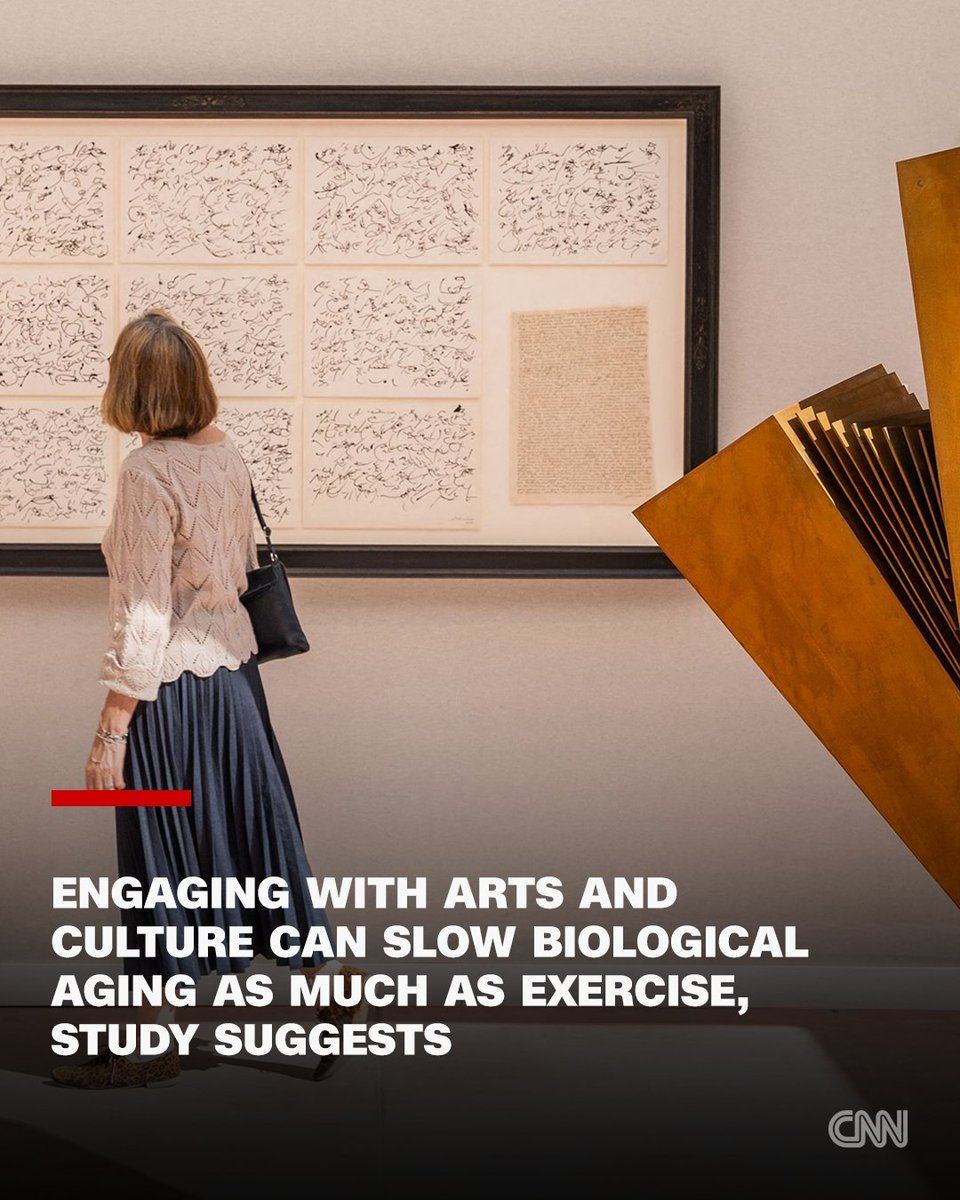
When it comes to slowing down our biological aging, engaging with arts and culture is as beneficial as physical activity, a new study suggests. https://t.co/fimaVcoDd1