@cbokhove@helenrey Yes. There are better studies available for promoting the effectiveness of the DI model. PFT is more useful for illustrating some of the issues with identifying the effectiveness of models generally.
@helenrey@cbokhove The chart below provides a pretty clear picture of how ineffective the components of Follow Through were at closing the achievement gap:
@gorge_lilley@Onderwijsbanaan Yes. The independent national evaluation needs to be considered. None of the approaches used in Follow Through succeeded more times than they failed to close the achievement gap. See chart below:
@gorge_lilley@C_Hendrick People who receive five weeks of training about identifying something turned out to be substantially better at identifying it than people who didn't receive the training. Wow!
The effect appears to be .01 SD. That's basically zero. Well within what we'd expect from methodological noise. This does not support phone bans.
Incredibly low standards prevail when people want something to be true.
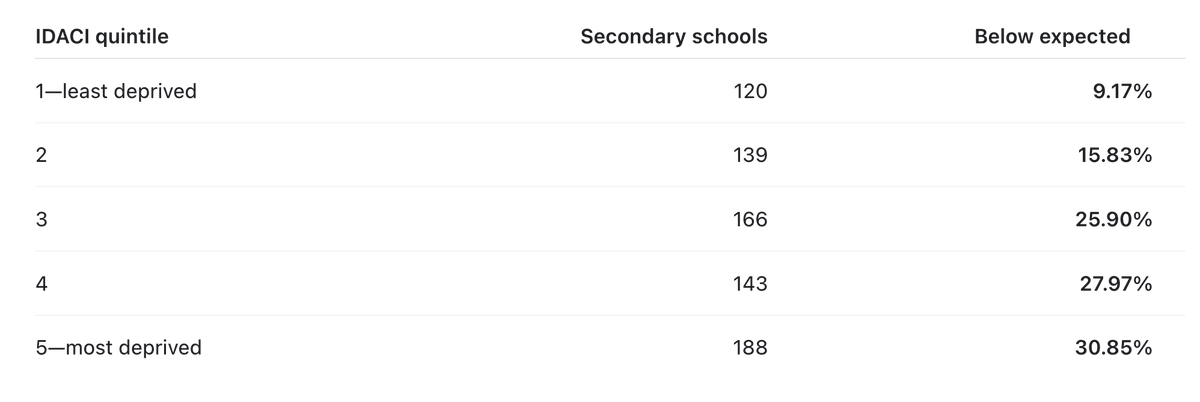
With more than 3,600 schools now graded, deprivation and geography remain strongly associated with Ofsted’s curriculum-and-teaching judgements; the question is no longer whether the pattern exists, but what Ofsted believes is causing it.
Schools in the most-deprived quintile were therefore 1.8 times as likely to receive a below-expected curriculum-and-teaching judgement...
@FrankWNorris@TPLTD
@Rpelufc If Ofsted wants inspectors to use their experience and expertise to report on what they find when they visit schools then there needs to be greater clarity on what is meant by 'consistency'. See below: https://t.co/6vSJ15xjq3
Ofsted needs to scrap the secure fit approach to grading. “The secure fit – in which schools must meet every criterion within an evaluation area to be awarded that grade by Ofsted – is leading to an "entirely data-driven approach, Ms Powell also told MPs.” https://t.co/x6ik3r73eB
The SoS acknowledges there are currently problems with Ofsted. These problems must emanate from somewhere. If the leadership of Ofsted is currently not a concern, then from where do the problems arise given Ofsted has designed and implemented the 'renewed' current framework?
I have to disagree with @LucyMPowell comments at the Education Select Committee on Ofsted's current problems, being 'no one's fault'. The new Framework was introduced to address previous serious weaknesses in both its construction and implementation. Faults lie with leadership.
@zanekhanerman If you haven't seen it before a professional association's review of Ofsted's review of research on teaching mathematics wasn't particularly complimentary. See link below for a brief summary: https://t.co/F6G0tX1gy8
The recent excellent and insightful article from Adrian Lyons in @tes called '2005 reforms were meant to fix Ofsted - now they're the cause of inspection concerns'. encouraged me to reflect on events around that time when Ofsted grew rapidly. https://t.co/LkgZhKDCge
@jonmedeiros@mathillustrated@SciInTheMaking@mpershan Is some of this going on here? The only people who know anything about teaching are people who currently work as teachers? Does it matter whether Ralph teaches in a public school?
https://t.co/Wob6NFc01j
@Isegoria The podcast does not present all the findings from the official independent analysis. EG, only 6/16 DI sites reached national norms in reading, 7/16 in mathematics, and 6/16 in spelling. https://t.co/5eEGZSwvT3
New: An alternative interim report on school inspection
https://t.co/8k9Wg2Hh42
Former HMIs Colin Richards and Frank Norris analyse the independent report, commissioned by Ofsted, which had sought to set out providers’ views on the recently-reformed system.
@Yorkshire_Steve “Similar schools coming into play in inspector thinking?” Ever optimistic Steve. Ofsted have made it clear that inspectors have been taking context into account and the similar schools data has made no difference to inspector judgements.