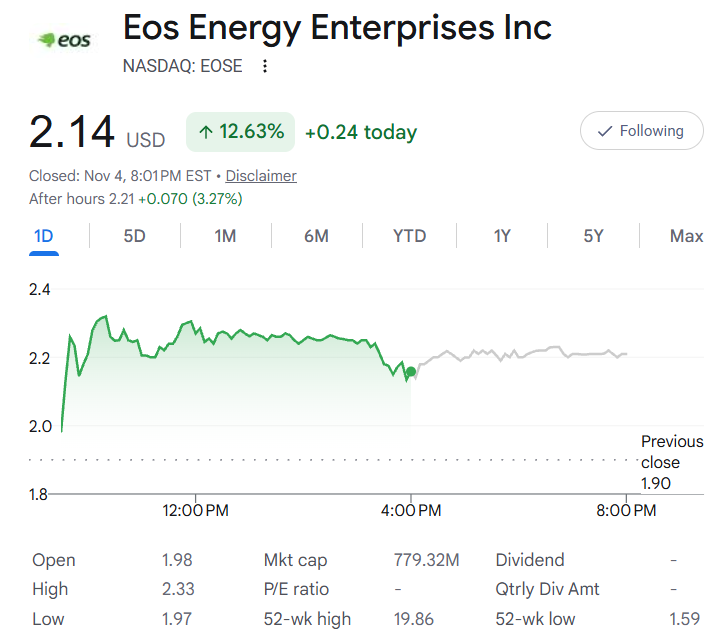
$EOSE
FlexGen Power Systems announced it will serve as the integrator of MN8 Energy’s Mammoth Solar project in Kanawha, West Virginia. Owned and operated by MN8, the project includes 86MW of utility-scale solar, 70MW/280MWh of lithium-ion storage, and 10MW/100MWh of Eos Energy (EOSE) Enterprises’ Eos Z3 zinc-based storage operating as a single dispatchable resource.
https://t.co/xcjmKChRQF
Unpopular opinion!
To all Tesla fans and Cybertruck owners who are wholeheartedly defending Elon’s decision to discontinue the Cybertruck:
I’m a huge Tesla supporter, shareholder, and Cybertruck owner. My Cyberbeast is the best vehicle I’ve ever owned. I strongly believe in Tesla’s future, FSD, Optimus, and Cybercab. But that doesn’t mean I have to blindly agree with every decision Elon makes.
The argument that Tesla needs the Cybertruck production space and experienced workers to ramp up Cybercab production is understandable. But why are we pretending these are mutually exclusive goals?
Tesla has the land, capital, engineering talent, and manufacturing expertise to build additional production facilities. If the goal is eventually to produce 2 million Cybercabs annually, Tesla will need significantly more manufacturing capacity anyway.
But here’s what bothers me even more: Elon is effectively conceding America’s biggest vehicle segment, and one of its largest consumers of fossil fuels, to ICE manufacturers.
Think about that for a moment. Pickup trucks are deeply embedded in American culture and are essential working vehicles for millions of Americans. They aren’t going away because robotaxis become popular. If Tesla abandons this segment, Ford, GM, and Ram will happily continue selling millions of gasoline and diesel trucks.
How exactly does that advance Tesla’s mission to accelerate the world’s transition to sustainable energy?
The Cybertruck was Tesla’s opportunity to disrupt one of the most profitable, fuel-consuming, and difficult-to-electrify segments of the American auto industry. Instead of improving the product, lowering costs, and expanding production, Tesla would be walking away from it entirely.
And please don’t tell me Tesla has no choice because it needs the factory space and workers for Cybercab. Tesla has built entire factories in record time. Surely a company capable of revolutionizing autonomous driving, robotics, and AI can figure out how to manufacture two different vehicles simultaneously.
Robotaxis will revolutionize transportation, but millions of Americans will still want to own their vehicles, especially pickup trucks.
Being a loyal Tesla supporter doesn’t mean defending every decision Elon makes. Sometimes loyalty means speaking up when you believe the company is making a serious mistake.
We should be demanding better decisions, not inventing excuses to justify questionable ones.
I support Elon and Tesla’s mission, but abandoning the pickup truck market to gasoline and diesel manufacturers while claiming to accelerate the transition to sustainable energy seems like a massive contradiction to me.
And I refuse to pretend otherwise just because Elon made the decision.
@elonmusk #Cybertruck
@StockSavvyShay Gross margin improved materially as revenue increased, demonstrating real operating leverage. EOSE is moving in the right direction on manufacturing economics.
EOS ENERGY $EOSE — REVENUE +171%, GROSS MARGINS IMPROVE 58 POINTS. BUT PROFITABILITY REMAINS THE REAL TEST.
Eos Energy delivered another quarter of rapid growth, with record revenue, improving manufacturing efficiency and expanding demand for its zinc-based long-duration energy storage technology.
I'm bullish on the long-term opportunity, particularly as AI data centres and electricity grids increasingly need reliable power beyond conventional short-duration batteries.
But the financials show why execution matters just as much as demand.
THE NUMBERS
🔹 Revenue: $82.7M (+171% YoY, +20% QoQ)
🔹 GAAP gross margin: −53% vs −111% LY
🔹 Adjusted gross margin: −44%
🔹 Gross loss: $44.2M vs $33.9M LY
🔹 Adjusted EBITDA: −$63.8M vs −$71.4M Q2
🔹 Adjusted EBITDA margin: −77%
🔹 GAAP net income attributable to shareholders: $125M, primarily from noncash valuation gains
🔹 Cube shipments: +216% YoY, +23% QoQ
The margin improvement is significant, marking the eighth consecutive quarter of progress.
But gross margins remain deeply negative. Higher revenue is helping manufacturing efficiency, yet Eos still needs a substantial reduction in production costs to achieve sustainable profitability.
FY2026 GUIDANCE
🔹 Revenue: $300M–$350M (range maintained)
🔹 Management expects results in the lower half of the range
🔹 Nine-month revenue: $208.5M
That implies approximately $91.5M–$116.5M of Q4 revenue to finish between $300M and $325M.
Management's decision to consolidate production into Thorn Hill will temporarily constrain manufacturing capacity and affect shipment timing.
BACKLOG AND COMMERCIAL DEMAND
🔹 Backlog: $765M, representing 3.2GWh
🔹 Backlog growth: +19% YoY, −5% QoQ
🔹 Commercial opportunity pipeline: $24.9B
🔹 Six orders booked during Q3
🔹 Google/MN8 Energy project: 10MW/100MWh
The Google-related project is particularly interesting.
As data centres expand, long-duration storage could become increasingly valuable for managing electricity demand, integrating renewable generation and improving grid reliability.
Eos's zinc-based technology offers an alternative to conventional lithium-ion systems for longer-duration applications.
But I wouldn't confuse a $24.9B commercial pipeline with contracted revenue.
The backlog is $765M, and even that must still be manufactured, delivered and converted into cash.
WHAT'S CHANGING
Eos is accelerating the consolidation of its manufacturing operations into Thorn Hill.
Line 2 contributed approximately 17% of battery production during Q3, compared with roughly 1% in Q2.
Its first-pass manufacturing yield reached parity with Line 1 within three months, while output per shift was approximately 20% higher.
Thorn Hill began 24-hour operations in October.
Following consolidation, management expects approximately 4GWh of annual nameplate production capacity across two lines.
I see this as a critical development.
Eos doesn't simply need more orders. It needs a manufacturing operation capable of delivering those orders at positive margins.
However, Line 1 is not expected to restart until near the end of Q1 2027, creating near-term execution risk.
CASH FLOW AND FINANCING
🔹 Cash including restricted cash: $344.1M
🔹 Nine-month operating cash outflow: $261.6M vs $160.9M LY
🔹 Nine-month investing cash outflow: $219.0M
🔹 DOE loan advance received: $87M
The financing position deserves attention.
Eos is scaling a capital-intensive manufacturing business while continuing to consume substantial cash.
The DOE financing provides support for capacity expansion, but it also creates repayment obligations.
And although quarterly cash benefited from customer deposits and milestone payments, those inflows shouldn't be confused with sustainable positive operating cash flow.
MY TAKE
I'm bullish on the long-term opportunity for Eos, but cautious about the pace and cost of execution.
The 171% revenue growth, 58-point gross margin improvement and expanding data centre opportunities are encouraging.
But negative 53% gross margins show how far the business still has to go.
The investment thesis depends on three things:
Scaling manufacturing without sacrificing quality or delivery schedules.
Turning backlog into revenue at increasingly attractive margins.
Reaching positive operating cash flow without excessive financing costs or shareholder dilution.
WHAT MATTERS NEXT
Can Eos turn its expanding manufacturing capacity and growing demand into positive gross margins during 2027?
That's the milestone I'm watching.
The demand opportunity is real. Manufacturing progress is encouraging. But the next stage must be about unit economics, cash conversion and shareholder returns.
$EOSE revenue just went up 171% in ONE year, and they’re building batteries for Google’s data centers 🚨
Q3 2026:
- Record revenue $82.7M (+171% YoY, +20% QoQ)
- Cube shipments +216%
- Gross margin −53% (from −111%)
- 8th straight quarter of margin improvement
- Line 2 already at ~20% higher output per shift than Line 1
- Backlog $765M, pipeline $24.9B
- 100 MWh zinc storage project serving Google data centers
Still burning cash, but the trend is moving fast.
Turning point for zinc batteries? 👇
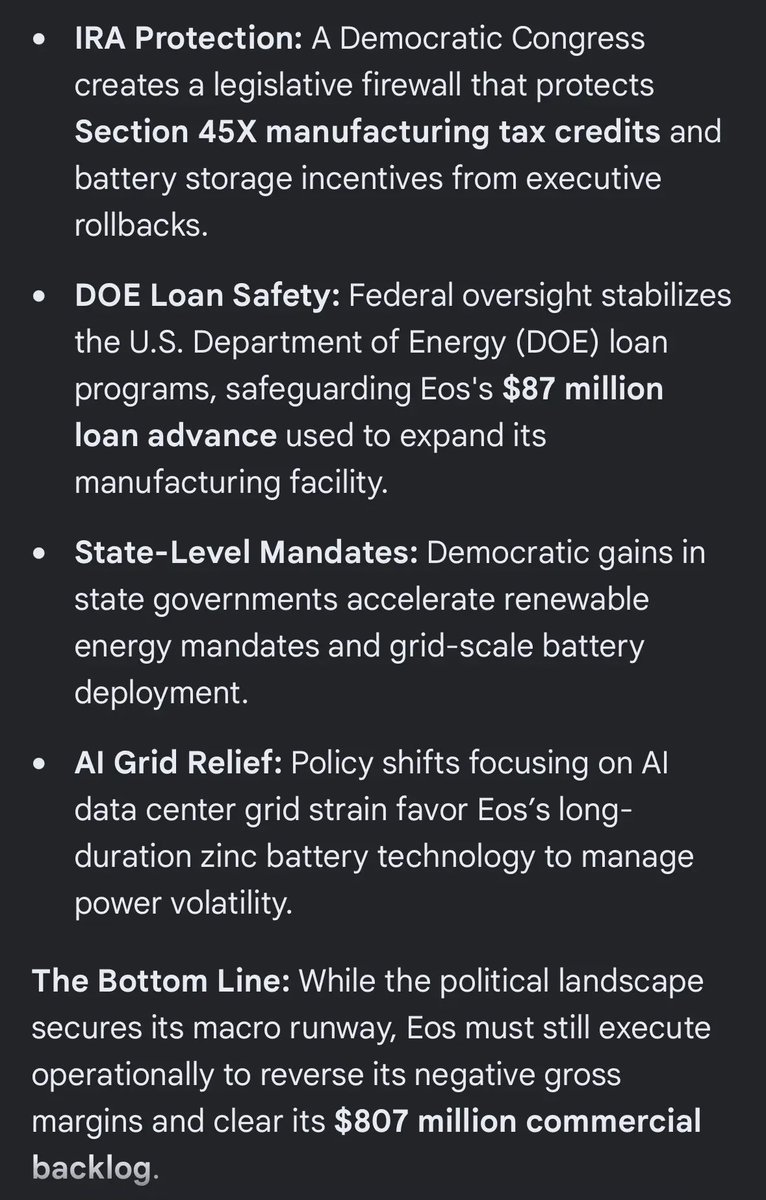
THE BIGGEST WINNER OF THE MIDTERMS COULD BE $EOSE
I think the most important thing investors are overlooking about Eos following the November 3 midterms is that the real opportunity has much less to do with Democrats winning control of Congress and far more to do with a fundamental change in who is expected to pay for the electricity infrastructure supporting the AI economy.
Democratic control of Congress should reduce the risk of further legislative cuts to existing Section 45X manufacturing and Section 48E storage incentives, although those credits remain subject to eligibility requirements and President Trump still has veto authority, which is why I think the more meaningful development is happening at the state level.
Texas had already begun restricting new data center interconnections and environmental permits under Greg Abbott, while Gina Hinojosa's victory introduces the possibility of a longer moratorium and greater local control over future development.
What interests me is that both political parties have increasingly arrived at the same underlying conclusion, which is that communities should not have to absorb the electricity and infrastructure costs of supporting enormous AI campuses, effectively shifting more of the responsibility for securing reliable power onto the developers themselves.
That changes the economics of data center construction because electricity is no longer simply something a developer purchases after building a facility, but increasingly something it must secure, finance and potentially generate before that facility becomes commercially viable, although a broader permitting moratorium could still delay projects regardless of how independently they are powered.
This is where I think Eos could become considerably more important than the market currently appreciates because making data centers responsible for their own power creates demand for an entire electrical system rather than generation equipment alone.
A gas turbine can provide continuous electricity and solar can reduce fuel consumption, but neither eliminates the need to manage sudden changes in AI workloads, periods of excess generation or interruptions that could leave extremely expensive computing infrastructure sitting idle, which is why storage becomes valuable when it allows developers to use generating assets more efficiently while maintaining greater control over power availability.
The distinction is that batteries do not create electricity and cannot independently sustain a data center through an extended outage, so their economic value depends on how intelligently they are integrated with generation and whether the resulting savings in fuel, infrastructure costs and downtime exceed the cost of the storage system itself.
That is why I find Eos's zinc technology particularly interesting for applications requiring eight or more hours of storage, especially given its nonflammable chemistry and domestic supply chain, although its roughly 78% demonstrated round trip efficiency means it must overcome an energy efficiency disadvantage relative to conventional lithium systems through better lifetime economics, safety or longer discharge duration.
The planned Google and MN8 project illustrates that opportunity particularly well because it combines ten hours of Eos zinc storage with four hours of lithium storage and solar generation to support the PJM grid, demonstrating how these technologies can complement one another rather than compete for every application while the TURBINE-X agreement targeting integrated gas generation and up to 2 GWh of Eos storage brings that same architecture closer to the independent power systems AI developers may increasingly require, even though those targeted deployments are not yet binding production orders.
What gives me conviction that this opportunity could become financially meaningful is that Eos is already seeing the shift appear in its commercial activity, with management indicating that approximately 32% of its $24.6 billion opportunity pipeline is connected to data centers and supporting infrastructure, representing roughly $7.9 billion in potential projects before considering how quickly the regulatory environment is changing.
However I think it is critical to separate that pipeline from the approximately $765 million of preliminary September backlog because even contracted projects can experience financing and construction delays, while a large pipeline tells us relatively little about future profitability until customers actually commit capital and equipment is delivered.
This is why Frontier Power USA could become such an important part of the business model, with approximately $263 million raised to support a platform targeting more than $1 billion of project investment capacity, because access to development financing can help convert qualified projects into real orders, although Eos holds a minority interest in the venture and its financing arrangements introduce concentration, dilution and related party risks that investors should not overlook.
In fact, a single Cerberus financed project accounted for approximately 80% of Eos's second quarter revenue, which is a reminder that financing driven demand is not necessarily the same as diversified customer adoption.
The manufacturing economics are equally important because preliminary third quarter revenue of $82 million to $83 million still came with GAAP gross margins around negative 54%, meaning Eos was spending approximately $154 on cost of revenue for every $100 of sales, so the planned expansion toward roughly 4 GWh of annual production capacity at Thorn Hill only becomes valuable if higher utilization, improved yields, lower material costs and manufacturing credits fundamentally improve those unit economics.
Its Golden Dome defense award provides another potential source of credibility, but neither that award nor its approximately $344 million cash balance, which includes restricted cash and has been supported by customer deposits, tax credit collections and DOE loan advances, should be mistaken for evidence that the underlying business has become self sustaining.
This is why I believe the midterms may have provided Eos with the catalyst its turnaround needed, although I view the election as something that could accelerate an existing structural opportunity rather than an event that suddenly makes the company profitable.
The fundamental change I am watching is that as AI infrastructure becomes increasingly constrained by the availability of electricity, developers will have stronger incentives to invest in systems that provide dependable power on commercially acceptable timelines and I think Eos has a credible opportunity to become an important supplier within that emerging infrastructure architecture if its longer duration zinc technology can deliver an attractive total cost of ownership.
What I need to see now is the commercial conversion of that opportunity through binding data center orders, financed projects progressing into construction, actual deployments under relationships such as TURBINE-X and MN8, and independent evidence that Eos can deliver the reliability and performance customers require at a competitive price.
Equally important, I want to see Thorn Hill translate higher production volumes into positive GAAP gross margins and eventually recurring operating cash flow that does not depend on customer advances, government credit collections or additional borrowing, because a company can participate in an enormous market and still destroy shareholder value if it cannot manufacture its products profitably.
My conviction ultimately comes from the belief that reliable electricity is becoming just as strategically important to the AI economy as the computing infrastructure consuming it, and if Eos can turn that changing relationship into repeat customer deployments, improving unit economics and sustainable cash generation, I think its long term opportunity could be significantly larger than what investors currently associate with a struggling battery manufacturer, but the real validation will come from the business becoming economically stronger rather than simply the market becoming more enthusiastic about its story.
They’re in a quiet period and aren’t going to say sh t to you or anyone. If your claims were true they would have been material enough to be in an 8K or 10Q furthermore the bromine TTI guidance and felt would be totally misaligned as unmatched sets which they aren’t. You have good intentions yet have fallen into the same trap as many microanalyzing a company on an hourly basis that has 14-18mo interconnection queue times and thinking that time in between is literally the worst possible scenario about everything. Also equating stock price to fundamentals when most of small cap energy have been equivalently thrashed. There’s nothing wrong with questioning an investment. but to think that they raised capital in July and November the prior year and didn’t disclose any of this is pretty naive or criminal… they released their head of sales for a reason. He wasn’t closing deals. Their comms have gone to total sh t. Last year they were on TV really pushing. The whole thesis from here is closing deals and getting ramped into profitability. One guess is they have multiple hyperscaler deals in final phases on qualification prior to announcing and NYSERDA in Q4. They’re valued at their backlog which is about 4-5 quarters long unmitigated . After a 10x draw down the upside downside risk is skewed favorably. Go have a cocktail or gummie, chill
$EOSE
"That (aqueous) zink-bromine chemistry is the point. The batteries are nonflammable."
Engineers in Alabama overcharged them by roughly 300% to try to provoke a thermal event, then put a live flame to them. They would not ignite.
The plastic smoked, then melted, and the electrolyte that spilled out extinguished anything that might have caught fire.
"So it’s like self-extinguishing,” @AlexFitzDC said.
♻️🌳🔋💦
In this very short video you see a tease of America's domestic battery manufacturing jewel!
$eose was busting out of the seams a year ago, so they leased this spacious building.
The equipment you see looks large, but in 3 months they will double the amount of equipment in the building as they continue their move in!
In just 3 more short months Eos will have one of the most state-of-the-art manufacturing facilities in the US of A!
$EOSE
Some things I've learned this week.
Over the past several months, there have been significant efforts iterating on DawnOS, wiring, and the electronics. I guess we knew all that, but stay with me for the actual new info.
The battery module (the gray, plastic tub) hasn't really changed. There have been quality issues with dividers, etc., but those are fixable with improved tooling, processes, attention to detail, and QA/QC.
But both things - the hardware and the software / electronics - were deficient to varying degrees in previous systems. The software / electronics should not be understated.
I have had a longstanding theory, which I've posted numerous times about, that all cubes produced on the semi-automated line were junk. That opinion has been reinforced with indefinitely postponed hot commissioning, evidence of those customers receiving newer equipment, and overseas shipments (e.g. Italy) sending their cubes back.
First piece of information I learned this week - basically all containers made by CMP, or so-called "ILC-A" generation (includes those on semi-automated line, and some on sorta-automated line in early days of 2024) were basically deficient.
We also know that all those legacy systems installed in the field are being upgraded to DawnOS. This not only involves software upgrades, the but electrical wiring. And there were 3 different configurations that need different types of updates, depending on the vintage of the cube.
The quality culture of Eos in the 2024 time period really, really sucked. But, I guess we knew that.
Second piece of information I learned this week (pay attention!), is that there is a third generation circuit board that's been developed. Joe explained some of this on recent earnings call. They started with a circuit board used by Li-ion system, but it wasn't adequate for their bipolar system. They designed a custom circuit board to solve the problem. And there's a third one coming (en masse by EOY) affectionately called the New New Board. I presume the prototype for this has been in testing on smaller systems for some time, and the mass production will follow.
As management has said, all those legacy Z3 systems are being upgraded in the field: DawnOS updates, re-wiring, maybe whole new cubes, and apparently new circuit boards coming in larger numbers by EOY. It explains a lot about why hot commissioning for many of these systems have not been completed. I would describe this whole situation as an insanely expensive R&D program that was also paid for with a premium (Viejas batteries were $386/kWh). Nevertheless, all parties paid a price and were frustrated along the way. There were complaints about poor and not-credible communication along the way, and it was escalated to highest levels of management. It explains so much about the lack of commercial field data, hot commissioning, etc.
Alessandro's recent cost-out slide quantified this as 20 of the overall 72 point plan. I'm astounded it's that small, but I'll believe him for now. The company still has a lot of work to do to deliver those upgrades, and make some piqued customers whole.
I'll just state the obvious. If the larger public knew about these issues last year, the company never would have raised the capital they did. Most battery companies fail. "Fake it till you make it" apparently worked for them. They were extremely lucky to have us as cheerleaders, who believed the DOE actually fully vetted all this and don't take risks on technical issues. I personally know they do now, and aren't all that at vetting.
But, that was then, this is now. I am really hopeful these basic issues have been resolved technically. I think there are smaller systems demonstrating it, and companies like Google and Talen and the DOE cutting another $87m check would have never signed on without seeing real performance data.
Eos is turning over a new leaf with the move to Thornhill and the formation of FPUSA that can provide them predictable backlog. Thornhill looks really promising. Previous employees have left, and fresh talent has come in. I hope they've solved DawnOS and the electronics by now. I'm giving them one final chance to see it through.
I would very much welcome the company correcting me on any of this. It's possible I misinterpreted some of the info I have. But I do have some hard receipts obtained through proper channels for how I came to these conclusions, in case you're interested in getting into any discussion about it.
Hope you guys knock it out the park next week on the earnings call.
Your biggest fan,
Bert
$EOSE ☕️
Talking with numerous investors.. the main concern is the dilution it will take to reach profitability… but less & less questioning around IF eos can make it to the other side which is key.. and important to recognize.
After one of the most brutal momo unwinds coupled w the heightened cost of capital many small cap unprofitable clean tech co’s have been taken to the woodshed..
Need to acknowledge the challenging capital env is not idiosyncratic but thematic & broad based.
This is exactly why Eos is emphasizing margins over revs.. the margin bridge is what they need to sell investors on.
To reiterate for the 100th time… this is how I think about the tailwinds to margins + two call options within the company that get glossed over when modelling out..
Cheaper inputs (buying in bulk), faster lines (TH), cheaper installs (Cores), more output.. PLUS two high margin rev/income streams
Supply side- TTI just raised $100M to build the Arkansas Bromine plant.. 75M lbs/yr at Phase one for production in early 28. Domestic Bromine at scale once eos needs more of it. Increased levels of Felt Shipments relative to 2024 & 2025.
Suppliers that add capacity means more secure supply & better leverage on prices.
We are living through this right now imo. And its key bc you cant grow unless your supply base grows with you. -> Lower material cost
The Factory: 8 straight quarters of margin improvement even with TH only at 17% of Q3 production on a partial shift. TH will go live in Q4 as they hire.
L1 in TH will have 10-15% lower conversion cost.. rising automation, more redundancy, and faster cycle times.
I think 2gwh (in time) will prove to be conservative. Eos just needs to demonstrate 2gwh per line is low. Don’t make the cardinal sin of saying it before proving it. We have lived through that before.
With faster cycle times + redundancy.. each line could make 2.5Gwh/yr at just 80% utilization once demand is there/ cost model is solid.
2 lines -> 5Gwh and 4 Lines is 10Gwh.
Same fixed cost over more output means better margins.
Some of the cost pressure today is temporary.
Field commissioning and DawnOS upgrades on installed cubes.. those will roll off as retrofits end.
They aren’t structural for all the folks who look at cogs in a vacuum… which 80% of folks do. 🔑
Why Indensity should win…
Cheaper to build: batteries + controls are pre installed, wiring is built into the frame so its not done in the field, no auxiliary HVAC
Simple install: No crane, forklikft ready telehandler. Push to connect with no fasteners above head height
Better in the field: Each level has 12 cores; so one bad core is <1.5% of a six high system & its swappable. Six high = 500mwh or 12 high is 1gwh
Speed to power is the whole game: If Eos can pull of a 250mwh install within a week it’s a huge validation; but more importantly.. it proves speed to power which is the most critical trait in todays mkt.
Very scarce. Very valuable. Faster energization = faster revs
Field Data: Q2 pointed to 200mwh+ of z3s in the field. CU, Viejas, Lincoln electric.
This data matters a lot for the sharebase bc it’s the same data Eos will use to sell early indensity deployments if I had to guess. Dominoes..
Call option 1: nobody models service revenues. Long term service agreements equate to 20-25% of total project capex cost. So ~25% of ~300/kwh+ all in.
Probably higher than that (300kwh)
So each Gwh earns 3-4M in service revs… So 3.5Gwh shipped in 2027 plus 5-7Gwh in 28 puts 9-11Gwh in field by end of 2028… which will be up to 30-45M/yr in service revs. Add 7-10Gwh in 2029 and its 16-21Gwh live which is ~48-85M/yr at 50% margins.. itll compound with the fleet.
It will take time.. but it will be very accretive
Call option 2: FPUSA
~263M committed expected to deploy $1B into projects with 1.8Gwh under construction or near NTP.
Eos owns 36% so operating projects send cash back to Eos below the line.