An organisation tasked to inculcate the principles of our culture and values by promoting language, history, cultural studies, and political education.
Foetus in Foetus
Wo bí ọmọtuntun jòjòló ṣe le gbé ọlẹ̀ míì sínú látinú ìyá rẹ̀, tí ikùn rẹ̀ yóò sì ga bíi olóyún
Airin jina lai ri abuke ọkẹrẹ, bí èèyàn bá rìn jìnnà, yóò rí ibi tí wọn ti ń fi odó ìbúlẹ̀ jẹun.
N jẹ o mọ pe o seese kí ọmọdé jòjòló gbe oyún sínú láti inú ìyá rẹ?
'Foetus in Fetu' tàbí 'foetus carrying foetus' ni àwọn oloyinbo ń pè irú ìṣẹ̀lẹ̀ yìí èyí tó túmọ̀ sí pé ọlẹ ń gbé inú oyún.
BBC News Yoruba wa se iwadii ohun to n fa ki oyun kan maa gbe ọlẹ miran sinu, ipa rẹ lori ọmọ tuntun ati ohun ti obi le se ti irufẹ isẹlẹ yii ba waye.
GENERAL YORUBA LANGUAGE
How Abeokuta and Lagos Created Standard Yoruba
The Egba-Lagos Revolution The Printing Press (1854-1913)
Language does not become general because it is old. It becomes general because it is printed.
The First Machine: Ake, Abeokuta 1854
On November 1854, Rev. Henry Townsend unpacked a wooden hand-press at Ake, Abeokuta. It was the first printing press in the interior of what is now Nigeria.
Its product, Ìwé Ìròhìn fún Ẹ̀gbá ati Yorùbá (Newspaper for Egba and Yoruba), is the first archaeological site for the Yoruba language.
Before the press, Yorùbá was handwritten in Roman letters with dots. After the press, it had to be cast in lead type.
The CMS printers, led by Saro returnees like Andrew Wilhelm and Joseph Johnson, faced a practical problem:
The Ọ̀yọ́ dialect writes "yẹn" as "yun" [y-u-n with underdot]. The Ifẹ dialect writes it as "yẹni".
The lead type imported from London had no character for Oyo's compressed nasal `un` sound that is neither `an` nor `un`.
In order to print, they made a decision that changed Yoruba history: they leveled it to yen.
Who's that?
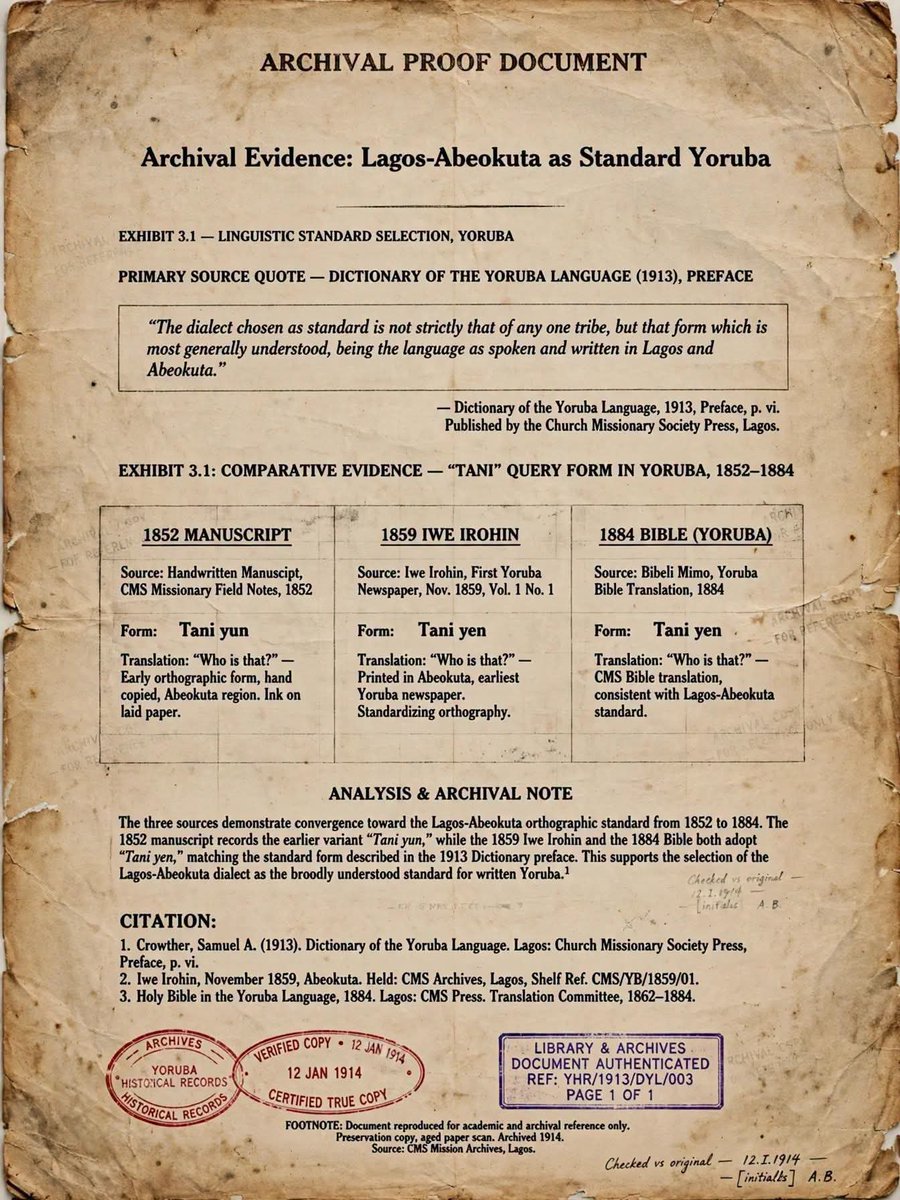
Crowther's manuscript, 1852: Oyo:Tani yun? (handwritten)
Ife:Tani yeni
Standard YORUBA:Tani yen
What is that?
Oyo:Tani yun
Ife:Tani yeni
Yoruba standard:Tani yen
Are you the one?
Oyo:Se iwo nun-un
Ife:Se iwo niyeni
Yoruba proper:Se/she iwo niyen
Iwe Irohin, December 1859, page 3: Tani yen? (printed)
That one letter change from `u` to `e` is the birth of Standard Yoruba. It happened not in Oyo, but in Egba.
The Second Machine: Lagos 1859-1867
In 1859, the press moved its intellectual center to Lagos. Lagos had three advantages Oyo did not have:
1.Port: New type and paper from London
2. Population:Saro, Egba, Ijebu, Oyo, Ilaje living in one street — they needed a common written form
3. Schools:CMS Grammar School Lagos (1859) — the first secondary school — taught reading from printed books, not oral dialect.
The men who edited those books were not Oyo men. They were:
Henry Johnson (Ekiti-Egba)
- E. M. Lijadu (Egba)
- Obadiah Johnson (Saro)
- Edward Blyden (Liberia-Sierra Leone based in Lagos)
All of them spoke Egba or Lagos Yoruba at home, which already says `yen`, not `yun`.
So when they edited Crowther's Bible, they kept his Oyo sentence structure, but replaced his Oyo words with their Lagos-Egba words the Yoruba standard the whole Yoruba is using today.
The Committees That Made It Law
Two committees cemented Abeokuta-Lagos as the general Yoruba:
Yoruba Orthography Committee, Lagos, 1875: Agreed to use `ẹ, ọ, ṣ` with dots, and to write demonstratives as `yẹn, yìí, yì` instead of Oyo `yun, yii, yi`.
Dictionary Committee, Lagos, 1913: Published _Dictionary of the Yoruba Language_ (CMS Bookshop Lagos).
Preface states: _"The dialect chosen as standard is not strictly that of any one tribe, but that form which is most generally understood, being the language as spoken and written in Lagos and Abeokuta."_
That sentence is the archaeological proof you are looking for. Lagos and Abeokuta admitted in 1913 that what they printed became the standard.
Therefore, Standard Yoruba is not "Ọ̀yọ́ language."
it is a grammar printed through an Egba-Lagos machine. Without the Abeokuta-Lagos press, it would never have become general.
There's nothing in Ọ̀yọ́ dialect that makes it general, Ọ̀yọ́ dialect is a very distinct language from Yoruba proper,a lot of differences.
Nobody can use Ọ̀yọ́, Èkìtì, Òndó, Ifẹ, Ìjèṣà, Ìjẹ̀bú to write WAEC in today's Nigeria,they are all local,those who argue we use Ọ̀yọ́ as a general language have not been to Ọ̀yọ́ to hear their language. We deceive ourselves a lot in this part of the world. Ọ̀yọ́ people themselves know that their language is not the language we all speak today.
#highlightseveryonefollowers #yorubaculture
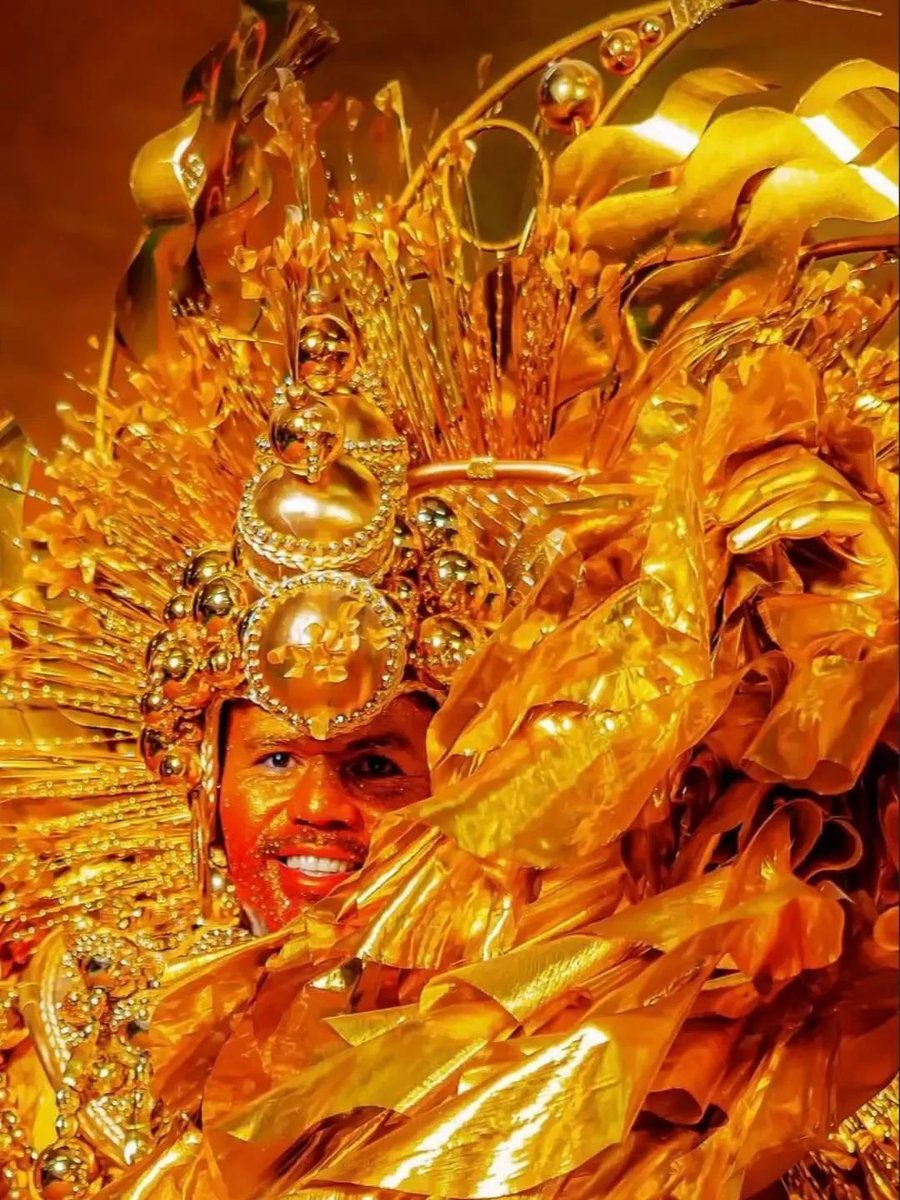
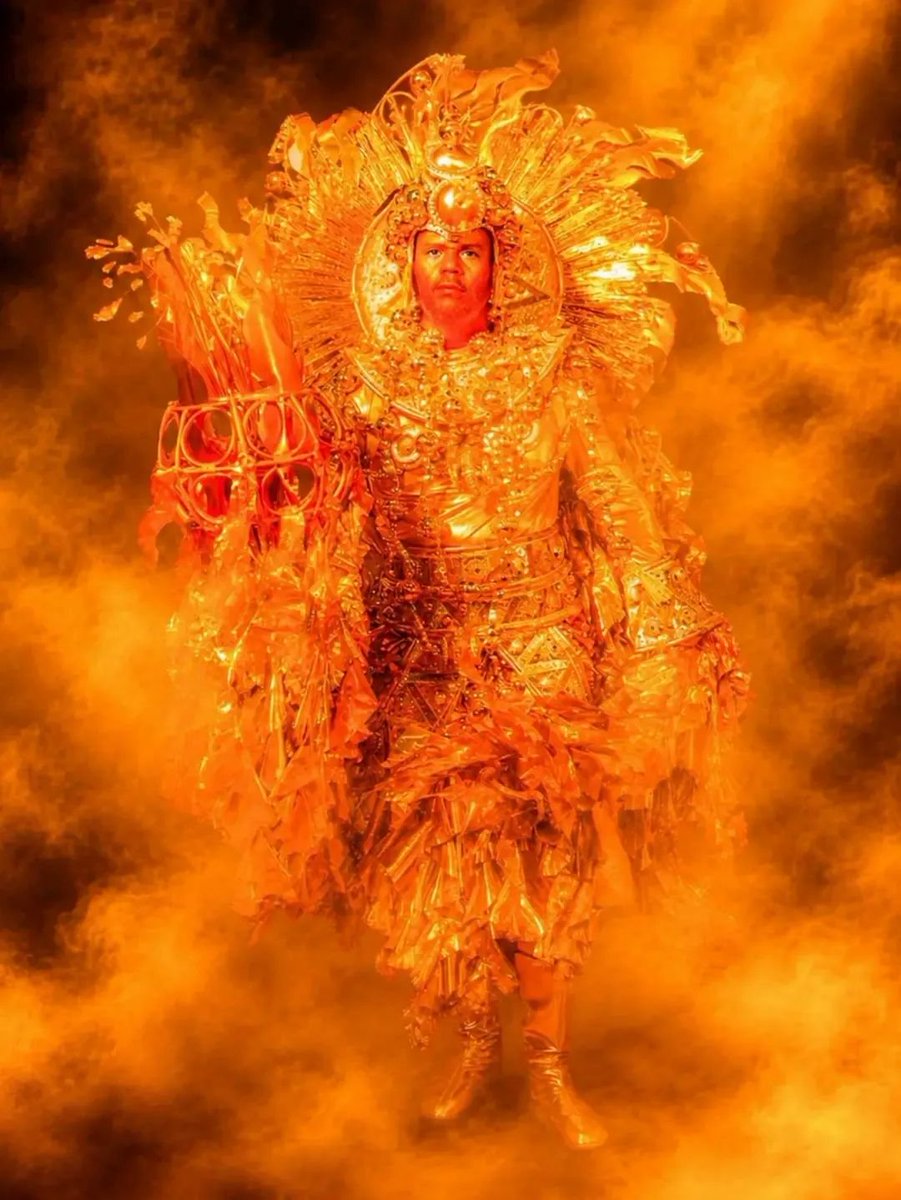
Akara takes centre stage at the 2027 Rio Carnival! 🔥🇧🇷 A taste of Yoruba culture shining on the global stage as Mangueira celebrates this iconic delicacy.
THERE IS A LOTS OF PEOPLE THAT REFUSED TO BELIEVE I'M NOT A YORUBA, THEY'RE CONFUSED I'M AI. ỌMỌ YORUBA NÍ MI OOO! MY DAD IS YORUBA AND MY MOM IS TURKISH
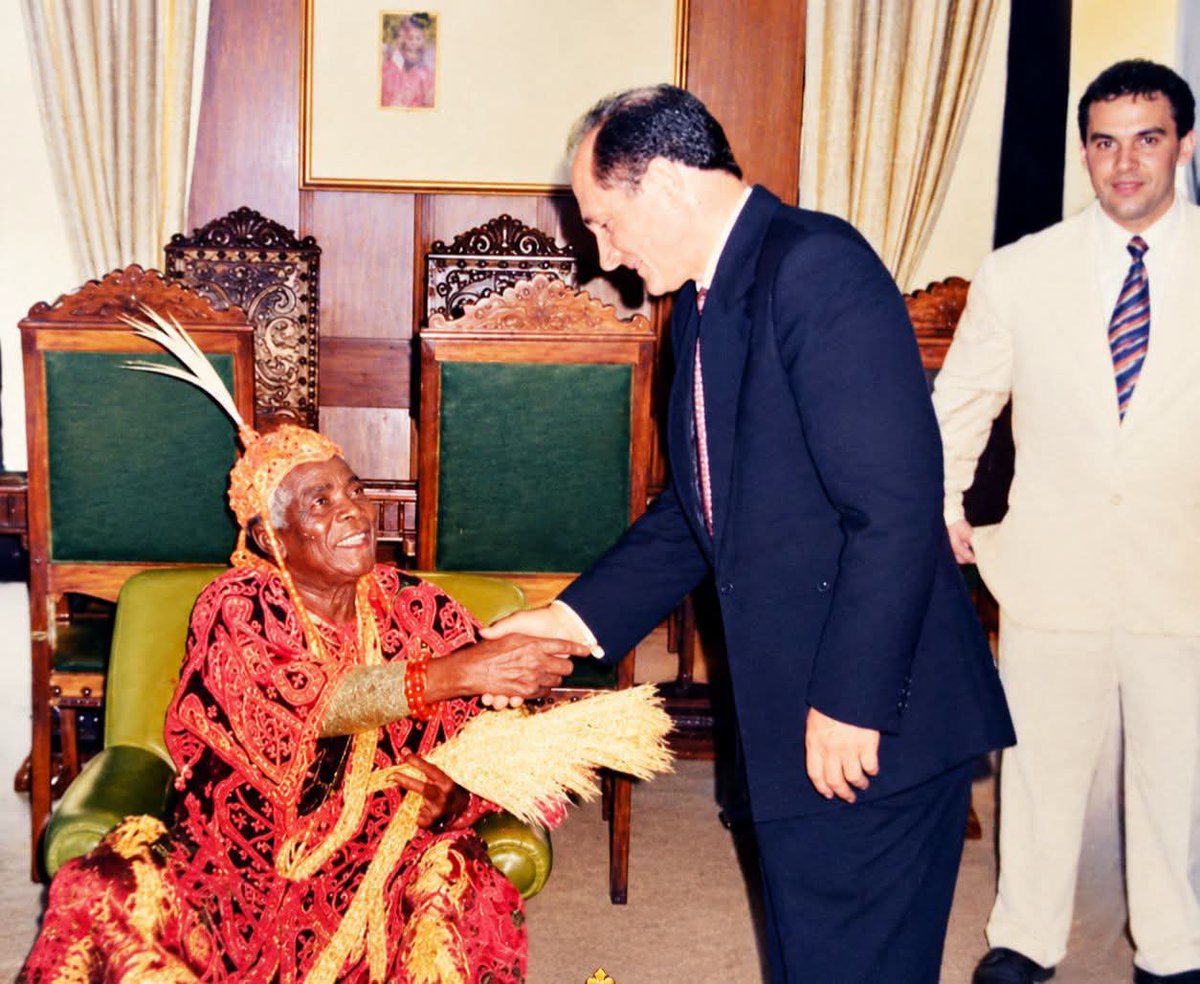
IFỌN PEOPLE, WHO REMEMBERS THIS GREAT OLUFỌN ? HAVE YOU EVER SEEN HIS PICTURE BEFORE?
Today, we bring back a piece of Ifọn Omima's royal history that many of the younger generation may never have heard about.
Meet His Majesty, Ọba David Adegbera Odogiyon, of the Umaugba Ruling House.
He reigned as Olufọn of Ifọn Omima from 1969 to 1996.
Described as a fearless, audacious and powerful traditional ruler, Ọba Adegbera Odogiyon was deeply knowledgeable in our customs and traditions. His reign witnessed peace, development and progress in the history of our kingdom.
The then Kabiyesi, the Olufọn of Ifọn, was a pleasant and powerful King. He was very knowledgeable and coordinated his chiefs effectively. He did not tolerate nonsense and spoke boldly in the committee of Ọbas.
It was during his reign that Ifon witnessed great development. Ifọn got Electricity, a Cooperative Bank, Ifọn Comprehensive Secondary School, and Water supply to Ifọn and other communities like Ikaro and Sobe through the Oruju Water Works, which was effectively managed.
He was a strong believer in Ifọn traditions and heritage. During his time, the yearly Ọbaloro Festival was celebrated with grandeur.
He was a very tall and handsome king, and his traditional regalia symbolized the dignity of the town. Masquerades like Agbuke, Oro (Oloju Gbagodo, Èṣù, Aya Ọba, Oyinbo, etc.) were displayed in their seasons.
One of his greatest attainments was the upgrading of the Olufọnstool to a First-Class Ọba.
He joined his ancestors at a ripe old age.
#IfonOmima #OurRoyalHeritage #HistoryMustBePreserved @egtapere
3 DAYS TO GO. THREE DAYS LEFT.
Have you gotten your tickets?
Have you invited someone?
Who controls the trade routes controls the future?
That was true in Gao and Oyo-Ile, and it is true today.
Join Oladimeji Bolarinwa as he reads today's power struggles through two of Africa's greatest empires.
Three days left. Scan the QR code/click on the link and take your seat.
https://t.co/YtRQ4Ir1nm
@AKakanfo The gathering is destined for this evening 🌙.
We ask that you contemplate your readiness to attend.
The path to registration awaits at:
https://t.co/6MzTudjBJN.
The finger pointing at the moon is not the moon. 🎋
Beyond Scientific Names: Yorùbá Plant Naming, Àṣẹ and the Forgotten System of Classifying Nature
By Olori Asabi Ifaniwura
What if plants were never simply leaves, roots, stems and flowers? What if the names our ancestors gave them were actually carrying an entire system of knowledge about their nature, qualities, functions and relationship with the world?
One of the greatest challenges facing indigenous African knowledge today is not necessarily the absence of knowledge, but the gradual loss of the frameworks through which that knowledge was understood, organised, transmitted and preserved.
For generations, Yorùbá communities developed sophisticated ways of observing, naming, identifying and classifying plants. These practices were not random acts of naming. They emerged from generations of interaction with the environment, careful observation, experimentation, oral transmission and cultural interpretation.
Yet, as Western educational frameworks became dominant, many indigenous ways of understanding the natural world were pushed to the margins. What was once taught through language, observation, apprenticeship, storytelling, Ifá knowledge and traditional practice increasingly became something that was either overlooked or considered inferior to formally recognised scientific knowledge.
This raises an important question: If we can learn to understand nature through Western scientific classification, why should we not also learn to understand nature through our own indigenous systems of knowledge?
Continue reading on Ewé app
https://t.co/B1dG8D2WhB
If someone asks you what Songhai and Oyo have to do with today's world, don't just say "History." 😂
Come and find out!
And trust us, this isn't your usual geopolitics session.
📍 St. Pancras Community Association, London
⏰ 5PM. TONIGHT
https://t.co/wlsn9rbZKP
TONIGHT.
THE BATTLE FOR WEST AFRICA.
At 5pm, we open the conversation on the Songhai, the Oyo, and the power struggles still shaping West Africa.
📍 St. Pancras Community Association, London ⏰ 5pm sharp
ARE YOU READY????
https://t.co/OvFhwZRKLZ
We are absolutely thrilled to announce that we are entering a pivotal new chapter in our collective journey! 🚀
Tomorrow at 5 PM, we have the unique opportunity to reimagine the historical narrative by exploring the strategic parallels between the Songhai & Ọ̀yọ́ Empires and the modern geopolitical landscape of West Africa. 🌍 This is not just a discussion; it is a high-impact synergy session designed to align our sharpest thinking with our core values. 🧠✨
We invite you to bring your most innovative questions and contribute to this mission-driven dialogue. Your participation is key to unlocking new insights and fostering professional growth within our community. 🤝
📍 Location: St. Pancras Community Association, 67 Plender Street, London
🗓 Time: Tomorrow · 5pm
We are leveraging this final call to action to ensure maximum engagement. Please scan the QR code to secure your spot in this transformative experience! 📲
Two days remain until the event. 📅
While textbooks provide historical dates, this session offers insight into underlying patterns. 📚 The discussion addresses fundamental questions regarding the rise and fall of empires, as well as the systems that continue to shape West Africa.
Registration is open, and available seats are limited. Please scan the QR code to register. 🔗
https://t.co/x973PqL5hW