Just 20 years ago, drivers could freely enter and park in Delft’s historic core.
Then a broad coalition narrowly (19 to 18 votes) passed an autoluwe binnenstad (‘low-car city center’) policy.
Now not a single resident or merchant misses the days when cars choked their streets.
In 2007, Zoran Janković, the mayor of Ljubljana, was slapped and mobbed by protesters for proposing to make downtown car-free. It’s been so wildly successful that a recent survey of city residents showed that 97% of residents supported keeping the streets car-free.
Some people think Teslas-in-tunnels are the future of urban mobility.
We think they misdirect attention and resources from simple solutions already proven to address congestion, safety and inequity—problems caused by cars that won’t be fixed by cars.
Rotterdam Centraal Station.
Things about Dutch bike lanes that just make sense…
- joined up from A to B
- secure parking where you need it
- separate, protected lanes (mostly)
- linked to other transport networks
- safe for vulnerable people
Pls feel free to add to non-exhaustive list in comments ✌🏽
When a 26-year-old Deputy Mayor proposed a 1977 plan that made the centre of Groningen virtually impenetrable by car, his party was the subject of outrage, protests and death threats.
Decades later, no one regrets the change or remembers the controversy.
https://t.co/lOoPbOE84B
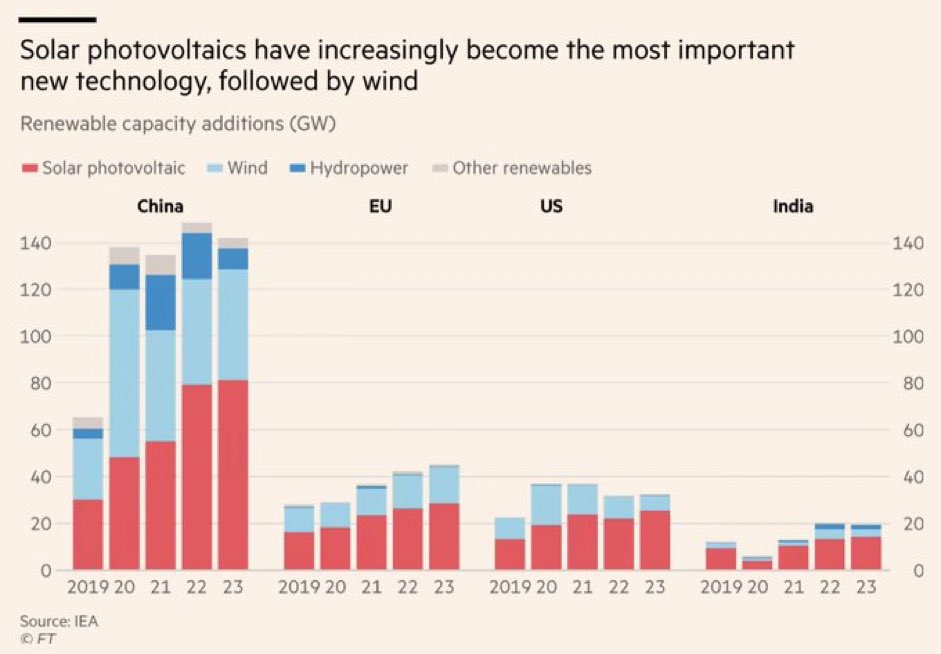
“China isn’t doing anything about climate change”
It gets more outlandish each year. It’s like being in the United States in the late 19th century and saying it isn’t industrialising.
"It’s important to understand that getting more people cycling isn’t—in and of itself—the end goal. Cities in the Netherlands use the bicycle as a tool to reduce car dominance and dependence and improve the equity, safety and livability of their streets."
https://t.co/tGZrUe9Y9x
80% of the Dutch population live within a short bike ride to a station, so it’s no wonder rail is also a major part of the transport network.
50% of rail trips start with a bike ride. Of the 17.6 billion km ridden each year, 25% are to or from a station.
https://t.co/q8lQrbxoJ2
A train that runs on 100% wind power, at a station that runs on 100% sun power, fed by a bike that runs on 100% leg power.
The tools needed for a resilient and sustainable mobility future aren’t waiting to be invented tomorrow; they exist and are waiting to be implemented today.
Absolutely immense road space reallocation in Barcelona on Avinguda Meridiana.
From 12 lanes for private vehicles down to 2 lanes for private vehicles, with bus lanes, cycle lanes and widened pavements. As well as significant greening.
Great new paper by Hermes Escalona and colleagues at the Australian National Collection on the “dung weevil” Tentegia. Great photos and discussion of biology. Here is title page and some images. #speciesdiscovery#weevil @ColeopSoc @EntCollNet@SysEB_Entsoc
To a hammer, everything looks like a nail. To an engineer, everything looks like a car.
But bikes aren’t little cars; and don’t need dedicated traffic circles, signals and signs.
They’re wheeled pedestrians; capable of navigating complex interactions without such interventions.
Remember this picture every single time you hear someone in your city say "we're not Amsterdam."
This was #Amsterdam in the 1970s, via @fietsprofessor.
The cities we admire made better choices regarding cars, and are still making them today.
Better choices instead of excuses.