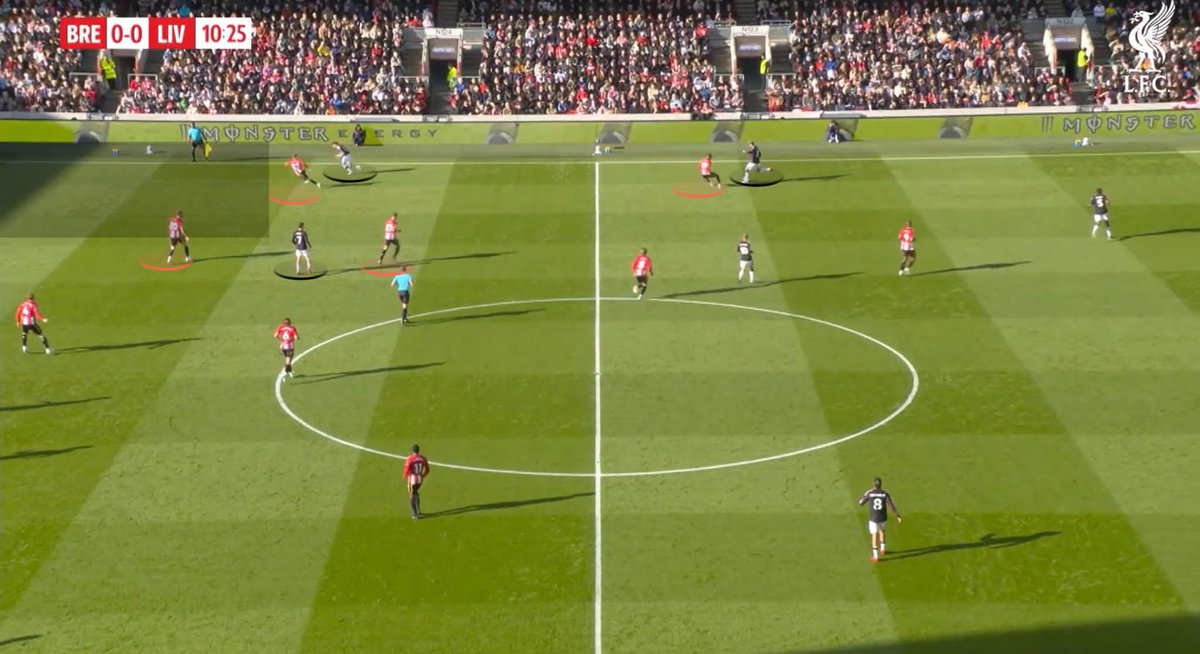
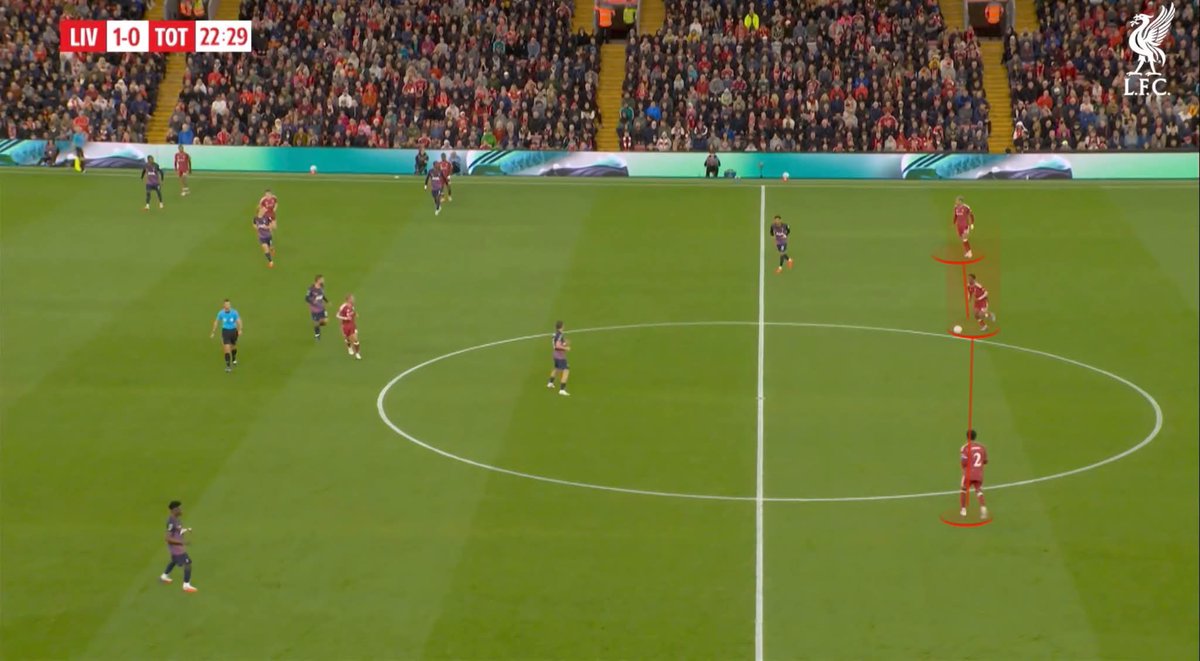
@ConnorHolden00 The role of 6/8 is largely about moments like these. They ensure smooth ball circulation and provide passing options that help progress the ball into advanced areas
@billycarpy I’m not sure it’s worth pursuing this line of thinking, but I still think it would be good to balance it with someone whose lead leg is their left
I often see Iraola’s model analysed through the lens of fixed positions — LW, RW, CAM and so on. However, this perspective overlooks the main idea behind his football: it is built primarily on relationships rather than positional attachment.
There is no abstract attachment to territory or fixed occupation of zones. Players are not valuable because they simply occupy a specific area of the pitch. Space is a tool used to create advantages, not an objective in itself. The main reference point is the ball and the relationships around it — how players interact to create temporal, numerical and qualitative advantages.
Iraola’s players do not rely on rare individual traits that are difficult to find. His model is based on communication, interpretation, movement and autonomy in decision-making. The important question is not where a player comes from positionally, but what behaviours and qualities they can bring to the structure.
This is why recruitment should focus more on profiles than positions. Instead of asking whether a player is a winger, attacking midfielder or forward, we should analyse whether they can create advantages, understand spaces, react quickly after losing the ball, interpret situations and contribute to collective movements.
If Iraola wants, he can field six or seven attack-minded players because the balance of the team does not come primarily from maintaining a fixed ratio between offensive and defensive profiles. It comes from collective organisation: pressing, counter-pressing, distances between players, and coordinated reactions. His teams do not simply wait for opponents to make positional mistakes — they actively create those mistakes through intensity, movement and structure.
However, this does not mean that every elite attacking profile would automatically fit Iraola’s football. A player like Olise or Neymar would only be suitable if they were able to adapt their qualities to the demands of the system. Individual talent alone is not enough. The player must provide intensity, tactical responsibility, adaptability and the ability to contribute to collective actions without the ball.
Iraola’s idea is trainable because the roles and behaviours within the model are clearly defined. The system does not exist to accommodate players; rather, players must adapt to the requirements of the football. The focus should therefore not be on positions, but on profiles — the traits that allow players to be useful, functional and compatible with the structure
I can’t retweet from my main account for obvious reasons so i’ll just reiterate it:
you can absolutely take pre season performances more seriously than ever before because of this new hyper-coaching era. As shown with Brentford, Sunderland, Arsenal & Utd last yr.
@peter_kamaras74 Did the wingers move into the half-spaces while the No. 9 dropped deep? That was something he often did at Bologna, using long balls to exploit the space
@TotalAnalysis I read that analysis a couple of weeks ago, the threat volume was impressive and despite all that, there is still plenty of room for growth and improvement. An exciting player
For some time now, I’ve been exploring the laws of physics in football (not literally), relating them to movements and counter-movements. I’m interested in how opposing directions (or forces) can influence the game’s dynamism, fluidity, and the disruption of defensive blocks. I’m not sure whether this theory holds up or if it’s just a bit of a crazy idea (after all, as Bielsa says, football loves the crazy ones), but Pep Guardiola once described football as a hypnotic element. If we manage its movement (direction) properly—which will always be one of the four reference points in the defensive phase—we can create confusion within the opponent’s structure.
Notice how Sunderland’s players (numbers 1, 2, and 4) adjust their body orientation as the ball moves in a certain direction. With the right interpretation (Rio, in this case), those subtle movements can repeatedly manipulate the opponent, creating confusion and opening new passing lanes. This enables diagonal play, opens up space, and frees players to become passing options for the ball carrier. At one moment, we have seven players condensed into the same area.
I suspected Iraola was working with this kind of movement management, but I wanted to wait for the first match before saying so. It may be a misguided theory, but I think it’s worth considering and discussing.
What do you think, football thinkers? @MeiaArmador__@Jon_Mackenzie@FathalliMo@FathalliMo@Ruxiiii4@rajsinghchohan@danieIscouting
Andoni Iraola took charge of his first game for Liverpool this weekend. A 4-2 win vs Sunderland in Nashville meant the new Boss kicked off his Liverpool tenure with a win. As expected, we saw a squad consisting of some youthful faces, returning loanees and familiar names take the field to build fitness and cohesion, and set the wheels in motion for a new tactical approach. Everyone familiar with Iraola knows that his Bournemouth team were vertical and direct on the ball and relentless off it, and even in game one we are already seeing some similarities on display. In this thread we will have a look at Liverpool's on and off the ball structure, what worked and what didn’t. 1/
I often see Iraola’s model analysed through the lens of fixed positions — LW, RW, CAM and so on. However, this perspective overlooks the main idea behind his football: it is built primarily on relationships rather than positional attachment.
There is no abstract attachment to territory or fixed occupation of zones. Players are not valuable because they simply occupy a specific area of the pitch. Space is a tool used to create advantages, not an objective in itself. The main reference point is the ball and the relationships around it — how players interact to create temporal, numerical and qualitative advantages.
Iraola’s players do not rely on rare individual traits that are difficult to find. His model is based on communication, interpretation, movement and autonomy in decision-making. The important question is not where a player comes from positionally, but what behaviours and qualities they can bring to the structure.
This is why recruitment should focus more on profiles than positions. Instead of asking whether a player is a winger, attacking midfielder or forward, we should analyse whether they can create advantages, understand spaces, react quickly after losing the ball, interpret situations and contribute to collective movements.
If Iraola wants, he can field six or seven attack-minded players because the balance of the team does not come primarily from maintaining a fixed ratio between offensive and defensive profiles. It comes from collective organisation: pressing, counter-pressing, distances between players, and coordinated reactions. His teams do not simply wait for opponents to make positional mistakes — they actively create those mistakes through intensity, movement and structure.
However, this does not mean that every elite attacking profile would automatically fit Iraola’s football. A player like Olise or Neymar would only be suitable if they were able to adapt their qualities to the demands of the system. Individual talent alone is not enough. The player must provide intensity, tactical responsibility, adaptability and the ability to contribute to collective actions without the ball.
Iraola’s idea is trainable because the roles and behaviours within the model are clearly defined. The system does not exist to accommodate players; rather, players must adapt to the requirements of the football. The focus should therefore not be on positions, but on profiles — the traits that allow players to be useful, functional and compatible with the structure
Iraola said "everyone says you need to add a bit of control. Okay, we are working on this" in his Anfield Wrap interview. I think he knows he can't turn up with a front 4 of two wingers and Wirtz + Isak. There's not enough stability there against decent sides.
As for last summer's transfers, the rule says to wait at least two seasons; for now, the sample is partial, and Slot didn't have a plan for all of this, which is why he's not here. I won't comment on the rest because those are your (I think unnecessary) tribal battles proving your points; does being right in football always have to be the most important thing? I don't think so
@billahibarkley I was at that match right by the goal, one of my favorite players. The way he managed the team, how he motivated and instructed them (I once had the chance to hear him sitting in the front row at Anfield, it was phenomenal). A leader!
Eventually, they realised that the right blend of youth and experience was the key to success. They enjoyed spells like the autumn of the 2024/25 season, but when difficult moments arrived, they lacked composure—someone who could slow the game down, keep everyone grounded and steady the ship. They simply didn’t have that kind of figure, while the coach himself was still finding his feet at the highest level. Alonso, on the other hand, has seen and experienced enough in football to understand the importance of balance. That’s why he’s building a squad capable of getting through the difficult spells that every team inevitably faces. Those moments almost always come after a strong run of form and results—and that’s when true title contenders reveal themselves
🚨 BREAKING: Chelsea working to sign Jordan Henderson from Brentford. #CFC top contender among multiple PL clubs eyeing England midfielder as #BrentfordFC ready to grant free transfer. Amicable situation + healthy relations between 36yo/club @TheAthleticFC https://t.co/8dOBIcm9g4
For some time now, I’ve been exploring the laws of physics in football (not literally), relating them to movements and counter-movements. I’m interested in how opposing directions (or forces) can influence the game’s dynamism, fluidity, and the disruption of defensive blocks. I’m not sure whether this theory holds up or if it’s just a bit of a crazy idea (after all, as Bielsa says, football loves the crazy ones), but Pep Guardiola once described football as a hypnotic element. If we manage its movement (direction) properly—which will always be one of the four reference points in the defensive phase—we can create confusion within the opponent’s structure.
Notice how Sunderland’s players (numbers 1, 2, and 4) adjust their body orientation as the ball moves in a certain direction. With the right interpretation (Rio, in this case), those subtle movements can repeatedly manipulate the opponent, creating confusion and opening new passing lanes. This enables diagonal play, opens up space, and frees players to become passing options for the ball carrier. At one moment, we have seven players condensed into the same area.
I suspected Iraola was working with this kind of movement management, but I wanted to wait for the first match before saying so. It may be a misguided theory, but I think it’s worth considering and discussing.
What do you think, football thinkers? @MeiaArmador__@Jon_Mackenzie@FathalliMo@FathalliMo@Ruxiiii4@rajsinghchohan@danieIscouting
This skill is vital for teams that rely on an aggressive press, as opponents are often forced to go long to bypass it. That’s when the ability to dominate aerial duels becomes essential. At one point, together with Fabinho, they completely controlled the aerial space
Virgil van Dijk is one of the most aerially dominant players in Premier League history.
He has finished 1st in our Aerial Duel Grade for three seasons in a row.
#LFC
These discussions do more harm than good for the sport. We all know we’ll never be able to settle these comparisons or reach a definitive conclusion. Instead, we should simply appreciate that every generation brings extraordinary talent and enjoy watching it.
The biggest problem is that people rarely take context into account. That has always been the case, but nowadays it’s become more extreme than ever